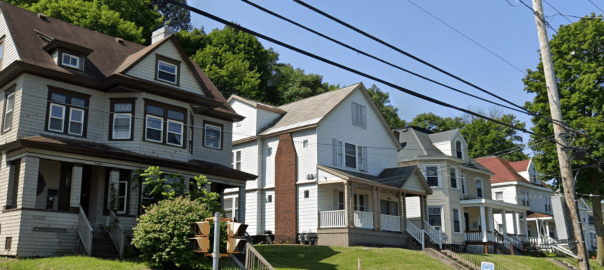
“Affordable housing” has at least three different meanings in Central New York right now, and as more and more people are talking about housing, those conflicting definitions are confusing our conversations on the topic.
The first and most common meaning is something like ‘reasonably priced housing.’ Housing costs were pretty low and pretty stable around here for decades before the pandemic. Most people who had a full-time job expected to be able to find housing where they wanted to live without breaking the bank. Our area’s ‘affordable housing’ meant people could comfortably find a place to live, and it has long been one of the first things people point to when talking about local quality of life. Maybe you couldn’t find a mansion, but there are plenty of starter homes, fixer uppers, and good deals out there for people to find housing they can afford.
At root, this is a first-person understanding of affordability. What’s ‘reasonable’ is what I’d be willing to pay, and a lot of people who paid a lot less for their housing a long time ago find today’s prices unreasonable. People who paid $75,000 for their house 30 years ago and might have thought they could sell for $150,000 in 2019 can’t believe similar houses in their neighborhood now go for $300,000. People who have paid $900 a month in rent for years are now seeing apartments listed for $1,500, $2,500, and $3,500. It’s shocking, and people reasonably ask “who can afford that?”
The second definition of ‘affordable’ attempts to answer that question. Banks and nonprofits and policy people consider housing to be affordable when it costs 30% or less of the occupying household’s income. The idea is that when a household spends more than 30% of their income on rent or the mortgage payment, that starts to squeeze out their ability to pay for other necessities like food and transportation. This is the standard government agencies use to come up with measures like “about half of all renters and one fifth of all homeowners in Onondaga County are cost burdened.”
This definition of ‘affordable’ is based on a relationship between the cost of individual homes and the incomes of individual households, so it’s impossible to say that any rent or mortgage payment is or isn’t affordable without knowing how much money the people who live in it make. According to this definition, those $3,500-a-month apartments in Downtown Syracuse or Cicero are ‘affordable’ to households making $140,000 a year, and they’re ‘unaffordable’ to households who do not.
Think of this as a way to universalize the first definition of affordability by creating a standard that accounts for all income levels. Like any universal standard, it has its exceptions—households who don’t spend as much on transportation can ‘afford’ to spend more on housing, for instance—but it establishes a definite, measurable goal for public policy to pursue.
The third definition of ‘affordable’ outlines the tools public policy can use to achieve that goal for households with lower incomes. ‘Affordable Housing’ (with a capital ‘A’ and a capital ‘H’) refers to subsidized, income-restricted housing. This kind of housing requires some level of government intervention that trades public money (or some other in-kind benefit like free land) for a developer’s or landlord’s agreement to set rents at levels that households with lower incomes can afford.
This definition of ‘affordable’ is based on any housing unit’s participation in a program that guarantees it will be occupied by a low-income household. These programs all determine who can live in a unit with a measure called the Area Median Income (AMI). The US Department of Housing and Urban Development calculates AMI every year for every metropolitan area in the country. In Syracuse, the 2023 AMI for a 3-person household is $84,000. HUD considers households that only make 80% of AMI ($67,200) to be low-income, households that make 50% of AMI ($42,000) to be very low-income, and households that make 30% of AMI ($25,200) to be extremely low-income. Different Affordable Housing programs restrict occupancy to these different levels.
These three definitions are all related and sometimes end up meaning the same thing. A person making $35,000 a year might think that $875 (30% of their monthly income) is a reasonable monthly rent for a 1-bedroom apartment, and that’s the rent you’d get in an apartment restricted to households earning 50% of AMI. In that situation, different people can use different definitions of the term ‘affordable’ and still understand each other.
Other times, these definitions do not line up so well. A reporter might ask a developer if their proposed apartment project will include affordable housing and really just be asking what the rents will be. The developer might respond ‘no’ because they don’t intend to apply for funding under any of the Affordable Housing programs that would require them to restrict occupancy to low-income tenants. A person reading about the project in the newspaper might then conclude that all of the apartments will be unreasonably expensive or unaffordable. In this situation, all three people understand the term ‘affordable’ to mean something slightly different, so they misunderstand each other.
Onondaga County is talking about housing a lot now. That’s good—this is a conversation we need to have—but it’s going to be a much more productive conversation if we can get a clearer understanding of what we all mean by key terms like “affordable housing.”
 inthesalt.city