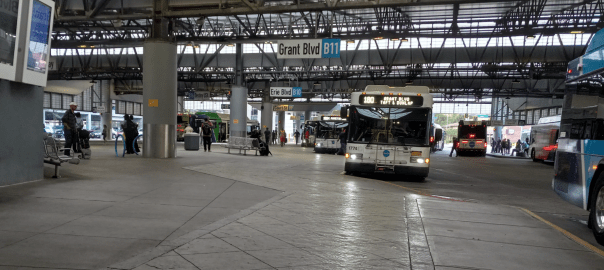
Centro’s bus network is built around the ‘lineup’—a tool that facilitates connections between bus lines but constrains Centro’s ability to provide the fast, frequent, reliable service that Syracuse needs and deserves. The lineup influences almost every service decision Centro makes, and so it is an extremely important principle for understanding why Syracuse’s transit operates as it does and how the system might be made better.
A lineup is when multiple buses—as few as 8 and as many as 20, but usually about 15—arrive at the Hub, layover, and then depart simultaneously. It’s an impressive sight as buses pull in one after another, riders speedwalk between connections, operators trade off shifts, and then all the buses leave together with a cacophony of honking, shouts, and revving engines. If you’ve ever seen a row of buses running north up Salina or State Streets, that’s the immediate aftermath of a lineup. On Centro’s current reduced (since 2021) service, 89% of runs begin at one of the 31 daily lineups. They are the organizing principle of Syracuse’s transit network.

Lineups allow Centro to facilitate transfers despite its terrible service frequencies. Buses regularly run on 40 minute (or longer!) headways, so if the schedules weren’t timed to all arrive at the Hub simultaneously, then riders trying to make connections could be stranded at the transfer point. Anybody unwilling or unable to wait that long would be effectively confined to travel along whatever bus line was within walking distance from their home. Lineups avoid that problem by scheduling many different lines to meet up at one place at the same time so riders can easily transfer between a number of different lines. This gives riders access to a huge portion of Centro’s total network whenever they catch a bus heading to a lineup.
That’s the central promise of Centro’s service: the buses might not run very often, and they might not run very fast, but if you catch one headed Downtown, then you have access to a pretty large area of Onondaga County.
But to get this massive benefit, Centro has to give up a lot. Because the lineup requires scheduling every single bus line in relation to the entire system as a whole, and because it requires every line to start from a single point, it makes the transit network difficult to adapt and imposes huge efficiency costs. Here are three ways the lineup constrains Centro’s service
Bunching
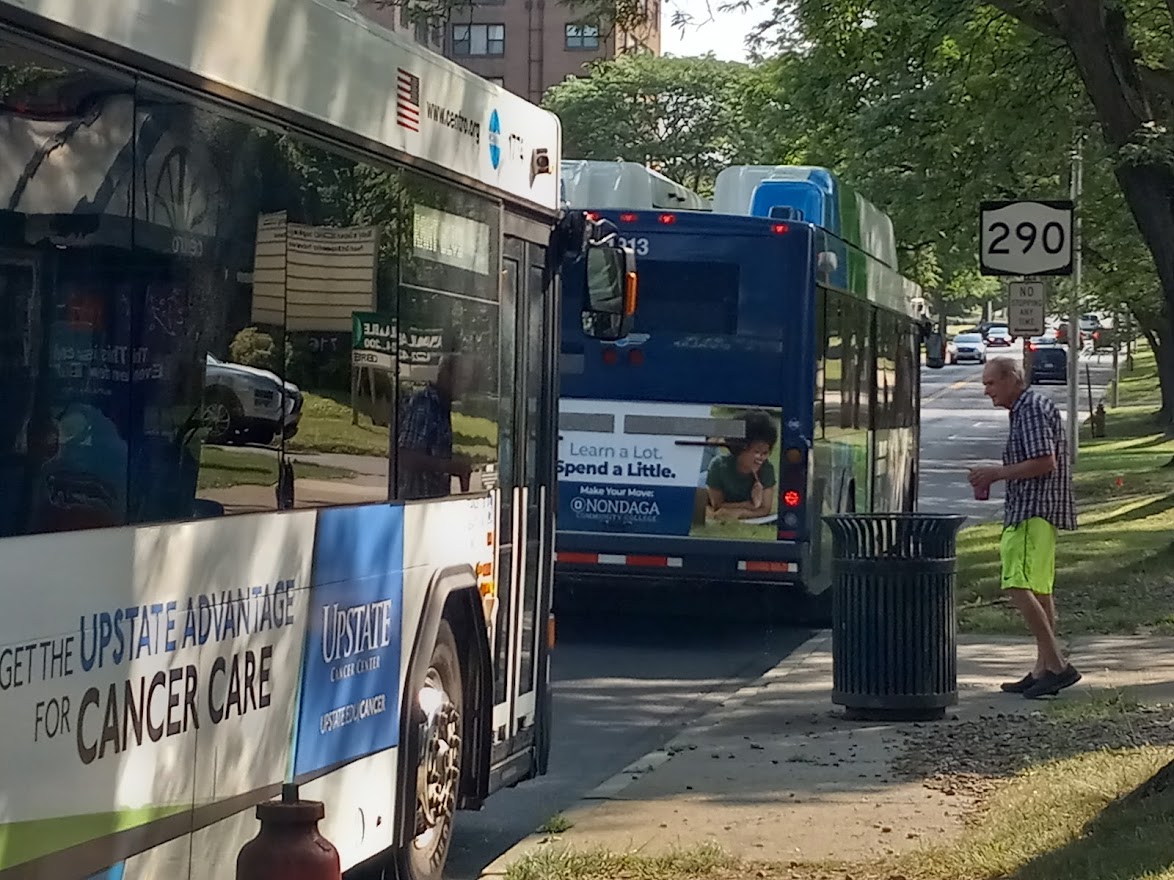
In a high frequency system, ‘bunching’ (when two buses on the same street run close together) is a huge problem that agencies spend a lot of time trying to solve. Bunching is bad because it effectively lengthens headways and makes some buses overcrowded while leaving others relatively empty. This wastes valuable operating capacity.
The lineup is basically one big intentional bus bunch. The buses all leave at once, and they travel in packs through the City’s center before eventually branching off to serve individual neighborhoods. The most egregious case of bunching occurs on James Street below Oak. There, the 80 and 20 buses run back to back 20 times a day. Centro spends enough operating money on this corridor to run 17 minute headways, but the lineup’s forced bunching wastes so many resources that Centro only manages 26 minute headways here. A similar example occurs on the Eastside where the 76, 62, and 68 have the resources to run on 16 minute headways from Downtown all the way to Westcott Street, but forced bunching doubles average headways on the Eastside to 32 minutes.
Inflexible route design
If every bus line is supposed to arrive at and depart from the Hub at the same time, then every line needs to take the same amount of time to make its run and return to the Hub for the next lineup. Look at Centro’s timetables and you’ll see that most buses take about 35 minutes to get from the Hub to their last stop, and another 35 minutes to get back to the hub.
But it doesn’t make sense for every bus line to go in one direction for exactly 35 minutes. To fit that rigid schedule, some buses crawl along meandering routes and others drive into low-ridership areas just to fill the time. This wastes valuable operating capacity that could be better used running more buses through high ridership areas.

No crosstown lines
If every single Centro bus line starts and ends its runs at the Hub, then no lines run through the Hub. That means every crosstown trip requires a transfer, and it makes many trips take longer than they really should.
Since every bus line starts at the Hub, it’s simple enough to imagine combining lines from opposite sides of the City—the 52 (Court Street) and 54 (Midland Avenue), say, or the 10 (South Salina) and 16 (North Salina) maybe—to reduce the need to transfer by giving people seamless crosstown rides. In fact, Centro does this in a way by interlining those routes; if you take the 110 to the Hub and just stay in your seat through the lineup, your bus will eventually turn into the 116 and take you up North Salina Street. But this doesn’t really give people the benefits of a crosstown route because they still have to hang out at the Hub through the whole lineup process. In effect, it imposes the time penalty of a transfer on every single crosstown rider even if they don’t have to transfer at all.
Without the need for a lineup-induced layover, a single bus could run straight through the Hub, and Centro could link routes from opposite sides of the City to give people seamless crosstown rides.
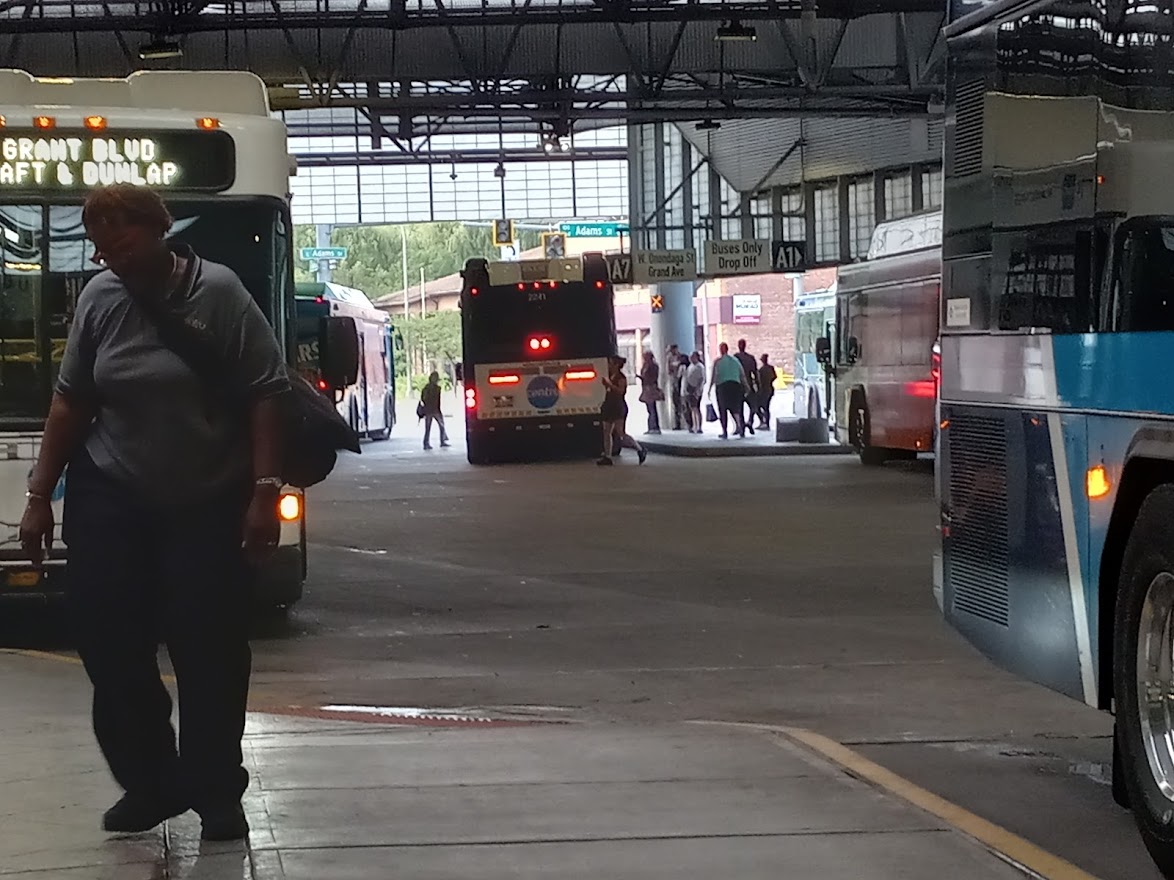
The lineup is highly effective at connecting a couple dozen different bus lines so that riders can make transfers relatively easily. But the lineup also stands in the way of Centro making the kind of service changes that riders have been demanding for years now. Above all else, riders want more buses running more often, and the lineup fundamentally reduces service frequency. Any realistic path towards providing the kind of high-frequency transit service that Syracuse needs and deserves leads away from total reliance on the lineup.
 inthesalt.city
1 thought on “What is Centro’s Lineup”
Comments are closed.