Tag Archives: Centro

SMTC’s Plan for Better Bus Service

On November 2, the Syracuse Metropolitan Transportation Council held its final public information session about the SMART1 study. That study looks at the possibility of improving bus service along specific corridors in the Syracuse metropolitan area. It is the first of multiple planned studies that will recommend specific service improvements to Centro based on the Syracuse Transit System Analysis that SMTC produced as a supplement to NYSDOT’s work on I-81.
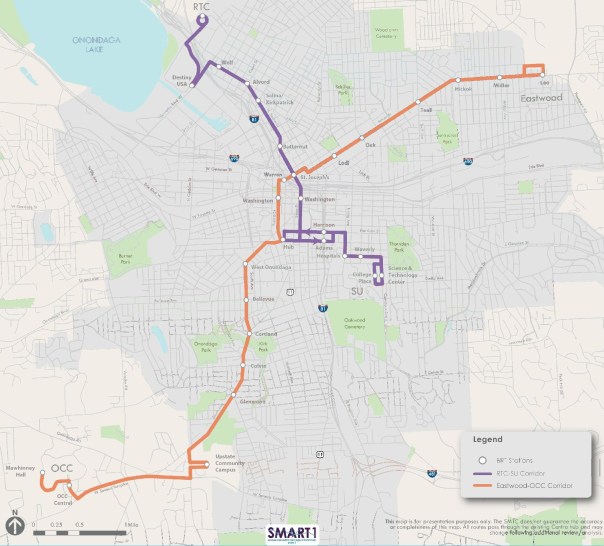
SMART1_Public_Meeting_3_Presentation_11217-page-001

The SMART1 study focuses on bus service from Eastwood to OCC and from the train station to SU–these are two of the six high-priority transit corridors identified in the STSA. For each corridor, the SMTC analyzed low, medium, and high levels of improvement. The low level increases the number of buses running along existing routes, builds new shelters at the bus stops, and gives buses priority at traffic lights. The medium level runs even more buses along new routes in the corridor, removes some bus stops, builds new shelters at the remaining bus stops, and buys new buses. The high level does everything that the medium level does, but it also puts in bus lanes where streets are wide enough to accommodate them.

For both corridors, SMTC recommends that Centro build the medium level of improvement. That means buses running every 10 to 15 minutes along James St/South Ave, and along Salina St through downtown to SU. It means no transfer for people riding either route crosstown. It means new buses and shorter travel times. That’s all good.

It’s also good that the SMTC hasn’t recommended the high level of improvement. In order to build bus lanes between SU and the train station, Centro would have to run the new bus route along Solar St instead of N Salina St. That’d cut down on travel times, but it would send the bus through a bunch of planned and existing luxury apartment complexes instead of through the Northside. Given that choice, it’s better that the bus run through a neighborhood where it’s needed, even if that means it has to deal with some traffic.

Now it’s up to Centro to act on these recommendations. It’ll require a lot scheduling of work–the SMTC’s recommendations don’t go into details like when the buses should actually run, how these new routes will connect with existing routes, or what should happen to minor routes like the 21 or 28 that run through these corridors but serve other neighborhoods too. It’ll require a lot of cooperation–some of these improvements, like priority at traffic lights, can only come if Centro works with City Hall to make them happen. It’ll require a lot of money–those new buses and bus shelters will cost money up front, and Centro will have to hire more drivers and pay for more repairs if it’s going to offer more frequent service. Those are all steep hills to climb, but they’re well worth climbing. Call Centro and tell them you want these changes. Call City Hall and tell them you want them to help Centro make these changes. Call your state reps and tell them you want the State to help pay for these changes.

Centro:
315-442-3400
CEO@centro.org

Mayor Stephanie Miner:
315-448-8005
Mayor@syrgov.net

Common Council:
Councilors’ Contact details are available here

Senator John DeFrancisco:
315-428-7632
jdefranc@nysenate.gov

Senator Dave Valeski:
315-478-8745
valesky@nysenate.gov

Assemblymember Bill Magnarelli:
315-428-9651
MagnarW@nysassembly.gov

Assemblymember Pam Hunter:
315-449-9536
HunterP@nysassembly.gov

Centro’s Proposed Weekly Pass

On September 27, Centro proposed a new transit pass that would offer unlimited rides for seven consecutive calendar days. These new MAX passes would cost $20 ($10 reduced fare), equivalent to the cost of paying the full cash fare two times each day of a five-day work week.

Centro had sold 7-day unlimited passes for $15 prior to 2015. The transit agency stopped offering unlimited passes in order to save enough money to maintain its late-night and Sunday service during a budget crisis in the Spring of 2015. Since that time, the only way for people to get a deal on their fare has been to buy 10-ride passes for $18, 20-ride passes for $36, or 30-ride passes for $54. Centro also sells unlimited single day passes for $5.

The new MAX passes are definitely a good thing. For anyone who takes the bus at least 12 times a week, the $20 MAX passes will be cheaper than the cheapest option currently available–the multi-ride passes that price out to $1.80 a trip.

Unlimited passes like these also remove the stress of choosing which trips to make in any given week. An unexpected trip to the doctor won’t take away the fare that you’d intended to use to get to the grocery store. With unlimited rides, each extra trip you take makes the pass a better deal.

This benefits Centro as well, because part of their funding from the State is determined by the number of rides they provide. If these passes allow people to afford more bus rides, then Centro will receive more State funding automatically.

Although this is all good news, the MAX pass still won’t make transit as affordable in Syracuse as it is in Rochester or Albany.

transitfarecomparison

RTS and CDTA provide Rochester and Albany with more extensive service than Syracuse gets from Centro, and they do it while charging their riders less money. Syracuse should be getting better transit service for the price its people are paying. NFTA in Buffalo charges the same $2 cash fare as Centro, and they’ve got a subway to show for it.

An unlimited monthly pass would go a long way towards making the bus more affordable in Syracuse. Before that 2015 budget crisis, Centro had offered monthly passes for $60. If they reintroduce an unlimited monthly pass for something like $65 or $70, that would put a little more money in people’s pockets, and it would encourage more people to ride the bus. Hopefully, this weekly MAX pass is the first step towards bringing the monthly passes back.

Centro is hosting an information session from 4:00 pm to 5:30 pm on Wednesday October 18 at OCPL’s Central Library. At 5:30 pm they’ll begin a public hearing. Show up, find out all the details, and let them know what you need out of your transit system.

Bus Service at the Community Library of Dewitt and Jamesville

On August 20, the Community Library of Dewitt and Jamesville will open its brand new building at 5110 Jamesville Road. This new location is two miles away from Shoppingtown Mall where the library had been a tenant for 55 years. On August 2, the Post-Standard reported that Centro would not divert an existing bus line to service this new location. Wendy Scott, the Dewitt library’s executive director, told the Post-Standard that “we would welcome a bus route to the new library and plan on revisiting the issue after we open at the new location.”

DewittLibraryTransit

This should be obvious, but Centro can’t just change a route because the library’s moving. All of its routes are timed in relation to each other in order to facilitate transfers. If Centro extends the 62 route to service the new library, then that bus would miss the lineup at the end of its return trip to the Hub, and people trying to get across town would have to wait until the next lineup to make their transfers.

It’s also unreasonable to expect Centro to run a bus line down Jamesville Road just to serve the library. Transit only works when it links lots of riders with lots of destinations. Buses travel along Erie Boulevard and Genesee Street because lots of people need to get to the many destinations along those corridors. Jamesville Road doesn’t have enough destinations to support a bus line, and adding a single destination like a library is not going to change that.

Since Centro can’t just change its bus schedule to cater specifically to the library’s needs, the library should have moved to a location along an existing bus line. This is something bus riders understand. When you rely on the bus to get around, decisions about where to live or where to work or where to hang out depend on the presence of a bus line–it’s non-negotiable.

Director Scott doesn’t see bus service as something that the library needs. She sees it as a luxury–an option that she would like for the library to have, but not one that’s important enough to really drive big decisions. It certainly wouldn’t have been impossible for the library to find a location along an existing bus route–every single one of the other 31 libraries in Onondaga County is accessible by bus–but access for bus riders took a backseat to other concerns when the library’s board decided to move to Jamesville Road.

As a public institution committed to the empowerment of the entire community without regard to income, the library is its most effective when it’s accessible to the entire community–especially those members of the community who can’t afford to buy books or access technology on their own. These are the same people who also can’t afford cars. It may be that “less than 2 percent of library users said they take the bus to the library,” but that’s no reason to make the library inaccessible to that two percent. If only 2 percent of library users need wheelchairs, that wouldn’t be a reason to remove the handicap ramps. The library’s decision to move to a spot inaccessible by bus was a decision to exclude part of the community from a valuable public resource, and it was a mistake.

Transit and Ridesharing in Upstate

On February 6, the New York State Senate passed a bill that would legalize ridesharing services like Lyft and Uber in Upstate New York. (Ridesharing has been legal in New York City since 2011.) That bill was based, in part, on a bill that Governor Andrew Cuomo proposed in his FY 2018 budget. Governor Cuomo’s proposal guarantees that a portion of the fees collected from ridesharing will fund upstate transit agencies. The Senate’s bill makes no such guarantee.

Ridesharing provides transportation to people who cannot or will not drive a car. This puts the service in direct competition with upstate transit agencies like Centro. The Post-Standard said as much in an editorial published in the Spring of 2015. The Editorial Board cited “rising costs and stagnant funding” as the cause of Centro’s poor service, and suggested that ridesharing could provide better transportation service for commuters and “the elderly and disabled… at times when the buses aren’t running.”

Centro’s rising costs and stagnant funding are not facts of nature. They are the results of choices made at every level of government from the Common Council to Congress. If rising costs and stagnant funding have created a problem worth solving, then the City and County should assess the mortgage recording tax on all new development, the State should index the State Operating Assistance Fund to inflation, and the Federal Government should expand its funding to cover Centro’s operating costs.

More to the point, ridesharing will not provide better service for the people who rely on public transit the most. These people fall into two categories: those who cannot afford to purchase and maintain their own personal vehicle, and those who cannot operate their own personal vehicle because of a disability.

Centro rides cost $2, and they include option of a free transfer. Ridesharing charges significantly higher fares, and the people who ride the bus for economic reasons cannot afford them. Nevermind that almost half of Syracuse’s low-income households can’t afford an internet subscription, and won’t be able to access any ridesharing apps at all.

Every Centro bus is ADA compliant and accessible to wheelchairs, and its Call-A-Bus service provides more specialized transportation for anybody whose disability keeps them off the bus. Ridesharing is, at-best, only intermittently accessible to the disabled. Philadelphia’s disabled community is lobbying against ridesharing because its members have such a hard time finding handicap-accessible Ubers.

Ridesharing will compete directly with upstate transit authorities, but its cost and the nature of its vehicles mean that it will not be a viable option for the poor or the disabled. Legalizing it without making provision to also support upstate transit will improve transportation options for the better off at the expense of those who need public transportation the most.

All that said, if the state government does legalize ridesharing in Upstate, Centro could work with ridesharing companies to dramatically improve its service. Currently, Centro must provide bus service for the entire County, including its more sparsely populated rural and suburban regions. Many bus routes in these areas are little used, and they draw money away from high-demand routes. If Centro contracts ridesharing companies to provide handicap-accessible service in rural and suburban areas at no extra cost to riders, it could then redirect funds to provide better service along routes through the more densely populated areas where transit can be its most effective.

Complementary Centro Schedules

In order for transit to meet a variety of peoples’ daily needs, its service must be both regular and frequent. Regular service makes runs throughout the whole day, and those runs are all separated by similar lengths of time. Frequent service makes many runs in a day, and those runs are all separated by short lengths of time. When service is both regular and frequent, people can rely on the bus to run when they need it.

Very few of Centro’s bus routes offer regular frequent service. For people relying on a single irregular or infrequent bus route, it can take hours to get across town for work, appointments, or errands.

Fortunately, many places in the City of Syracuse are within walking distance of multiple bus routes. Because all routes terminate at Centro’s downtown transit hub, and because most riders are trying to get to Downtown Syracuse, places within walking distance of multiple routes enjoy service that is regular and frequent.  People living in these places can rely on transit to meet their daily needs.

The following schedules show how people living in specific places can use multiple bus routes in order to meet daily transit needs:

Southside (S Salina and Colvin)

Northside (Grant and Bear)

Northside (Butternut Circle)

West Side (W Genesee and Milton)

Valley (S Salina at Green Hills Farms)