By Zach Zeliff
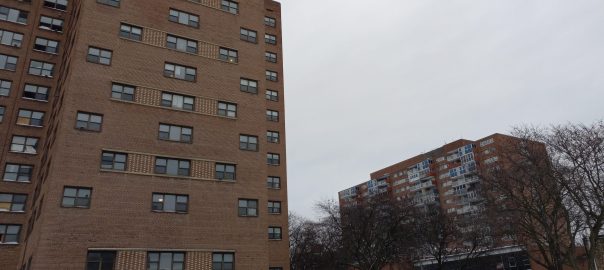
A disturbing trend is emerging among large midcentury apartment buildings in Syracuse. Buildings that used to provide quality housing for hundreds of people have fallen into disrepair and become uninhabitable. The Skyline and Vincent—both run into the ground by local slumlord Troy Green—are the highest profile examples of this trend in recent years, and a similar fate threatens Nob Hill and Parkside Commons. We need a way to stop the negative spiral of deferred maintenance and poor management leading to reduced cash flow through vacancies and rent abatements that leads to further deferred maintenance until these buildings fall completely out of the housing market.
Currently City Hall and the County Health Department only have enforcement tools. They can cite buildings for code violations or fine owners for health violations. In the high profile cases of Green National, the Attorney General eventually sued them out of owning property. The outcome of two of the largest of those buildings, the Vincent and Skyline? Every tenant was forced to move and the buildings are still totally vacant. Beyond the impact on individual tenants whose lives are upended and their homes are gone, I believe that the loss of these units is an underappreciated factor in why rents have increased so dramatically at the lower-cost end of the rental market.
Now we are seeing dramatic building decline at Nobb Hill, and Parkside Commons in a different way (buildings built with subsidy often have different funding streams/economic models). With our aging housing stock, it’s likely to happen again. Code and health enforcement are important tools, but obviously given the past failures described they are not sufficient. While discussing Skyline during its downward descent, a friend asked if the building could be seized by the city. My response: What would happen next? City Hall isn’t a property developer. It doesn’t currently have the capacity to finance or implement the kind of renovation these buildings need.
Given the frequency of this situation, I believe the “what next” should be built. An institution which has the capacity to take over distressed buildings, fix conditions crises, restore dignity to the lives of tenants, and stabilize the physical and financial health of buildings is sorely needed. If the landbank’s proposed Invest Syracuse gets started, this can be precisely that type of institution. The ability to acquire buildings, real estate expertise, a robust balance sheet and the ability to finance projects through its own capital and obtaining various subsidies.
We know Syracuse’s big mid century apartment buildings can be successful. Right across the street from the Skyline is the Regency Tower—another large apartment building constructed in 1960. It houses hundreds of tenants without any of the kinds of problems that plagued its neighbor across the street, and it’s an asset to its neighborhood and the City at large. The Skyline and the Vincent and Nob Hill and Parkside Commons could all contribute to Syracuse in the same way, but when private ownership and market conditions put them on the path to disrepair, we need a public solution. Hopefully the owners of Nob Hill can turn things around for the good of the tenants. But no matter where, whether it is Invest Syracuse or something else, we need an institution that goes beyond just enforcement, and has the ability to turn things around at failing buildings for tenants.
 inthesalt.city