Tag Archives: Zach Zeliff

Missing Middle Midplexes

By Zach Zeliff

In planning/housing discourse, a lot of attention is given to so-called “missing middle” development. The take runs roughly like this: lots of developers build detached single family homes, and then there are fewer but still numerous developers build larger multifamily buildings, but very few developers build anything in between. Over the last 70 years or so, there has been less building of “middle” housing of small apartment buildings including two to maybe 8 units. Compared to single family homes, these missing middle buildings offer more affordability because they can be built at a lower per unit cost. They can also be built on relatively small lots where larger multifamily homes would never fit and so allow the kind of finely-grained infill that matches conditions on the ground in so many of our community’s neighborhoods. Syracuse should be looking for ways to encourage the construction of more of these types of homes.

Luckily, other cities have paved the way with zoning reforms designed to produce this type of housing. 
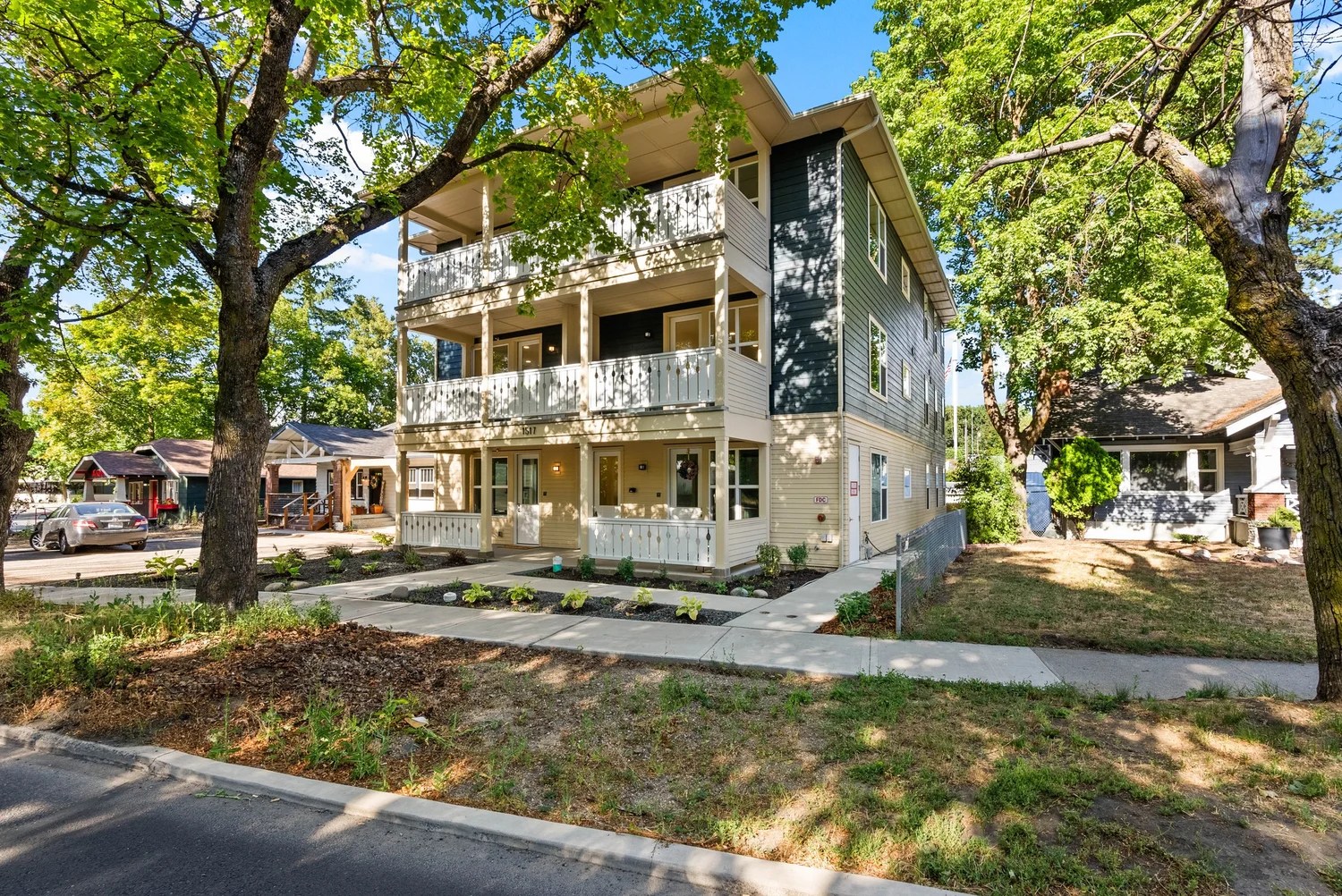
The best reforms tackle the problem directly. Take Spokane, Washington for example. Spokane allows building types of up to 6 units on any typical lot in their city. This has led to a huge spike in units permitted in their city—which as we wrote before puts downward pressure on rent prices. One architecture firm has even started using Spokane 6 as a branding term for a type of housing that includes six homes in a 3-story building that can fit on small city lots (locally, you can find this building type in neighborhoods like Eastwood). By making requirements simple and easy to navigate, builders can get quite good at producing this type of housing—repeating the formula and gaining scale, which can lead to decreased construction costs.

Like in Spokane, missing middle housing was more prevalent in Syracuse until relatively restrictive zoning typologies were instituted in the second half of the 20th century. You’ll still see lots of duplexes and triplexes, and even some rowhomes and six-plexes in various Syracuse neighborhoods, but very few of these types of homes have been built recently.
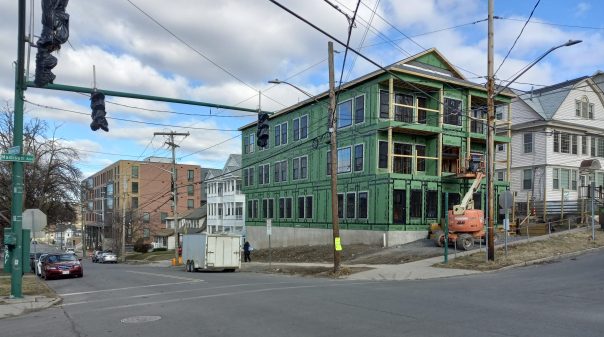
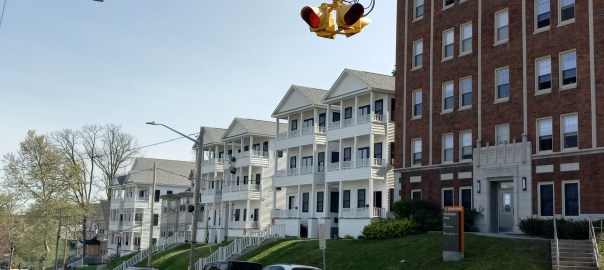
A short section of Walnut Ave shows that this kind of housing can still be built in Syracuse where the zoning allows it. Over the last few years, a single developer has built seven small apartment buildings on the 500 and 600 blocks of Walnut Avenue. Not only do these new buildings add much needed housing at familiar scale, they’re also made up of 5 and 6-bedroom apartments that can fit large families—a needed complement to the proliferation of studios and 1-bedrooms being built for households without children.

However, this housing can only be built in a select few neighborhoods like University Hill where R-5 zoning allows multifamily housing. In contrast, the vast majority of Syracuse neighborhoods only allow up to two-units per lot. Through their location and marketing, these buildings are clearly designed with student tenants in mind, but in our opinion this is the exact type of incremental density we should be adding to every neighborhood—why limit it to students?

The proposition is simple—by changing zoning to allow this type of missing middle housing to be built on every residential lot, you allow developers to get good at building them, and then work at building them at scale to drive down the cost per unit. This type of development is also ideal for local/smaller developers, who can get the access to capital and labor needed to build this type of housing when compared to large apartment buildings. 

Other municipalities are producing an interesting way of getting new housing online: the pre-approved catalogue. Vermont, the Cape Cod Commission, and Cincinnati are three of the municipalities engaging in this. These pre-approved plans are ways to enhance the aesthetics of design while making the permit processing easier—something we pointed out is quite difficult in Syracuse in the ADU article.

By pre-approving different types of housing, and allowing wide land use allowances in the city, we could be making it much easier and predictable for housing producers to build. This is a win win in many ways – for our tax base, for maximizing existing infrastructure, for promoting neighborhood walkability, and most of all for housing cost.
We Need a Better Solution for Failing Buildings

By Zach Zeliff

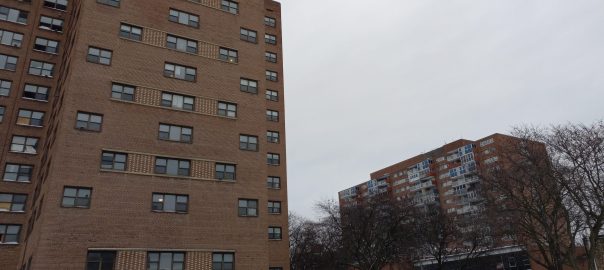
A disturbing trend is emerging among large midcentury apartment buildings in Syracuse. Buildings that used to provide quality housing for hundreds of people have fallen into disrepair and become uninhabitable. The Skyline and Vincent—both run into the ground by local slumlord Troy Green—are the highest profile examples of this trend in recent years, and a similar fate threatens Nob Hill and Parkside Commons. We need a way to stop the negative spiral of deferred maintenance and poor management leading to reduced cash flow through vacancies and rent abatements that leads to further deferred maintenance until these buildings fall completely out of the housing market.

Currently City Hall and the County Health Department only have enforcement tools. They can cite buildings for code violations or fine owners for health violations. In the high profile cases of Green National, the Attorney General eventually sued them out of owning property. The outcome of two of the largest of those buildings, the Vincent and Skyline? Every tenant was forced to move and the buildings are still totally vacant. Beyond the impact on individual tenants whose lives are upended and their homes are gone, I believe that the loss of these units is an underappreciated factor in why rents have increased so dramatically at the lower-cost end of the rental market.

Now we are seeing dramatic building decline at Nobb Hill, and Parkside Commons in a different way (buildings built with subsidy often have different funding streams/economic models). With our aging housing stock, it’s likely to happen again. Code and health enforcement are important tools, but obviously given the past failures described they are not sufficient. While discussing Skyline during its downward descent, a friend asked if the building could be seized by the city. My response: What would happen next? City Hall isn’t a property developer. It doesn’t currently have the capacity to finance or implement the kind of renovation these buildings need.

Given the frequency of this situation, I believe the “what next” should be built. An institution which has the capacity to take over distressed buildings, fix conditions crises, restore dignity to the lives of tenants, and stabilize the physical and financial health of buildings is sorely needed. If the landbank’s proposed Invest Syracuse gets started, this can be precisely that type of institution. The ability to acquire buildings, real estate expertise, a robust balance sheet and the ability to finance projects through its own capital and obtaining various subsidies.

We know Syracuse’s big mid century apartment buildings can be successful. Right across the street from the Skyline is the Regency Tower—another large apartment building constructed in 1960. It houses hundreds of tenants without any of the kinds of problems that plagued its neighbor across the street, and it’s an asset to its neighborhood and the City at large. The Skyline and the Vincent and Nob Hill and Parkside Commons could all contribute to Syracuse in the same way, but when private ownership and market conditions put them on the path to disrepair, we need a public solution. Hopefully the owners of Nob Hill can turn things around for the good of the tenants. But no matter where, whether it is Invest Syracuse or something else, we need an institution that goes beyond just enforcement, and has the ability to turn things around at failing buildings for tenants.

The Square

By Zach Zeliff

It can be difficult to have a frank, public, political conversation in Syracuse. We are often very polite and rarely direct. You hear things around town, but we don’t really have it out. Yet there are real issues facing our City where people sincerely disagree, and in those cases our civic discourse would really benefit from a blunt exchange. 

Take one of the most controversial, and important, local governance issues of the past two years: Good Cause Eviction. Sure, there was a lot of discourse about it. People wrote op-eds, the Common Council invited interested parties to speak at committee meetings, the Post-Standard reported on all of it. But never was there a public confrontation between the parties who disagreed about the law. You’d hear landlords make their case, and then—at a separate time—tenants would make theirs. Even people who followed all this talking could be left confused about what Good Cause would actually do because there was never an opportunity for a back-and-forth discussion to clarify what disagreeing parties actually disagreed about.

To opponents of this incredibly common sense measure, I would like to ask a series of questions:

If a tenant calls codes/otherwise advocates for conditions to improve at their home, what is preventing a landlord from non-renewing their lease in retaliation the next time it is up? Should the landlord be able to do that? How would a tenant be able to prove this was retaliation and stay in their home? If this isn’t acceptable to you, how can you vote against good cause eviction?

Maybe they have good answers I haven’t thought of. Maybe they will realize the overwhelming error of their ways and come to have correct opinions. Either way, we will have had it out and clarified what it is we’re actually talking about when we talk about Good Cause.

There are probably a bunch of different ways to facilitate more honest public conversations like that, but I have one idea that would also be a lot of fun. I call it The Square. 

We get people together on a Friday around 5 PM in a public square-shaped space—Lemp Park, maybe—and hash out some disagreement in a very loosely structured way. The interested public are all invited, and encouraged to picnic, and maybe bring travel mugs filled with various beverages. It will be festive! 

Some of the conversations would be confrontational, some may be more chill and informational, some might even end in agreement, but they would all help fix the issues in the town.

A Land Value Tax for Syracuse

By Zach Zeliff

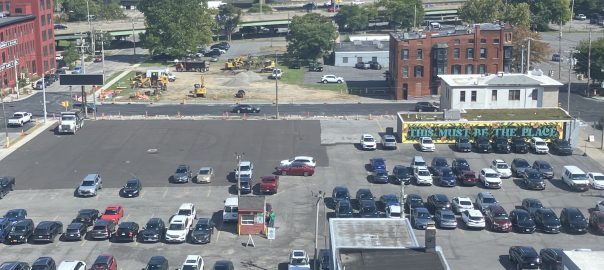
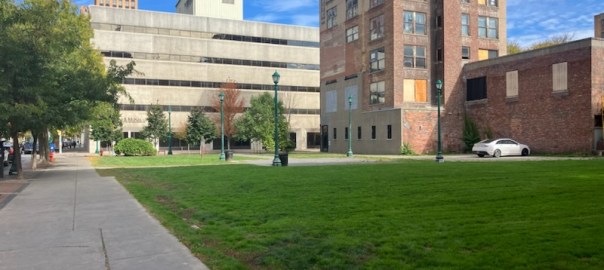
Must this be the place? It’s a good mural and a great song, but seeing such good public art surrounded by a sea of surface parking is….. depressing. Is this the highest and best use of a large lot Downtown, directly across the street from one of the highest rent apartment buildings in the region? Is the amount of property tax, or lack thereof, generated helping the fiscal health of the City? How can we encourage a better future for the block surrounding the mural? 

Luckily, there may be a solution to this problem that generates more housing, economic development, and tax fairness. It’s also the policy with maybe the highest amount of internet fanatics: the land value tax.

An idea most associated with 19th century thinker and NYC mayoral candidate Henry George, a land value tax—also sometimes called a split-rate tax—assesses property taxes according to the value of a piece of land rather than the value of any building constructed on top of it. This means that underused land in high value places—like surface lots downtown—typically have a higher proportionate share in taxes while residential properties in lower land-value neighborhoods typically see their assessments go down. This incentivizes highest and best use in high value Downtown lots—if empty or underutilized parcels pay the same tax as fully developed land, then owners are more likely to build or sell to someone who can.

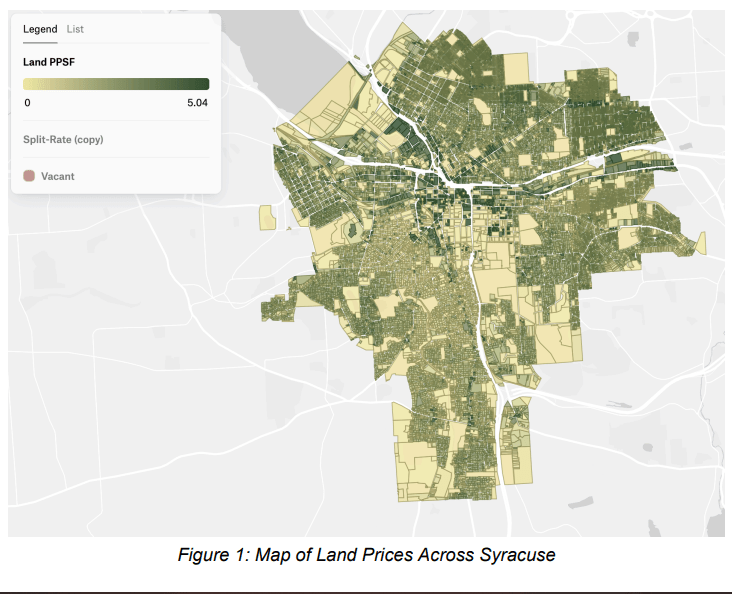
The Center for Land Economics recently published a study of how a hypothetical land value tax would affect tax rates in Syracuse. It found that most tax increases be downtown while the highest share of tax decreases would occur in the south and west sides. They also published this really interesting map charting land values in the city.

Greg Miller, author of the report, is coming to present his research as part of our In The Salt City Policy Happy Hours. October 8th at Harvey’s, we will gather starting at 5 with the presentation starting at 5:30. Please join us, the first two events have been a mixture of fun and informative with a good conversation, this should be the same!