City Hall plans to buy all of Syracuse’s streetlights. That will save about $2 million every year, so it’s a no-brainer for a city government staring down bankruptcy. But City Hall will get more than just savings—it will also get control of a network of electrical outlets and poles that stretches across the entire City. City Hall can use this new resource to install a smart city technology called ‘signal priority’ that will improve Centro’s bus service.
Signal priority lets a traffic light know when a bus is coming. Then, the traffic light can respond to that real-time information by making a minor adjustment to its cycle—staying green a few seconds longer, say, so that the bus can make it through the intersection—so that buses spend less time stuck at red lights.
This means a bus can get across town faster. Minneapolis started using signal priority, and its buses increased their average speed by 4-15%. In Portland, Seattle, and Los Angeles the buses got 8-10% faster. That allows riders to spend less time sitting on the bus and more time doing whatever it is they’re on their way to do.
Faster buses are also more frequent buses. Take the 168 bus. Its first run leaves Shoppingtown at 6:02 am and arrives at the Hub at 6:35 am before continuing on as the 364 bus. That’s a 33 minute trip, but with signal priority it might only take 30 minutes. Then, that same bus and driver can leave the Hub three minutes earlier to start the 364 run. If that run is 10% faster too, then the driver can turn around and come back to the Hub even earlier to start a new 168 run.
All that saved time means that the driver and bus are free to make more runs in a single shift. Since the biggest cost of any run is the driver’s pay, that means Centro can run more buses without spending hardly any extra money.
This isn’t to say that Centro should have to pay for all of its service improvements by scrimping and saving the money it’s already got. It—and every other public transportation authority in New York State—needs better dedicated funding in order to offer people the freedom to live without a car, to reduce our dependence on fossil fuels, and to build stronger communities.
But that’s up to New York State and the federal government. Transit signal priority is something that City Hall can do on its own to improve life in Syracuse now. It’s an innovative use of this new municipal resource, and it should be one of the very first acts that this new smart city takes.
Buses work best where there are lots of people, businesses, and institutions all within walking distance of each other. Zoning laws that allow a mix of people, businesses, and institutions work best in places with good bus service. Transportation planning and land use planning go hand in hand.
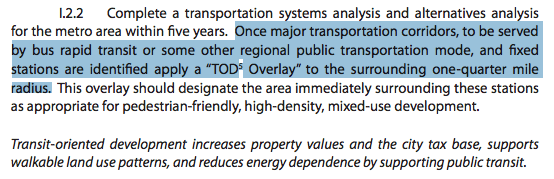
In Syracuse, the left hand doesn’t seem to know what the right hand is doing. Take ReZone, City Hall’s once-in-a-generation rewrite of the City’s zoning ordinance. It grants a 30% reduction in off-street parking requirements for lots within .25 miles of a public ‘transportation terminal,’ but it doesn’t define what a transportation terminal is. The 2012 Land Use & Development Plan—upon which ReZone is based—suggests that ReZone is talking about stations on a Bus Rapid Transit network:
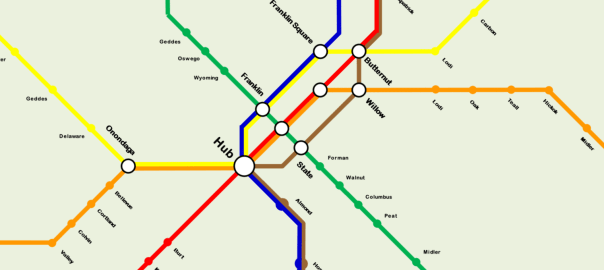
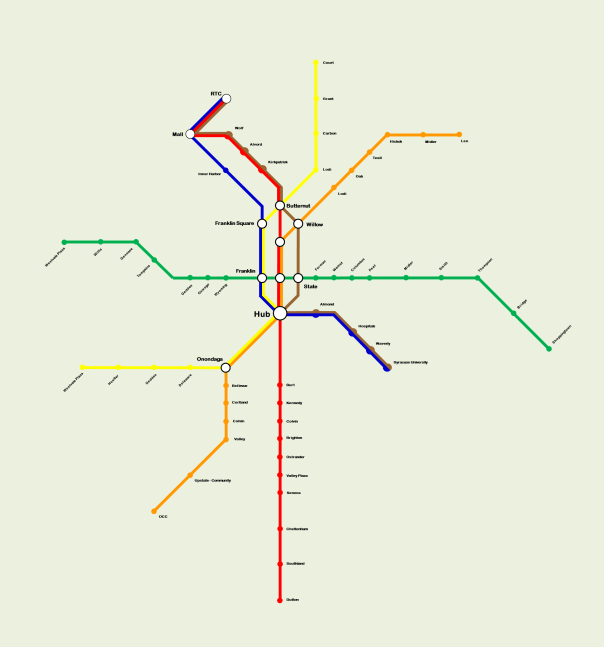
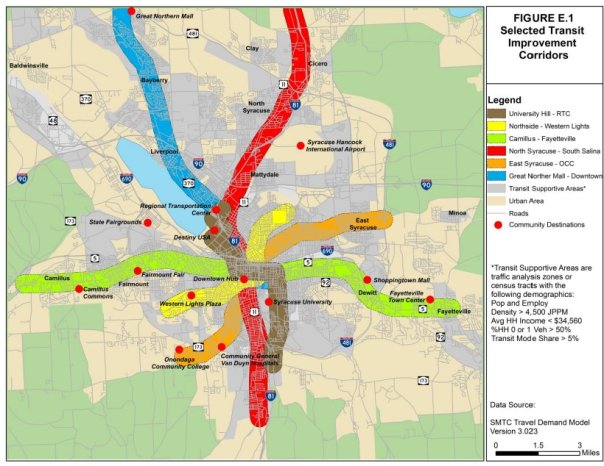
The 2014 Syracuse Transit System Analysis identified six “major transportation corridors” for improved bus service, but it did not identify any “fixed stations” along them. The Syracuse Metropolitan Transportation Council’s SMART1 report does identify station locations, but only for two BRT lines.
STSA Transportation Corridors
SMART1 BRT Lines
Area within .25 miles of BRT stop
It’s anyone’s guess, though, when and if Centro will actually run that BRT service. The fixed stations identified in the SMART1 report don’t actually exist yet, and if the Common Council turned ReZone into law tomorrow, there would be no clear ‘transportation terminals’ in the City to trigger the ordinance’s 30% parking requirement reduction.
In the meantime, City Hall’s very reluctance to zone for transit is affecting Centro’s ability to offer the service. Centro is going to need money from the Federal Transportation Administration in order to build out this BRT network, and the FTA takes a city’s land use policies into account when it decides whether or not to fund a project there. According to the STSA, Syracuse’s current zoning policies hurt its chances of getting funding from the FTA.
Even worse, City Hall keeps revising ReZone in ways that will make Centro’s life harder. One glaring example is the area around the Regional Transportation Center. The RTC is supposed to be the last stop on one of SMART1’s BRT lines. The first ReZone draft would have allowed housing and businesses on all of the parking lots around there, but the current draft actually bans new housing in the area—how’s that for TOD?
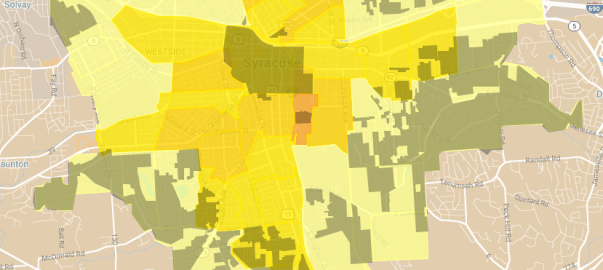
Less obviously, each new draft of ReZone has reduced housing opportunity along the corridors that the STSA picked out for BRT service. Around N Salina, Solar, W Fayette, and W Genesee Streets, City Hall has amended its zoning map to either ban or minimize residential development in the very areas where SMTC and Centro are planning to provide better bus service.
Draft #1 (February 2017)
Draft #2 (June 2017)
Draft #3 (March 2018)
The idea of a TOD-overlay makes sense, but it’s impossible to implement while planning for that BRT service is independent from the ReZone project—the overlay won’t come into effect until the BRT service starts running, and the BRT service is difficult to plan until the overlay comes into effect. It’s a catch-22.
City Hall, Centro, and SMTC can fix this with a little cooperation. All three organizations need to get together and narrow the STSA’s transportation corridors to specific streets. City Hall has already said that it wants the eastern half of the Camillus-Fayetteville corridor to run along Erie Boulevard. It shouldn’t be so hard to make similar decisions for the rest of the corridors—will that line’s western half run on Fayette or W Genesee? Will the Northside-Western Lights line run on Gifford or Onondaga? Where will the buses stop?
Once they’ve agreed on specific streets where BRT service would run, the ReZone project team will have enough information to write transit-supportive zoning policies into the new ordinance without relying on an unnecessarily complicated mechanism like the ‘proximity to transit’ parking reduction. That means making all lots within .25 miles of the planned BRT stations MX-4 or R-4—zoning classifications that allow enough housing to mix with businesses and institutions so that people can meet their daily needs on foot.
Since Democrats took full control of the state government in Albany on January 9, they have been working overtime, already passing the Reproductive Health Act, GENDA, and voting reform. All of these major pieces of progressive legislation are necessary to push back against the regressive policies coming out of the federal government. They’re part of an agenda that will make New York State a progressive beacon for the nation, and that agenda needs to include better support for public transportation across the State.
In more normal times, the federal government gives money to local transit agencies for capital improvements like new buses, shelters, and bus lanes. When the Syracuse Metropolitan Transportation Council recommended that Centro run a new Bus Rapid Transit service, it picked out Small Starts—a Federal Transportation Administration program designed exactly for this kind of project—as the best place to get the money to build it.
SMART1 BRT Lines
Of course, these aren’t normal times. The current FTA is acting in bad faith, holding back money that it had already promised to local transit agencies:
“FTA’s position for next year’s budget is that the pipeline of transit projects should grind to a halt completely, leaving cities and communities on their own to raise yet more local funding than they already have to complete their projects.”
Because public transportation empowers poor people, because it’s most useful in cities, because it’s environmentally responsible, regressive federal politicians are defunding it in cities across the country.
Clearly, Centro isn’t going to be able to work with this administration’s FTA to provide the kind of bus service that Syracuse really needs—multiple high-frequency routes connecting the City’s most populous neighborhoods to its centers of employment, signal priority at stop lights, new shelters that tell riders when the next bus is coming, dedicated bus lanes.
And so the same logic that has made it necessary for New York State to pass a law like the Reproductive Health Act also makes it necessary for New York State to increase its support for public transportation. Good bus service is necessary for a progressive society, it’s under attack from a regressive federal government, and New York State has the power and the responsibility to protect and advance it.
Last week another truck crashed into the train bridge over Onondaga Lake Parkway. It wasn’t the first time, and it won’t be the last. No matter how many flashing warning signs they put up about that being a low bridge, drivers keep using that road, and all those crashes are symptoms of a bigger problem: the Parkway is a freeway where a freeway shouldn’t be.
The part of Onondaga Lake Park that runs along either side of the Parkway is a place where people want to be. There are weddings at the Butterfly Garden, people fishing off the stone bridge, and our history is on display at the Gale Salt Spring, the LeMoyne Well, and the Skä•noñh Center.
Those places are all worse for being right next to a freeway. What’s a wedding like with cars screaming by at 55 mph in the background? It’s amazing that people go to any of those spots the with the Parkway how it is now.
It’s also an issue of access. Syracuse is on Onondaga Lake, but somehow there’s no sane way for a person to get from the City to Onondaga Lake Park without a vehicle. That’s because the one connection between the two places is taken up entirely by a freeway. People should be able to walk or bike from the City to that park, and calling the shoulder of a freeway a ‘bike lane’ isn’t good enough.
There have been plans to fix this problem for a long time. People have talked about eliminating tolls on the Thruway to try and get commuters to use I81 instead, and they’ve talked about moving the Liverpool Post Office to sit in the middle of the Parkway so people don’t think to use the road. Both of those ideas required multiple levels of government to cooperate on a complex solution, and neither of them ever came about.
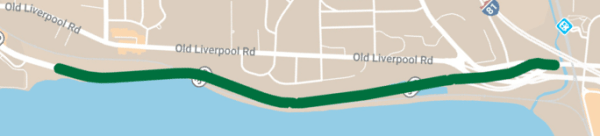
Why not try something simpler? There are only 2 miles of Parkway where cars are allowed to go 55 mph.
Those are the only 2 miles of road where drivers go so fast that they need extra wide lanes and a rumble strip to keep them safe from themselves. Reduce the speed limit on those 2 miles of road the 30 mph, and it’d be simple to narrow the lanes (or remove them) and use the extra space for a biking/walking path from the City to the rest of the park.
. . .
Onondaga Lake Park is Onondaga County’s “Central Park.” It’s a symbol of the switch from the destructive economy and mindset of the past to a new appreciation for the environment and a new focus on people’s quality of life. The Parkway is a vestige of that destructive past and mindset–a 4-lane freeway running through the middle of the park, cutting off access for the County’s poorest. A simple change–reducing the speed limit for 2 miles and repainting the lanes–would fix those problems. As an added bonus, it’d keep tractor trailers from running into the train bridge too.
On November 1, elected officials descended on Hancock Airport to announce the end of its 2-year $62.4 million renovation. They gave out quotes about how the bigger terminal and updated exterior would bring “economic growth” and “bolster tourism.” They talked about how airports are “gateways” and “the first impression that many visitors have of our city and our region.”
A bigger airport serving more passengers is also an opportunity to diversify Syracuse’s transportation network. Anyone arriving at the Syracuse airport on a plane has to find some other mode of transportation to reach their final destination. Fly into other cities, and you’ll see signs directing travelers to options like buses, trains, and cars.
We’re missing that opportunity. People flying into Syracuse are limited to using some kind of car, whether it’s a taxi, a rental, a Lyft, or a ride from a friend. Talk about first impressions–someone coming to Syracuse for the first time might leave the airport thinking that this City is too small to even have a public bus system. (Trailways does run extremely limited private bus service between the airport and the RTC).
There are challenges to providing bus service at the airport. Here’s a summary of them from the Syracuse Transit System Analysis:
“Challenges to providing transit service to the airport include the ample, convenient, low-cost parking located directly across from the terminal, and relatively low passenger volume. The lower passenger volumes and varying arrival and departure schedules would also make it difficult to provide a service that is convenient for all airport users. The location of the airport terminal would require too much time off-route for the airport to be a regular stop on one of the trunk routes. Finally, Airport employees work under a variety of shift schedules, making mass transit service expensive and ineffective.” STSA pg 63
The airport is too far away from anything else to be a stop regular stop on an existing bus line, and it doesn’t generate enough regular traffic on its own to support a new dedicated bus service.
Those are real challenges, but they’re not insurmountable. The STSA suggests one option: running a shuttle service between the airport and the RTC. A more regional approach to public transportation could also make bus or rail service to the airport more feasible. Any new service would cost money, but we already know that New York State is willing to spend money on the airport–why not finish the job and truly connect it to the City.
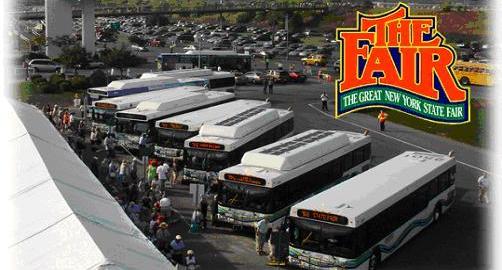
1,279,010 people attended the 2018 New York State Fair. That’s a new record, and all those people trying to get to the same place made for some pretty bad traffic. 690 backed up for miles, and more than once the Fair ran completely out of parking spaces. Onondaga County Executive Joanie Mahoney told people to use Centro’s park-and-ride service to avoid that headache.
A lot of people took the County Executive’s advice, drove to one of those park-n-ride spots, bought a two-way ticket, and rode the bus to the Fair. For many of those people, that was the one time of the year that they’ll see the inside of a Centro bus, and it’s a good opportunity to reflect on the state of public transportation in Syracuse.
First, it’s worth thinking on why so many people will ride the bus to get somewhere like the Fair (or the Amphitheater or an SU game), but so few people use Centro on a daily basis. Centro’s Fair service is more convenient than driving in all of that traffic on 690, and it’s easier than trying to park at the Fairgrounds themselves. The buses run frequently, it’s easy to get to the bus stop, and they let you off right where you need to be.
Try to take the bus to run any other errand, a lot of those benefits disappear. Most of Centro’s buses don’t come all that often, it can be difficult to get to the nearest bus stop, and the bus that stops there might not take you very near to where you’re going. That’s why so many people don’t even consider taking the bus most of the time.
But those people should remember that a lot of their neighbors have to put up with all that because the bus is their only legitimate option for getting around town. They have to deal with those same issues that scare so many people away from the bus, and they’d benefit from the same frequent reliable bus service that so many Fairgoers enjoy.
Second, it’s worth noting that Centro’s park-and-ride Fair service loses money. That might surprise some people who couldn’t find a seat on the bus at the end of the night, but it’s true. A bus going to the Fair at 11am on a Saturday might be full of people, but once it drops them off at the front gate, it’s going to turn around and run empty all the way back to its park-and-ride stop. That means that the service brings in money less than half the time that it’s running, and the Fair has to put up money to cover Centro’s costs.
That’s not a bad deal for the Fair, though, because those buses make it possible for so many more people to come through the front gates. Imagine if attendance was limited by the number of parking spaces right next to the fairgrounds. The Fair might lose money on the bus service itself, but it benefits from having so many extra people pay admission, buy food, and spend money at the midway.
It’s the same with public transportation every other day of the year. Centro can’t run its regular service with just the money it brings in from fares, so City Hall, Onondaga County, New York State, and the Federal Government all chip in to keep the buses running in Syracuse. That money ensures that all kinds of people can get to work, can get to school, can get to the grocery store. It gives businesses access to more potential employees, and it lets shops market to more potential customers. When government pays into Centro’s budget, it makes all of Syracuse richer.
It’s easy to forget all this. It’s easy not to think about the daily challenges that bus riders face in Syracuse, and it’s easy to ignore the fact that Centro is a necessary part of the City’s economy. So for everyone who rode a bus to the Fair, take this opportunity to remember all that. Think about the people who ride the buses the rest of the year, and keep them in mind the next time you vote.
During the Spring of 2017, Centro asked its riders about how the bus fits into their lives. SMTC published the results of that survey in June. There’s a lot of good stuff in the final report, but the overriding finding is that there’s major support for putting more buses on the streets at all hours of the day.
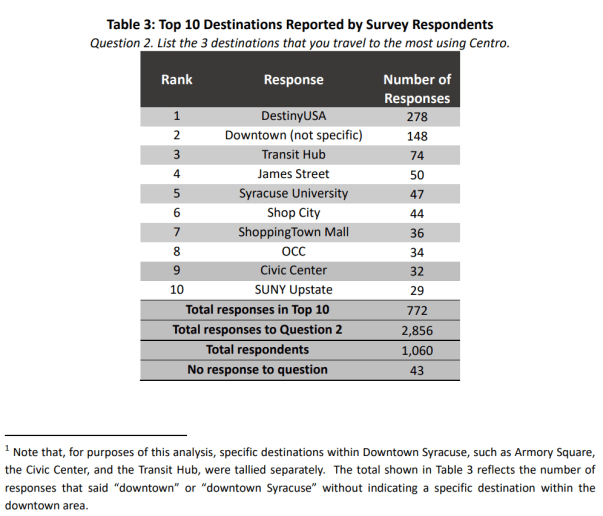
You find this in riders’ habits. When asked to list “the 3 destinations that you travel to the most using Centro,” people named places like the Mall, Downtown, and the University that already have good frequent service.
You also find this in riders’ responses to direct questions. When asked “Do you have additional suggestions for improving the Centro system?” people said they want shorter wait times and more service on nights and weekends:
“The single biggest issue was frequency of bus service and the length of time riders spend waiting for buses. Of the 388 surveys that included some kind of service improvement recommendation, 105 indicated this as an issue. Service at night and on weekends and holidays also came up frequently; 74 respondents included this concern.”
Riders also provided a whole list of other places in the City where they’d like for that service to run. When asked “are there specific locations that you wish Centro would serve,” riders listed “a variety of destinations” that they want for “Centro to serve, or serve more often”:
“Several destinations in the city were mentioned repeatedly, with Midland Avenue identified more than any other street in the city as needing upgraded service. Service to Strathmore was also identified as being needed. Other general destinations in the city included James Street, Grant Boulevard / the north side, Valley Drive, Midler Avenue, and the Westcott neighborhood.”
When riders are already using what frequent service exists, they’re saying that they want more of it, and they have a list of places where they’d like for it to go, it makes a lot of sense to start building out that service to those places.
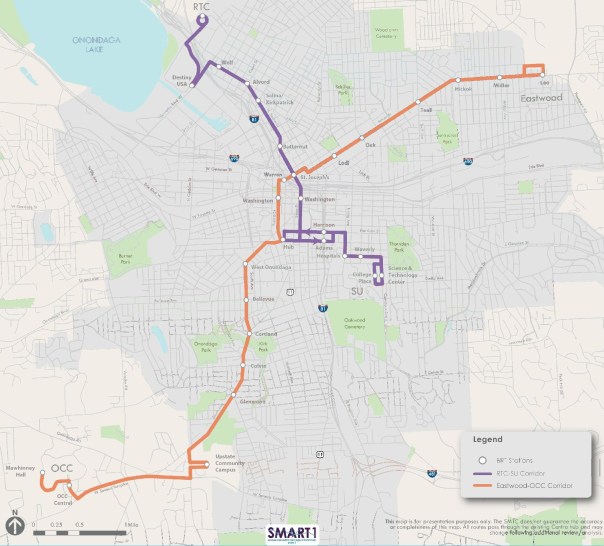
So it’s a good thing that SMTC and Centro are already working on it. Building on the Syracuse Transit System Analysis, SMTC has already recommended that Centro run frequent service on two major crosstown bus lines that connect several of the places where people are asking for better service.
These recommendations are a good first step. Centro needs to take them, and we all need to push the City’s political representatives to pay for them.
SMTC should also take a few more steps by making similar recommendations for the remaining “transit improvement corridors” identified in the STSA. Then, Centro and the City’s governments should find a way to act on those recommendations too.
The City has to get past this point where people’s lives are limited by their transportation options. Centro’s survey found that 80 percent of riders do not have access to a car, but “roughly half [of riders] said they use Centro only for a single purpose.” That means there are plenty of people who need the bus to get around the City for all kinds of reasons, but who can only use the service we’ve got now to make one kind of trip. That means limited opportunities for schooling, or working, or shopping, or worshiping, or whatever else it is that a person might need to travel outside of their immediate neighborhood to do. This survey is another reminder of those limitations, and it’s a call for the City to remove them.
Syracuse’s draft zoning ordinance requires properties used for different kinds of things to have different numbers of parking spaces. 1-family houses must have 1 parking space, grocery stores must have 1 parking space for every 300 square feet of floor space, golf courses must have 2 parking spaces for every hole, and so on.
The draft ordinance also includes mechanisms that can reduce those requirements in certain situations. Properties located in certain zoning districts and properties located on bus lines can reduce the total number of required parking spaces by anywhere from 15% to 50%, properties located nearby public parking lots and properties with street parking can count those spaces towards their total requirement, and so on.
A single property can qualify for more than one of these parking requirement reductions. If a barber shop would normally need 4 parking spaces, but it qualifies for a 50% reduction because of it’s zoning district, and there are 2 on-street spaces along its property line, then those two reductions combine to reduce the barber shop’s parking requirement to 0 spaces.
At least, that’s how it would have been before City Hall capped the total cumulative reduction for any property at 75% in the March 2018 revision of the draft ordinance. Now, as a result of this new cap, that barber shop would still need to find space on its lot for at least 1 off-street parking space.
This cap will have a huge effect on the housing market in Syracuse’s inner neighborhoods. These neighborhoods are mostly zoned R-2 or higher, meaning that they’re full of 2 and 3-family houses. Residential properties like those must have 1 parking space per dwelling unit (a 2-family home needs 2 spaces, a 3-family home needs 3 spaces, and so on). In previous drafts of the zoning ordinance, these homes could meet their parking requirements with on-street spaces. As of March 2018, however, because of this new 75% cap, the draft ordinance requires that every residential structure that can house at least 2 families have at least 1 off-street parking space.
This cap won’t affect any of Syracuse’s outer neighborhoods. Those neighborhoods are zoned almost entirely R-1, so they are made up of 1-family houses, each of which is only required to have 1 parking space. Once you account for the street-parking space out front of each of those houses and apply the new 75% cap, then each house is required to have .25 parking spaces. The draft ordinance rounds that down to 0.
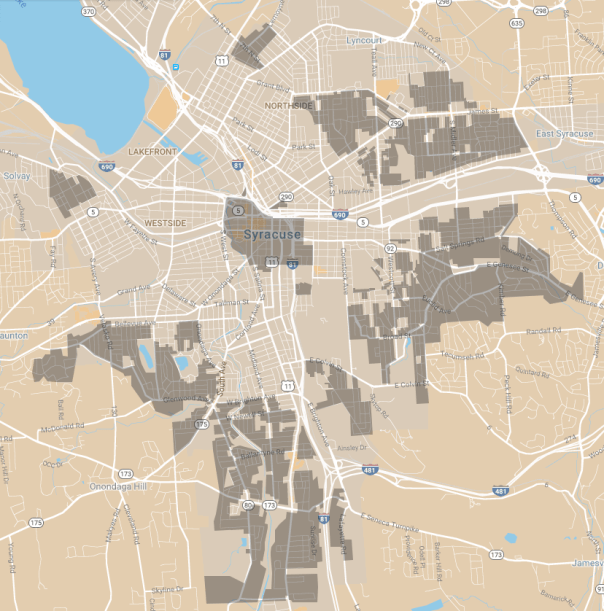
The result is that in areas zoned R-1, all new residential development will be exempt from parking requirements, while in areas zoned R-2 or higher, a lot of residential development will not be exempt from parking requirements (Downtown is also exempt from all parking requirements).
Areas where all residential development is exempt from parking requirements
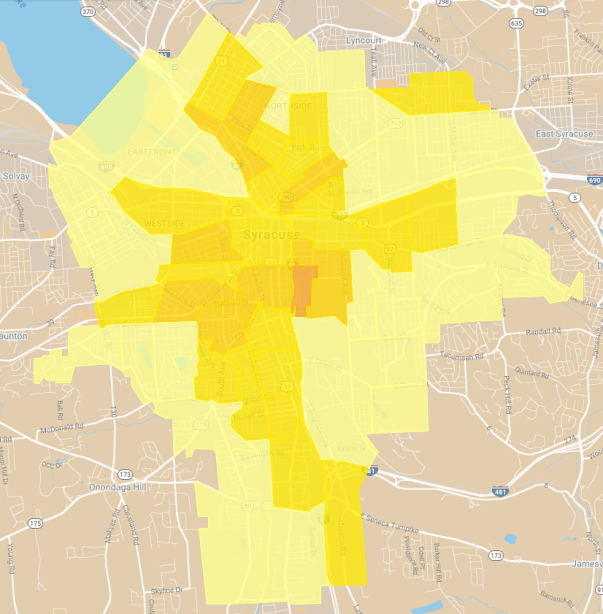
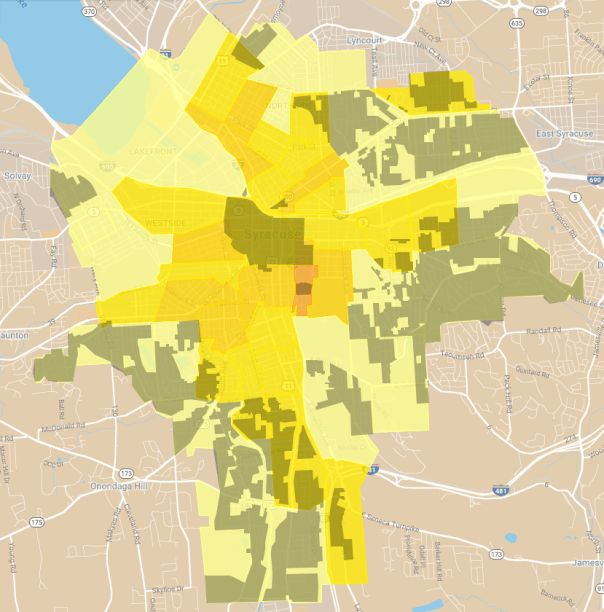
Syracuse’s inner neighborhoods are some of the best places to live in the entire County if you’re trying to make a life without a car. Neighborhoods like Hawley-Green and the Near Westside have relatively good bus service, a mix of businesses within walking distance, and easy access to the jobs Downtown and on University Hill. That’s why the people living in those neighborhoods are much more likely to go without a car than the people living in Syracuse’s outer neighborhoods like Strathmore and Meadowbrook.
Percentage of carless households by census tract
When you combine these two maps, it becomes clear just how insane the draft ordinance’s minimum parking requirements are. They require off-street parking for the people least likely to own cars, but they don’t make similar demands of the people most likely to own cars.
City Hall needs to amend the draft zoning ordinance to fix this problem. They could remove the 75% cap on parking minimum reductions. If a property is on a bus line and nearby a public parking lot, it makes sense to give the property owner credit for having set up in a spot where off-street parking isn’t necessary. The arbitrary 75% cap is just a way of saying that people in Syracuse shouldn’t try to make the best use of shared resources, and that’s not a message worth sending in a city that doesn’t have enough resources as it is.
City Hall could also amend the draft zoning ordinance to say “When measurements of the number of required spaces result in a fractional number, the fraction shall be rounded down to the nearest whole number.” For example, a project requiring 2.25 spaces would only actually have to build 2 spaces, and a project requiring 2.75 spaces would also only actually have to build 2 spaces. Even with the 75% cap, this would make 1-family, 2-family, and 3-family houses eligible for exemption from any parking requirements.
City Hall could also count on-street parking spaces in front of a property towards the total required number of spaces for any property after applying the 75% cap on parking minimum reductions. Allowing on-street parking to substitute for off-street parking in this way would allow 1-family houses and small scale apartments to meet their parking requirements without having to build off-street parking.
Those small changes would do a lot to make the zoning ordinance better, but it’d really be best to just trashparkingrequirementsentirely. They’re awful, ham-fisted solutions to a problem best solved by individuals. If a developer builds an apartment without off-street parking, they’ll get tenants who don’t own cars or who don’t mind finding on-street parking. Other people who value off-street parking will pay a little extra to rent or buy some other housing that includes a place to store a car. There’s no reason for parking lots to line James and Salina Streets when so many of the people living there don’t drive, and there’s no way that eliminating parking requirements will get people living in Meadowbrook to give up their driveways and garages.
That might be too much to ask in a town as car obsessed as this one. Whatever–any of those more technical fixes would be good enough. All that matters is that this new zoning ordinance not make it even harder to make a life in this City without a car.
In an episode of the WAER’s City Limits series, reporter Scott Willis talks to people who use Providence Services, a shuttle service that helps get people to and from work at an affordable rate. Willis asked Providence’s riders if they’d ever tried getting to work another way. They all said they’d tried using Centro, but the way the schedules were set up meant either getting to work 2 hours early or 5 minutes late.
That’s a pretty serious problem. If you’ve got any kind of responsibilities outside of work, there aren’t two hours in your day available to spend sitting outside of your job, waiting for your shift to start. If a potential employer is going to require that you give them an extra two hours every day without any kind of compensation, that’s not a job many people can take.
This isn’t just a problem for people trying to find work. It’s also a problem for those employers trying to find workers. The Post-Standard recently published an opinion piece predicting that Syracuse-area companies would soon have tens of thousands of open positions that they wouldn’t be able to find workers to fill. Elsewhere in WAER’s report, Providence Services’ President Deborah Hundley talked about reaching out to employers and hearing that “they want to have a diverse workforce. They want that. The diversity is in the City, but they have to be able to get there.”
When there are plenty of people reliant on Centro to get to work, and there are plenty of companies that want to hire the best candidate for the job–regardless of how that person gets around town–this ‘show up 2 hours early or 5 minutes late’ problem shouldn’t even exist. Employees and managers should be able to agree on a simple solution–whether that’s coming back from lunch 5 minutes early, staying 5 minutes past the end of the shift, or whatever–that gets us past this point where people are stuck without jobs and employers are stuck without workers just because no one can be inconvenienced to find an extra 5 minutes in the day.
What this boils down to is that both the employer and the employee share responsibility for the morning and evening commutes. That’s so obvious for people who drive that it’s easy to forget. Businesses locate on public roads accessible by car. They often provide ample amounts of free parking for employees. Blue Cross Blue Shield took this to such an extreme that it actually built an entirely new office in Dewitt a few years ago because its employees had a hard time parking Downtown. Employers do all of that to accommodate people who commute by car, and then those car commuters are responsible for using all those resources to get to work every day.
It’s the exact same with bus riders. It’s on the employee to catch the bus, pay the fare, make the transfers and all that, but the employer is also responsible for creating a workplace where commuting by bus is a reasonable possibility. The workers that WAER talked to in this City Limits piece were working out at Spectrum near Carrier Circle. Spectrum chose to set up shop in a location with spotty bus service. That’s on them. It’s not too much to ask that they make up for that by being a little flexible with bus riders’ work schedules. If Spectrum, or any other employer, takes on that small responsibility, everybody benefits.
Late last year, the Syracuse Metropolitan Transportation Council suggested that Centro run buses every ten minutes between Syracuse University and the Train Station, and between Eastwood and OCC. That’s a good idea, and there should be more good ideas like it on the way. City Hall has already asked the SMTC to look at how Centro can offer similar service on Erie Boulevard.
The problem is that it will cost money. The SMTC has estimated that it’ll cost $2.8 million to run the buses between the University and the Train Station, and it will cost $3.6 million to run the buses between Eastwood and OCC.
Normally when Centro talks about money, it’s talking about how it doesn’t even have enough to pay for the service it runs now. It wasn’t that long ago that Centro thought it would have to cut all late night and Sunday service in for lack of money. This year Centro is only planning to get an extra $450,000 from the State this year. That’s chump change for an organization with a $117,785,000 budget.
If Centro’s not going to get the money to run this service from out of thin air, then it’ll need to find the money in the budget it’s already got. The easiest way to do that is to take the drivers and vehicles from existing bus routes and move them to these new lines. There are opportunities for Centro to run its buses more efficiently so that it can free up drivers and vehicles to do just that without seriously cutting back on the service it already provides.
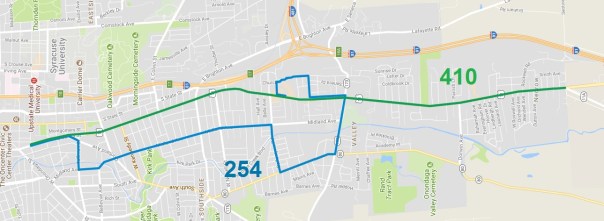
Take the 254 and 410 buses. Those buses run, for the most-part, within a couple blocks of each other, so a lot of people can catch either bus depending on when they need to ride. That’s good when the buses run at different times, because it offers better service for people who can get to either line. But when those buses run at the same time, it means that Centro is paying for two drivers and two vehicles to provide the service when it could just pay one instead.
If Centro cut all of the 254 buses that run at exactly the same time as a 410 bus, it would free up an extra bus and driver for 64 hours and 40 minutes a week, or 3372 hours a year. That’s 12% of what the SMTC thinks it’ll take to run the new bus service between the University and the Train Station–not enough to pay for the whole thing, but not nothing either.
There are lots of other situations like this because Centro times its routes to arrive and depart from the Hub all at once. That’s good for people trying to make transfers to get across town, but a lot of the time it means that more than one bus from the same side of town end up lining up together. Whenever that happens, there’s an opportunity for Centro to move one of those drivers to another route to provide better service.
There are some tradeoffs. Some people are going to have to walk farther to catch the bus, and that’s a lot to ask if you’re talking about a person for whom walking is difficult because of age, physical disability, or injury. The 254 bus also runs down a stretch of Valley Drive that’s not within easy walking distance of the 410 bus, and the 254 bus makes a special stop at the Bernadine Apartments that the 410 bus does not.
But this bus service is worth those tradeoffs. It’s a simple, reliable, effective way for people to get across town. It runs through neighborhoods where a lot of people are poor and a lot of people don’t have cars. It connects those neighborhoods to the three places in Syracuse where there are the most jobs, and it also connects them to the colleges where people can improve themselves and their opportunities for employment. That’s what the bus needs to do in this City.






 inthesalt.city