Tag Archives: Centro

Centro at the Fair

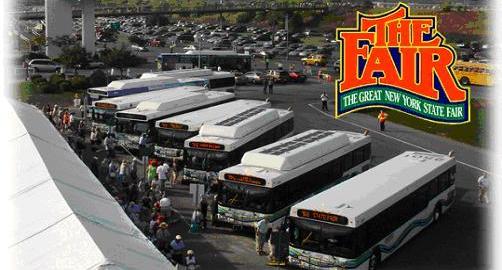
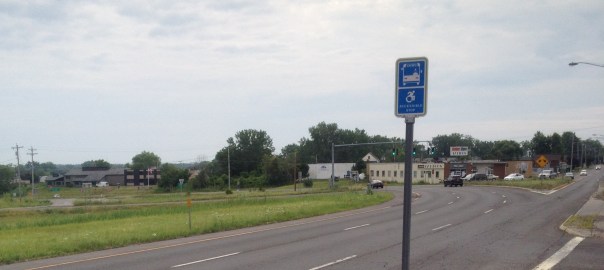
1,279,010 people attended the 2018 New York State Fair. That’s a new record, and all those people trying to get to the same place made for some pretty bad traffic. 690 backed up for miles, and more than once the Fair ran completely out of parking spaces. Onondaga County Executive Joanie Mahoney told people to use Centro’s park-and-ride service to avoid that headache.

A lot of people took the County Executive’s advice, drove to one of those park-n-ride spots, bought a two-way ticket, and rode the bus to the Fair. For many of those people, that was the one time of the year that they’ll see the inside of a Centro bus, and it’s a good opportunity to reflect on the state of public transportation in Syracuse.

First, it’s worth thinking on why so many people will ride the bus to get somewhere like the Fair (or the Amphitheater or an SU game), but so few people use Centro on a daily basis. Centro’s Fair service is more convenient than driving in all of that traffic on 690, and it’s easier than trying to park at the Fairgrounds themselves. The buses run frequently, it’s easy to get to the bus stop, and they let you off right where you need to be.

Try to take the bus to run any other errand, a lot of those benefits disappear. Most of Centro’s buses don’t come all that often, it can be difficult to get to the nearest bus stop, and the bus that stops there might not take you very near to where you’re going. That’s why so many people don’t even consider taking the bus most of the time.

But those people should remember that a lot of their neighbors have to put up with all that because the bus is their only legitimate option for getting around town. They have to deal with those same issues that scare so many people away from the bus, and they’d benefit from the same frequent reliable bus service that so many Fairgoers enjoy.

Second, it’s worth noting that Centro’s park-and-ride Fair service loses money. That might surprise some people who couldn’t find a seat on the bus at the end of the night, but it’s true. A bus going to the Fair at 11am on a Saturday might be full of people, but once it drops them off at the front gate, it’s going to turn around and run empty all the way back to its park-and-ride stop. That means that the service brings in money less than half the time that it’s running, and the Fair has to put up money to cover Centro’s costs.

That’s not a bad deal for the Fair, though, because those buses make it possible for so many more people to come through the front gates. Imagine if attendance was limited by the number of parking spaces right next to the fairgrounds. The Fair might lose money on the bus service itself, but it benefits from having so many extra people pay admission, buy food, and spend money at the midway.

It’s the same with public transportation every other day of the year. Centro can’t run its regular service with just the money it brings in from fares, so City Hall, Onondaga County, New York State, and the Federal Government all chip in to keep the buses running in Syracuse. That money ensures that all kinds of people can get to work, can get to school, can get to the grocery store. It gives businesses access to more potential employees, and it lets shops market to more potential customers. When government pays into Centro’s budget, it makes all of Syracuse richer.

It’s easy to forget all this. It’s easy not to think about the daily challenges that bus riders face in Syracuse, and it’s easy to ignore the fact that Centro is a necessary part of the City’s economy. So for everyone who rode a bus to the Fair, take this opportunity to remember all that. Think about the people who ride the buses the rest of the year, and keep them in mind the next time you vote.

Building for Equal Opportunity

When a big developer comes to Syracuse and asks for a break on paying their property taxes, that’s an opportunity. City Hall can use the promise of a tax break to negotiate for that developer to do something good for Syracuse.

City Hall used to miss these opportunities all the time. Anybody willing to build in the City could get a tax break without promising to do anything to benefit the community. In the past couple of years, though, City Hall has started asking for more. Recent projects have traded tax breaks for new rent-controlled apartments and promises to hire city residents for construction jobs.

That change is good. It means that Syracuse is becoming more valuable, and that City Hall is using its leverage over the people who want to exploit that value. It also means that City Hall can get more creative about how it uses tax breaks to benefit the community.

Here’s one idea: use tax breaks to concentrate new building in areas with good bus service.

People who get around by riding the bus do not have equal access to opportunity in Syracuse. A lot of employers are beyond Centro’s reach, and that keeps a lot of willing and able people from getting and holding a job. A lot of new quality housing has the same problem.

It’s in the community’s interest to fix this situation–to make more jobs and more housing accessible to bus riders–and that’s going to mean more building in places that support quality bus service.

So the next time some developer comes looking for a tax break to build a new apartment or office in Syracuse, City Hall can use that opportunity to get that project built in a place that bus riders can get to. It’s a new use for an existing policy tool, and it will give more people equal access to opportunity in Syracuse.

Riders Call for More Buses on the Streets

During the Spring of 2017, Centro asked its riders about how the bus fits into their lives. SMTC published the results of that survey in June. There’s a lot of good stuff in the final report, but the overriding finding is that there’s major support for putting more buses on the streets at all hours of the day.

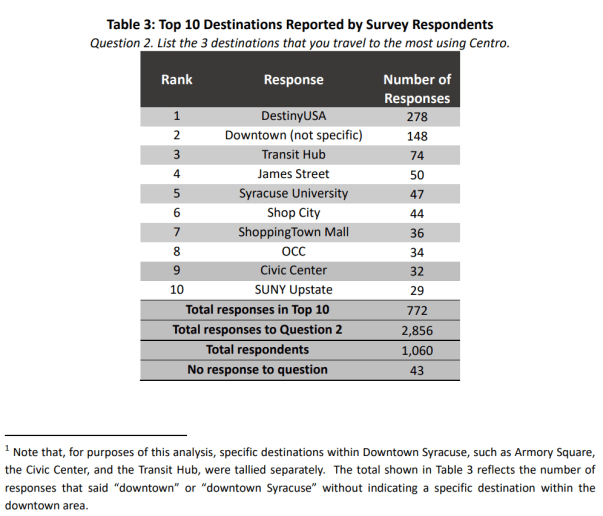
You find this in riders’ habits. When asked to list “the 3 destinations that you travel to the most using Centro,” people named places like the Mall, Downtown, and the University that already have good frequent service.

centrotolocations

You also find this in riders’ responses to direct questions. When asked “Do you have additional suggestions for improving the Centro system?” people said they want shorter wait times and more service on nights and weekends:

“The single biggest issue was frequency of bus service and the length of time riders spend waiting for buses. Of the 388 surveys that included some kind of service improvement recommendation, 105 indicated this as an issue. Service at night and on weekends and holidays also came up frequently; 74 respondents included this concern.”

Riders also provided a whole list of other places in the City where they’d like for that service to run. When asked “are there specific locations that you wish Centro would serve,” riders listed “a variety of destinations” that they want for “Centro to serve, or serve more often”:

“Several destinations in the city were mentioned repeatedly, with Midland Avenue identified more than any other street in the city as needing upgraded service. Service to Strathmore was also identified as being needed. Other general destinations in the city included James Street, Grant Boulevard / the north side, Valley Drive, Midler Avenue, and the Westcott neighborhood.”

When riders are already using what frequent service exists, they’re saying that they want more of it, and they have a list of places where they’d like for it to go, it makes a lot of sense to start building out that service to those places.

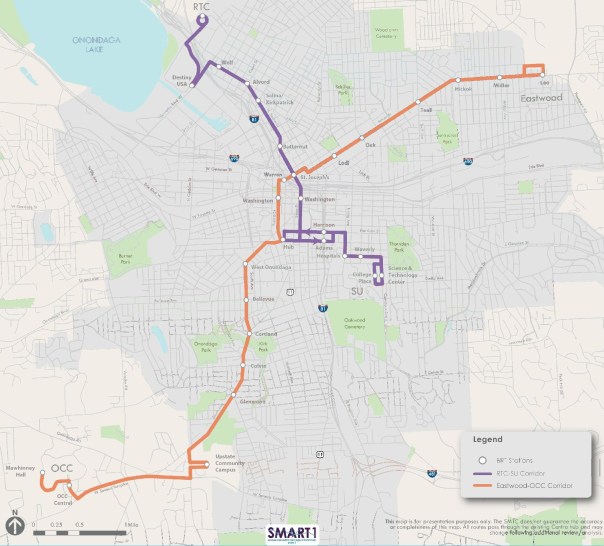
So it’s a good thing that SMTC and Centro are already working on it. Building on the Syracuse Transit System Analysis, SMTC has already recommended that Centro run frequent service on two major crosstown bus lines that connect several of the places where people are asking for better service.
SMART1_Public_Meeting_3_Presentation_11217-page-001

These recommendations are a good first step. Centro needs to take them, and we all need to push the City’s political representatives to pay for them.

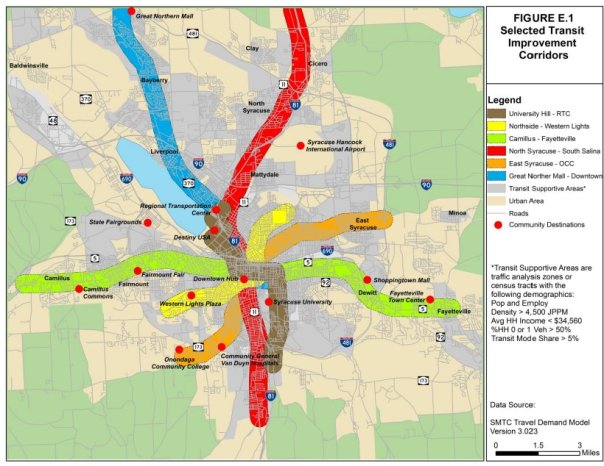
SMTC should also take a few more steps by making similar recommendations for the remaining “transit improvement corridors” identified in the STSA. Then, Centro and the City’s governments should find a way to act on those recommendations too.

DieME9UX0AAT9G7The City has to get past this point where people’s lives are limited by their transportation options. Centro’s survey found that 80 percent of riders do not have access to a car, but “roughly half [of riders] said they use Centro only for a single purpose.” That means there are plenty of people who need the bus to get around the City for all kinds of reasons, but who can only use the service we’ve got now to make one kind of trip. That means limited opportunities for schooling, or working, or shopping, or worshiping, or whatever else it is that a person might need to travel outside of their immediate neighborhood to do. This survey is another reminder of those limitations, and it’s a call for the City to remove them.

Hiring Bus Riders

In an episode of the WAER’s City Limits series, reporter Scott Willis talks to people who use Providence Services, a shuttle service that helps get people to and from work at an affordable rate. Willis asked Providence’s riders if they’d ever tried getting to work another way. They all said they’d tried using Centro, but the way the schedules were set up meant either getting to work 2 hours early or 5 minutes late.

That’s a pretty serious problem. If you’ve got any kind of responsibilities outside of work, there aren’t two hours in your day available to spend sitting outside of your job, waiting for your shift to start. If a potential employer is going to require that you give them an extra two hours every day without any kind of compensation, that’s not a job many people can take.

This isn’t just a problem for people trying to find work. It’s also a problem for those employers trying to find workers. The Post-Standard recently published an opinion piece predicting that Syracuse-area companies would soon have tens of thousands of open positions that they wouldn’t be able to find workers to fill. Elsewhere in WAER’s report, Providence Services’ President Deborah Hundley talked about reaching out to employers and hearing that “they want to have a diverse workforce. They want that. The diversity is in the City, but they have to be able to get there.”

When there are plenty of people reliant on Centro to get to work, and there are plenty of companies that want to hire the best candidate for the job–regardless of how that person gets around town–this ‘show up 2 hours early or 5 minutes late’ problem shouldn’t even exist. Employees and managers should be able to agree on a simple solution–whether that’s coming back from lunch 5 minutes early, staying 5 minutes past the end of the shift, or whatever–that gets us past this point where people are stuck without jobs and employers are stuck without workers just because no one can be inconvenienced to find an extra 5 minutes in the day.

What this boils down to is that both the employer and the employee share responsibility for the morning and evening commutes. That’s so obvious for people who drive that it’s easy to forget. Businesses locate on public roads accessible by car. They often provide ample amounts of free parking for employees. Blue Cross Blue Shield took this to such an extreme that it actually built an entirely new office in Dewitt a few years ago because its employees had a hard time parking Downtown. Employers do all of that to accommodate people who commute by car, and then those car commuters are responsible for using all those resources to get to work every day.

It’s the exact same with bus riders. It’s on the employee to catch the bus, pay the fare, make the transfers and all that, but the employer is also responsible for creating a workplace where commuting by bus is a reasonable possibility. The workers that WAER talked to in this City Limits piece were working out at Spectrum near Carrier Circle. Spectrum chose to set up shop in a location with spotty bus service. That’s on them. It’s not too much to ask that they make up for that by being a little flexible with bus riders’ work schedules. If Spectrum, or any other employer, takes on that small responsibility, everybody benefits.

Finding the Money For Better Bus Service

Late last year, the Syracuse Metropolitan Transportation Council suggested that Centro run buses every ten minutes between Syracuse University and the Train Station, and between Eastwood and OCC. That’s a good idea, and there should be more good ideas like it on the way. City Hall has already asked the SMTC to look at how Centro can offer similar service on Erie Boulevard.

The problem is that it will cost money. The SMTC has estimated that it’ll cost $2.8 million to run the buses between the University and the Train Station, and it will cost $3.6 million to run the buses between Eastwood and OCC.

Normally when Centro talks about money, it’s talking about how it doesn’t even have enough to pay for the service it runs now. It wasn’t that long ago that Centro thought it would have to cut all late night and Sunday service in for lack of money. This year Centro is only planning to get an extra $450,000 from the State this year. That’s chump change for an organization with a $117,785,000 budget.

If Centro’s not going to get the money to run this service from out of thin air, then it’ll need to find the money in the budget it’s already got. The easiest way to do that is to take the drivers and vehicles from existing bus routes and move them to these new lines. There are opportunities for Centro to run its buses more efficiently so that it can free up drivers and vehicles to do just that without seriously cutting back on the service it already provides.

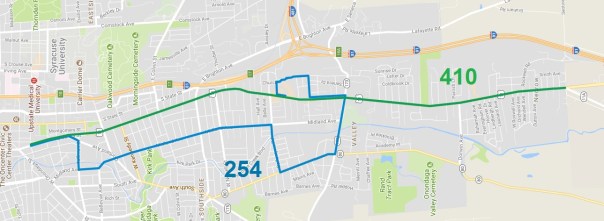
Take the 254 and 410 buses. Those buses run, for the most-part, within a couple blocks of each other, so a lot of people can catch either bus depending on when they need to ride. That’s good when the buses run at different times, because it offers better service for people who can get to either line. But when those buses run at the same time, it means that Centro is paying for two drivers and two vehicles to provide the service when it could just pay one instead.

254410

If Centro cut all of the 254 buses that run at exactly the same time as a 410 bus, it would free up an extra bus and driver for 64 hours and 40 minutes a week, or 3372 hours a year. That’s 12% of what the SMTC thinks it’ll take to run the new bus service between the University and the Train Station–not enough to pay for the whole thing, but not nothing either.

There are lots of other situations like this because Centro times its routes to arrive and depart from the Hub all at once. That’s good for people trying to make transfers to get across town, but a lot of the time it means that more than one bus from the same side of town end up lining up together. Whenever that happens, there’s an opportunity for Centro to move one of those drivers to another route to provide better service.

There are some tradeoffs. Some people are going to have to walk farther to catch the bus, and that’s a lot to ask if you’re talking about a person for whom walking is difficult because of age, physical disability, or injury. The 254 bus also runs down a stretch of Valley Drive that’s not within easy walking distance of the 410 bus, and the 254 bus makes a special stop at the Bernadine Apartments that the 410 bus does not.

But this bus service is worth those tradeoffs. It’s a simple, reliable, effective way for people to get across town. It runs through neighborhoods where a lot of people are poor and a lot of people don’t have cars. It connects those neighborhoods to the three places in Syracuse where there are the most jobs, and it also connects them to the colleges where people can improve themselves and their opportunities for employment. That’s what the bus needs to do in this City.

Bus Stops and Parking Spaces in ReZone

In April 2017, City Hall published a draft of the new zoning ordinance that allowed for buildings near to “any type of bus stop, regardless of service level” to build 30% fewer parking spaces than buildings without easy access to transit. That’s was a good idea because it costs money to provide off-street parking, and that’s an unnecessary expense when the people using a building don’t travel by car. When City Hall imposes that expense on a property owner by requiring that a building have more parking than is necessary, that amounts to a tax on pedestrians, cyclists, and bus riders.

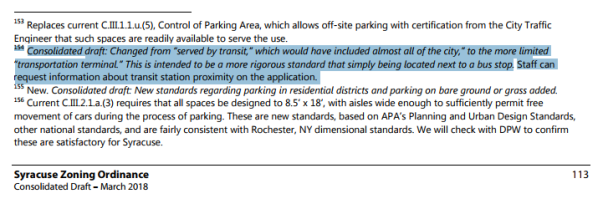
In March of 2018, the City Hall backed away from that good idea. Instead of reducing parking minimums for buildings within a quarter mile of “stations served by transit,” the new draft ordinance published that month talks about buildings within a quarter mile of “transportation terminals.” It’s not obvious what a transportation terminal would be in Syracuse (the Centro Hub, the RTC, the terminal stop for each bus line?), but it’s clear from the explanatory footnote that a transportation terminal is not a bus stop:

transitfootnote

It’s as if City Hall didn’t know that Centro is a viable transportation option in just about every neighborhood in the City, and now they’re trying to limit the benefits that bus service can provide.

In fact, Centro’s pervasive service is a good reason to take the opposite tack and allow greater density at the corner properties on each intersection where a bus stops. Elevating the properties at each bus stop by one zoning district (from R-2 to R-3, say, or from MX-1 to MX-2) would increase the City’s capacity to house people who do not own cars, and that’s right in line with the City’s Land Use & Development Plan:

“This capacity should be preserved by maintaining zoning for density levels in line with the existing built environment, so that over the long-term the City may market its ability to cost-effectively absorb regional population growth—based on existing infrastructure and an urban land-use pattern that lends itself to walkable neighborhoods, local commercial and business services, and efficient transit service.” Land Use & Development Plan, pg 12

Luckily, the City Hall is hosting three information sessions about the new zoning ordinance this week. The first will be on Monday at 6:30 at Nottingham High School, the second will be on Tuesday at 6:30 at Corcoran High School, and the third will be on Wednesday at 6:30 at Henninger High School. Check these info sessions out, learn more about the new ordinance, and ask why City Hall wants make it harder for people without cars to find an affordable apartment in the City.

Uniting Communities through Transit

Back in 2017 when the community was still seriously debating the merits of Consensus’ plan to merge the City of Syracuse with Onondaga County, Centerstate CEO Rob Simpson liked to talk about how a combined city-county would be the second biggest city in New York State. That wasn’t really a very compelling argument since it compared apples to oranges, but it did get at something important: communities with larger populations enjoy political and economic benefits over those with smaller populations, and cities like Syracuse, Cortland, and Ithaca suffer both politically and economically because they each have so many fewer people than other communities in New York State.

An intercity transit service connecting Syracuse, Cortland, and Ithaca would fix this problem by uniting those three cities and their metropolitan areas into a single region large enough to give its residents political and economic advantages that they do not currently enjoy.

Uniting these communities will benefit both businesses and workers. Easier commutes between cities will enable workers from any community in the region to work for businesses in any other community. This will create a single regional labor market that can support growing local businesses and that can also attract large businesses to move into the region. The other side of this coin is that workers will be able to apply for jobs outside of their individual communities, increasing economic opportunity for people living in each community.

That economic integration will also make the region stronger politically. It will mean that good things happening in one community are good for people living in communities across the region, allowing residents and elected officials to advocate with a single voice in State politics. So if Syracuse needs the State legislature to amend its charter to deal with the City’s impending fiscal crisis, Bill Magnarelli and Pam Hunter will be able to count on support from Al Stirpe, Barbara Lifton, and Gary Finch in the State Assembly to make that happen. If we go through something like the Upstate Revitalization Initiative again, the Central New York and Southern Tier Regional Economic Development Councils can work together to submit bids that will benefit the entire region.

By making daily travel between Syracuse, Cortland, and Ithaca easy and routine, an intercity transit service would unite those cities and their metropolitan areas as a single region with a single labor market and a unified political voice. This kind of transformation won’t happen overnight, and it will require cooperation between regional transportation authorities, county governments, other municipalities, and private institutions, but the potential benefits are worth the effort.

This is part of a series about a potential transit service serving Syracuse, Cortland and Ithaca. Here are links to the rest of the series:
Transit Service Between the Airport, Syracuse, Cortland, and Ithaca
Learning from OnTrack
University Students and Public Transportation

University Students and Public Transportation

In 2015 when Centro thought it would have to cut late-night and weekend service, plenty of people turned out for a Syracuse Common Council meeting to tell about how those changes would make their lives harder. The people who got up to speak at that meeting talked about things like working the third shift at hospitals and nursing homes, relying on the bus to overcome physical disability, greenhouse gases, and getting to church on the South Side. Those people represented the political coalition between workers, the disabled, environmentalists, and the poor that supports public transportation in Syracuse today.

University students would be natural members of that coalition. Nationally, students make of 24% of all transit users in urban areas with populations between 200,000 and 999,999. In Syracuse, people living in student neighborhoods like University Hill and the Near Eastside are less likely to own a car and more likely to commute by bus or by foot than people living in other Syracuse neighborhoods of comparable wealth. Syracuse University students ride Centro in huge numbers, particularly to get between South Campus, University Hill, and Downtown. Despite all that, no students got up at that meeting to voice their support for Centro.

Even though no students spoke, the University was a topic of discussion at the meeting. Councilor Khalid Bey asked Centro’s CEO, Frank Kobliski, whether or not Syracuse University paid Centro enough money to cover the operating costs of all those buses that run between University Hill and South Campus. That question got a lot of people grumbling, and one person shouted out, “they have more money than god!” Once Mr. Kobliski had the opportunity to respond, though, he surprised everyone by letting them know that the University overpays for the bus service it gets from Centro.

Syracuse University overpays for its buses because it treats Centro not as a public service, but as a charter bus company. It contracts with Centro to provide free service to its students as they travel between South Campus, University Hill, and Downtown. This means that students ride Centro buses in huge numbers, but they’re not riding truly public transportation.

This dampens student support for Centro. When reporting on Centro, the Daily Orange always distinguishes those special student buses from Centro’s public service. So in 2015 when Centro was considering those late-night and weekend service cuts, the Daily Orange wrote “the direct effect on SU students would remain small,” and no students turned out to advocate on Centro’s behalf. Later that year, when Congress voted to cut Centro’s funding by $12 million, the Daily Orange made the students’ position even more explicit:

“If the mass budget cuts currently facing Centro continue and affect on-campus busing, Syracuse University must take a firm stance to oppose the cuts and defend transportation resources for the university community… However, the university should only offer its support if cuts would directly impact bus service on the SU campus. The university’s priority should be to ensure these resources remain available to those on campus, and it does not have a financial responsibility nor obligation to ensure the bill prevents wide-scale change, affecting the city of Syracuse.”

That’s Centro’s political problem. As long as Syracuse University students receive specialized bus service from the University, they will think of it as a private good to be secured by paying tuition. That stance divides students from the majority of Centro riders who use the bus as a public good that must be secured by political action and advocacy. These opposing stances divide Centro’s natural base of political support and keep a large and powerful bloc of people who rely on transit in Syracuse from acting collectively on its behalf.

It doesn’t have to be this way. Bus riders in Syracuse don’t need to resent University students, and students don’t have to think of their interests as separate from the Syracuse community. Both groups rely on public services like Centro buses, and if they could be a potent political force in Upstate New York if they acted cooperatively.

Intercity transit service could change that status quo by providing a service that’s highly beneficial to Syracuse University and its students, but impossible for the University to build or pay for all on its own. A truly public transportation service connecting Hancock International Airport, the Regional Transportation Center, Centro’s Bus Hub, Syracuse University, Cortland, Cornell University, and Ithaca would benefit both students and transit riders, it would put them both in the same vehicle, and it would give them common cause to advocate for that service.

Both Centro riders and Syracuse University students depend on the presence of public or quasi-public services in a region where the middle and upper classes pride themselves on being entirely independent of such services. The travesty is that the University provides its students with those services at high but hidden cost, and that by segregating those services, the University divides what should be a natural alliance and kills support for truly public services. It will take a lot of work to overcome the institutional barriers that segregate students from City residents, but Chancellor Nancy Cantor took a first step with the Connective Corridor and her Scholarship In Action philosophy. Chancellor Kent Syverud plans to go further by moving student housing from South Campus to the City’s center. A truly public intercity transit service can do more of that same work, strengthening the whole City by aligning the interests of the people who live in it.

This is part of a series about a potential transit service serving Syracuse, Cortland and Ithaca. Here are links to the rest of the series:
Transit Service Between the Airport, Syracuse, Cortland, and Ithaca
Learning from OnTrack
Uniting Communities through Transit

Learning from OnTrack

Last week, this website published a proposal for a new transit service connecting Ithaca, Cortland, and Syracuse. Anyone familiar with the recent history of transit in Syracuse will recognize parts of this proposal from OnTrack, the rail line that ran from the Destiny Mall to Syracuse University during the nineties and thousands. OnTrack was a debacle, poorly planned and poorly implemented, but it was also an encouraging act of faith in the power of transit to improve life in Syracuse. This proposal attempts to learn the lessons of OnTrack in order to avoid its failures while still capitalizing on the potential that made it attractive in the first place.

That potential is the New York, Susquehanna, & Western right-of-way. It’s an elevated rail line that runs through Downtown on its way from Syracuse University past Destiny Mall to the William F. Walsh Regional Transportation Center. At first glance, it looks like a great way to get heavy rail transit for almost no money. Just start running trains on what’s already there, and you’ve got Chicago’s El on a Syracuse scale.

OnTrack didn’t live up to that promise. It never got enough riders to justify its operating costs, and after a few years it stopped running. A lot of people have taken the time to point out all of the problems that kept OnTrack from succeeding–it didn’t run frequently enough, it didn’t run fast enough, and it didn’t run through enough neighborhoods. Without fixing those problems, no transit service running on those train tracks could do what OnTrack tried to do.

Unfortunately, those problems are neither easy, simple, nor cheap to fix. They are the result of real practical constraints.

First, frequency. Most of the right-of-way is single-tracked, so trains running in opposite directions can’t pass each other. That means that only one train can run at a time. It would take that single train about 20 minutes to run between Syracuse University and the Regional Transportation Center or 40 minutes to make the full round trip. That’s no more frequent that Centro’s existing bus service, and it’s much less frequent than the Bus Rapid Transit service that the Syracuse Metropolitan Transportation Council recently recommended for a similar route.

Second, speed. Even though OnTrack only made a couple stops and didn’t have to deal with traffic or stop signs, it took a long looping 4 mile route to get from Downtown to the Mall and the Regional Transportation Center. A Centro bus gets from Downtown to the Regional Transportation Center in less than 3 miles, and so even though it might travel at a lower speed with more stops, its trip wouldn’t take any more time.

That all leads into the third problem, that OnTrack didn’t service residential neighborhoods. The existing track doesn’t run through the densely populated neighborhoods that already support frequent transit in Syracuse, so the only way for passengers from those neighborhoods to get to the train tracks is on a Centro bus. The tracks run within a block of Centro’s hub, so it wouldn’t be hard for people to make the transfer, but since a train running between Downtown Syracuse and the Regional Transportation Center would be neither faster nor more frequent than a bus serving the same destinations, there’s not much reason for a person to walk that block to make the transfer.

Using the existing right-of-way as part of a much larger intercity transit service avoids these problems. First, because its riders will be travelling to destinations not served by existing Centro bus routes, riders have a good reason to transfer from the bus to the train, meaning that the service does not need to pass through densely populated residential neighborhoods to pick up passengers. Second, because a train can make the 65 mile run between Ithaca and Syracuse so much faster than a bus can, it doesn’t matter that they’d run even over the 4 miles between Downtown Syracuse and the Regional Transportation Center. Third, because intercity service doesn’t need to run all that frequently to succeed, a single train running on a single track could provide the service effectively.

Old railroad rights-of-way are precious resources. New political and economic forces make it difficult to build anything like them anymore, so cities like Baltimore, Philadelphia, and Camden have taken their old underused rights-of-way and built new mass transit lines. The New York, Susquehanna, & Western right-of-way could be that kind of asset for Syracuse. OnTrack already showed us what won’t work, so let’s try something new.


This is part of a series about a potential transit service serving Syracuse, Cortland and Ithaca. Here are links to the rest of the series:
Transit Service Between the Airport, Syracuse, Cortland, and Ithaca
University Students and Public Transportation
Uniting Communities through Transit

Transit Between the Airport, Syracuse, Cortland, and Ithaca

This is a proposal for an intercity transit service connecting the region of Upstate New York that includes the cities of Syracuse, Cortland, and Ithaca. The region currently contains much of the infrastructure and conditions necessary for successful intercity transit, but what service actually exists is infrequent and disjointed. This proposal consolidates and extends existing service to make it more useful and efficient for the region as a whole.

Route
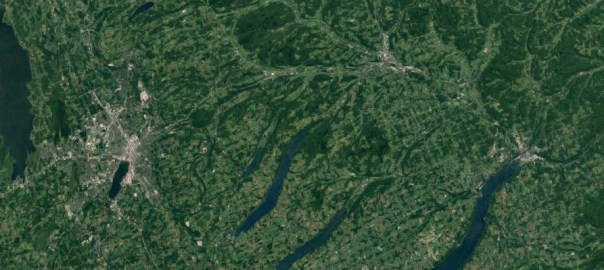
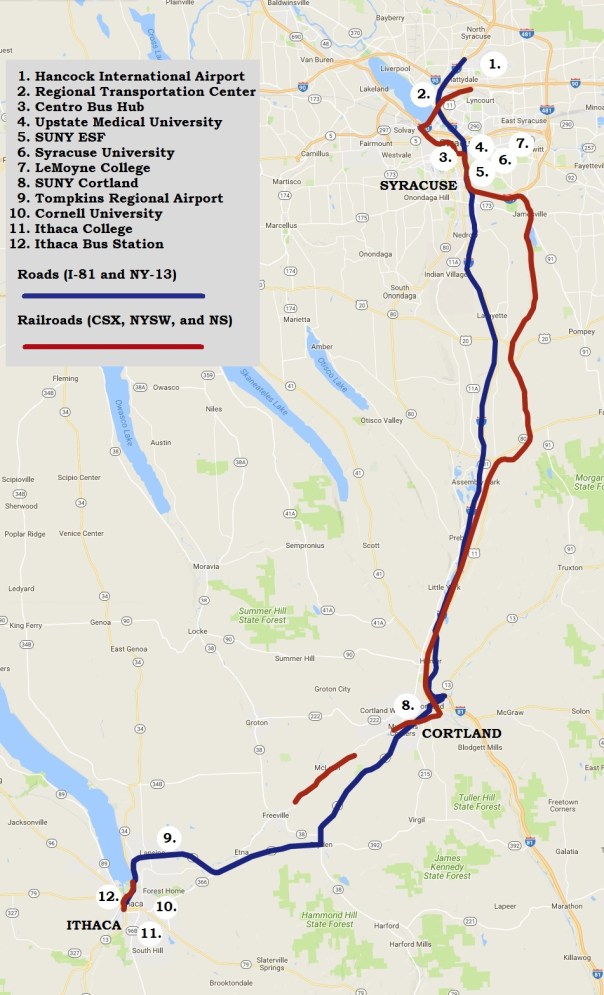
The proposed transit service would run through a corridor approximately five miles wide and seventy miles long. That corridor stretches from the Hancock International Airport (SYR) through Cortland down to Ithaca. From Syracuse to Cortland, the service would run through the relatively flat and straight valleys carved by Onondaga Creek, Butternut Creek, and the Tioughnioga River, climbing 750 feet over the course of roughly 40 miles. From Cortland to Ithaca, the service would follow a much more irregular valley carved by several small streams before descending 400 feet in less than a mile to reach the City of Ithaca on the southern shore of Cayuga Lake.
projectarealabels

There is already a good deal of transportation infrastructure along this corridor. I-81 stretches from SYR to Cortland, and from there vehicles can take NY-13 from Cortland all the way to Ithaca. Vehicles can also turn from NY-13 to NY-366 to pass through Cornell University on the way into Ithaca.

CSX owns a rail line that passes within two miles of the SYR’s passenger terminal. That line continues west through the William F. Walsh Regional Transportation Center (the RTC, Syracuse’s Amtrak and intercity bus station) to the southern end of Onondaga Lake where it connects to the New York, Susquehanna, & Western line. That railroad curves south through Syracuse, passing Centro’s Bus Hub and Syracuse University, and it continues all the way south through Cortland to the hamlet of Munson’s Corners. There is an abandoned railroad right-of-way between Cortland and Ithaca including roughly four miles of unused track near the hamlet of McLean. In Ithaca, Norfolk Southern owns track that runs from the Ithaca Bus Station (an intercity station) north along the eastern shore of Cayuga Lake and connecting to the abandoned right of way that leads to Cortland.

There are a number of regionally significant communities and institutions along the corridor. The cities of Syracuse, Cortland, and Ithaca are each the seat of their respective counties, and each serves as the center of a local transit system. Combined, these three cities and their immediate suburbs are home to more than 500,000 people. More broadly,  the Syracuse-Auburn and Ithaca-Cortland combined statistical areas have a combined population of more than 870,000. There are also seven colleges and universities along the corridor with a combined enrollment of more than 63,000 students as well as two community colleges with a combined enrollment of more than 18,000 students.

Demand
The transit service will enable riders to accomplish two distinct tasks: travelling to or from a transit hub that connects to another intercity transportation service such as Amtrak or Megabus, and travelling between cities within the corridor. There is demonstrated demand for transit service that accomplishes each task.

Transportation to a Hub:
The only intercity passenger train station in the corridor is the RTC in Syracuse. The RTC is also the only bus station in the corridor served by Megabus, and the Centro Bus Hub in Syracuse provides the only intercity bus service to the cities of Oswego and Auburn.

Both the Tompkins Regional Airport in Ithaca (ITH) and SYR provide intercity passenger service. Of these two airports, SYR provides more frequent service to a larger number of cities than does ITH. Flights into and out of SYR are also generally cheaper than those at ITH. People travelling to or from the region by plane often must use SYR even if it would be more convenient to get to ITH.

The service will connect these hubs to three schools with student bodies that need to travel outside of the region frequently. Syracuse University, Cornell University, and Ithaca College enroll a combined total of 50,197 students, 68% of whom are from states other than New York and 18% of whom are from outside of the United States.

Each of those three schools struggles to transport students and visitors to and from the region’s intercity transportation hubs. Syracuse University and Cornell University run their own shuttles to and from SYR at the beginning and end of each semester and holiday break. Syracuse’s service is free, but tickets for Cornell’s service cost $30. Otherwise, Syracuse University simply suggests taking a cab to travel between SYR and the university, or taking Centro between the RTC and the university. Ithaca College offers no transportation to SYR. Both Ithaca College and Cornell suggest that those who need to get either to or from SYR or the RTC can book a ride with the Ithaca Airline Limousine, a private transportation service that can make up to eight runs between Syracuse and Ithaca every weekday and costs $85 for a one-way ticket or $130 for a two-way ticket.

The Syracuse Transit System Analysis (STSA) also identified the need for improved transit service to both the RTC and SYR. The STSA selected the route from Syracuse University to the RTC as a ‘transit improvement corridor’ because of the presence of jobs, carless households, and demonstrated demand for transit along the route. The STSA also recommended the creation of a shuttle service running every half hour between SYR and the RTC to serve airport passengers and employees.

Additionally, other travelers arriving in the region by bus, train, or plane will benefit from improved transit from the intercity transit hubs to destinations such as convention centers and hotels in each city.

Transportation Between Cities:
Centro and Cortland Transit already provide limited intercity transit for commuters. Commuters from Cortland County can catch an express bus to Syracuse from Centro’s Park-N-Ride facility in the Village of Tully. Centro also provides commuter service from both Oswego and Auburn to Syracuse. Cortland Transit runs a commuter service between Cortland and Ithaca.

26% of all workers in Ithaca, Cortland, and Syracuse commute by some mode other than a personal vehicle (public transit, bike, taxi, or on foot). Improved intercity transit between these cities would improve economic opportunity for these workers and encourage intercity commuting. There are 1.3 jobs per household in both Cortland and Ithaca, but only 1.0 jobs per household in Syracuse. Despite the high proportion of jobs to households, median household income is lower in Ithaca ($30,436) than in Syracuse ($31,881) or Cortland ($40,025). At the same time, housing costs are much higher in Ithaca (median property value: $220,000) than in either Syracuse (median property value: $88,800) or Cortland (median property value: $94,200). Workers currently living in Ithaca could more easily move to Syracuse or Cortland for the low housing costs, while people in Syracuse could apply for the relatively more plentiful jobs in Cortland or Ithaca.

Improving transit between Ithaca, Cortland, and Syracuse will increase opportunities for collaboration between the seven colleges and universities in those cities. Currently, each school in Syracuse allows some students to take classes for credit at at least one other school in the city, and Cornell University maintains an exchange program with Ithaca College. Faculty from the seven schools also frequently collaborate on research. Similar programs and cooperation will be possible between schools in different cities when they are connected by reliable frequent transit.

Adjunct professors provide one example of how improved economic opportunity is connected to increased collaboration between the region’s colleges and universities. 26% of the 5,727 faculty employed by the six schools are non-tenure track part time instructors. These adjunct faculty are paid several thousand dollars a semester for each course that they teach. The people who work these jobs often need to teach classes at multiple schools in order to make ends meet. The proposed transit service would broaden the opportunities available adjunct faculty in Ithaca, Cortland, and Syracuse by allowing them to teach more easily at multiple schools in different cities. This would make the region more attractive to recent graduates of all those schools, and it would help the region retain a highly educated workforce.

Additionally, there are unique resources in each city–such as Syracuse’s hospitals and specialized medical centers–that will attract riders from elsewhere along the proposed transit line.

Existing Service
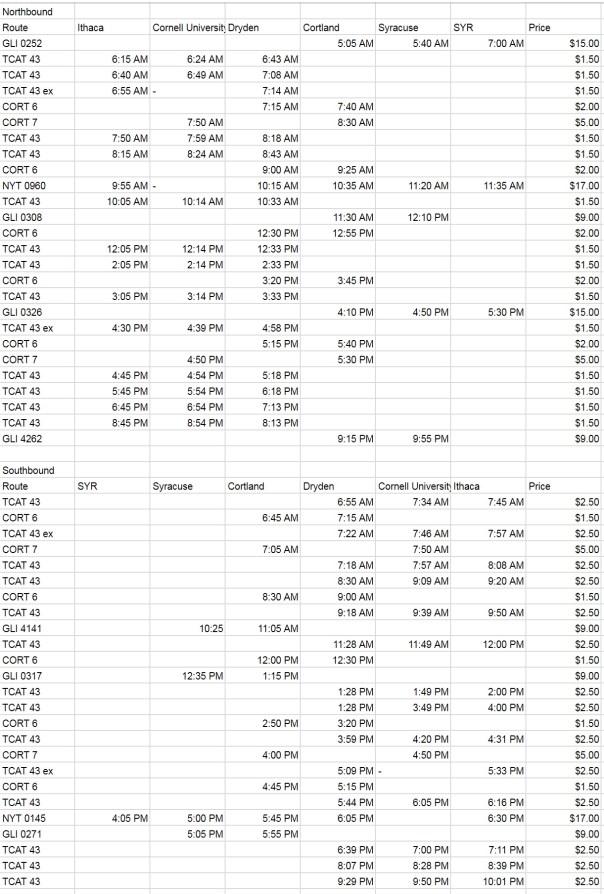
Currently, two intercity bus lines (Greyhound and New York Trailways) and three local transit authorities (Centro, Cortland Transit, and TCAT) provide service along the corridor. Many of these services overlap, making it possible to travel a great distance within the corridor by making transfers at important junctions. Here is a table of all connecting weekday service currently available within the corridor.
connectingservice

Although these different bus services can take a rider pretty far, it is very difficult to travel the corridor’s entire length. New York Trailways offers service once a day in each direction between Ithaca and SYR, and it is possible to use regional transit to travel from Ithaca to SYR at only one other time on any weekday. Here is a table of all connecting weekday service from Ithaca to SYR currently available within the corridor.

endtoendtimetable

Using currently available service, a rider trying to get between SYR and Ithaca will have to pay either $16.50 or $17.00 to take a ride lasts between 100 and 205 minutes.

Proposed Transit Service
Stops:
The proposed transit service should run from SYR to the Ithaca Bus Station and make intermediate stops at the RTC, the Centro Bus Hub, Syracuse University, the Cortland County Office Building (Cortland Transit’s main transfer point), and Cornell University.

Stops at the Centro Bus Hub, Cortland County Office Building, and Ithaca Bus Station will enable residents of all three cities to transfer between Centro, Cortland Transit, TCAT and the proposed transit service. By making these stops, the proposed service will be able to transport people to and from their homes.

Stops at SYR, the RTC, and the Ithaca Bus Station will enable people travelling to or from the region by train, plane, or bus to to transfer between those transportation modes and the proposed transit service. By making these stops, the proposed service will connect the region to a national transportation system.

Stops at the Centro Bus Hub, Syracuse University, Cortland County Office Building, and Cornell University will enable people to reach the centers of employment in all three cities. By making these stops, the proposed service will be able to transport people to and from their jobs.

The service could also make additional stops at the Village of Tully, Tompkins Cortland Community College, and/or ITH in order to allow local transit authorities to eliminate some existing service and redirect funds to support the proposed service.

Mode:
The proposed transit service should operate as either a bus line or rail line. Much of the infrastructure necessary for either mode is already in place, and each option has its own advantages and disadvantages.

As a rail line, the proposed transit service would follow a roughly 70 mile long route from SYR to the Ithaca Bus Station with intermediate stops at the RTC, the Centro bus hub, Syracuse University, and Cortland. The line would follow 48 miles of existing rights-of-way from the RTC to Cortland and in Ithaca, and it would require 22 miles of new rights-of-way between the RTC and SYR, and between Cortland and Ithaca.

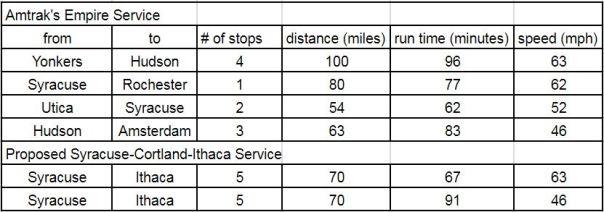
A rail line could run at high speeds unimpeded by traffic. Amtrak trains run at speeds between 46 and 67 mph on similar stretches of track elsewhere in Upstate New York. At those speeds, a train would complete the entire run between SYR and the Ithaca bus station in 67 to 91 minutes. That’s significantly faster the 120 to 150 minutes that a bus would take to make the same run.
railspeedcomparison

As a bus line, the proposed transit service would follow an approximately 68 mile route from SYR to the Ithaca Bus Station with stops at the RTC, Centro Bus Hub, Syracuse University, Cortland County Office Building, and Cornell University. The line would follow I-81 from SYR to exit 11 at Cortland, making stops at the RTC, the Centro Bus Hub, and Syracuse University on the way. From exit 11, the line would follow NY-13 through Cortland and Dryden before taking NY-366 to Tower Road and Cornell University. From Tower Road, the line would continue through Ithaca to the Ithaca Bus Station.

Operating the proposed transit service as a bus line eliminates the need to purchase, build, or negotiate for any inch of right-of-way. This would make the proposed transit service much less expensive upfront. Using existing roadways also would allow the transit service to stop at Cornell University, a stop that is inaccessible to rail because of the steep grade that separates the university from the Ithaca Bus Station. Finally, because existing roadways can accommodate two-way traffic, multiple buses could run along the line simultaneously, allowing for more frequent service. This would be impossible for a rail line because almost all of the existing rail infrastructure is single-tracked, meaning trains running in opposite directions cannot pass each other.

Schedule:
A rail service could make the round-trip in 180 minutes. Running continuously from 6:00 am to 9:00 pm, a train could make five round-trips between SYR and the Ithaca Bus Station. At higher speeds, a train could make the round-trip in less time, allowing for more runs in the same amount of time.

A bus service could make the round-trip in 270 minutes. Running continuously from 6:00 am to 7:30 pm, 2 buses could make six trips from SYR to the Ithaca Bus Station and six trips from the Ithaca Bus Station to SYR. More buses could make more runs in the same amount of time.

Operating on these or similar schedules, the proposed transit service would facilitate intercity commuting, and it would facilitate transfers to other intercity buses, trains, and planes.

Fare Structure:
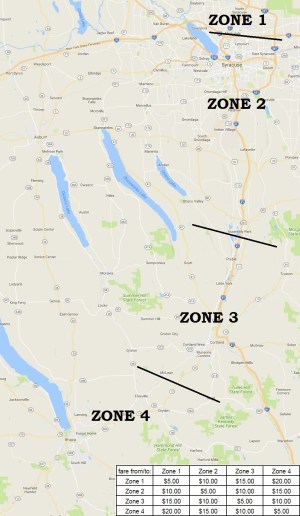
The proposed transit service should charge zone-based fares with significant discounts for multi-ride or monthly passes. This fare structure will allow the proposed transit service to compete for both regular commuters and for riders travelling between cities infrequently. Here are two potential ways to divide the proposed transit line into zones with one-way fares that can compete with all currently available transportation options.
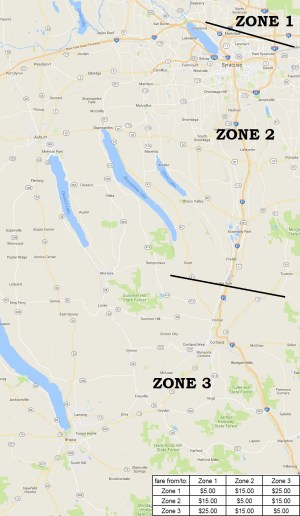
farestructure1 farestructure2

Conclusion
A transit service between Ithaca, Cortland, and Syracuse would benefit the entire region by connecting centers of population, employment, local transit, and intercity transportation. Such a service would build on the region’s strengths by facilitating travel to and between its many academic and research institutions, making them more attractive to students and scholars from outside the region, and more accessible to workers from within the region.

The main obstacle to establishing this service is cooperation. The service would run through, and require the support of, three different counties, three different cities, three different transportation authorities, many more towns and villages, and several large private institutions like Cornell University and Syracuse University. Very few of these entities have regular cause to work together, but this transit service has the potential to get them to cooperate on a single project, to start thinking of each other as part of a unified region with common goals and interests. That would be a big change in Upstate New York, and it would be the best thing this transit service could do.


For more reading on this proposal, click the links below:
Learning from OnTrack
University Students and Public Transportation
Uniting Communities through Transit