When a big developer comes to Syracuse and asks for a break on paying their property taxes, that’s an opportunity. City Hall can use the promise of a tax break to negotiate for that developer to do something good for Syracuse.
City Hall used to miss these opportunities all the time. Anybody willing to build in the City could get a tax break without promising to do anything to benefit the community. In the past couple of years, though, City Hall has started asking for more. Recent projects have traded tax breaks for new rent-controlled apartments and promises to hire city residents for construction jobs.
That change is good. It means that Syracuse is becoming more valuable, and that City Hall is using its leverage over the people who want to exploit that value. It also means that City Hall can get more creative about how it uses tax breaks to benefit the community.
Here’s one idea: use tax breaks to concentrate new building in areas with good bus service.
People who get around by riding the bus do not have equal access to opportunity in Syracuse. A lot of employers are beyond Centro’s reach, and that keeps a lot of willing and able people from getting and holding a job. A lot of new quality housing has the same problem.
It’s in the community’s interest to fix this situation–to make more jobs and more housing accessible to bus riders–and that’s going to mean more building in places that support quality bus service.
So the next time some developer comes looking for a tax break to build a new apartment or office in Syracuse, City Hall can use that opportunity to get that project built in a place that bus riders can get to. It’s a new use for an existing policy tool, and it will give more people equal access to opportunity in Syracuse.
On August 7, the Post-Standard published a letter by Ed Griffin-Nolan arguing that the rail viaduct that runs along Downtown’s south and west sides should be torn down.
That viaduct does have its problems. A small bridge used to carry Jefferson Street over Onondaga Creek, but when they elevated the trains they got rid of that bridge. Now there’s no way to get directly from Armory Square to the Near Westside, and that has something to do with the stark differences between Wyoming and Walton Streets.
SHA’s East Adams Street Neighborhood Transformation Plan also talks about how the viaduct needs “cosmetic treatment” and “noise reduction treatment” for the sake of the people living right next to it.
But let’s not overdo it. Despite its problems, the viaduct has a lot of potential too, and there are plenty of people talking about all the ways that it can be a positive asset for Syracuse.
In 2015, the Alliance of Communities Transforming Syracuse hosted a public forum where people talked about running some kind of transit service on the viaduct. The most interesting idea to come out of that was paving the viaduct as part of a Bus Rapid Transit system. That could give Syracuse something like the Silver Line in Boston or the trolleys in Philadelphia–transit that runs in the street through most city neighborhoods, but that avoids the worst traffic in the city’s center.
The viaduct is also a canvas for public art. It started with the murals on the bridges over West and Fayette Streets in 2010, and artists has continued to make good use of the viaduct’s long flat undecorated walls ever since. This is some of the very best public art in Syracuse, and it elevates people’s daily lived experience of the City.
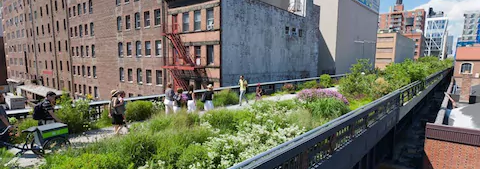
Syracuse could also follow in New York City’s footsteps and turn the viaduct into something like the High Line–an elevated linear park that’s a magnet for people. As an elevated greenway, the viaduct would let people walk or bike between several different neighborhoods without having to worry about car traffic. It would connect the Creekwalk to more neighborhoods, and it’s a good opportunity to bring the Onondaga Lake trail into the City. It would take what is now a visual barrier between Downtown and the Southside, and turn it into a vantage point for people to see the City in a new way.
Ed Griffin-Nolan is right to call that the rail viaduct a “vestige of the past.” It could only have been built in the past because the political and economic conditions that allowed the railroad to elevate its tracks through the center of Syracuse don’t exist anymore.
But he could just as well say the same thing about the New York City Subway. That city could never build its current subway if it had to start from scratch today either, but that that only makes the all those tunnels and rails more precious.
Syracuse is full of resources like this. No one would build something like Holy Trinity Church on Park Street anymore, but thank god it was there so that the City’s growing Muslim community could use it as a mosque. No one would dig a channel at the southern end of Onondaga Lake anymore, but the Inner Harbor is an asset for the City today anyway. No one would build a factory on Erie Boulevard, Wilkinson Street, Emerson Avenue, or Plum Street anymore, but old shop buildings on all those streets are finding new life as housing. Hell, the entire City of Syracuse is a relic of the 19th century, but it has remained relevant by making the best use of the resources at hand throughout its history.
Syracuse has 200 years of built heritage. For too long, the City treated that inheritance with contempt, demolishing buildings and tearing up infrastructure without thinking of the costs, all in the name of progress. We filled the Canal in to build a road, and then 100 years later decided we wanted part of the Canal back in Clinton Square. Syracuse isn’t so wealthy that it can afford to keep making mistakes like that. The City has to make the best use of what it’s got now. That’s the real challenge of the 21st century.
Someday, NYSDOT will demolish the structurally suspect I81 viaduct that runs alongside Downtown. That’s going to uncover a lot of land in the City’s center. Some people want for NYSDOT to build a new viaduct on that land, but last week, the Gifford Foundation put out a statement suggesting that Syracuse instead use the land to build a new neighborhood.
The Gifford Foundation isn’t interested in just any neighborhood–it thinks that this is an opportunity to do something “transformational”:
“A transformational neighborhood with mixed-income housing, extraordinary schools, and facilities, programs, and services that honor the rich history of the community, reflect priorities of those who live there, promote health and safety, and create jobs”
That sounds like a great place to live and a positive addition to the City. It’s the best possible outcome of this whole drawn-out process. Here’s hoping that kind of a neighborhood goes up when the viaduct comes down.
But in the meantime, let’s recognize that what the Gifford Foundation has described isn’t just a good blueprint for building a transformational new neighborhood. It’s also a call to transform the neighborhoods that Syracuse already has. Everybody living in this City deserves access to good schools, services, community, health, and employment, so while we’re all waiting for the possibility of getting a neighborhood that’s brand new, let’s do the work to make those things a reality in the neighborhoods that are already here.
It’s dangerous to focus too hard on something like I81. It’s such a big thing that’ll have such a big effect, that it’s too easy to just wait around for it to happen. But Syracuse can’t wait. Blodgett is falling apart now, people are showing up hungry at the Samaritan Center now, Centro’s out of money now, and this City needs to respond to all of that with urgency. If it does, then that new neighborhood the Gifford Foundation’s imagined won’t be so transformational. It’ll just be a new addition to a Syracuse that’s already transformed.
During the Spring of 2017, Centro asked its riders about how the bus fits into their lives. SMTC published the results of that survey in June. There’s a lot of good stuff in the final report, but the overriding finding is that there’s major support for putting more buses on the streets at all hours of the day.
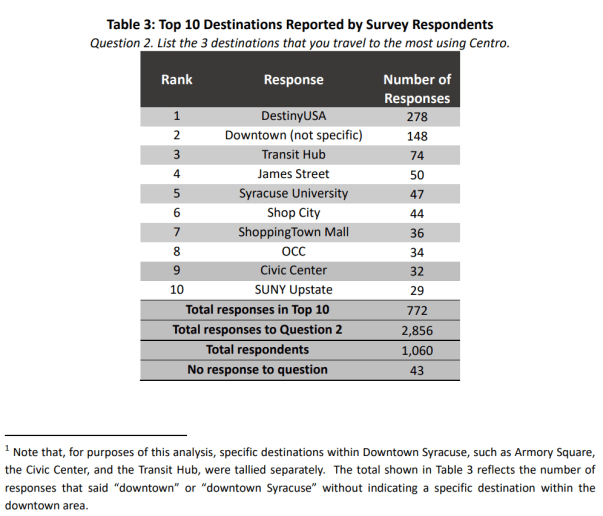
You find this in riders’ habits. When asked to list “the 3 destinations that you travel to the most using Centro,” people named places like the Mall, Downtown, and the University that already have good frequent service.
You also find this in riders’ responses to direct questions. When asked “Do you have additional suggestions for improving the Centro system?” people said they want shorter wait times and more service on nights and weekends:
“The single biggest issue was frequency of bus service and the length of time riders spend waiting for buses. Of the 388 surveys that included some kind of service improvement recommendation, 105 indicated this as an issue. Service at night and on weekends and holidays also came up frequently; 74 respondents included this concern.”
Riders also provided a whole list of other places in the City where they’d like for that service to run. When asked “are there specific locations that you wish Centro would serve,” riders listed “a variety of destinations” that they want for “Centro to serve, or serve more often”:
“Several destinations in the city were mentioned repeatedly, with Midland Avenue identified more than any other street in the city as needing upgraded service. Service to Strathmore was also identified as being needed. Other general destinations in the city included James Street, Grant Boulevard / the north side, Valley Drive, Midler Avenue, and the Westcott neighborhood.”
When riders are already using what frequent service exists, they’re saying that they want more of it, and they have a list of places where they’d like for it to go, it makes a lot of sense to start building out that service to those places.
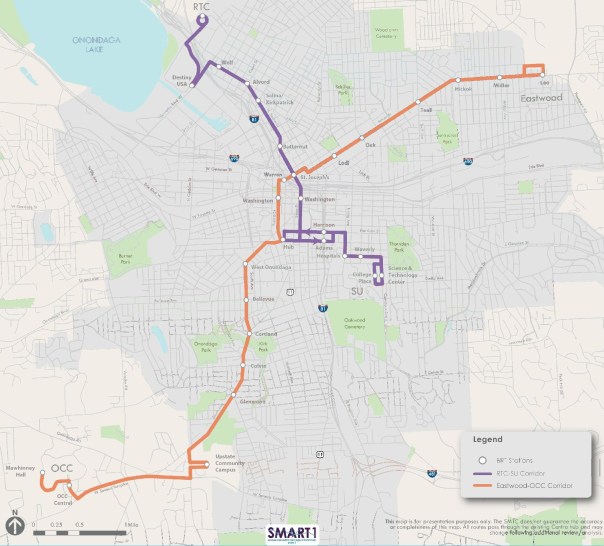
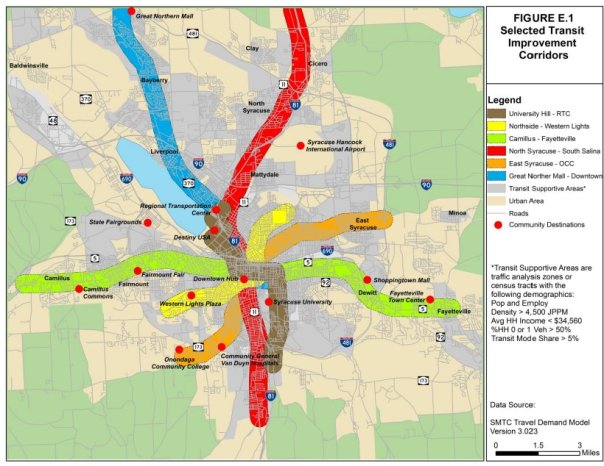
So it’s a good thing that SMTC and Centro are already working on it. Building on the Syracuse Transit System Analysis, SMTC has already recommended that Centro run frequent service on two major crosstown bus lines that connect several of the places where people are asking for better service.
These recommendations are a good first step. Centro needs to take them, and we all need to push the City’s political representatives to pay for them.
SMTC should also take a few more steps by making similar recommendations for the remaining “transit improvement corridors” identified in the STSA. Then, Centro and the City’s governments should find a way to act on those recommendations too.
The City has to get past this point where people’s lives are limited by their transportation options. Centro’s survey found that 80 percent of riders do not have access to a car, but “roughly half [of riders] said they use Centro only for a single purpose.” That means there are plenty of people who need the bus to get around the City for all kinds of reasons, but who can only use the service we’ve got now to make one kind of trip. That means limited opportunities for schooling, or working, or shopping, or worshiping, or whatever else it is that a person might need to travel outside of their immediate neighborhood to do. This survey is another reminder of those limitations, and it’s a call for the City to remove them.
Syracuse’s draft zoning ordinance requires properties used for different kinds of things to have different numbers of parking spaces. 1-family houses must have 1 parking space, grocery stores must have 1 parking space for every 300 square feet of floor space, golf courses must have 2 parking spaces for every hole, and so on.
The draft ordinance also includes mechanisms that can reduce those requirements in certain situations. Properties located in certain zoning districts and properties located on bus lines can reduce the total number of required parking spaces by anywhere from 15% to 50%, properties located nearby public parking lots and properties with street parking can count those spaces towards their total requirement, and so on.
A single property can qualify for more than one of these parking requirement reductions. If a barber shop would normally need 4 parking spaces, but it qualifies for a 50% reduction because of it’s zoning district, and there are 2 on-street spaces along its property line, then those two reductions combine to reduce the barber shop’s parking requirement to 0 spaces.
At least, that’s how it would have been before City Hall capped the total cumulative reduction for any property at 75% in the March 2018 revision of the draft ordinance. Now, as a result of this new cap, that barber shop would still need to find space on its lot for at least 1 off-street parking space.
This cap will have a huge effect on the housing market in Syracuse’s inner neighborhoods. These neighborhoods are mostly zoned R-2 or higher, meaning that they’re full of 2 and 3-family houses. Residential properties like those must have 1 parking space per dwelling unit (a 2-family home needs 2 spaces, a 3-family home needs 3 spaces, and so on). In previous drafts of the zoning ordinance, these homes could meet their parking requirements with on-street spaces. As of March 2018, however, because of this new 75% cap, the draft ordinance requires that every residential structure that can house at least 2 families have at least 1 off-street parking space.
This cap won’t affect any of Syracuse’s outer neighborhoods. Those neighborhoods are zoned almost entirely R-1, so they are made up of 1-family houses, each of which is only required to have 1 parking space. Once you account for the street-parking space out front of each of those houses and apply the new 75% cap, then each house is required to have .25 parking spaces. The draft ordinance rounds that down to 0.
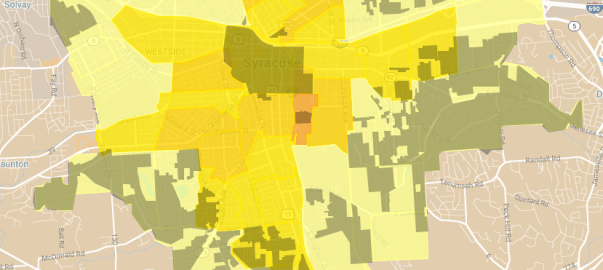
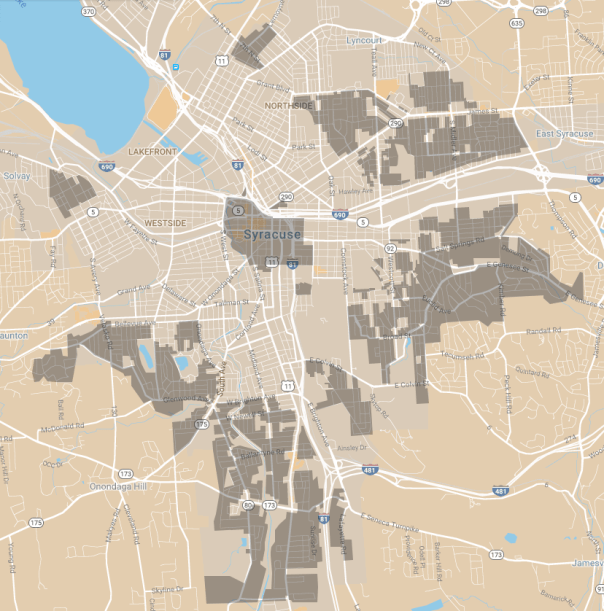
The result is that in areas zoned R-1, all new residential development will be exempt from parking requirements, while in areas zoned R-2 or higher, a lot of residential development will not be exempt from parking requirements (Downtown is also exempt from all parking requirements).
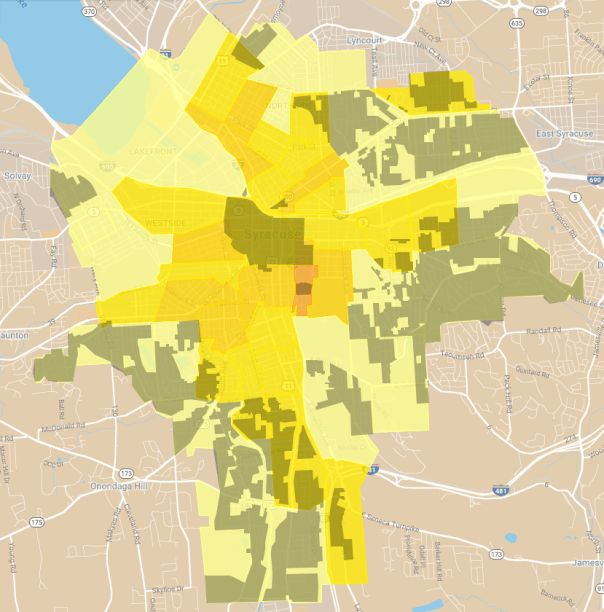
Areas where all residential development is exempt from parking requirements
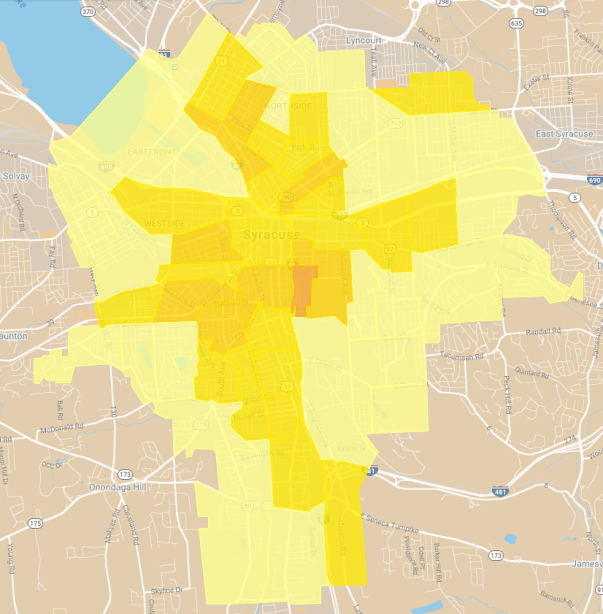
Syracuse’s inner neighborhoods are some of the best places to live in the entire County if you’re trying to make a life without a car. Neighborhoods like Hawley-Green and the Near Westside have relatively good bus service, a mix of businesses within walking distance, and easy access to the jobs Downtown and on University Hill. That’s why the people living in those neighborhoods are much more likely to go without a car than the people living in Syracuse’s outer neighborhoods like Strathmore and Meadowbrook.
Percentage of carless households by census tract
When you combine these two maps, it becomes clear just how insane the draft ordinance’s minimum parking requirements are. They require off-street parking for the people least likely to own cars, but they don’t make similar demands of the people most likely to own cars.
City Hall needs to amend the draft zoning ordinance to fix this problem. They could remove the 75% cap on parking minimum reductions. If a property is on a bus line and nearby a public parking lot, it makes sense to give the property owner credit for having set up in a spot where off-street parking isn’t necessary. The arbitrary 75% cap is just a way of saying that people in Syracuse shouldn’t try to make the best use of shared resources, and that’s not a message worth sending in a city that doesn’t have enough resources as it is.
City Hall could also amend the draft zoning ordinance to say “When measurements of the number of required spaces result in a fractional number, the fraction shall be rounded down to the nearest whole number.” For example, a project requiring 2.25 spaces would only actually have to build 2 spaces, and a project requiring 2.75 spaces would also only actually have to build 2 spaces. Even with the 75% cap, this would make 1-family, 2-family, and 3-family houses eligible for exemption from any parking requirements.
City Hall could also count on-street parking spaces in front of a property towards the total required number of spaces for any property after applying the 75% cap on parking minimum reductions. Allowing on-street parking to substitute for off-street parking in this way would allow 1-family houses and small scale apartments to meet their parking requirements without having to build off-street parking.
Those small changes would do a lot to make the zoning ordinance better, but it’d really be best to just trashparkingrequirementsentirely. They’re awful, ham-fisted solutions to a problem best solved by individuals. If a developer builds an apartment without off-street parking, they’ll get tenants who don’t own cars or who don’t mind finding on-street parking. Other people who value off-street parking will pay a little extra to rent or buy some other housing that includes a place to store a car. There’s no reason for parking lots to line James and Salina Streets when so many of the people living there don’t drive, and there’s no way that eliminating parking requirements will get people living in Meadowbrook to give up their driveways and garages.
That might be too much to ask in a town as car obsessed as this one. Whatever–any of those more technical fixes would be good enough. All that matters is that this new zoning ordinance not make it even harder to make a life in this City without a car.
Since 2000, Syracuse has welcomed more than 10,000 people from overseas. Many of them arrived in the City as refugees, escaping violence in places like Somalia, the Sudan, and Syria. It’s hard work to get those people to the City, to help them fit in, to get them housing and a job, and it takes a whole constellation of allied organizations, businesses, and neighbors to do that work well.
This is work to be proud of. For too long, Syracuse found its pride and identity in vain things–national prominence borrowed from name brands, ill-defined and ill-conceived notions of growth. But it’s a truer pride that Syracuse, even with all of its challenges, continues to accept and embrace an ever-larger portion of the human family. The City is keeping the Nation’s promise to ‘lift its lamp beside the golden door’ and fulfilling the sacred duty to ‘welcome the strangers,’ even if they are some of the ‘least of these.’
Keeping that promise and fulfilling that duty have changed Syracuse for the better. Refugees are renewing old neighborhoods–fixing up homes and opening businesses. They are bringing new life to institutions like the Farmers Market and the Public Schools, and to old community fixtures like DiLauro’s Bakery and St. Vincent DePaul Church.
But now that’s all in jeopardy. On June 17, the Post-Standard published a letter from Beth Broadway, CEO of InterFaith works, that talked about all kinds of artificial barriers that the federal government has thrown up to make it hard for people to come to America. The numbers don’t lie–Syracuse is on pace to welcome 72% fewer refugees this year than it did in 2017. The prospects for 2019 are even worse.
That is all the result of a poisonous national politics. A politics that demonizes people who are made in the same image as all of us. A politics that criminalizes self-improvement and replaces compassion with cruelty– that attempts to deny our commonality. Ultimately, this politics harms us all, because we are all created equal, and so when we dehumanize these others, we equally dehumanize ourselves.
Syracuse will suffer spiritually and practically from the effects of this politics. It will suffer from the loss of that good work, and it will suffer from the loss of so many good people who would otherwise have added to all that the City already has. But Syracuse can keep its pride by fighting for those people at every opportunity.
In her letter, Ms Broadway talks about three ways that we can do this:
› Write letters, make phone calls and speak out for refugees with elected officials. › Invite a refugee to speak to your congregation, club meeting or social group through InterFaith Works’ Spirit of America program. › Volunteer with any of the refugee-serving organizations in Syracuse. We can use English tutors, drivers, organizers, friends to teach people about our community and more.
We can also give money to InterFaith Works, Catholic Charities, the Northside Learning Center, or any other that works with refugees directly or indirectly.
June 20th is World Refugee Day. This should be an occasion to celebrate Syracuse and the good work that the City is doing, but that work is now in jeopardy. Take June 20th as an opportunity to make a personal commitment to that work and, in doing so, make Syracuse a city to be proud of.
In an episode of the WAER’s City Limits series, reporter Scott Willis talks to people who use Providence Services, a shuttle service that helps get people to and from work at an affordable rate. Willis asked Providence’s riders if they’d ever tried getting to work another way. They all said they’d tried using Centro, but the way the schedules were set up meant either getting to work 2 hours early or 5 minutes late.
That’s a pretty serious problem. If you’ve got any kind of responsibilities outside of work, there aren’t two hours in your day available to spend sitting outside of your job, waiting for your shift to start. If a potential employer is going to require that you give them an extra two hours every day without any kind of compensation, that’s not a job many people can take.
This isn’t just a problem for people trying to find work. It’s also a problem for those employers trying to find workers. The Post-Standard recently published an opinion piece predicting that Syracuse-area companies would soon have tens of thousands of open positions that they wouldn’t be able to find workers to fill. Elsewhere in WAER’s report, Providence Services’ President Deborah Hundley talked about reaching out to employers and hearing that “they want to have a diverse workforce. They want that. The diversity is in the City, but they have to be able to get there.”
When there are plenty of people reliant on Centro to get to work, and there are plenty of companies that want to hire the best candidate for the job–regardless of how that person gets around town–this ‘show up 2 hours early or 5 minutes late’ problem shouldn’t even exist. Employees and managers should be able to agree on a simple solution–whether that’s coming back from lunch 5 minutes early, staying 5 minutes past the end of the shift, or whatever–that gets us past this point where people are stuck without jobs and employers are stuck without workers just because no one can be inconvenienced to find an extra 5 minutes in the day.
What this boils down to is that both the employer and the employee share responsibility for the morning and evening commutes. That’s so obvious for people who drive that it’s easy to forget. Businesses locate on public roads accessible by car. They often provide ample amounts of free parking for employees. Blue Cross Blue Shield took this to such an extreme that it actually built an entirely new office in Dewitt a few years ago because its employees had a hard time parking Downtown. Employers do all of that to accommodate people who commute by car, and then those car commuters are responsible for using all those resources to get to work every day.
It’s the exact same with bus riders. It’s on the employee to catch the bus, pay the fare, make the transfers and all that, but the employer is also responsible for creating a workplace where commuting by bus is a reasonable possibility. The workers that WAER talked to in this City Limits piece were working out at Spectrum near Carrier Circle. Spectrum chose to set up shop in a location with spotty bus service. That’s on them. It’s not too much to ask that they make up for that by being a little flexible with bus riders’ work schedules. If Spectrum, or any other employer, takes on that small responsibility, everybody benefits.
In an opinion piece that the Post-Standard printed on May 13, Mitchell Patterson predicted that in the next few years, companies in and around Syracuse will be hiring for tens of thousands of jobs. This, he says, is a problem:
Having too many jobs sounds like a good problem to have. But not having the people – or the people with the right skills – to fill them is holding us back.
Who’s this “us,” and who’s a part of the “we” that worries elsewhere in the piece about how “we have a job glut,” and “we can’t even fill the current surplus of jobs that exist.”
That “us” certainly doesn’t include the 17,000 people who are looking for work right now. If it did, then several thousand new jobs would not be a problem, but an opportunity to improve several thousand people’s lives. When you include those people in the “us” that has a stake in Syracuse’s future, the problem instead becomes turning that opportunity into a reality for the people with the direst need.
To tackle that problem, Syracuse needs relevant educational opportunities for adult learners, and it needs useful transportation options for people who don’t own a car.
So many of these new jobs are going to require some kind of diploma, and that’s a barrier for a lot of people who are looking for work. Public educational institutions like OCC and BOCES serve adults who need to get new training so that they can earn those diplomas. These schools already do a lot of this good work, and they could do even more with larger staffs and more locations.
Those educational opportunities are no use, though, if people can’t reach them. It’s too difficult to take a class at OCC if you have to get there on the bus. It can be even more difficult to keep a job when day in and day out you’re relying on this bus system to get you to work on time. Organizations like Providence Services can help, but what the City really needs is to renew its commitment to public transportation as a tool of individual empowerment. The Syracuse Metropolitan Transportation Council’s SMART1 recommendations will make it possible for more people to get to OCC and to more of the jobs available in the community. Centro needs support and pressure to act on those recommendations, and the SMTC needs to finish the job it started by planning all the other service improvements suggested in the Syracuse Transit System Analysis.
17,000 people are out looking for work. That’s more people than live in all of Geddes. They have to be a part of the conversation when we’re talking about the future of work in Syracuse. When they’re included, the the community’s obvious overriding imperative is to make sure that they benefit from these changes that are coming, these new jobs that will open up. Once we’ve taken care of that basic business, then let’s talk about whether or not there are too many jobs and not enough workers in this community.
Late last year, the Syracuse Metropolitan Transportation Council suggested that Centro run buses every ten minutes between Syracuse University and the Train Station, and between Eastwood and OCC. That’s a good idea, and there should be more good ideas like it on the way. City Hall has already asked the SMTC to look at how Centro can offer similar service on Erie Boulevard.
The problem is that it will cost money. The SMTC has estimated that it’ll cost $2.8 million to run the buses between the University and the Train Station, and it will cost $3.6 million to run the buses between Eastwood and OCC.
Normally when Centro talks about money, it’s talking about how it doesn’t even have enough to pay for the service it runs now. It wasn’t that long ago that Centro thought it would have to cut all late night and Sunday service in for lack of money. This year Centro is only planning to get an extra $450,000 from the State this year. That’s chump change for an organization with a $117,785,000 budget.
If Centro’s not going to get the money to run this service from out of thin air, then it’ll need to find the money in the budget it’s already got. The easiest way to do that is to take the drivers and vehicles from existing bus routes and move them to these new lines. There are opportunities for Centro to run its buses more efficiently so that it can free up drivers and vehicles to do just that without seriously cutting back on the service it already provides.
Take the 254 and 410 buses. Those buses run, for the most-part, within a couple blocks of each other, so a lot of people can catch either bus depending on when they need to ride. That’s good when the buses run at different times, because it offers better service for people who can get to either line. But when those buses run at the same time, it means that Centro is paying for two drivers and two vehicles to provide the service when it could just pay one instead.
If Centro cut all of the 254 buses that run at exactly the same time as a 410 bus, it would free up an extra bus and driver for 64 hours and 40 minutes a week, or 3372 hours a year. That’s 12% of what the SMTC thinks it’ll take to run the new bus service between the University and the Train Station–not enough to pay for the whole thing, but not nothing either.
There are lots of other situations like this because Centro times its routes to arrive and depart from the Hub all at once. That’s good for people trying to make transfers to get across town, but a lot of the time it means that more than one bus from the same side of town end up lining up together. Whenever that happens, there’s an opportunity for Centro to move one of those drivers to another route to provide better service.
There are some tradeoffs. Some people are going to have to walk farther to catch the bus, and that’s a lot to ask if you’re talking about a person for whom walking is difficult because of age, physical disability, or injury. The 254 bus also runs down a stretch of Valley Drive that’s not within easy walking distance of the 410 bus, and the 254 bus makes a special stop at the Bernadine Apartments that the 410 bus does not.
But this bus service is worth those tradeoffs. It’s a simple, reliable, effective way for people to get across town. It runs through neighborhoods where a lot of people are poor and a lot of people don’t have cars. It connects those neighborhoods to the three places in Syracuse where there are the most jobs, and it also connects them to the colleges where people can improve themselves and their opportunities for employment. That’s what the bus needs to do in this City.
On City Hall’s new color-coded zoning map, strictly residential neighborhoods are shades of yellow while neighborhoods with housing, businesses, and other institutions are different shades of blue. So far, City Hall has published threenewdrafts of this map, and each one has less blue and more yellow.
The change has been driven by community concerns about corner stores. In an interview with WAER, Assistant Zoning Director Heather Lamendola said “a lot of concerns stemmed around what has been dubbed a ‘corner store,’ and the adverse effects that the activity there might have on the adjacent residential neighborhoods.” In an interview with the Post-Standard, Mayor Walsh specifically mentioned “a corner store going in down the street from you” as something that concerns him.
People living in many of Syracuse’s neighborhoods have good reason to be wary of corner stores, and it’s good that people in power are listening to those concerns, but City Hall’s particular response goes too far, and it threatens to limit housing opportunity in Syracuse’s neighborhoods.
That particular response has been to take a lot of properties that were originally zoned as part of the light blue MX-1 district, and to switch them to the yellow R-2 district. City Hall has made this switch in several neighborhoods.
Draft #1 (February 2017)
Draft #2 (June 2017)
Draft #3 (March 2018)
Draft #1 (February 2017)
Draft #2 (June 2017)
Draft #3 (March 2018)
Draft #1 (February 2017)
Draft #2 (June 2017)
Draft #3 (March 2018)
Changing all of those properties from MX-1 to R-2 will keep out corner stores, but it will also restricts a lot of other activity. Here’s the table of allowable uses for those two zoning districts:
MX-1
R-2
Residential Uses
1 Family
Allowed
Allowed
2 Family
Allowed
Allowed
Multi-Family
Allowed with permit
Live/Work
Allowed
Boarding House
Allowed with permit
Public Uses
Assembly Hall
Allowed
Allowed
Civic Building
Allowed
Cultural Institution
Allowed
Public Safety Facility
Allowed
Allowed
School
Allowed
Allowed
Park
Allowed
Allowed
Community Garden
Allowed
Allowed
Commercial Uses
Private Club
Allowed with permit
Beverage Cafe
Allowed
Restaurant
Allowed
Bed and Breakfast
Allowed
Allowed with permit
Office
Allowed
Retail
Allowed
Of all the differences between MX-1 and R-2, the most important have to do with housing. On MX-1 properties, you can have single family homes, two family homes, three- four- and five- family homes, apartment buildings, live/work homes, and boarding houses. R-2 properties on the other hand, only allow for one and two family homes. The switch from MX-1 to R-2 limits the variety of housing types in these neighborhoods, and that makes it harder for a variety of people to find a place to live.
Fortunately, there’s a simple way for City Hall to keep out corner stores without limiting people’s housing options. Here’s that same table of allowable uses with the R-4 and R-5 Districts included:
MX-1
R-2
R-4
R-5
Residential Uses
1 Family
Allowed
Allowed
Allowed
Allowed
2 Family
Allowed
Allowed
Allowed
Allowed
Multi-Family
Allowed with permit
Allowed
Allowed
Live/Work
Allowed
Allowed
Allowed
Boarding House
Allowed with permit
Allowed
Public Uses
Assembly Hall
Allowed
Allowed
Allowed
Allowed
Civic Building
Allowed
Allowed
Cultural Institution
Allowed
Public Safety Facility
Allowed
Allowed
Allowed
Allowed
School
Allowed
Allowed
Allowed
Allowed
Park
Allowed
Allowed
Allowed
Allowed
Community Garden
Allowed
Allowed
Allowed
Allowed
Commercial Uses
Private Club
Allowed with permit
Allowed with permit
Allowed with permit
Beverage Cafe
Allowed
Restaurant
Allowed
Bed and Breakfast
Allowed
Allowed with permit
Allowed with permit
Allowed with permit
Office
Allowed
Allowed with permit
Retail
Allowed
Like R-2, zoning districts R-4 and R-5 do not allow corner stores. Like MX-1, zoning districts R-4 and R-5 allow multi-family housing, and district R-5 allows boarding houses. If City Hall is really committed to keeping corner stores out of the neighborhood by banning retail, it could at least let people provide themselves with all of the different kinds of housing allowable in the MX-1 district by zoning these lots as R-4 or R-5. It’s done just that in Hawley Green, where several blocks of Green and Gertrude Streets have been changed from MX-1 to R-4 as City Hall has revised its zoning maps:
Draft #1 (February 2017)
Draft #2 (June 2017)
Draft #3 (March 2018)
Corner stores will not be able to move into these parts of the neighborhood, but at the same time, people will still have many different opportunities to find a place to live.
The zoning ordinance should allow for growth and flexibility. A landlord should be able to turn a two-family home into a three-family home if there’s enough people looking for housing to justify the cost of making that change. When individual people can make small adjustments like those, Syracuse will be able to respond to inevitable and unpredictable changes in population, income, demographics, and community needs in the coming decades. That’s what will make Syracuse a welcoming and resilient community.