Last week, Onondaga’s Town Supervisors—a group of people without any governmental responsibility for the City—got together to again let everybody know that they would like for I81 to stay in the middle of Syracuse. They want that, in part, because they’re concerned about the ‘environmental impacts‘ of removing the I81 viaduct.
On the face of it, that’s a stupid concern. The environment will be better off with one fewer piece of obsolete, overbuilt, car-only transportation infrastructure. Get rid of the viaduct, and there’s room for new housing within walking distance of major employers, making it more possible for more people to drive less.
But those supervisors were never really concerned about the environment. They’re concerned about upending the status quo where all of the County’s environmental problems get dumped in the City. Ed Michalenko doesn’t care that vehicular exhaust is giving kids asthma so long as those kids don’t live in DeWitt. Jim Lanning doesn’t care that trucks are driving through Onondaga County so long as they go through Syracuse instead of Skaneateles.
That’s the danger of shoving all of the County’s problems onto one community—it lets these suburban supervisors believe that if a problem doesn’t exist for them, then it doesn’t exist at all. It’s telling that their ‘compromise‘ for I81 is to bury it through the middle of Syracuse, as if putting those cars out of sight is the same thing as taking them off the road.
The only way that this project will do anything positive for the environment is if it makes Onondaga County into a place where fewer people have to drive to run every single errand. That’s the promise of the Grid—more walkable neighborhoods that can support better bus service, fewer miles of highway subsidizing and necessitating car ownership. That’s an environmental impact to be excited about, and by making car ownership less necessary in Onondaga County, it might just reduce the traffic in places like Skaneateles and DeWitt.
Congress is full of new members talking about a Green New Deal—a “broad and ambitious package of new policies and investments in communities, infrastructure, and technology to help the United States achieve environmental sustainability and economic stability.” The ideas for those new policies include regulations on carbon emissions, subsidies for alternative energy, and wetland reclamation. Less has been said about the relationship between housing and transportation, but Onondaga County’s experience shows that the Green New Deal needs to focus on that link in order to grow environmentally sustainable communities.
For 70 years, almost all new settlement in Onondaga County has contributed to global climate change. New housing has been built on former farms, it has been built too far away from jobs and schools for people to meet their daily needs on foot, and it has been built with big yards and cul-de-sacs that make public transportation ineffective and inefficient.
At the same time, people have been leaving Onondaga County’s older settlements—its City and its villages—where it was possible to live without a car. Syracuse, Liverpool, Solvay, and East Syracuse have all lost about ⅓ of their population since the 1950s and 1960s. That depopulation has drawn jobs and schools out of those older communities, it has made it more difficult for the people who remain to meet their daily needs on foot, and it has made established bus and train routes less effective and less efficient.
The result has been that many families living in Onondaga County can’t live their daily lives without the help of cars, and they drive those cars to run every single errand, attend every single church service, and visit every single friend. This is a terrible result for the environment.
It’s also reversible. In fact, the City’s Land Use and Development Plan anticipates that Syracuse’s neighborhoods will see exactly the kind of population growth that would allow Onondaga County residents to drive less often and burn less carbon:
“Several of Syracuse’s neighborhoods have borne the brunt of population loss and economic decline as regional population has shifted dramatically toward the suburbs since the 1960s. Despite this, Syracuse is uniquely positioned within the Central New York region in light of increased national and statewide focus on Smart Growth and widely renewed interest in urban living. The City of Syracuse possesses a concentration of interesting historic architecture, which dates from periods of dense urban settlement and is arranged in walkable neighborhoods. Many neighborhoods which currently possess high vacancy rates are poised to accept population growth, particularly among young professionals and families who desire a traditional urban environment and who may take advantage of Syracuse’s affordable historic housing stock and walkable, urban neighborhoods. Commercial corridors with low levels of activity and density today are dispersed through Syracuse’s neighborhoods in a connective, multi-nodal network which, when better utilized, are suited to provide centers of activity within walking distance of homes and support efficient mass transit.”
The document refers to the City specifically, but what it says is true of Onondaga County’s villages too. They all have relatively affordable houses. They all have neighborhoods where people can meet their daily needs on foot. They all have better bus service than their surrounding suburbs. They are all places where people can live more environmentally sustainable lives free from cars.
Affordability and sustainability sometimes work against each other, though. If a house is too cheap, then it’s difficult to get ahold of the money necessary to make major repairs. Banks won’t lend out the money to replace the roof on a house that isn’t even worth enough to be collateral for the loan. That situation—which exists in so many of the neighborhoods where the houses need new roofs but the residents don’t need cars—makes it financially impossible for many people to move into the communities where they can live environmentally sustainably.
The Green New Deal can remove this financial barrier by awarding grants for the renovation and/or construction of housing in neighborhoods where people can live without a car.
There are challenges to writing that kind of a policy well. To be effective, it will have to actually determine which communities offer the chance to live without a car—a determination that Syracuse’s City Hall has struggled to make as it rewrites the City’s zoning ordinance. To be efficient, the policy should limit its grants to those projects that wouldn’t happen without government subsidy—a limitation that both SIDA and OCIDA routinely ignore.
The effort of overcoming those challenges is worth the reward of creating a climate policy that makes it possible for people to live in communities where daily life burns less carbon—communities where people can walk to meet their daily needs, where Centro can provide quality bus service—communities like Syracuse, Liverpool, Solvay, and East Syracuse. That’s a policy that recognizes the link between housing and sustainable transportation, that addresses the difficulties of creating more of both, and it is exactly the kind of thing that needs to be a part of the Green New Deal.
When Syracuse takes notice of its neighboring upstate urban communities, it’s usually to see how we measure up. That’s the impulse behind City Hall’s decision to compare Syracuse to Albany, Buffalo, and Rochester in its recent report on poverty, and it’s the impulse that drove the CNY Business Journal to run a story about State economic development grants under this headline: “CNY Wins $88 Million Award in State REDC Competition, The Most of Any Region.”
Too often those comparisons about trying to outdo each other. That preening Business Journal headline is about the money that Governor Andrew Cuomo is giving to CNY instead of WNY. We’re on top now so we’re happy with the process, but things were different in 2014 when Syracuse luminaries like David Rubin were harumphing about how the Governor had lavished attention on Albany and Buffalo while ignoring Syracuse.
It’s no mistake that State economic development causes this kind of backbiting. The Governor knows that so long as his ersatz competitions are the easiest way to get some of the State’s largesse, Upstate’s cash-strapped cities will focus more on beating each other out to win those competitions than they will on working together to change the structural causes of their dependency.
It’s time to try something different. The reason that Syracuse’s City Hall can easily compare itself to Albany, Rochester, and Buffalo is that all four cities have the same problems. They’re all post-industrial and shrinking, they’re all trying to run their governments on insufficient property taxes, they’re patching holes in their antiquated sewer systems. It’s time to recognize that these are problems best solved through cooperation rather than competition.
That cooperation can take many forms. First, upstate mayors should all meet together with the State and Federal politicians who represent their constituents and agree to advocate for policies that will meet all their cities’ specific needs. That’s how New York State’s Land Bank legislation came about. There are plenty of other policies that would benefit all upstate cities, from better funding for transit Upstate, to amendments to the New York’s home-rule legislation. Coordinated lobbying will help Upstate’s cities push those policies through the legislature.
Second, upstate cities can also work together on regional projects that better integrate their economies. The State’s Regional Economic Development Councils encourage that kind of integration within a metropolitan region, but upstate cities should look beyond their immediate suburbs to partner with each other. Better transportation links between cities–whether that’s lower Thruway tolls or better train service–would make Upstate more attractive to big businesses looking to employ lots of people, and they would make it easier for small businesses to expand into new markets.
Third, upstate cities can share ideas to deal with their common problems and to act on their common opportunities. Syracuse studied Rochester before coming up with a plan to remove snow from its sidewalks. Buffalo’s Canalside is a good example for any city that regrets having paved over the Erie Canal. Utica is showing how upstate cities can take advantage of Amtrak. Syracuse, Rochester, and Ithaca can all look to each other when trying to figure out how to make a huge private university an asset to everyone who lives in the city.
Cooperating like this isn’t easy. It takes commitment, vision, and solidarity–rare qualities in New York’s political class. But people living in Upstate’s cities–from Troy to Tonawanda–can lay the foundation by visiting each other, recognizing our common interests, and learning to see ourselves as a community.
Syracuse doesn’t have hurricanes, tornadoes, or wildfires, but FEMA still exerts a lot of influence over city residents’ lives. That agency maps the City’s floodplains, determining which people need to buy flood insurance under certain circumstances. Whenever FEMA amends the map–putting that financial burden on new people–it always makes the news.
But those marginal adjustments aren’t the real story. The real story is that FEMA’s flood maps are one of a set of ‘color-blind’ government policies that work in concert to recreate the 20th century’s racist housing practices, all on the pretense that it’s required by Syracuse’s geography.
GEOGRAPHY
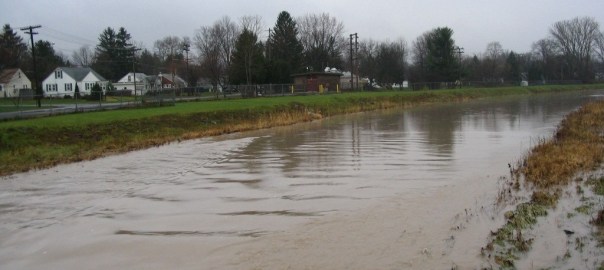
There are two major streams in Syracuse: Onondaga Creek and Meadowbrook. Onondaga Creek’s floodplain gets a lot more attention because it’s bigger and covers many more houses than Meadowbrook’s does.
Onondaga Creek
Meadowbrook
It’s tempting to say that this is just natural–the unplanned result of the different topography around each stream–but neither stream is in its ‘natural’ state. Both have been channelized in order to make their banks easier to build on and in order to keep them from flooding. It’s just that the engineers did a better job on one of those streams than they did on the other.
MORTGAGES
FEMA doesn’t require flood insurance for every house in its floodplains. That requirement only comes into effect if someone has, or applies for, a loan. Buy the flood insurance, and there’s no problem getting a loan, but, as Chris Baker reported, many people can’t afford monthly payments for both flood insurance and a loan.
This means that people living in a FEMA floodplain have limited access to credit. On the one hand that makes it difficult for someone who already owns a home to leverage that asset–one of the chief benefits of home-ownership. On the other, it keeps a lot of people from buying a home in the first place.
ZONING
On some level, the extra cost of flood insurance should discourage people from trying to buy a home in a floodplain. Houses that flood aren’t a good investment anyway. Better for people to move somewhere, like Meadowbrook, that’s safe from flooding.
City Hall’s zoning maps restrict that kind of movement, though. The land around Meadowbrook has very large lots–often 4 times the size of the lots around Onondaga Creek–but it’s zoned so that there can only be one unit of housing on each lot. This restricts housing supply and inflates housing prices.
Onondaga Creek
Meadowbrook
If ever there were a place to restrict housing supply, it’s on Onondaga Creek’s floodplain. That area, though, has very loose zoning restrictions, allowing for some of the densest residential development in the City. All that abundant housing ends up being pretty cheap.
The net effect is to push people away from the safe area around Meadowbrook and onto Onondaga Creek’s floodplain.
RACE
It just so happens that the neighborhood that floods, where it’s expensive to get a loan but cheap to live, where people can’t accumulate wealth, is a neighborhood that’s overwhelming populated by African-Americans (green on the map). The neighborhood with good flood control, where credit’s easy, and where people enjoy all the benefits that accrue to American homeowners is populated by Caucasians (blue on the map).
Onondaga Creek
Meadowbrook
Who would have guessed?
REDLINING REDUX
When redlining was federal policy, nobody cared to disguise its racism. One factor in drawing red lines on the FHA’s Security Maps was the presence of “Negroes.” People were open, then, about making access to home ownership dependent on race.
That kind of honesty doesn’t fly today. Race can’t be an explicit reason for giving someone a loan or letting someone move into a neighborhood. Now FHA-backed loans are dependent on ‘color-blind’ criteria like whether or not the loan in question will be used for a house near a stream that floods.
But the streams that flood–in Syracuse anyway–seem to be the ones in Black neighborhoods. White neighborhoods, even the ones with streams, stay dry, and they stay homogenous because the zoning ordinance inflates their housing prices and makes it difficult for new people to move in.
It’s in City Hall’s power to unmake this racist housing policy. First, it can reduce flooding along Onondaga Creek by building a levy. That will shrink the floodplain on FEMA’s maps and expand access to credit for the people living in that part of the City. City Hall can do this as part of Phase II of the Creekwalk–the long-promised extension of the City’s best new public space into the Southside.
Second, City Hall can redraw the zoning maps to allow more housing in the neighborhoods where banks are already willing to make loans. That will allow more people to move into a good neighborhood where they’ll have access to the benefits that come from owning a home.
On September 24, Onondaga County Executive Joanie Mahoney announced that she would leave County government to take a job working with both SUNY ESF and SUNY Upstate. That new position will give her a lot of power to guide the City’s future.
For years, New York Governor Andrew Cuomo has used other SUNY schools to direct State money to Upstate’s cities. Cuomo won’t give City Hall any cash to help close its budget deficits, but Albany, Utica, and Buffalo have all received lots of money from the State through their local public universities. Working high up in both of Syracuse’s SUNY schools will put Mahoney in control of a lot of State spending in the City.
SUNY Upstate owns a lot of the vacant land between Downtown and the Eastside, and it’s always pushing to buy up more land on the Southside just south of Downtown. Those are the two areas of land where City Hall is changing zoning to allow a lot more building because it wants to extend Downtown-style development out into the City’s neighborhoods. That’s a major piece of land-use policy, and, as a SUNY official, Mahoney will have a lot more say in its implementation than she would have had as County Executive.
So far, Syracuse University is the only school that’s really exerted its influence on the City. By taking this new job, Mahoney will have the opportunity to make SUNY Upstate and SUNY ESF big players in local politics too. As County Executive, she steered a suburban-dominated county government towards City-minded policies. Here’s hoping she continues to keep the City’s best interests in mind at her new job.
When a big developer comes to Syracuse and asks for a break on paying their property taxes, that’s an opportunity. City Hall can use the promise of a tax break to negotiate for that developer to do something good for Syracuse.
City Hall used to miss these opportunities all the time. Anybody willing to build in the City could get a tax break without promising to do anything to benefit the community. In the past couple of years, though, City Hall has started asking for more. Recent projects have traded tax breaks for new rent-controlled apartments and promises to hire city residents for construction jobs.
That change is good. It means that Syracuse is becoming more valuable, and that City Hall is using its leverage over the people who want to exploit that value. It also means that City Hall can get more creative about how it uses tax breaks to benefit the community.
Here’s one idea: use tax breaks to concentrate new building in areas with good bus service.
People who get around by riding the bus do not have equal access to opportunity in Syracuse. A lot of employers are beyond Centro’s reach, and that keeps a lot of willing and able people from getting and holding a job. A lot of new quality housing has the same problem.
It’s in the community’s interest to fix this situation–to make more jobs and more housing accessible to bus riders–and that’s going to mean more building in places that support quality bus service.
So the next time some developer comes looking for a tax break to build a new apartment or office in Syracuse, City Hall can use that opportunity to get that project built in a place that bus riders can get to. It’s a new use for an existing policy tool, and it will give more people equal access to opportunity in Syracuse.
Syracuse’s draft zoning ordinance requires properties used for different kinds of things to have different numbers of parking spaces. 1-family houses must have 1 parking space, grocery stores must have 1 parking space for every 300 square feet of floor space, golf courses must have 2 parking spaces for every hole, and so on.
The draft ordinance also includes mechanisms that can reduce those requirements in certain situations. Properties located in certain zoning districts and properties located on bus lines can reduce the total number of required parking spaces by anywhere from 15% to 50%, properties located nearby public parking lots and properties with street parking can count those spaces towards their total requirement, and so on.
A single property can qualify for more than one of these parking requirement reductions. If a barber shop would normally need 4 parking spaces, but it qualifies for a 50% reduction because of it’s zoning district, and there are 2 on-street spaces along its property line, then those two reductions combine to reduce the barber shop’s parking requirement to 0 spaces.
At least, that’s how it would have been before City Hall capped the total cumulative reduction for any property at 75% in the March 2018 revision of the draft ordinance. Now, as a result of this new cap, that barber shop would still need to find space on its lot for at least 1 off-street parking space.
This cap will have a huge effect on the housing market in Syracuse’s inner neighborhoods. These neighborhoods are mostly zoned R-2 or higher, meaning that they’re full of 2 and 3-family houses. Residential properties like those must have 1 parking space per dwelling unit (a 2-family home needs 2 spaces, a 3-family home needs 3 spaces, and so on). In previous drafts of the zoning ordinance, these homes could meet their parking requirements with on-street spaces. As of March 2018, however, because of this new 75% cap, the draft ordinance requires that every residential structure that can house at least 2 families have at least 1 off-street parking space.
This cap won’t affect any of Syracuse’s outer neighborhoods. Those neighborhoods are zoned almost entirely R-1, so they are made up of 1-family houses, each of which is only required to have 1 parking space. Once you account for the street-parking space out front of each of those houses and apply the new 75% cap, then each house is required to have .25 parking spaces. The draft ordinance rounds that down to 0.
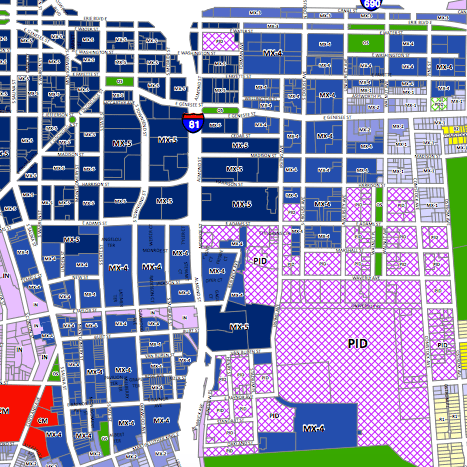
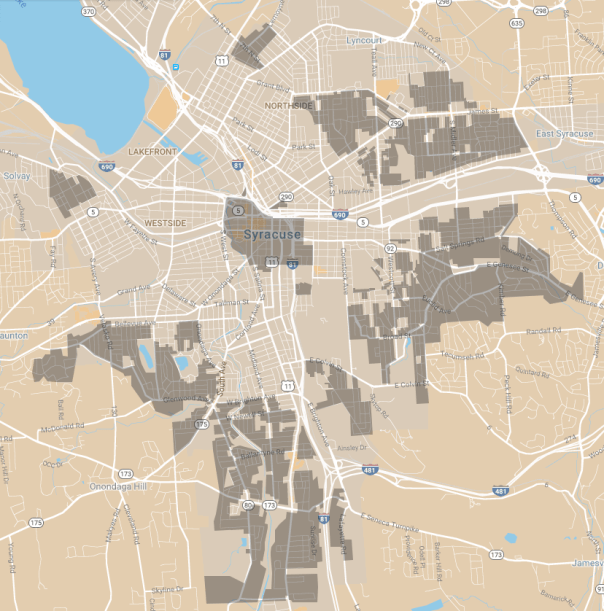
The result is that in areas zoned R-1, all new residential development will be exempt from parking requirements, while in areas zoned R-2 or higher, a lot of residential development will not be exempt from parking requirements (Downtown is also exempt from all parking requirements).
Areas where all residential development is exempt from parking requirements
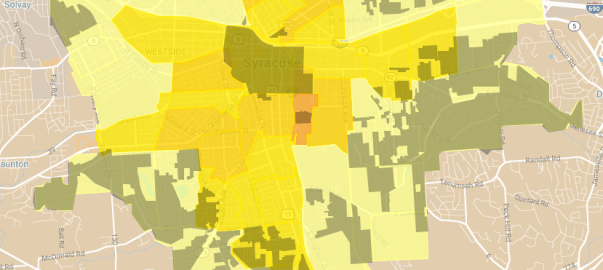
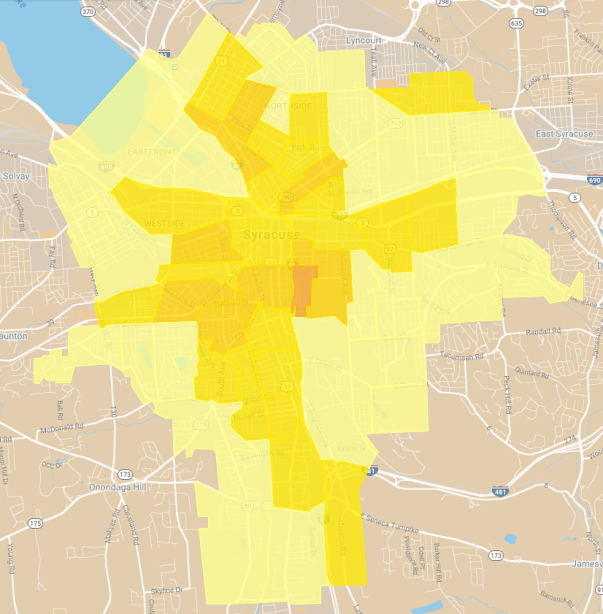
Syracuse’s inner neighborhoods are some of the best places to live in the entire County if you’re trying to make a life without a car. Neighborhoods like Hawley-Green and the Near Westside have relatively good bus service, a mix of businesses within walking distance, and easy access to the jobs Downtown and on University Hill. That’s why the people living in those neighborhoods are much more likely to go without a car than the people living in Syracuse’s outer neighborhoods like Strathmore and Meadowbrook.
Percentage of carless households by census tract
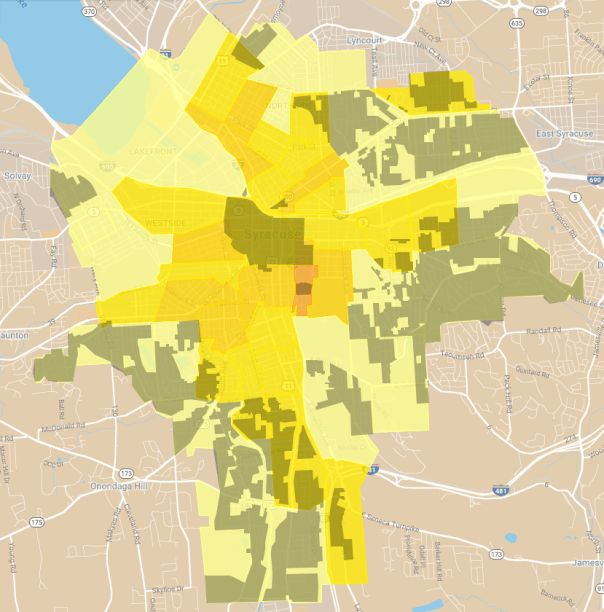
When you combine these two maps, it becomes clear just how insane the draft ordinance’s minimum parking requirements are. They require off-street parking for the people least likely to own cars, but they don’t make similar demands of the people most likely to own cars.
City Hall needs to amend the draft zoning ordinance to fix this problem. They could remove the 75% cap on parking minimum reductions. If a property is on a bus line and nearby a public parking lot, it makes sense to give the property owner credit for having set up in a spot where off-street parking isn’t necessary. The arbitrary 75% cap is just a way of saying that people in Syracuse shouldn’t try to make the best use of shared resources, and that’s not a message worth sending in a city that doesn’t have enough resources as it is.
City Hall could also amend the draft zoning ordinance to say “When measurements of the number of required spaces result in a fractional number, the fraction shall be rounded down to the nearest whole number.” For example, a project requiring 2.25 spaces would only actually have to build 2 spaces, and a project requiring 2.75 spaces would also only actually have to build 2 spaces. Even with the 75% cap, this would make 1-family, 2-family, and 3-family houses eligible for exemption from any parking requirements.
City Hall could also count on-street parking spaces in front of a property towards the total required number of spaces for any property after applying the 75% cap on parking minimum reductions. Allowing on-street parking to substitute for off-street parking in this way would allow 1-family houses and small scale apartments to meet their parking requirements without having to build off-street parking.
Those small changes would do a lot to make the zoning ordinance better, but it’d really be best to just trashparkingrequirementsentirely. They’re awful, ham-fisted solutions to a problem best solved by individuals. If a developer builds an apartment without off-street parking, they’ll get tenants who don’t own cars or who don’t mind finding on-street parking. Other people who value off-street parking will pay a little extra to rent or buy some other housing that includes a place to store a car. There’s no reason for parking lots to line James and Salina Streets when so many of the people living there don’t drive, and there’s no way that eliminating parking requirements will get people living in Meadowbrook to give up their driveways and garages.
That might be too much to ask in a town as car obsessed as this one. Whatever–any of those more technical fixes would be good enough. All that matters is that this new zoning ordinance not make it even harder to make a life in this City without a car.
For ten years, the City of Syracuse sent a different representative to Congress every time it had the chance. Until Congressman John Katko beat Colleen Deacon in 2016, the City hadn’t elected an incumbent since Jim Walsh–the current Mayor’s father. It’s a difficult seat to hold onto, and Katko managed to do it by positioning himself as a moderate who could appeal across party lines. This last year, though, has made that a difficult position to maintain–Katko refused to say who he intended to vote for in the 2016 presidential election, and he has hemmed and hawed every time someone has asked about national politics since then.
If only the Congressman would be so boring when it came to local politics. In June, when then-Mayor Stephanie Miner thought about running for his seat, Katko responded by saying that Syracuse suffers from a “plague” of “systematic poverty, record murder rates, crumbling infrastructure, failed schools.” In November when Mayor Miner called out his vote on the tax bill, he talked about Syracuse’s “economic malaise” and it’s “stunning rate of local poverty.” Just this past week, in response to a question about I-81 during a Facebook event with Tim Knauss, the Congressman said, “It’s not just a decision for the City of Syracuse. It’s a decision for the region” and then went on to talk about all of the problems that Dewitt and Skaneateles might have without ever mentioning what the project might mean in the City.
All of this talk has one thing in common–it divides the people that Katko represents between those who live in the City and those who live outside of it. Take his sparing with Miner. She won both her terms with huge majorities and remains popular among city residents, so he can’t actually be appealing to those people when he says she turned the City into a hell hole. He’s playing on the fears of suburban people who are afraid of the City, who believe that it’s a hell hole, and who wouldn’t want anything to do with anyone from there.
He’s doing the same thing with I-81. It’s not a city-suburb issue. Suburban legislators like Al Stirpe and Karin Rigney want the highway out of the City, while some City politicians like Bill Magnarelli and John DeFrancisco want to keep it as a tunnel. Katko ignored all that, though, and talked like everyone’s real concern should be that the City not be allowed to impose any kind of decision on the suburbs.
The Congressman is in a tough spot. He can’t say anything substantive about national politics without appearing partisan and alienating half the district. His solution has been to turn partisan on local issues, betting that he can appeal to the 80% of the district that lives outside the City by making them fear the 20% that live in it. That’s a small thing to do, and we all have to call him out on it and say so.
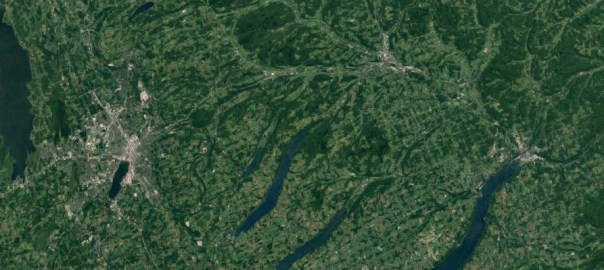
Back in 2017 when the community was still seriously debating the merits of Consensus’ plan to merge the City of Syracuse with Onondaga County, Centerstate CEO Rob Simpson liked to talk about how a combined city-county would be the second biggest city in New York State. That wasn’t really a very compelling argument since it compared apples to oranges, but it did get at something important: communities with larger populations enjoy political and economic benefits over those with smaller populations, and cities like Syracuse, Cortland, and Ithaca suffer both politically and economically because they each have so many fewer people than other communities in New York State.
An intercity transit service connecting Syracuse, Cortland, and Ithaca would fix this problem by uniting those three cities and their metropolitan areas into a single region large enough to give its residents political and economic advantages that they do not currently enjoy.
Uniting these communities will benefit both businesses and workers. Easier commutes between cities will enable workers from any community in the region to work for businesses in any other community. This will create a single regional labor market that can support growing local businesses and that can also attract large businesses to move into the region. The other side of this coin is that workers will be able to apply for jobs outside of their individual communities, increasing economic opportunity for people living in each community.
That economic integration will also make the region stronger politically. It will mean that good things happening in one community are good for people living in communities across the region, allowing residents and elected officials to advocate with a single voice in State politics. So if Syracuse needs the State legislature to amend its charter to deal with the City’s impending fiscal crisis, Bill Magnarelli and Pam Hunter will be able to count on support from Al Stirpe, Barbara Lifton, and Gary Finch in the State Assembly to make that happen. If we go through something like the Upstate Revitalization Initiative again, the Central New York and Southern Tier Regional Economic Development Councils can work together to submit bids that will benefit the entire region.
By making daily travel between Syracuse, Cortland, and Ithaca easy and routine, an intercity transit service would unite those cities and their metropolitan areas as a single region with a single labor market and a unified political voice. This kind of transformation won’t happen overnight, and it will require cooperation between regional transportation authorities, county governments, other municipalities, and private institutions, but the potential benefits are worth the effort.
In 2015 when Centro thought it would have to cut late-night and weekend service, plenty of people turned out for a Syracuse Common Council meeting to tell about how those changes would make their lives harder. The people who got up to speak at that meeting talked about things like working the third shift at hospitals and nursing homes, relying on the bus to overcome physical disability, greenhouse gases, and getting to church on the South Side. Those people represented the political coalition between workers, the disabled, environmentalists, and the poor that supports public transportation in Syracuse today.
University students would be natural members of that coalition. Nationally, students make of 24% of all transit users in urban areas with populations between 200,000 and 999,999. In Syracuse, people living in student neighborhoods like University Hill and the Near Eastside are less likely to own a car and more likely to commute by bus or by foot than people living in other Syracuse neighborhoods of comparable wealth. Syracuse University students ride Centro in huge numbers, particularly to get between South Campus, University Hill, and Downtown. Despite all that, no students got up at that meeting to voice their support for Centro.
Even though no students spoke, the University was a topic of discussion at the meeting. Councilor Khalid Bey asked Centro’s CEO, Frank Kobliski, whether or not Syracuse University paid Centro enough money to cover the operating costs of all those buses that run between University Hill and South Campus. That question got a lot of people grumbling, and one person shouted out, “they have more money than god!” Once Mr. Kobliski had the opportunity to respond, though, he surprised everyone by letting them know that the University overpays for the bus service it gets from Centro.
Syracuse University overpays for its buses because it treats Centro not as a public service, but as a charter bus company. It contracts with Centro to provide free service to its students as they travel between South Campus, University Hill, and Downtown. This means that students ride Centro buses in huge numbers, but they’re not riding truly public transportation.
This dampens student support for Centro. When reporting on Centro, the Daily Orange always distinguishes those special student buses from Centro’s public service. So in 2015 when Centro was considering those late-night and weekend service cuts, the Daily Orange wrote “the direct effect on SU students would remain small,” and no students turned out to advocate on Centro’s behalf. Later that year, when Congress voted to cut Centro’s funding by $12 million, the Daily Orange made the students’ position even more explicit:
“If the mass budget cuts currently facing Centro continue and affect on-campus busing, Syracuse University must take a firm stance to oppose the cuts and defend transportation resources for the university community… However, the university should only offer its support if cuts would directly impact bus service on the SU campus. The university’s priority should be to ensure these resources remain available to those on campus, and it does not have a financial responsibility nor obligation to ensure the bill prevents wide-scale change, affecting the city of Syracuse.”
That’s Centro’s political problem. As long as Syracuse University students receive specialized bus service from the University, they will think of it as a private good to be secured by paying tuition. That stance divides students from the majority of Centro riders who use the bus as a public good that must be secured by political action and advocacy. These opposing stances divide Centro’s natural base of political support and keep a large and powerful bloc of people who rely on transit in Syracuse from acting collectively on its behalf. It doesn’t have to be this way. Bus riders in Syracuse don’t need to resent University students, and students don’t have to think of their interests as separate from the Syracuse community. Both groups rely on public services like Centro buses, and if they could be a potent political force in Upstate New York if they acted cooperatively.
Intercity transit service could change that status quo by providing a service that’s highly beneficial to Syracuse University and its students, but impossible for the University to build or pay for all on its own. A truly public transportation service connecting Hancock International Airport, the Regional Transportation Center, Centro’s Bus Hub, Syracuse University, Cortland, Cornell University, and Ithaca would benefit both students and transit riders, it would put them both in the same vehicle, and it would give them common cause to advocate for that service.
Both Centro riders and Syracuse University students depend on the presence of public or quasi-public services in a region where the middle and upper classes pride themselves on being entirely independent of such services. The travesty is that the University provides its students with those services at high but hidden cost, and that by segregating those services, the University divides what should be a natural alliance and kills support for truly public services. It will take a lot of work to overcome the institutional barriers that segregate students from City residents, but Chancellor Nancy Cantor took a first step with the Connective Corridor and her Scholarship In Action philosophy. Chancellor Kent Syverud plans to go further by moving student housing from South Campus to the City’s center. A truly public intercity transit service can do more of that same work, strengthening the whole City by aligning the interests of the people who live in it.




 inthesalt.city