Tag Archives: ReZone

Bus Stops and Parking Spaces in ReZone

In April 2017, City Hall published a draft of the new zoning ordinance that allowed for buildings near to “any type of bus stop, regardless of service level” to build 30% fewer parking spaces than buildings without easy access to transit. That’s was a good idea because it costs money to provide off-street parking, and that’s an unnecessary expense when the people using a building don’t travel by car. When City Hall imposes that expense on a property owner by requiring that a building have more parking than is necessary, that amounts to a tax on pedestrians, cyclists, and bus riders.

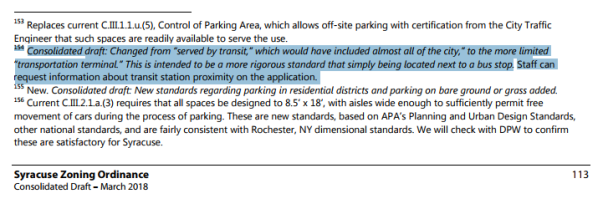
In March of 2018, the City Hall backed away from that good idea. Instead of reducing parking minimums for buildings within a quarter mile of “stations served by transit,” the new draft ordinance published that month talks about buildings within a quarter mile of “transportation terminals.” It’s not obvious what a transportation terminal would be in Syracuse (the Centro Hub, the RTC, the terminal stop for each bus line?), but it’s clear from the explanatory footnote that a transportation terminal is not a bus stop:

transitfootnote

It’s as if City Hall didn’t know that Centro is a viable transportation option in just about every neighborhood in the City, and now they’re trying to limit the benefits that bus service can provide.

In fact, Centro’s pervasive service is a good reason to take the opposite tack and allow greater density at the corner properties on each intersection where a bus stops. Elevating the properties at each bus stop by one zoning district (from R-2 to R-3, say, or from MX-1 to MX-2) would increase the City’s capacity to house people who do not own cars, and that’s right in line with the City’s Land Use & Development Plan:

“This capacity should be preserved by maintaining zoning for density levels in line with the existing built environment, so that over the long-term the City may market its ability to cost-effectively absorb regional population growth—based on existing infrastructure and an urban land-use pattern that lends itself to walkable neighborhoods, local commercial and business services, and efficient transit service.” Land Use & Development Plan, pg 12

Luckily, the City Hall is hosting three information sessions about the new zoning ordinance this week. The first will be on Monday at 6:30 at Nottingham High School, the second will be on Tuesday at 6:30 at Corcoran High School, and the third will be on Wednesday at 6:30 at Henninger High School. Check these info sessions out, learn more about the new ordinance, and ask why City Hall wants make it harder for people without cars to find an affordable apartment in the City.

Bike Lanes on Euclid Avenue

On July 11, the Post-Standard reported that Syracuse’s DPW had requested almost $935,000 to repave Euclid Avenue between Comstock and Westcott Streets. The City of Syracuse has been mulling the idea of painting bike lanes on this stretch of Euclid Avenue for a few years now, and the DPW’s request is just the latest step in what has been an extremely slow process.

This request makes it look like city government prefers to provide basic services in some neighborhoods rather than others. As the Post-Standard notes, the city government can only afford to pave about 2 miles of streets a year, and, according to the DPW’s own scale for measuring street quality:

Euclid was rated a seven out of 10 in 2015, according to the city’s public data. That’s better than most streets in the city.

Chris Baker, the reporter who wrote this article later tweeted that Euclid Avenue is in better shape than the streets “anywhere south of downtown”–a reference to the City’s most visible public housing projects and its most concentrated black neighborhood.

It’s impossible to look at this plan for Euclid Avenue and ignore Syracuse University’s influence. In its recently published Campus Framework, the University emphasized the importance of creating ‘gateways’ to campus, and it specifically called for this kind of work on Euclid Avenue:

Along Comstock Avenue and Euclid Avenue, new cycle lanes and streetscape improvements signal arrival to a campus district.

In the past, when the University wanted to make some change to University Avenue and Walnut Park, city government just turned those public resources over to this private entity in exchange for money. If city government is repaving Euclid Avenue in response to pressure from the University, then we should be thankful that at least this time the street is staying in public hands. It’s also possible that city government agreed to do this work in the negotiations that led to the 2016 Service Agreement, or in return for the money that the University spends to subsidize Centro.

Apart from any questions about who’s paying for this paving, the street’s new design also shows how the proposed zoning ordinance can influence seemingly unrelated issues in city neighborhoods. All of this talk about bike lanes got real momentum when the DPW published its 2014 Euclid Avenue Parking Study. That report surveyed demand for on-street parking along Euclid Avenue and proposed different bike lane designs that would maintain the necessary number of on-street parking spaces. That kind of evidence-based demand study is a good way to make decisions about parking, but runs up against a zoning ordinance that regulates parking without considering evidence at all.

On the most recent draft of the City’s zoning map, all of this stretch of Euclid Avenue is zoned as MX-1. As the Post-Standard notes, the vast majority of properties along this stretch of Euclid Avenue are multi-family apartment buildings. According to the most recent draft of the new zoning ordinance, multi-family residential properties that are zoned MX-1 are required to provide 1 off-street parking space per apartment. The draft allows that “On-street parking spaces along the property line may be counted to satisfy the minimum off-street parking requirements, if approved by the Zoning Administrator.”

All of that is to say that it doesn’t matter whether or not people use the on-street parking along Euclid Avenue–if DPW paints new bike lanes in such a way that they remove on-street parking in front of residential properties, the property owners will have to build new off-street spaces in order to meet the new zoning code. By effectively requiring property owners to pave their backyards, this bikelanes project will influence landlords’ willingness to renovate their properties, it will influence the uses to which those properties can be put, and it will even frustrate the County’s efforts to keep rainwater out of the city sewer system.

City issues are interrelated. The DPW wants money to repave a road, but the causes and effects of that request are difficult to trace. In this case, that request has to do with city government’s money problems, Syracuse University’s long range plans to attract students, and the proposed zoning ordinance–it’s about a lot more than potholes and bike riders.

ReZone Syracuse and Neighborhood Centers

The main objective of ReZone Syracuse, a project to rewrite the City’s zoning ordinance, is to “facilitate the implementation of the Syracuse Land Use & Development Plan 2040 (LUP), a component of the City’s adopted Comprehensive Plan 2040.” As of the most recent draft of the new zoning ordinance and map, ReZone fails to do this evenly across all of the City’s neighborhoods. In order to fully implement the Land Use Plan, ReZone needs to allow more residential density in select neighborhoods.

The City’s Land Use Plan focuses on Syracuse’s existing ‘neighborhood centers’–clusters of businesses and institutions served by major bus lines and surrounded by residential development. These are places, like Westcott Street and North Salina Street, that grew up in the 19th and early 20th centuries when people relied on streetcars to get around town.

Along with limiting off street parking and encouraging mixed-use development, the Land Use Plan suggests revising the zoning ordinance to allow high density residential development within a quarter mile (or 5 minute walk) of the neighborhood centers:

“Enable and encourage higher-density housing within the pedestrian-shed of mixed-use corridors and neighborhood nodes, placing people within walking distance of neighborhood centers.” Land Use Plan, pg 32

“Support and encourage high-density residential projects on upper floors of corridor buildings, and on properties adjacent to the commercial corridors to promote more foot traffic, interaction and vitality, as recommended by the Land Use Plan. (This may call for Zoning changes as well as selectively incentivizing residential projects when market conditions do not.)” Comprehensive Plan, pg 23

Dense residential development is necessary to sustain the businesses, institutions, and bus lines that make these neighborhood centers what they are. Without a lot of people living within walking distance, businesses in Syracuse’s neighborhood centers will rely on customers who travel by car from other neighborhoods or municipalities. That means more land used for parking lots, which makes the entire neighborhood center less walkable and discourages bus use, and the whole thing falls apart.

ReZone does not fully implement this recommendation. Comparing the map of proposed land uses from the Land Use plan and ReZone’s first draft map, it’s clear that the City intends to allow increased residential density (indicated on the Land Use map by yellow and pink, and indicated on ReZone’s map by yellow and blue) in some neighborhoods but not others.


Particularly, the blocks around the James Street neighborhood center in Eastwood are zoned almost entirely as R-1–single family detached houses on lots at least 40 feet wide and setbacks at least 30 feet deep. This is the opposite of “higher-density housing,” and it is totally inconsistent with the City’s Land Use and Comprehensive Plans.

It doesn’t take much effort to find two maps in the Land Use Plan that explain ReZone’s decision to keep Eastwood low-density.


ReZone’s draft map allows for higher residential densities in neighborhoods with high concentrations of vacant buildings and land, which is to say that ReZone proposes to increase residential density in poor neighborhoods.

If it makes sense to allow developers to build multi-family housing around the City’s neighborhood centers (it does), then ReZone should reclassify the blocks within a quarter mile of James Street as R-2 or denser. Revising the zoning ordinance in this way isn’t going to change anything overnight. Allowing apartment buildings on the blocks adjacent to James Street isn’t going to bring a huge wave of construction to Eastwood. But there’s no reason to leave existing density limits in place around neighborhood centers when the City’s own Land Use Plan recommends doing just the opposite.

Form-Based Zoning

Syracuse’s Proposed Zoning Ordinance contains a section that regulates certain aspects of building form. Form-based ordinances are meant to “promote high quality building design,” but legislating design is tricky, and this draft fails to focus on the kind of design that matters most. The City should adopt rules that support community interaction rather than rules that dictate taste.

One of the draft ordinance’s many regulations governs building rooflines:

Buildings shall be designed to avoid any continuous roofline longer than 50 feet. Rooflines longer than 50 feet shall include at least one vertical elevation change of at least two feet in height.

It’s not clear exactly how this supports the zoning ordinance’s mission, but you have to imagine that the people who wrote it had buildings like One Park Place in mind–big boring rectangles that feel out of place among Syracuse’s beautiful old buildings. However, some of those beautiful old buildings in Downtown Syracuse also have long unbroken rooflines.

The length of a roofline is a measurable indication of the architectural style of a building, but that single measurement can’t tell you whether a building is ugly, or–more to the point–whether people will think it’s ugly in thirty years. The dilemma here is that an ordinance cannot be both strict enough to guarantee taste and loose enough that a small staff of zoning employees can easily enforce it:

This draft tries to strike an important balance between raising the bar for design while recognizing that staff capacity limits the City‘s ability to effectively administer and enforce too many new standards.

This particular regulation errs on the side of enforceability, so while its authors might have intended that it give us more buildings with interesting roofs and outlines like City Hall or NiMo, it’s not specific enough to guarantee that. Instead we’re getting buildings, like the Amos Extension, that satisfy the ordinance in the cheapest possible way.

The Syracuse Zoning Board should focus, instead, on building forms that make it easy for people to interact as a community. This means buildings that let people communicate across the property line. It means forms that allow people to experience the interior space of a building from the exterior space of a sidewalk, and vice versa. It means stitching the public and private realms together. That’s a lofty way to talk, but all it really means are windows and doors that face the street, minimum setbacks, first-floor retail, and parking lots placed behind buildings. It’s very simple, easily enforceable, and more likely to succeed than legislated taste.

Luckily, Syracuse’s proposed form-based zoning ordinance contains regulations like these that will encourage community interaction. The sections on “Building Placement and Orientation,” “Primary Entrance Orientation,” “Building Entrances,” and “Transparency” are all reasonable and only need minor tweaking to focus their purpose. Other sections concerning things like “Building Materials,” “Mechanical Equipment Screening,” “Facade Colors,” and “Vertical Articulation” are unnecessary and should be cut out. These revisions will put the focus squarely on form-based zoning’s true goal: community.

ReZone Syracuse and Housing Supply in Older Neighborhoods

When a house in Syracuse is in such bad shape that no one would invest the money to repair it, then it makes sense to demolish that building. In a neighborhood that’s losing population and doesn’t need the housing, that newly vacant land can be put to good use as a side yard or community garden. In growing neighborhoods like the Northside, it makes more sense to let people build new houses on those vacant lots.

The City is currently rewriting its zoning ordinance as part of a project called ReZone Syracuse. The most current proposed draft ordinance restricts all new residential construction to lots at least 40 feet wide.

The Northside is jam packed with lots that are 33 feet wide. Narrow lots like these are common in Syracuse’s older neighborhoods. If the City adopts its current draft zoning ordinance as law, it will be illegal to build any new houses on these lots, and any demolition will permanently reduce the available housing stock in those neighborhoods. That will cram more people into the remaining apartments and houses, drive up rents and mortgages, and make it harder for people to make a life in the City.

This is a real problem. As of January 19, 2017, the Greater Syracuse Land Bank owns 218 vacant lots within the City. 86 of those lots are between 25 and 39 feet wide–large enough to build a normal-looking house, but technically non-buildable under the proposed draft ordinance.

It doesn’t have to be that way. The current zoning ordinance mandates that all residential lots be at least 40 feet wide as well, but it allows for construction on existing narrow lots through a special exemption for parcels created before 1962. A similar exemption in the new ordinance would eliminate this problem.

While Syracuse loses population, it makes sense to also reduce its overall supply of housing, freeing up city land for other more beneficial uses like community gardens and private yards. It doesn’t make sense to reduce the housing supply in every neighborhood, and it doesn’t make sense to reduce it permanently in any neighborhood. Some neighborhoods are still growing, and others will eventually grow again. The City’s proposed zoning ordinance threatens that growth by placing an unnecessary limit on the housing supply in Syracuse’s older neighborhoods. The proposed draft zoning ordinance must be amended to allow for construction on existing lots.