All posts by inthesaltcity

Building out BRT

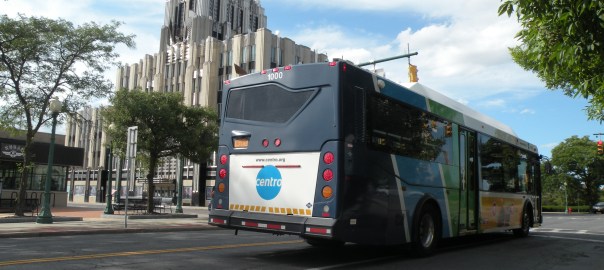
Bus Rapid Transit—a set of service and infrastructure improvements that makes buses run faster and more frequently—is Syracuse’s best opportunity to improve the City’s public transportation network because it’s much simpler and easier to expand BRT than either rail or traditional bus service.

To see why, look at Syracuse’s planned BRT system. Right now, it’s just two lines—Eastwood to OCC along James and South Ave, and SU to the Regional Transportation Center along Adams and North Salina Streets. That’s a good start, but obviously this city needs quality transit in more places than just those two corridors, so the BRT network will have to expand over time.

That expansion can take two forms. First, Syracuse could add more lines. South Salina Street, for example, obviously needs better transit service, so the 10 bus should be upgraded to BRT. Second, BRT lines can be extended further out. New development along Old Liverpool Road might make it worthwhile to extended the SU-RTC line all the way to the Village of Liverpool.

But that kind of expansion is almost impossible under Centro’s current, traditional pulse-timed service model, and it’d be incredibly difficult if Syracuse was committing to some sort of rail-based transit service.

The problem with expanding rail service is pretty straightforward—it costs a bunch of money and takes forever to build. And since you can’t run a train until the tracks are in the ground, service improvements get delayed for decades. Just ask Buffalo, where plans to extend the subway have been in the works for four decades without any new service to show for it.

The difficulty of expanding traditional pulse-timed bus service is less intuitive. Centro time’s its buses so that they meet all at once at the hub every forty minutes, or so. It’s called a lineup, and it helps riders transfer between different bus lines that don’t run very often. Since the buses are all timed in relation to each other, it’s impossible to change any line’s schedule without throwing the whole system out of whack. Any significant improvement in service requires a full network redesign—like the one that Rochester is rolling out next week—and that also takes years.

BRT avoids these problems because it’s so much cheaper to implement than rail, and because its frequent service doesn’t require a lineup to facilitate transfers between lines. If Syracuse wanted to extend service to Liverpool or add BRT to South Salina, we could just do it without taking 10 years to lay down rails or rejigger the rest of the bus network. That’s what’s happening in Albany, where the Capital District Transit Authority is building out a full BRT network one line at a time.

There are a lot of reasons that BRT is the best option for improving public transportation in Syracuse, but this is the most compelling one. It’s iterative—we can build the network in manageable pieces—we can get started now, and we can keep expanding the system into the future.

Food Deserts and Parking Lots

Too many people living in too many neighborhoods have too hard a time getting fresh food. In part, this problem has to do with the fact that grocery stores won’t open in poor neighborhoods—so-called ‘food deserts.’ But, because food deserts are only ‘deserts’ for people without cars, it also has to do with how accessible  grocery stores are to pedestrians.

If food deserts were just about the presence or absence of a grocery store in any particular neighborhood, then just about every suburban subdivision would warrant the name. Fairway East in Clay is not a food desert even though the nearest grocery store is 2 miles away because the people who live in Fairway East have easy access to food. They own cars and can easily drive to any number of grocery stores.

A food desert isn’t just a neighborhood without a grocery store. It’s also a neighborhood where people don’t have cars. That’s why, last summer, Last Chance For Change walked to Green Hills Grocery to show how hard it is for a lot of people on the Southside to get to fresh food. Driving from the Southside to Green Hills (or to the Nottingham Tops, or to the Western Lights Wegmans, or to the South Ave Price Rite, etc) is easy—walking there is hard, and that’s what matters.

And if the goal is to get more grocery stores within walking distance of more people, then not all grocery stores are created equal. Some—like the Route 31 Wegmans out near Fairway East—are designed to be driven to. They’re huge buildings that sit back behind huge parking lots, and they have to draw a huge number of customers from a huge area in order to survive.

This kind of design is bad for pedestrians because it’s unpleasant to walk across parking lots, but it’s also bad for food deserts because those huge parking lots could be full of housing for people who need to live within easy walking distance of a grocery store.

Take the Pond Street Tops on the Northside. It’s a 32,000 square foot store with a 85,000 square foot parking lot. Its front door is about 50 feet from the sidewalk on Pond Street and about 500 feet from the sidewalk on 1st North. That means the closest houses are actually pretty far away from the front door, and it means that fewer houses are within walking distance of the fresh food for sale in this store.

Compare that to the Co-op in Westcott. It has no parking lot, and it’s front door is right at the sidewalk. The nearest houses are just next door. In fact, if you tally up all of the street frontage around these two stores, the Co-op is within walking distance of 22% more land than is the Pond Street Tops.

Neighborhood-scale grocery stores—like the Co-op or Dominick’s in Hawley-Green—are highly accessible to people who get around on foot. That makes them really effective at putting fresh food within walking distance of lots of people. If more grocery stores in Syracuse were like them—if less land around the grocery stores we already have was wasted on parking—more people in more neighborhoods would have an easier time getting fresh food.

A police contract from the past

Mayor Walsh’s deal with the PBA pretends that 2020 never happened. It pretends that the City’s situation right now is that same as it was in 2019. It pretends that nobody marched for reform or said anything worth hearing about policing last year.

Headed into arbitration over the police contract, City Hall just wants to get the same terms that they negotiated back at the end of 2019—terms that would add millions of dollars to the police budget for years to come. As the Walsh administration’s lead negotiator put it: “There really, in our mind, wasn’t any reason to go back to the drawing board and start all over again.”

I would think it’d be obvious to anyone who lived through 2020 why a huge increase to the police budget isn’t appropriate in 2021. I would think it’d be obvious why today is different from a year ago and why City Hall had a mandate to go back to the drawing board and get a new deal.

There was a national popular uprising against the common practice of policing in American cities. The Syracuse community participated in that movement and clearly communicated that the problems with modern American policing are problems in this City too.

One of the biggest problems the movement identified is the overwhelming size of police budgets. In Syracuse—a city perennially on the brink of fiscal collapse—20 cents of every dollar goes to the SPD. This extravagance makes it impossible to provide the municipal programs and services the City really needs, and so it is necessary for City Hall to rebalance its budget by committing more resources to the community.

This was a specific, explicit criticism that Syracuse activists repeated for months. Mayor Walsh heard it, but it’s clear he did not listen. It will be impossible to invest in community programs and services if police are taking an ever larger slice of the municipal pie.

The voices that explained all this last year were powerful and eloquent. City Hall needs to pay them heed and negotiate a new agreement with the PBA.

Corporate Governance

When OCIDA gave Amazon $71 million in tax breaks, a lot of us were left wondering what Jeff Bezos—the wealthiest man on the planet—could possibly need all that money for. Now we have 2.5% of the answer. He’s going to give $1.75 million of that money back to the public as a donation to the new countywide STEAM school that will soon be operating out of the old Central High building.

But that money comes with strings attached. It’s for “robotics and computer science programs” because Amazon’s new warehouse “will depend heavily on robotics for fulfilling orders and Amazon wants to help train the next generation of workers.” And Amazon very pointedly left the A (for Arts) out of STEAM in its statement on the donation:

“We want to inspire the next generation of innovators to explore opportunities in science, technology, engineering, and math, so we’re proud to partner with Onondaga County—which we will soon call home—to increase access to STEM education for thousands of local students for years to come. We hope they’ll join our team at Amazon one day and teach us a thing or two as they build their careers here.”

We’re outsourcing curriculum design to a private corporation that is explicitly and primarily interested in bending public education to serve its own interests. And all it cost Amazon was $1.75 million that we had already given them in the first place.

It’s not hard to imagine this pattern repeating in other areas of local government. Amazon paying for improved bus service to its warehouse even when that money would have a greater impact increasing service on high-ridership lines, say.

The STEAM school is still worth getting excited about, and it’s better that Amazon spends $1.75 million there than on stock dividends or whatever. But in a more just world, Amazon would have just paid its whole tax bill (like the rest of us), that would have covered almost the entire $74 million cost of building the STEAM school, and educators would have retained control over the school’s curriculum.

Fare Capping

Fare capping is a public transit payment reform that boosts ridership and minimizes inequality by making transit passes more affordable for people without a lot of money. Centro should implement fare capping in Syracuse.

Time-based transit passes allow riders to take as many trips as they like within a given amount of time—a day, a week, a month, a year. This rewards frequent riders who use transit often, and it encourages people to take more trips by making the marginal cost of each trip $0.

Centro sells two types of time-based passes—a daily pass and a weekly pass. The $5 day pass is a good deal for anyone making more than two trips in a day, and the $20 week pass saves money for anyone riding more than 10 times a week. Before 2015, Centro also sold a monthly pass for $60—a good investment for anyone riding more than 30 times a month, so any regular commuter with a full-time job.

However, these time passes are often unaffordable for the poorest riders. It’s one thing to come up with $2 for a single bus ride, but a lot of people have a harder time scraping together $20 to buy a weekly pass—let alone $60 for a monthly pass—even if they ride the bus often enough that the time-based pass would save them money in the long run. This is a real problem for Centro’s riders who are very likely to have very low incomes.

Fare capping makes time-based passes more affordable by allowing riders to buy them in installments. Each time a rider pays the individual fare, it goes towards the cost of purchasing an unlimited pass. This ‘caps’ the total cost that any rider pays in a given amount of time at the total cost of an unlimited pass for that same amount of time. So a rider would never pay more than $5 in a single day or $20 in a single week to ride Centro.

This will require new fare payment technology. Installments only work if there’s a way to track them, so riders will need to have payment accounts. This might mean account-connected payment cards that riders keep from month to month, or it might mean upgrading the mobile payment system that Centro piloted in 2019.

All of this will be even more important when Centro begins running Bus Rapid Transit. High frequency service will allow people to make more trips by bus, and that will only make time-based passes more attractive to riders. Centro should implement fare capping in order to make unlimited passes accessible to everyone who needs them.

Public Parks and Climate Change

Climate change is here, and Syracuse is already feeling it. The last several summers have been some of the hottest on record, and new weather patterns are scrambling all our seasons. We need to do everything we can to stop climate change, of course—driving less, greening the grid—but in the meantime we also have to mitigate the negative effects of climate change that are already here. City parks are some of our best tools to do that. 

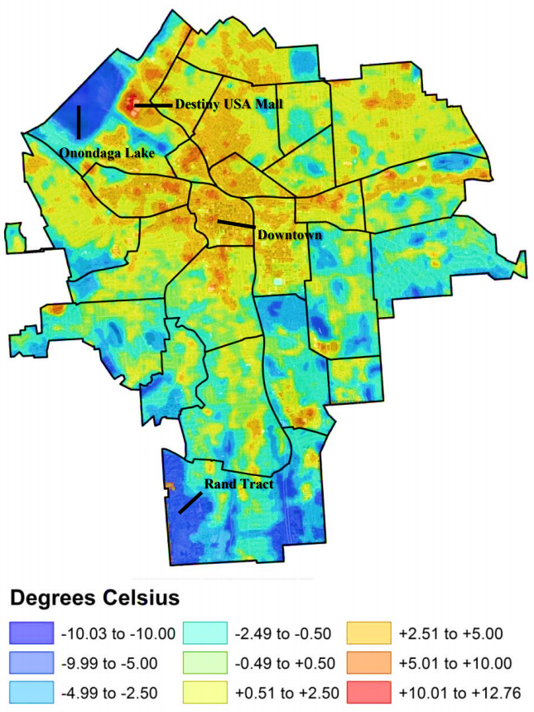
In a map of average temperature variation across the City, parks pop out as islands of cool. They are 10 to 20 degrees cooler than the rest of the city on average. This is because of their ample tree cover and the lack of heat retaining buildings, and it’s a big part of why people flock to parks in June, July, and August. In a town built for harsh winters where many houses have never had air conditioning, parks offer a respite in increasingly hot summers.

Public pools are a super-charged version of this same phenomenon. Many families and children build their summers around the public pool because it’s a fun, safe, affordable, guaranteed way to beat the heat. That’s why kids were so insistent that City Hall find a way to open up the pools last summer—we had a historically hot summer and there wasn’t anything else to do.

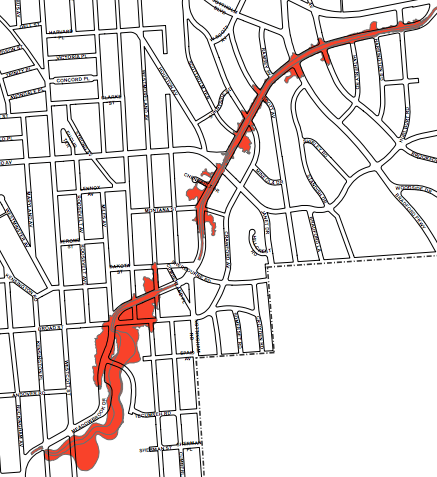
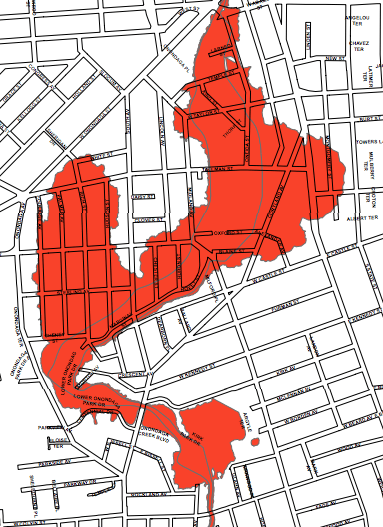
Climate change isn’t just about rising temperatures—it will also cause more rainfall. Parks can act as ‘green infrastructure’ that protects neighborhoods from flooding. On the Eastside, the Barry Park Detention Basin is a constructed wetland designed to keep Meadowbrook from flooding, and it’s worked. City Hall should construct a similar pond along Onondaga Creek to minimize flooding there too. And as an added bonus, people actually like living near Barry Park pond.

This is all wrapped up with racial segregation and economic inequality. Homes in richer whiter census tracts and more likely to have private backyard pools than homes in poorer blacker neighborhoods. Barry Park protects home values in a richer whiter area while the lack of similar protection has made it impossible to build wealth through homeownership in a poorer blacker neighborhood. This is environmental racism, It’s up to City Hall to combat it.

. . .

Parks are not just amenities. In the 21st century, in a warming world, they are necessary community infrastructure. It’s time we started acting like it.

How to build bus ridership

Syracuse needs more people riding the bus. Increased ridership is good for Centro, obviously, because it provides increased fare revenue and a broader base of political support for public transportation. But increased ridership would also indicate that Centro is serving Syracuse better, because more people are choosing to ride.

So how do we do it?

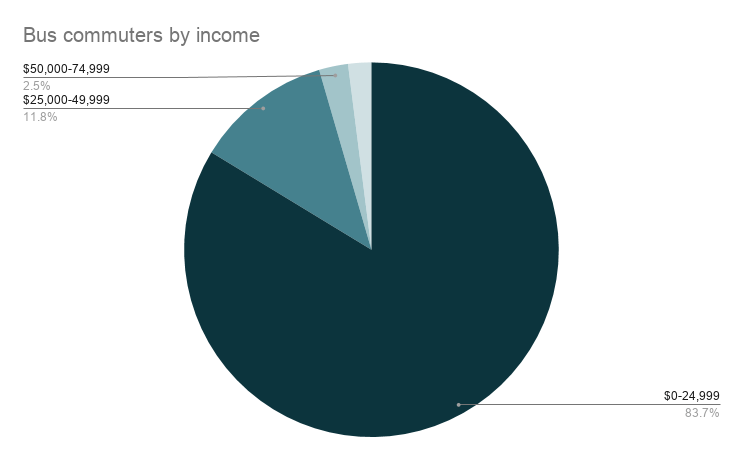
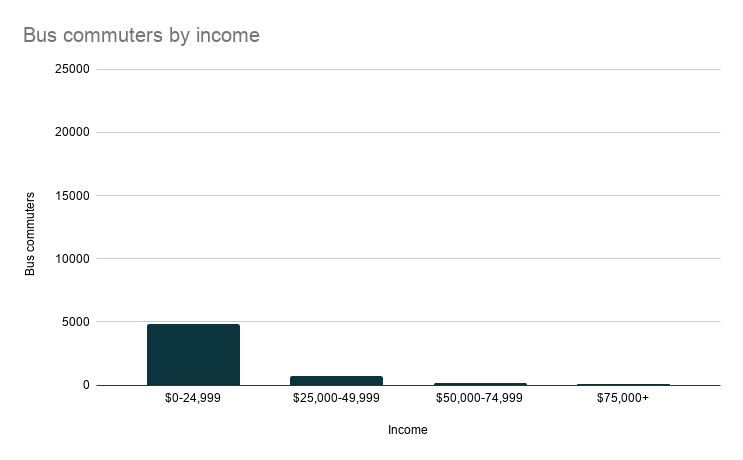
Here’s a breakdown of Centro’s commuter ridership by income. People making less than $25,000 a year account for 84% of Centro’s Syracuse-based commuter ridership. People making more than $50,000 a year account for less than 5% of workers who live in Syracuse and commute by bus.

One approach to building ridership—the ‘captive-choice’ approach—tries to even out the pieces of that pie. 84%(!) of riders are poor—so the thinking goes—because low income correlates with other factors—like lack of access to a car—that constrain people’s transportation options and force them to ride the bus. People making less than $25,000 a year are “captive” riders, and so Centro can count on their ridership no matter what.

High income earners, on this theory, are “choice” riders—they have lots of options for getting around and will only choose the bus if it’s the most attractive option. Current bus service is obviously not an attractive option because high income workers don’t ride, so the answer is to cater service specifically to them. That’s the SYRculator: a high-frequency route that loops around Downtown’s high-priced apartments and office buildings while avoiding all the “captive” riders who pass through the Hub.

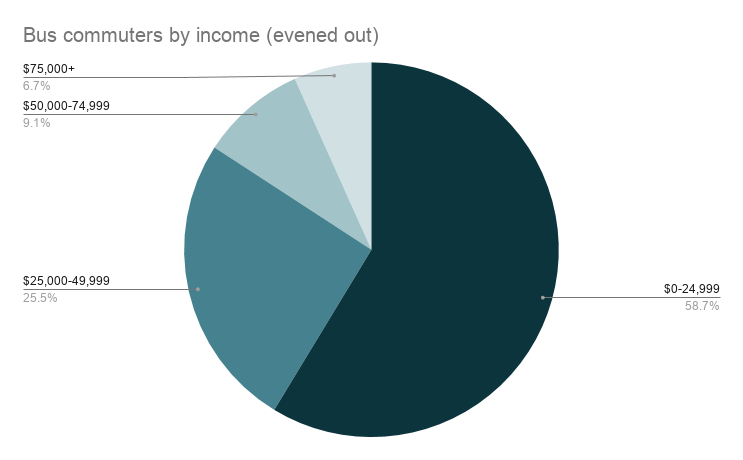
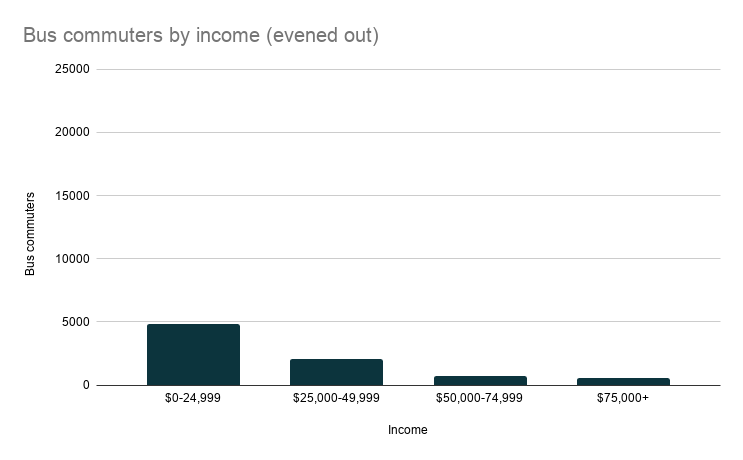
Centro serves 38% of workers in its “captive” market—those who make less than $25,000 and commute by some means other than a car. If Centro ‘evened out’ its performance by capturing 38% of the non-car-commuting population across all incomes, it would increase the total number of people who commute by bus by 43%. 

But even in this extremely unlikely scenario (quintupling the number of bus commuters earning more than $50,000), workers making less than $25,000 would still account for 59% of regular bus commuters. There just aren’t that many people making lots of money for whom it would make sense to ride the bus. In part, that’s because there aren’t that many people making lots of money, period. And in part, it’s because the people who do make that much money own multiple cars, and for the foreseeable future driving a car will never be less convenient than riding the bus.

But to even frame the question in terms of individuals making choices shows what’s wrong with the entire captive-choice analysis: every person has a choice, there are no ‘captive’ riders, and there are lots of low income people who currently choose not to ride the bus but who would if it met their needs better.

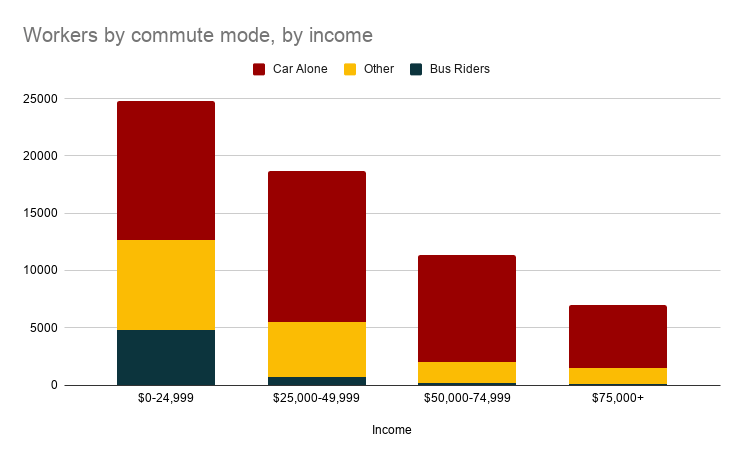
Here’s a graph showing the total number of workers living in Syracuse according to income. Within each bar, the different colors show how different riders commute. Blue is current bus commuters, and red is commuters who drive and are extremely unlikely to switch to riding the bus. Yellow is people who commute on foot, on bike, by taxi, or by sharing a ride, and it represents Centro’s best chance at ridership growth

Workers earning less than $25,000 make up about half of all workers in that yellow area, and so although that population already accounts for 84% of Centro’s current commuter ridership, it also is the portion of the working population with the greatest potential for ridership growth.

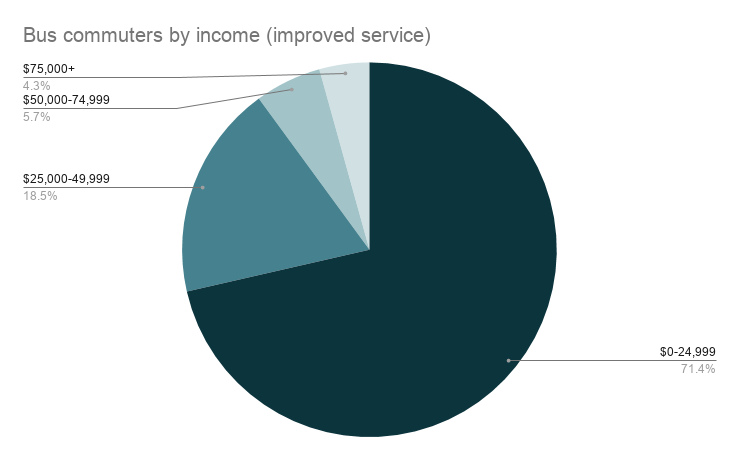
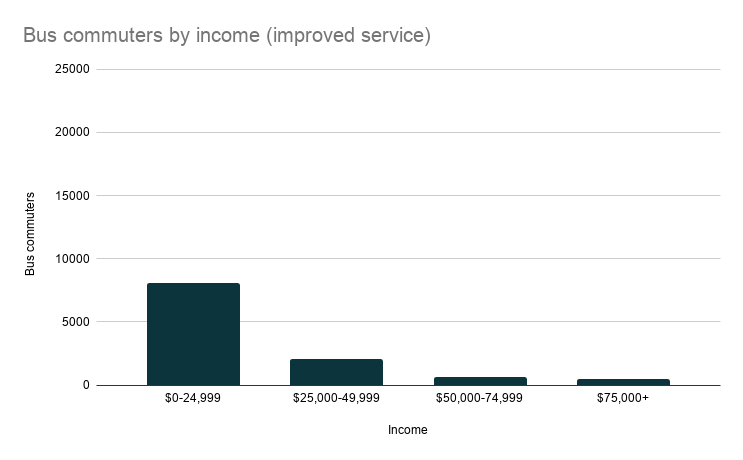
‘Evening out’ ridership across all incomes increased the share of non-car commuters who make between $25,000 and$50,000 by about 26 percentage points. If Centro improved service and enticed enough riders to see a proportional increase in ridership across all incomes, it would increase overall ridership by 96% (twice as much as ‘evening out’ performance among high earners).

57% of that increase would come from workers making less than $25,000. There are just so many low income workers, and so many of them have limited access to a car, that Centro could see huge ridership gains if it simply focused on serving the City’s poorest neighborhoods better.

And the best part is that we already have a plan to do that. It’s Bus Rapid Transit, and for all of the branding and the technology and the hype, the core of the idea is that Centro should spend every extra dollar improving service on the lines that already carry lots of people. Those lines run through neighborhoods with lots of potential bus riders, they connect to places with lots of jobs, and if they ran faster, more frequently, and more reliably, more people in those neighborhoods would use them. That’s how you build ridership.

A bus line for no one

It’s unclear exactly who is supposed to ride Centro’s new Downtown circulator route—a 2-mile figure-8 loop that winds its way from the Tech Garden to Dinosaur BBQ and back.

It can’t be people who live Downtown. The residential population is growing because the neighborhood is so famously easy to walk around. There’s no need to get in the car or wait for the bus to get from Hanover Square to Salt City Market—you can just walk there. A potentially actually useful bus service for Downtown residents would connect them to the City’s other neighborhoods, but this circulator route doesn’t do that because it never leaves Downtown.

It can’t be Centro’s regular riders. The circulator very pointedly avoids interacting with the Hub, and anyway, anybody who rides a bus into Downtown already has ample options for getting themselves around Downtown using Centro’s existing bus lines. This circulator route doesn’t add any new options for regular bus riders.

It can’t be people who drive into Downtown for entertainment. Anybody who shows up in a car has to put it someplace, and they might as well park it where they’re going. Even if they plan to move around Downtown—drinks at Hanover Square and then a hockey game at the War Memorial, maybe—the bus still isn’t much help because after riding from the restaurant to the theater, they’d have to ride back to pick up the car, and this bus doesn’t run past 7pm.

It can’t be commuters. The route doesn’t even start running until 11am.

It’s hard to imagine who would have a transportation problem that this circulator could possibly solve. But to even ask that question you’d have to think like a bus rider, and not many people in positions of power think like that because not many people in positions of power ride the bus. The officials who pushed this new service do not, in their daily personal lives, have to worry about what it would take for a bus line to make life easier, and so their reasoning on this issue is not much more sophisticated than this: “Downtown is booming, Downtown is success, a Downtown bus will succeed!”

If anyone involved had taken a moment to consider the service from the point of view of someone who might actually ride it, then they would have seen that the Downtown circulator will not serve a need, that it is a waste of money, and—because Centro’s budget is not unlimited—wasted money means worse service on the lines that people actually ride. Syracuse will never get the public transportation system that this City needs and deserves until someone with the power to make decisions at Centro takes the perspective of a bus rider.

Downtown’s suburban population

We’ve all heard about Downtown’s growing residential population, but the most recent census figures only put the neighborhood at 3,298 permanent residents. That’s just 2.3% of Syracuse’s entire population, and it’s far fewer people than live in Eastwood, the Southside, Westcott, or just about any other city neighborhood. If Downtown were a village, it’d be medium sized for Onondaga County—bigger than Liverpool, but smaller than Fayetteville and less than half as large as Baldwinsville.

Downtown’s village-sized residential population is dwarfed by the roughly 20,000 people who commute into the neighborhood for work. 78% of those workers live outside of the City. The Downtown that exists during the workday—the Central Business District filled with commuters—disappears at night and on the weekends when its primarily suburban population is absent.

This same pattern repeats itself at festivals like the Taste of Syracuse, and entertainment events like Symphoria concerts. These crowds sustain Downtown’s businesses, its infrastructure, its vitality—they’re what make Downtown different from other city neighborhoods and the villages that its purely residential population otherwise resembles.

But they also mean that when there are lots of people Downtown, a majority of them likely live outside the City, and that throws a lot of Downtown-specific policy choices into a new light. City tax cuts for Downtown companies often go to supporting suburban households. Panhandling bans protect suburban visitors from having to interact with city residents. Circulator bus routes that skip the Hub and only run from 11am to 7pm are designed to ferry suburban office workers to business lunches and happy hours for the short time that they spend within the city limits every day.

Downtown is the City’s center, but it’s also—in an economic, cultural, and governmental sense—the center of the entire region. That makes it some of the most contested space in the county, and it is key to understanding this demographically dynamic neighborhood.

The highways are walls

81, 690, and the West Street Arterial are designed to make Downtown more accessible from the suburbs, but they’re also designed to make Downtown less accessible to city residents.

They do this in two ways. The first is to cut off local streets that connect adjacent neighborhoods. 81—and the urban renewal projects that went with it—closed Jefferson, Cedar, Madison, Montgomery, and McBride Streets. The interchange with 690 closed Oswego Boulevard and Pearl and Canal Streets. The West Street Arterial closed Belden Avenue and Walton Street, and it severed Marcellus, Otisco, and Tully Streets from their connection to Downtown too.

The second is to funnel so much vehicular traffic onto the remaining streets that they become unusable to anybody not in a car. This is the state of Harrison and Adams most obviously, but it’s also a problem on Fayette, Genesee, and Erie Boulevard. A car driver approaching from the East used to have 11 different options for entering Downtown—now there are only 6. These remaining swollen streets are awful to walk along, difficult to cross, and impossible to bike in, so they crowd out local foot traffic between adjacent neighborhoods.

Any plan to fix that damage has to do more than just remove the highway—it also has to break down the barriers that segregate neighborhoods by establishing new connections between them.

NYSDOT’s plan for the Grid does this a little bit. It reopens streets like Pearl and Oswego Boulevard,  expands the Creekwalk, adds a few blocks of bike lanes, and shortens crosswalks at major intersections.

But those are just starts. Syracuse needs a more comprehensive plan to reconnect Downtown to the City. That will mean adding low-traffic pedestrian-friendly connections—like a bridge over Onondaga Creek at Fabius or opening footpaths through Presidential Plaza. It will mean narrowing West and Adams so that people can walk across them safely. It will mean building a functional public transportation system.

It should not be easier, cheaper, and more convenient for a person from Van Buren to drive Downtown than it is for someone from Park Avenue to walk Downtown. It shouldn’t be that way for no other reason than that Van Buren is 10 miles from Clinton Square while Park Avenue is less than a mile away. We’ve successfully warped the County’s geography so that 10 miles seems like less than 1, but we did it by building a wall between Downtown and the surrounding City neighborhoods. It’s time to tear that wall down and reestablish the City’s connection to its center.