Category Archives: Community

Systematic Reformation of Public Safety

Protests across the county have shown that American policing is broken—every single city has local cases of abuse, brutality, and murder to march against, and in every single city police have responded to criticism with military force. The problem isn’t just ‘a few bad apples,’ the problem is a broken institution that replicates the same unacceptable, anti-democratic, racist problems no matter where it’s implemented and no matter who is in charge.

So it’s good to hear that elected officials across America—including those with power in this City—are listening to the protesters. The Mayor is talking about structural reform to combat this systemic problem, and the Governor will withhold state funding from police departments that refuse to “reform themselves.”

But ‘reform’ can mean a lot of different things, and the kind of ‘reform’ that we’ve all seen for years—more training, new technology, revised codes of conduct—are clearly insufficient to meet the demands that protesters are making today.

In Syracuse, protesters have issued the People’s Agenda for Policing: a list of nine demands that could make real change in the SPD—not the kind of weak ‘reform’ that tinkers with the existing system—a system that is hopelessly broken—but a real reformation of the institutions of Public Safety in this community.

Reducing the “oversized role of policing” means taking traffic enforcement out of armed officers’ hands. Traffic enforcement should make our streets safer, but instead racism and the incentive structure of policing serves to make the traffic cop a threat to safety on the street—people don’t get stopped for breaking the law, they get stopped in order to make the department money, or to get a drug bust press release, or to just perform dominance.

Instead, use cameras and unarmed municipal employees—in the mold of crossing guards—to enforce the law without ulterior motives, to remove the inherent bias that comes when a driver tries to ‘argue their way out’ of a ticket, and to avoid unnecessary escalation. When someone runs a red, send them a ticket in the mail. If someone’s tail light is out, let them know and provide a new bulb on the spot.

Reducing the oversized role of policing means sending someone else when people call for help with domestic problems. Armed officers focused on ‘compliance’ and ‘order’ are ill-equipped to mediate these kinds of conflicts, and the predictable result is that they respond inappropriately, escalatorily, and they end up beating a man for no reason and costing City Hall $1.5 million in a police brutality lawsuit.

Instead, send social workers and trauma specialists who can mediate and de-escalate domestic disputes. Send people who have the professional judgment to determine when to attempt reconciliation or when to help a person escape an abusive relationship.

These situations—and so many others like them—do not require a gun. They do not require handcuffs or a taser. When City Hall equips police with those tools—but not the training to actually address the needs of the community—what can we expect but escalation? When the person responding to a minor traffic violation carries a gun and is empowered to take away people’s freedom, it’s no wonder that a disagreement over when to signal a turn ended with the SPD drugging and sexually assaulting Torrence Jackson. It’s shocking, appalling, disgusting, infuriating, but it’s not surprising.

So systemic reformation means fewer police officers whose very presence necessarily implies violence and incarceration, and more municipal employees who are trained and equipped to treat root causes of the problems in the community. It means taking money away from the SPD and using it to pay for staff and programs that support public safety. That’s the kind of reform that can actually deconstruct the present unacceptable system and build a new one that makes the community safe.

Quit asking if the protests are peaceful

After night fell on a day of speeches and demonstrations, a number of the protesters attacked the building where the police were waiting. The protesters were breaking the law, and they knew it, and the police responded with force.

It was 1851. It was the Jerry Rescue. There’s a monument to it in Clinton Square.

That event—one that we valorize and memorialize—parallels the protests going on in the City today, and acknowledging that means grappling with these complicated facts:

the fight against racism and white supremacy is not always legal

the fight against racism and white supremacy is not always peaceful

the fight against racism and white supremacy cannot be judged purely on its legality or its nonviolence

That’s hard for a lot of people. It’s so much easier to ask ‘well are these protesters peaceful, do they obey the law?’ Asking that question puts the burden on the protesters. It allows people to think of themselves as outside observers and to pass judgment on the protests based on how the protesters act. It puts the protests themselves on trial, and once they have been judged—peaceful, legal, good or violent, illegal, bad—then the neutral observer moves on, having made their decision, without ever actually addressing the content of the protests.

Taking these protests seriously, respecting the history of the Jerry Rescue, means instead asking ‘what are they saying, is it true, how am I implicated?’ It means hearing the names of the men, women, and children brutalized and killed by the Syracuse Police Department. It means examining the relationships between those beatings, those killings, and your own life. It means putting yourself on trial, recognizing the ties that bind you to the people whose lives the police have cut short, and deciding what you’re going to do about it.

And once you’ve done that, who cares whether or not the protests broke this curfew or smashed that window? What does any of that have to do with you, with your own action, with your response to the racism and injustice that permeates the United States, New York State, Syracuse?

How Far From Minneapolis, Syracuse?

This weekend’s protests are about Syracuse Police Department as much as they are about George Floyd’s murder at the hands of Ex-Minneapolis Police Officer Eric Chauvin. It might be comforting to those in power to pretend otherwise, to think that it’s all about something that happened in some other community, somewhere far away from here, but that’s a lie.

Those protests are also about how police dragged Shaolin Moore from his car and beat him in the street, how their justification was that they were afraid of the communities they serve, and how they arrested Yamil Osorio in retaliation for filming the whole thing.

And those protests are about how police officer Chester Thompson used the power granted him by his badge and the gun on his belt to rape multiple women—including Maleatra Montanez—while on duty, and how the Syracuse Police Department just let it happen.

And they’re about how the Syracuse Police Department ordered medical professionals at St. Joseph’s Hospital to drug Torrence Jackson and then to sexually assault him with an anal probe.

And the protests are about how Syracuse police officers Paul Montalto and Damon Lockett beat Alonzo Grant because he punched a screen door in his own home.

And they’re about how the Syracuse Police Department singled out Elijah Johnson while breaking up a party near Syracuse University, beat him, and then falsely charged him with inciting a riot.

And those are just some of the highest profile cases of the last couple years. This list could go back for decades, more than a century, as far back as police kidnapping William “Jerry” Henry to sell him into slavery in 1851, and it go much broader, encompassing every racist traffic stop that traumatizes a family but somehow isn’t ‘newsworthy’ enough to make it into the paper.

If the people in power are actually listening, if they have ears to hear what protesters are saying, they’ll acknowledge this abuse, and they’ll use their power to end it.

Coronavirus, the Sidewalks, and Race

The coronavirus has disproportionately hospitalized black people in Onondaga County. The County’s population is 76.5% white, but only 54% of people hospitalized for coronavirus are white. The County’s population is 11.5% black, but 27% of people hositalized for coronavirus are black.

Looking for a possible explanation, the County Executive “speculated that the trend might be due to the fact that African-Americans have, as a whole, larger percentages of diabetes and heart disease, preexisting conditions that can make the virus much worse.”

That checks out. The overwhelming majority of black people in Onondaga County live in a few segregated neighborhoods in Syracuse, and those are the very same neighborhoods where the CDC has found the highest rates of diabetes and high blood pressure.

Why though? Why is it that black people in Onondaga County are so much likelier to have been sick than white people, even before all this started?

The CDC also keeps data on factors (like lack of sleep) that contribute to health outcomes (like diabetes and high blood pressure). Here are maps of obesity, lack of sleep, and lack of exercise.

Put all this together, and you get a pretty stark picture. Black people are segregated into specific neighborhoods where environmental factors like polluted air and lack of access to opportunities for exercise have made it difficult for people to maintain their health, contributing to chronic conditions like diabetes and hypertension which have put them more at risk to contract coronavirus.

So it was a good thing that City Hall had announced its intention to maintain the sidewalks. Better sidewalks are the kind of positive environmental factor that would improve health outcomes by making it easier to get around on foot, making that light exercise a more prominent part of the routine of daily life. This is particularly true in those neighborhoods where people are less likely to own a car and more likely to live within walking distance of job centers like University Hill and Downtown—neighborhoods like the segregated ones where negative environmental factors have made coronavirus so much of a problem today.

But on the same day that we learned of coronavirus’ disparate racial impact, City Hall postponed that plan to maintain the sidewalks because the coronavirus has blown a hole in the municipal budget. City Hall was going to introduce a new frontage fee to pay for that maintenance, but Mayor Walsh explained that “we didn’t feel it would be fair to constituents to bear that burden now.”

But why should it take a new fee to pay for the sidewalks when DPW manages to maintain the rest of the street with money from its regular budget? Why can’t City Hall just redirect some of the road repaving money to fix the sidewalks? Why is the funding so fragile for a public resource primarily used by Syracuse’s poorest residents while the funding for the roads driven on by relatively richer City residents (and County commuters) is so resilient?

Taken together, these environmental conditions that contribute to poor health in black neighborhoods and particularly fragile funding for the mitigation of those conditions amount to an instance of structural racism—a series of seemingly neutral, unrelated, and agentless decisions that conspire to yield inequitable outcomes divided along racial lines.

Clearly, the Mayor isn’t postponing his sidewalk maintenance plan because he’s racist. And clearly, fixing the sidewalks would not, on its own, mitigate coronavirus’ disparate impact on black people in Onondaga County. And that’s the problem with structural racism—when inequity is the unintended effect of boring stuff like appropriations, when no one makes those original decisions for racist reasons, and when unmaking any one of those decisions will only have a slight and delayed effect on the enormous overall problem of racist inequality, then it’s too easy to put anti-racist action off indefinitely.

But we have to take that action now. The truth is that it’s never easy to dismantle the racist structures that hold up our municipal government. The coronavirus may make it seem like now is a particularly bad time to start, but a look at the racial disparity in infections should be enough to prove that Syracuse needs to do this work now more than ever.

What if they had put the trains in the Erie Canal bed in 1925?

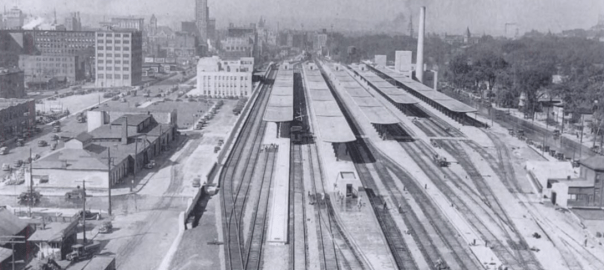
Early in the twentieth century, Syracuse was facing two huge shifts in transportation. The Erie Canal became obsolete after New York State built the Barge Canal in the Seneca River north of Onondaga Lake, and railroad traffic through Downtown had gotten so bad (158 trains a day) that the tracks had to be moved off of Washington Street. City leaders saw an opportunity to deal with both problems at once by putting the railroad tracks in the old Erie Canal bed.

What if the New York Central Railroad had moved its tracks from Washington Street to the Erie Canal bed after the Barge Canal was finished?

The New York Central main line entered Syracuse from the East between Burnet Avenue and the Erie Canal. It ran at grade level through that industrial valley to about Teall Avenue. There, the tracks crossed the canal and ran in the middle of Washington Street all the way through Downtown. Past West Street they passed through the rail yard between the Canal and Fayette Street, and then followed the path of the current New York, Susquehanna, and Western tracks out of town.

A 1917 report on grade crossing elimination proposed maintaining the line’s eastern section to Teall, turning to enter the Canal bed at Beech Street, running in that trench all the way to Montgomery Street, turning north into the Oswego Canal, and then following the path of the West Shore Railroad (present-day 690) on an elevated route out of the City. A new passenger station would go at the corner of West and W Genesee Streets, and the old station would be used for Interurban Trolleys (a precursor to Centro’s intercity coach service). That same report also recommended elevating the Delaware, Lackawanna & Western tracks along Armory Square.
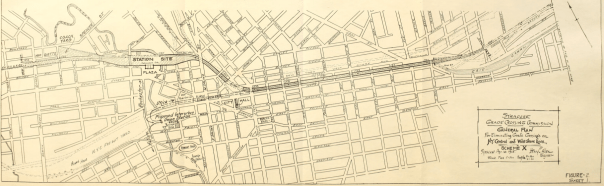
What actually happened is that, in 1936, the New York Central elevated its tracks on a berm in the West Shore Railroad right of way along Burnet Ave, Noxon St, Belden Ave, and State Fair Boulevard (that embankment now supports 690 through the City), and the new passenger station went up at Erie Boulevard and Forman Ave (the current Spectrum Cable building). (The DL&W elevated its tracks in 1941, just as the earlier report proposed).

These three maps show the situation in 1917 at left, the Grade Crossing Commission’s recommendation in the middle, and the eventual 1941 elevation on the right. Red lines are train tracks at street level, blue are lines running below the streets, and green are those lines running on bridges over the streets.

The difference between the Grade Crossing Commission’s recommendation and the eventual 1941 elevation amounts to moving about 1.5 miles of track 300 feet to the south and putting those tracks in a ditch instead of on a berm. It doesn’t look like that big of a switch, but it would have been huge for Syracuse’s development.

First, tracks below grade are very different from those above grade. The pictures on the left show the New York Central’s elevated line in Syracuse, and the pictures on the right show the canal bed in Rochester after that city repurposed it as a below-grade rail line. Imagine standing at the back of City Hall and being able to see into the Northside versus the situation we have now where that view is blocked by a two-story berm.

Second, running the trains in the canal bed would have kept Erie Boulevard from becoming a major East-West crosstown route for car traffic. It’s possible that the City Planning Commission would have turned the canal into a road east of Beech Street, west of West Street, and connected those two segments with Canal or Washington Street (at the time, they were very interested in joining streets to create more crosstown routes), but it’s just as likely that another street would have taken on the role that Erie Boulevard East has come to occupy—Burnet Ave, maybe. Then, Salvation Army, Lowe’s, Price Chopper, etc. would all be in Eastwood instead of on the Eastside.

It is also possible that the canal might still run through part of the City. The main reason to fill it in was to get rid of the unreliable mechanical lift bridges that crossed it Downtown. That wouldn’t be a problem anymore if trains ran in the canal bed, some businesses did still use the canal for shipping, and cutting out the middle section would have made Erie Boulevard much less useful for getting across town, so—instead of cutting it off at Butternut Creek—the City and State might have allowed the canal to run all the way to Teall Ave or so.

Third, Syracuse would have gotten a different train station in a different place. The Grade Crossing Commission called for a new passenger station at the corner of West and W Genesee Streets. It would have sat back from the street on a new plaza at the Western edge of Downtown, and—having been designed and built in the 1920’s instead of the 1930’s—it would have been in a different architectural style from the late Art Deco station that Syracuse actually did get on Erie Boulevard outside of Downtown. That station is pictured on the left. The other pictures show some of the New York Central’s slightly earlier stations built in other New York Cities.

Of course, that station plaza is now the site of the West Street interchange, and imagining a train station there raises questions about how this all would have changed the decisions that politicians and engineers made about where to put the highways.

81 could still run where it does now. It’s just worth pointing out how crazy it’d be to walk up North Salina Street with a train rumbling along below your feet while cars roared overhead.

690 is a different case. It’s built on the embankment where the New York Central elevated its trains in 1936. If the railroad had put its trains in the canal bed, then that embankment wouldn’t exist, and so 690 would have to go somewhere else.

Initial plans for 690—made before NYSDOT knew that the railroad wanted to abandon its elevated track—ran the highway on a viaduct between Washington and Fayette Streets to an interchange with 81 at Almond Street. From there, the highway curved around the northern side of Downtown to follow the elevated train tracks out of the City. If the train station were at West Street, however, that route would not work. In that case, NYSDOT may have adopted a part of the City Planning Commission’s proposal to route the highway along West Street to Erie Boulevard West, and from there to State Fair Boulevard out of the City.

This would have shifted the highway several hundred feet south, covering dozens of city blocks and hundreds of acres of land—not very different from the terrible plans that NYSDOT has drawn up for rebuilding the I81 viaduct. It would have destroyed City Hall, the weighlock building, put the highways within a block of Clinton Square, and cut the train station off from Downtown.

Of course, all of these adjustments to the City’s transportation infrastructure would have had rolling implications on Syracuse’s development. What would it mean for the Westside if the Geddes Street exit from 690 was right at Fayette instead of Marquette Street? What would it mean for Eastwood if Burnet Ave had room to breath instead of being overshadowed by 690? How would Centro’s bus lines change if the train station was Downtown instead of all the way at the City’s northern edge? Would more of the factories off Carrier Circle have located on Canal Street if freight trains could still run through that valley?

For all those questions, we do know this: if they had put the trains in the canal bed after New York State built the Barge Canal, it would have shaped Syracuse very differently over the course of the twentieth century.

Coronavirus, the Digital Divide, and Public Libraries

Social distancing has moved so much of our work, learning, and social interaction online, but we’re leaving too many people behind. Only about ¾ of Syracuse households have internet access. That leaves 13,000 families where the parents simply cannot telecommute and the kids simply cannot participate in a virtual classroom.

In more normal times, these families use free wifi or public PCs when they need to get online. They go to school, to the library. That’s why libraries have left the wifi on even though they’ve locked their doors—so that people who need the internet can sit in the parking lot, log on, and check their email, submit an assignment, join a video meeting, or whatever else it is that they need to do online in these crazy times.

But that’s clearly not enough. For one thing, too many of the families that need public internet can’t very well drive to the library because they don’t own a car. At the same time, only essential workers are supposed to be on the buses, and there aren’t enough branch libraries to be within walking distance of all the neighborhoods.

Internet access (in green) and car access (in yellow) in Syracuse. The black lines show streets within 1/2 mile of a library

So how are all of those people without internet and without reliable access to public wifi supposed to work from home or become distance learners? For that matter, how are they supposed to file for unemployment or look for jobs or see the faces of loved ones living away from here?

And while coronavirus has highlighted the digital divide, it’s a problem that’s been around for years, and it will still be a problem even after the world goes back to ‘normal.’ In a few months time (god willing), the same people who can’t telecommute are going to have to go to the library to file for unemployment, to apply for new jobs, to fill out the census.

So it’s extremely distressing that Onondaga County just laid off a slew of library workers. Will they have jobs when all of this is over? Will the branches be fully staffed when they reopen? Anybody who’s spent any time in a public library can tell you that the staff is just as necessary as the computers for ensuring equal access to the internet. 

The coronavirus is widening the fault lines in the community. Who gets laid off versus who can work from home—who can enroll their children in a private online learning program versus who has to home school without any resources at all. These  lines are expressions of the digital divide. If Syracuse is going to come out of this crisis even more united and less unequal, it’s going to have to bridge that divide. Instead of laying off library staff, the County has to open new branches in more neighborhoods. That’s what it will take to make the City stronger than it was before.

Coronavirus and the Bus

Crises reveal what really matters. Work that used to be forgotten is now understood to be essential. Workers who used to be taken for granted are now recognized as heroes—fighting on the frontlines against this global pandemic—the hospitals, the nursing homes, the garbage routes, the checkout counters.

Renewed appreciation for these people and the work that they do is shaking up Syracuse’s ideas about what makes the City work. When Syracuse started social distancing, a lot of people expected Centro to cut its service. After all, demand was bound to go down, and anyways, no one really rides the bus, right?

Instead, the entire community is learning just how much Syracuse needs the bus. While big cities like Chicago and Boston have seen 75% drops in transit use, Centro’s ridership has only dropped 55%. And the people who are still on the bus are the ones getting Syracuse through this crisis. As Centro spokesman Steve Koegel pointed out, the remaining bus riders are often in uniform: “A lot of people are wearing hospital garb. It’s visible those are the people using our service. They are critical-need workers.”

So while the buses remained full of heroes riding to work in the hospitals, and highway interchanges went empty, our transportation priorities shifted. The federal stimulus included $21.5 million for Centro, a necessary lifeline for a perennially underfunded service. After years of getting cut out of budget deals, left to languish with declining local, state, and federal support, this crisis shook people up and made them realize that Syracuse needs a functioning public transportation system to survive.

.   .   .

But the risk is that once this crisis is over, once we’ve moved from dealing with a global pandemic to managing its economic aftershock, the people in power will forget that lesson and go back to business as usual—back to neglecting the basic necessities that made it possible for the City to get through this, back to starving the bus.

We can’t let it happen. We need to come out of this smarter than when we went in, with a greater appreciation for what makes life in Syracuse livable. That means a new commitment to the services that support the people who do Syracuse’s most essential work—it means better bus service.

What if Liverpool had merged with Salina and Syracuse in 1848?

In 1848 the villages of Salina (the area around Washington Square) and Syracuse (the area around Clinton Square) merged to form the City of Syracuse. According to Dennis Connor’s book Crossroads in Time, local leaders also considered including the villages of Geddes and Liverpool in the new city. Geddes (the area around St Mark’s Square on West Genesee Street) eventually joined the City in 1886, but Liverpool never did. In fact, the City never annexed any land between Salina and Liverpool.

What if Liverpool had joined Salina and Syracuse to form a new City in 1848?

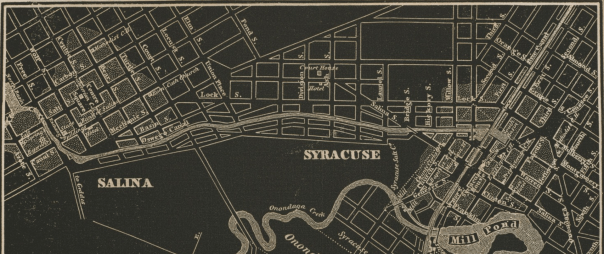
When Salina and Syracuse merged in 1848, there was still a lot of empty land between them. In 1830, Onondaga County moved its courthouse from Onondaga Hill to the corner of Salina and Division Streets in an attempt to stimulate development there so that the two villages would grow into each other. That didn’t happen. An 1838 map shows the courthouse sitting all alone, Salina only extending as far south as Court Street, and Syracuse only reaching as far north as Hickory Street. When that courthouse burned in 1856, its location was still so out of the way that the County built its third courthouse on Clinton Square.

Screenshot 2020-03-19 at 1.22.32 PM

But in 1860, the City’s very first streetcar line began service between Washington and Clinton Squares, and by 1868, Syracuse and Salina had grown together. A bird’s-eye-view from that year shows houses and businesses lining Salina, State, and Lodi Streets between the two former villages. A similar print from 1874 shows even more development and less open land on the blocks surrounding North Salina Street.

Meanwhile, the land between Liverpool and Salina stayed empty. Developers built a few new blocks of housing at the intersection of Old Liverpool and Buckley Roads in the early 20th century, but a lack of fresh water and public transportation limited development there, It wasn’t until after World War II that a new municipal water source and higher rates of car ownership made Galeville’s subdivisions possible.

Let’s assume that if Liverpool had merged with Salina and Syracuse in 1848, this would have extended the new City’s boundaries to include the present Village of Liverpool and all of the land between it, Ley Creek, 7th North Street, and Onondaga Lake—Galeville, basically. As part of the new City of Syracuse, anyone living there would have had access to municipal services like fresh water in the 1860’s and fire protection in the 1870’s. They could have walked to work at the Galeville Salt Works, and streetcar service would have connected Liverpool to Syracuse before 1903.

All of which is to say that if Liverpool had joined the City of Syracuse in 1848, then Galeville would have developed in the late 1800s rather than the late 1900s.

Different neighborhoods built at the same time follow a similar pattern. The Northside neighborhoods that grew up in the 1850s look like the oldest parts of the Near Westside—Scottholm looks and feels like Sedgwick and Strathmore because they were all built in the 1910s and 1920s when curving streets, big lots, single-family zoning, and eclectic architecture were in style. Galeville looks a lot like Pitcher Hill and Franklin Park because developers built all three neighborhoods at the same time.

So we can imagine how different Galeville might look if it were built 100 or 80 or 60 years earlier. Galeville’s distance from Downtown, its topography, and the nearby railroad, canal, and salt works all make it very similar to Tipperary Hill. It’s just a guess, but if Galeville had been part of Syracuse from 1848, then people might have started moving there in the 1870s—about the time that people moved to Tipp Hill. Then, like that older city neighborhood, Galeville would be covered in taller houses on smaller lots along narrower streets with businesses, churches, and schools scattered throughout the neighborhood so that people could buy groceries, get a haircut, or go to the bar without having to catch a trolley.

Of course, if the Village of Liverpool had merged with Salina and Syracuse in 1848, it would be a different place too. The Village already had ready access to municipal services like water, schools, and fire protection in the 1800s, and it had lots of jobs in salt making, boat repair, and basket weaving—none of those factors constrained Liverpool the way they did Galeville, and the Village would probably have grown just as it actually did.

With one big difference. The postwar suburban boom hit Liverpool hard—people wanted to pass through the Village to get from their new subdivisions to Downtown, and NYSDOT responded by widening Oswego Street to more than 60 feet across. That wide road made it easy for all of northern Onondaga County to drive though Liverpool on their way to Syracuse, but it also made it unnecessarily hard for anybody to walk from one side of the Village to the other.

There are roads that wide in other County suburbs—West Genesee in Fairmount, Route 5 in Fayetteville, Erie Boulevard in Dewitt—but there are none in Syracuse. City neighborhoods didn’t want their walkable streets widened into dangerous roads, and they had collective political power to keep it from happening. If Liverpool were a city neighborhood, Oswego Street would be a reasonable size.

Picture that: Liverpool, a lakeside city neighborhood with its mix of apartments and 1-family homes, neighborhood businesses, and walkable streets. Take a bus into Downtown, and you’d pass through Galeville—a tight-knit community on a bluff overlooking Onondaga Lake Park. What if, right?


(aerial photographs from Cornell University Library. Black and white photographs of Liverpool from the Liverpool Public Library.)

Big Demographic Trends, part 3

Big demographic trends are bringing equally big changes to Onondaga County and the City of Syracuse. Two weeks ago we looked at where those changes are happening. Last week we tried to figure out who is driving them. This week we’re asking why we should care.

The Old Growth

outer ring
Areas that were farmland in 2000 gained population as they were suburbanized. Those that were already villages in 2000 lost population. Almost all were much richer in 2016 than in 2000.

The dominant demographic trend in Onondaga County is the wave of older wealthier people migrating away from the City along major highway routes.

Over the first 16 years of the 21st century that wave crossed Rt 31 in the northern part of the County, it mounted Onondaga Hill in the South, and it passed old Camillus in the west and Manlius in the East. In all of those places, it has spurred the subdivision of thousands of acres of farmland into tract housing, filling previously rural areas with new, older, richer residents. In the existing villages where political and bureaucratic pressures prohibited developers from building much new housing, this wave made the population older and richer, but also smaller. Altogether, that outer ring of suburbs grew by 13,200 people between 2000 and 2016.

Older suburbs had trouble attracting new residents between 2000 and 2016. They became smaller, poorer, and older.

That huge growth at the leading edge of Onondaga County’s suburban development obscures the very different conditions left in its wake. The older suburbs slightly closer to the City are almost all aging faster than the rest of the County too, but they’re also losing population and getting poorer. When the main thing is to have the newest house as close to the country as possible, then every new subdivision outmodes the last one. Since the County as a whole is only growing by a very small amount, a bigger and richer population in Van Buren necessarily means a smaller and poorer population in Lakeland. That inner ring of older suburbs lost 6,555 people between 2000 and 2016.

The County can maintain its overall stability as long as new growth at its edge outweighs the decline towards its center. So much of what makes the outer suburbs attractive places to live—the schools, the roads, the sewers—requires constant new investment and repair, and it’s the new tax revenue generated by new suburban development that pays for all of it.

The very bad news for the County is that, in several directions, the wave of wealthy, populous, tax-generating suburban growth is about to cross the County line. When that happens—when older richer people are more likely to commute to Syracuse from Cazenovia than from Manlius, or from Central Square instead of Cicero—the population growth, new development, and tax revenues that have made Onondaga County pleasant and prosperous will all go to other municipalities. All of a sudden it’ll be Oswego and Madison Counties enjoying those benefits while Onondaga is stuck with the costs of maintaining the infrastructure that makes them possible—a neat inversion of Onondaga County’s current relationship with the City of Syracuse.

The New Growth

suburbsplusgrowingcity
The suburbs closest to the City, as well as several City neighborhoods gained population and got younger between 2000 and 2016.

The good news is that there is new growth in the City and its immediate suburbs that could save the County. That growth is driven by people who are generally younger and more likely to have children than those moving to its outskirts, and it’s driven by people who want access to the benefits that come from living in the middle of the metropolitan area rather than at its farthest edges.

From the middle of Downtown to just inside the wake of the Old Growth wave, much of the County is growing, and it’s getting younger. This central area includes early post-war suburbs like Mattydale and Nedrow, pre-war suburbs like Eastwood and Salt Springs, 19th century neighborhoods like Westcott and the Northside, a large part of Dewitt right on the City line, and new development at the very center of the City Downtown and in Franklin Square.

This area includes all of the central suburbs where people are taking advantage of shorter commutes and cheaper housing. It includes City neighborhoods where there are a variety of housing options that can accommodate people living a variety of lives. It includes the only places in the entire County where adequate bus service and walking neighborhoods make life without a car possible. Altogether, this part of the County gained 11,745 people between 2000 and 2016. If it continues to grow, that may offset the loss of that Old Growth wave when the metro area’s outermost suburban development moves into Oswego and Madison Counties.

Many City neighborhoods are losing population but getting younger.

In order for that to happen, more of the middle of the County needs to start growing. That should happen in those City neighborhoods that are still losing population overall, but gaining younger residents and becoming more likely to include households with children. This greening City lost 5,875 people between 2000 and 2016, but it is poised for future growth if it just gets the necessary support. That means addressing the acute pressures on family life—things like lead paint, schools, jobs, and safety—that are currently keeping potential residents from moving in or pushing existing residents to try and move out.

Some City neighborhoods are losing population and getting older.

At the same time, Syracuse needs to take a hard look at the City neighborhoods that are shrinking, aging, and losing children despite all of their natural advantages—the neighborhoods that are trending in the same direction as the shrinking suburbs. The South Avenue corridor is one. There, decades of racism and disinvestment have taken their toll and need to be rectified.

Winkworth, Meadowbrook, and Eastwood south of James are all also shrinking and aging. Those neighborhoods—ones that appear to be some of the ‘best’ in the City, but are trending in the same direction as the ‘worst’—share too much in common with suburban villages like Baldwinsville where bans on new construction crowd out potential new residents. All need zoning reform to allow for smaller lots and more apartments in order to make enough room for the people who want to move to those neighborhoods.

Altogether, these nine census tracts lost 4,474 people between 2000 and 2016.

So why do we care?

Onondaga County is a demographic time bomb. The County has always relied on suburban growth driven by older richer residents moving into new housing built on farmland at the edge of the metropolitan area, but that wave of prosperity will soon cross the line into Oswego and Madison Counties, leaving Onondaga County behind. If current trends hold, then at that point Onondaga’s suburbs will be smaller, older, and poorer, and unable to afford basic maintenance on their most basic infrastructure.

To thrive after that shift, the City and County have to encourage the new growth that’s already happening at their center now. That’s going to require a new way of thinking about the metropolitan area’s future. Young people are moving to its middle for entirely different reasons than old people are moving to its edges. Syracuse can’t succeed by trying to imitate the suburbs that it sometimes envies. Winkworth, Meadowbrook, and Eastwood south of James are all evidence of that.

Instead, Syracuse and Onondaga County need to focus on the natural advantages that are already drawing people to the center of the metropolitan area. Lots of housing, a variety of housing, short trips to work that people can make by bus, bike, foot, or car, neighborhoods where things like groceries, libraries, doctors, and schools are easily accessible. These are what differentiate Syracuse and its central suburbs from so much of the rest of the County, and they are the future of the entire community.

Big Demographic Trends, part 2

From 2000 to 2016, the different neighborhoods, villages, and towns that make up the City of Syracuse and Onondaga County saw huge swings in population while the County and City as a whole held steady. Those neighborhood fluctuations reveal big demographic trends that point to a very different future for the City and County.

Last week we looked at where those changes are happening. This week we’ll try and figure out who is driving them.

To do that, we’ll compare population change to two other major demographic trends—change in median age and change in median income. We’ll examine these three trends in individual census tracts as deviations from Onondaga County’s overall trend. In tract 3, for instance, median income rose by $20,208 between 2000 and 2016, but what really matters is that median income rose by $5,338 more than median income in the County as a whole.

We’ll also confine our focus to census tracts where more than 3 people live on every 2 acres of land. As we saw last week, the effects of population change are concentrated in the more densely populated areas at the center of the County, but small changes can appear exaggerated in the large, outlying, sparsely populated towns at the County’s edge. It’s the same with changes to median age and income, and it’s easier to discern these trends by focusing on their effects in the City and its more established suburbs.

Change in median age, 2000-2016

In Onondaga County, the median resident was about 2.5 years older in 2016 than the median resident in 2000. The outer suburbs drove that trend, aging significantly between 2000 and 2016 (orange). Meanwhile, most of the City and inner suburbs actually got younger (purple) over that same time. The notable exceptions were Meadowbrook, the South and West sides, and tracts like 16 and 61.01 that contain large senior living facilities.

Change in median income, 2000-2016

The median household in Onondaga County made about $15,000 more in 2016 than it did in 2000. In general, the neighborhoods that aged also got richer (green), and the neighborhoods that got younger also got poorer (red). That trend was reversed in some City neighborhoods like Downtown, Franklin Square, Strathmore, and Sedgwick, which got both younger and richer. On the other side, inner suburbs like Geddes and the southern part of Clay were both older and poorer in 2016 than they were in 2000.

Who is Driving Population Change?

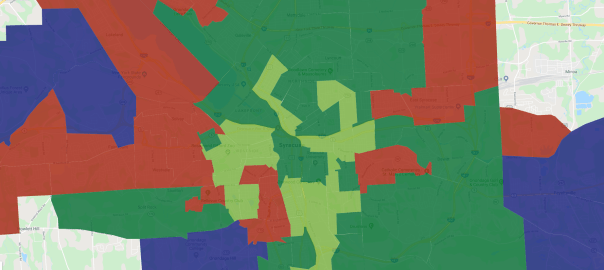
Compare change in median age to change in median income and population change, and each census tract falls into one of 8 different categories:

Growing, Younger, Richer:

Well-off young people are moving into city-center neighborhoods like Franklin Square and Downtown, or they’re moving into the near-in suburbs in Dewitt. Interestingly, the decision to pick the City or the County doesn’t seem to depend on whether or not these people have children—the percentage of households with children increased roughly equally in both areas between 2000 and 2016.

Growing, Younger, Poorer:

Households in all of these neighborhoods are getting bigger, but for different reasons. In the suburbs and on the Northside, bigger, poorer, younger households correlate with increases in the number of children in a household. On the Northside specifically, immigrants are driving this change—the percentage of immigrants living in census tracts 4, 6, 14, and 15 rose by more than 10 points between 2000 and 2016.

In the other City tracts—in the area around Teall Ave south of James, the foot of Tipp Hill and in Westcott—bigger households correlate with decreasing rates of children, suggesting that young people are moving in together to save on expenses.

Growing, Older, Richer:

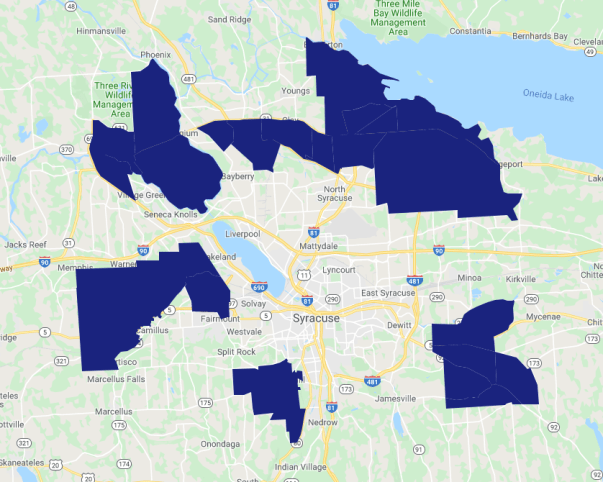
These outer areas—not one census tract in the City displays all three of these trends—are quickly transitioning from rural to suburban development. They are places with lots of new housing that have attracted older people with above average incomes.

Growing, Older, Poorer:

In the City, these are tracts with big senior housing complexes.

The suburban tracts are less straightforward. Tract 135 in Salina has added almost 700 households between 2000 and 2016, and the proportion of households with children held steady over that time, but the neighborhood still aged by almost 6.5 years. In 2016 the median resident was 48.4—10 years older than the media resident of the County.

Shrinking, Younger, Richer:

Screen Shot 2019-12-22 at 6.39.36 PM

In the City, these are neighborhoods like Sedgwick, Strathmore, Tipp Hill, and the University Area where older residents have moved away and been replaced by new young families. Despite the new well-off residents—or maybe because of them—these neighborhoods are still shrinking because those new families are smaller than the households they replaced. That’s even true in several tracts where families were more likely to have children in 2016 than in 2000.

In the County, these are some of the very oldest post-war suburbs like Bayberry and Westvale. The households moving into these neighborhoods are younger, richer, and smaller, but they’re also less likely to have children. If these couples start having kids and raising families, then these neighborhoods might start growing in the near future.

Shrinking, Younger, Poorer:

Screen Shot 2019-12-22 at 6.41.30 PM

This trends typify a huge swath of the City, stretching from the Eastside to the Southside in a continuous arc. This is the blackest part of the City (and County), and it has suffered decades of targeted racist disinvestment and oppression.

Something similar is happening in suburban spots like Mattydale and the G streets in Clay.

Shrinking, Older, Richer:

Screen Shot 2019-12-22 at 6.42.53 PM

In City neighborhoods like Meadowbrook and Winkworth, and in suburban villages like Baldwinsville, Liverpool, and Manlius, an aging population, declining number of children, high housing costs, and restrictions on new construction have combined to bring the population down, while the residents that remain are increasingly richer and older than the rest of the County.

Shrinking, Older, Poorer:

Screen Shot 2019-12-22 at 6.43.50 PM

These trends typify another huge swatch of the City, stretching from Solvay through the Westside down along the South Ave Corridor. This part of the City, too, has suffered from decades of disinvestment and neglect, particularly around Onondaga Creek where the frequent flooding and federal policies have contributed to housing instability.

This pattern repeats in the suburbs in parts of Camillus, Clay, and Dewitt, but primarily along the 690 corridor from the City line all the way to Baldwinsville through Lakeland, Seneca Knolls, and Village Green.


Screen Shot 2019-12-22 at 6.20.03 PM

Put all of that together and you get a pretty good picture of who is driving population change in Onondaga County. This map shows the area’s population radiating from the City along six major highways: Interstates 81 and 690, and Routes 5, 11, 57, and 92. The metro area is growing in a classic donut pattern, with the most intense population increases occurring in the outer suburbs and the city center. Older people are driving that growth at the outer ring, while younger families are driving it in the inner core. Wealth is also either moving out to the County’s edge or concentrating in a few spots at its center. Many areas in the middle are getting smaller, and most all are getting poorer.

Next week, we’ll suss out why all of this matters for the City and the County’s future.