When you’ve already started cooking dinner and realize that you’re out of eggs and that you absolutely have to have eggs for this meal to work, it’s a beautiful thing to be able to just run down the block to buy a dozen without even turning the stove off.
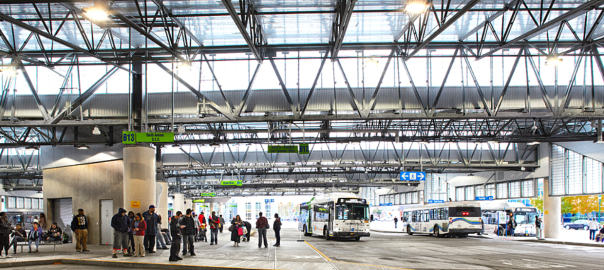
When you don’t own a car and normally have to rely on a bus that only runs every 40 minutes whenever you want to leave the neighborhood, it’s a beautiful thing to be able to just wheel a cart around the corner to make the weekly grocery run.
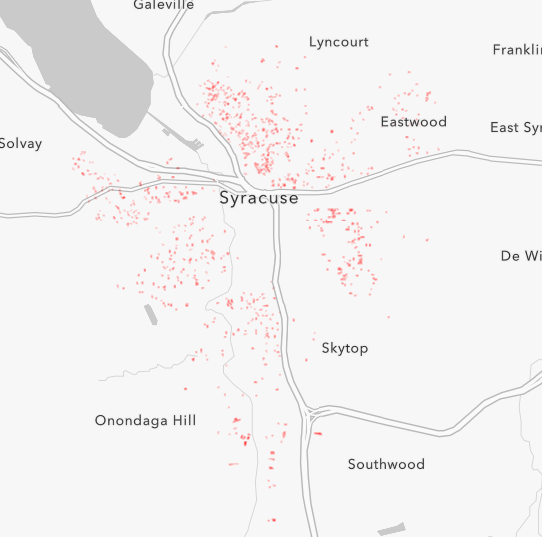
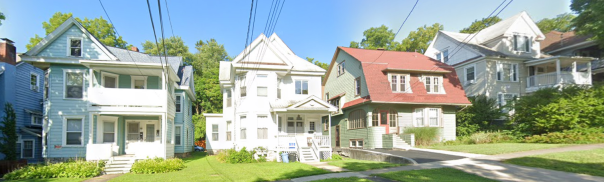
Living near retail is convenient—especially for people who live car-free—and a lot of city neighborhoods would be a lot better off if they had more of it. More grocery stores, post offices, pharmacies, laundromats, hardware stores, libraries, barbers, and daycares within easy walking distance of more people’s homes.
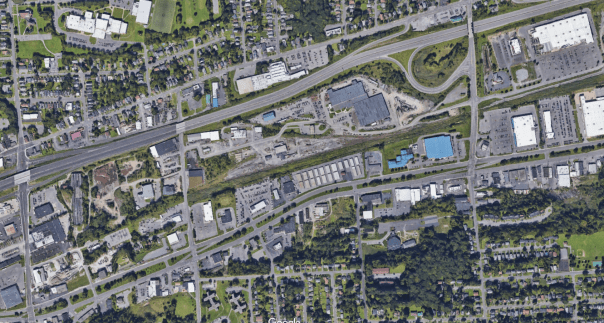
But it’s a real challenge to make those kinds of businesses ‘fit’ into the neighborhoods that need them. Erie Boulevard has a hardware store, a post office, a pharmacy, a bank, multiple restaurants, three (!) grocery stores, and specialized retail like a local guitar store and bike shop all within a mile’s walk, but most of those businesses are huge, set back behind mammoth parking lots, flanked by and dependent on 690. People in Eastwood might want to be able to walk to the grocery store, but they sure as hell don’t want Price Chopper’s 3.75 acre parking lot with all of that car traffic and those glaring floodlights anywhere near their houses. On the flipside, Erie Boulevard is so choked with asphalt that there isn’t any room for anybody to live nearby all those businesses.
Car dependence and excessive bigness go together. No one is supposed to walk to Price Chopper (although plenty of people do out of necessity)—everyone is supposed to drive there. So the parking lot has to be big enough to store every customer’s car, and the streets leading to it have to be wide enough for all of that traffic. The result is a single store that sits on a property larger than the entire Westcott business district. A business entirely out of scale with the neighborhoods that should benefit from its proximity.
So to get more businesses that people can walk to, Syracuse needs more small stores designed for customers who arrive on foot. Dominick’s market in Hawley-Green is a perfect example. It’s small enough to focus on the immediate neighborhood, so it doesn’t need a big parking lot to get enough customers to support itself. It’s a store that fits into Hawley-Green and makes the neighborhood better for the people who live there.
This kind of neighborhood-scale retail is in short supply in Syracuse, but it’s starting to make a comeback. New small stores are opening up on old neighborhood main streets like North Salina, South Salina, and James Street. New zoning laws will make it easier for businesses to better serve their immediate neighbors. New people are moving into these neighborhoods because they want the convenience the comes from living near businesses. It’s all going to make for a better City.
The dominant narrative of Downtown’s resurgence goes something like this: after years of neglect, a huge change in popular attitudes towards ‘the city’ have drawn people back to Downtown and supported millions of dollars in investment in new businesses, building renovations, and housing. No longer is Downtown just a place to go for work—a central business district—now it’s a real neighborhood where people actually live, a place where you can feel “the hum of city life.”
Which is why the people pushing this narrative cite Downtown’s rising residential population. 1,019 more people lived Downtown in 2018 than did in 2010. What better proof of the area’s resurgence than that more people are moving there?
But when you dig into the census data, that statistic doesn’t fit so neatly with the resurgence narrative. Focusing on the 1,019 increase in total population means ignoring the 2,146 people who already lived Downtown in 2010. Only talking about total population obscures the different reasons that people actually live within the 311 acre district, and it erases the people who live in public housing, the shelters, and the jail in Syracuse’s premier urban playground.
This 2010 map represents each resident of Syracuse as a single colored dot. The dots correspond to each person’s race—blue dots are White people, orange dots are Latinx, red dots are Asian, and green dots are Black people.
Here is that same map zoomed in on Downtown. The thick gray line that curves across the top and right side of the image is I81. The thick gray line on the left side of the image is the West Street Arterial. The thin horizontal line through the middle of the image is Fayette Street, and the thin vertical lines are, from left to right, Clinton, Salina, State, and Townsend Streets. The bottom of the image is Adams Street. Got your bearings?
One remarkable thing about this image is just how much of Downtown’s population is concentrated in just a few blocks. Nobody lives in the white space that dominates the map. People only lived on 21 of the 131 city blocks that make up the neighborhood.
Old buildings with new lofts at Hanover Square
It’s not hard to break those 21 populated blocks up into four categories according to housing type and demographic profiles of their populations.
The biggest group is a single block that contains the urban renewal high rises at Presidential Plaza. In 2010 it was home to 668 people or about 31% of Downtown’s total population. 51% of the people living there were white, 38% were Asian, and about 8% were Black. This single block accounted for 85% of Downtown’s total Asian population in 2010. These towers are “popular with medical school students and staff,” and are much more likely to house people who commute to University Hill than the rest of Downtown.
The next largest group was low-income housing—Clinton Plaza, the YMCA Senior Apartments and Mens’ Residence, and Catholic Charities. These three census blocks contained 27% (574 people) of Downtown’s total population, and they were 43% White and 47% Black.
The third most populous group was the County Jail. The 2010 census listed it as the “primary residence” of 548 people—a full quarter of all the people living in Downtown. The inmate population was 38% White and 61% Black. Those 332 incarcerated Black people accounted for 50% of all Black people living Downtown during the 2010 census (those living in low income housing were another 40%).
And finally, sixteen Downtown blocks containing 17% of Downtown’s total 2010 population made up what you might call the “resurgence” areas. This is Armory Square, Hanover Square, and the area around Dinosaur Barbecue where developers turned old commercial buildings into apartments marketed to white-collar professionals. These areas are not very densely populated—usually between 20 and 40 people living on each block—and they’re overwhelmingly white—85%.
The most recent population data for Downtown isn’t broken down all the way to the block-level—the Census Bureau only does that every 10 years—but by looking at block groups, we can make some educated guesses about the composition of Downtown’s population change. The census breaks Downtown into two block groups divided by Montgomery Street. Block Group 1—west of Montgomery, blue on the map—contains all of Downtown’s low-income housing and almost all of its resurgence blocks, but not Presidential Plaza and not the Jail. Block Group 2—east of Montgomery, red on the map—contains the Jail and Presidential Plaza, no low-income housing, and only two resurgence blocks which contain a total of just 18 people.
Between 2010 and 2018, Block Group 1 grew by 36% (326 people, or 32% of Downtown’s total population increase). The Block Group’s population became slightly whiter (from 58% to 60%), and it’s Asian population more than tripled (from 41 to 129 people, or from 4% to 10% of the total population). These changes are partly due to the growth of resurgence housing (like the Pike Block, a 2013 project that converted several 19th century commercial buildings into 67 apartments), but also new apartments (like Creekwalk Commons, a 2014 146-bed apartment building) that differed from older loft renovations in that they were marketed to students rather than professionals. In this way, the demographic profile of Presidential Plaza moved east as students moved further into Downtown.
At the same time, the Black population in Block Group 1 actually decreased (from 279 to 261) even as the overall population of the area grew by more than a third. Consequently, the Black portion of Block Group 1’s population dropped from 31% to 21%. This is probably due to a decrease in low-income housing Downtown.
Over this same period of time, Block Group 2 grew by 56% (693 people, or 68% of Downtown’s total population increase). The vast majority of this increase came from growth in the White population (451 people, an 80% increase), so that Block Group 2’s total population went from 46% White to 53%. The Black and Asian portions of the population also increased (by 121 and 29 people, respectively), but their share of the Block Group’s total population fell (from 31% to 26%, and from 21% to 15%, respectively). This growth is partly the result of new housing in renovated high rises—like the new SUNY Upstate dorm that houses 272 students and opened in 2012—and partly the result of rising prison population at the chronically overcrowded Justice Center.
Geneva Towers, a high-rise SUNY Upstate dormitory in Presidential Plaza
So take this with a grain of salt, but here’s what it looks like the census data is saying:
New market rate apartments have accommodated modest growth in the resurgence population, and that population has spread over more of Downtown. Since 2010, developers have built new apartments marketed to professionals on Salina, Warren, and State Streets.
These same parts of Downtown have also seen an increase in the population that commutes to University Hill. Creekwalk Commons is explicitly marketed to students, and the terms of its leases (tenants rent bedrooms rather than full apartments) are similar to those of other new large apartment buildings on University Hill.
But these changes are dwarfed by the enormous increase of housing on Downtown’s west side, where a single renovated high rise accommodated more new residents than the dozens of tiny new projects around Armory Square, and where the system of mass incarceration has put even more people in prison.
And at the same time, all this growth has been counteracted by a decrease in the number of people living in low-income housing Downtown. That’s the definition of displacement, and it has probably led to a decrease in Downtown’s non-incarcerated Black population.
So when you hear people talk about Downtown coming back, about how so many more people are living there, remember that the numbers they’ll use to justify that narrative include the the high rises, include the shelters, and include the jail.
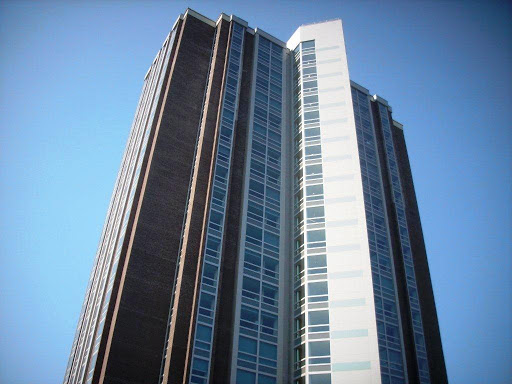
331 Winton St is a 2-story, 3-unit apartment building on the Northside. Jefferson Tower is a 23-story, 295 unit Downtown high rise. ReZone can’t tell them apart—as far as City Hall’s new zoning ordinance is concerned, both are ‘multifamily’ housing, and both will be banned from most of Syracuse.
Jefferson Tower
That will cause 2 huge problems: it will make neighborhoods less able to adapt to change—both population gain and loss, changing family size, climate change—and it threatens neighborhood character because 331 Winton St is part of Lincoln Hill and contributes to its character, so banning that building from that neighborhood necessarily means changing the neighborhood’s character. Fixing the first problem is easy (just add housing), but fixing the second is harder because it means coming up with a definition of ‘multifamily housing’ that can differentiate between 331 Winton St and Jefferson Tower.
The question ReZone needs to answer is this: how many apartments can a building have and still fit in with the rest of the neighborhood? The best way to find out is to just look at which different kinds of housing already are in which neighborhood. This is the only way to describe neighborhood character as it actually exists without resorting to personal opinion.
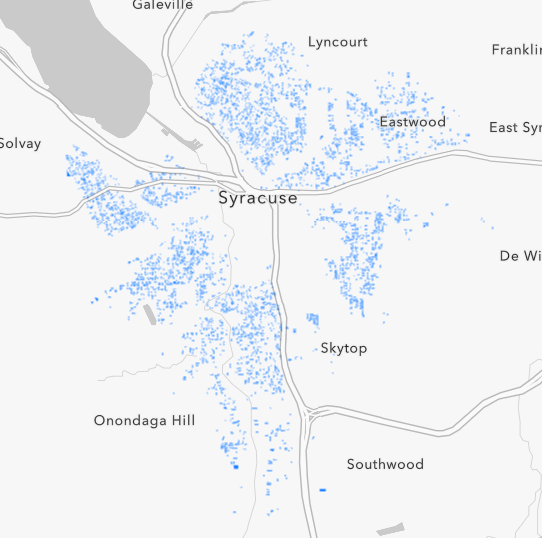
2-family houses in blue
Here’s a map of all 2-family houses in Syracuse. They’re spread across most of the City and are common in almost every residential neighborhood. The only exceptions are the City’s sparsest neighborhoods—like Sedgwick and the Valley—and it’s most built up areas—like lower James and Downtown.
3- and 4-family houses in red
Here’s a map of the City’s 3- and 4-family houses. 3- and 4-family homes are common in almost every residential neighborhood in the City, and they are absent from Sedgwick, the Valley, lower James, and Downtown.
Here are maps of the geographic areas where you can find these two groups of housing in Syracuse. On the combined map, the blue areas show where you can find 2-family houses, the red areas show where you can find 3- and 4-family houses, and the purple areas show where 2-, 3-, and 4-family houses are all mixed in together. Every single neighborhood that 2-family houses also has 3- and 4-family houses. Every neighborhood that has 3- and 4- family houses also has 2-family houses.
That makes good sense since so many 3-family homes are just modified 2-flats, and it’d be hard for someone to tell exactly how many apartments are in one of these buildings just by looking. They couldn’t have existed anywhere but those neighborhoods that already have 2-family homes, and they fit into those neighborhoods’ character just fine.
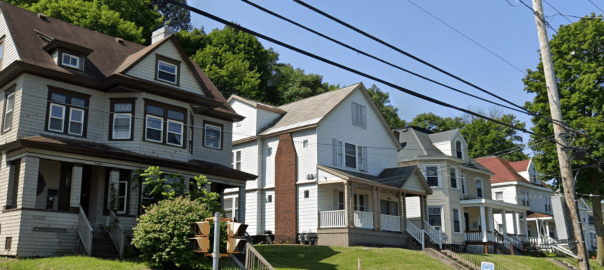
1-, 2-, 3-, and 4-family homes are all part of the character of this Syracuse street
ReZone could (and probably should) make even finer distinctions among multifamily housing—buildings with between 5 and 15 apartments are also common across the City, often look like big houses, and are worth distinguishing from larger apartment complexes—but this is the big one. In any Syracuse neighborhoods where you can find a 2-family house, you can also find 3- and 4-family houses. No neighborhood whose character accepts 2-family houses can reject 3- and 4- family houses. When ReZone acknowledges this, it will make Syracuse more adaptable, more equitable, and more resilient, and it will actually protect and preserve Syracuse’s neighborhood’s character.
These three actions show how the separation of powers between Cities and the State really aren’t all that separate. 50-a was a state law, so there was no way for City Hall to get around it without help from the State Legislature. Chokeholds though, are covered in individual departments’ use-of-force policies, so getting them banned had seemed like a local issue until a state law superseded all local use-of-force policies. But the State doesn’t have to confine itself to passing statewide laws—as Senator May’s bill shows, it’s entirely within the Legislature’s power to pass what are effectively local Syracuse laws from Albany.
So given that the State seems more willing than City Hall to act on police reform, it’s worth asking what else Syracuse should be demanding of its representatives in the State Legislature.
The State Legislature could make the Citizens Review Board more powerful by recreating it as a State entity (like a fiscal control board) with power over local decisions about police officer discipline.
They could pass legislation banning local police departments from using and/or owning military equipment.
They could decriminalize marijuana, seriously impeding local police departments’ ability to perpetuate the racist system of mass incarceration.
They could amend parole laws, making it possible for returning citizens to move back to their old neighborhoods and associate with their old friends without automatically breaking the law just because a broken criminal justice system has criminalized entire communities.
There’s all that and a whole lot more that the State Legislature could do to meaningfully reform the system of law enforcement in Syracuse. They can do things that City Hall can’t, and they will do things that City Hall won’t.
Jobs are the number one issue in Syracuse. Good jobs, ones that pay well, ones that don’t require unnecessary credentials, jobs that people can get to whether or not they own a car.
In a real way, the best thing that City Hall could do for the City of Syracuse would be to run a massive jobs program.
The bitter irony is that City Hall does run an enormous jobs program, but it doesn’t do a thing for people living in the City. Every year the Syracuse Police Department spends $45 million dollars to pay more than 400 police officers a generous salary, substantial overtime, and good benefits, and 95% of the people who receive that municipal largesse live in the suburbs.
That money—about a fifth of the municipal budget—should go to employing City residents instead.
That could mean hiring City residents to work in the SPD, but City Hall has been trying to do that for years, and they’ve got nothing to show for it. State law bans City Hall from requiring police officers to live in the City, and persuasion hasn’t worked either. On the one hand, the SPD built such an awful reputation that a lot of people don’t want to work for them. On the other, the culture at SPD rejects the City residents who do actually try to become cops.
Much easier would be to take a bunch of money away from the police, eliminate a bunch of police officer positions, and create new positions in other departments to do a lot of the same work—work that shouldn’t ever have been left up to armed officers in the first place. Police are City Hall’s highest paid employees—often making more than $100,000 with overtime—so for each officer position eliminated, City Hall could hire multiple City residents at a salary of $56,000 (the County’s median household income). And since these wouldn’t be police officer positions, City Hall could restrict its hiring to City residents just as it does with civil engineers, paralegals, mechanics, and just about every other position on the municipal payroll. Call them Public Safety Officers, give them official uniforms, and have them report to the Parking Violations Bureau.
A third of the City is poor. People need work. City Hall has the money and the need to employ a lot of them, but instead it’s sending its money out to Camillus and Salina and Manlius. Enough. Fire those suburban police officers and hire City residents to do the same work.
But it is ridiculous that it took a GoFundMe to make it happen. After City Hall announced that they were closing all the pools for lack of money, they found the funds to open two, and then went out to the community to ask for $100,000 to open two more.
And Syracuse responded because this town is full of good people, so it worked out.
But how about at the same time that City Hall was passing the hat so it could open two pools (and at the same time that people are out in the streets calling to defund the police), the Mayor was also talking about increasing SPD’s budget?
City Halls pleads poverty whenever people ask for better municipal services. And they’ve got a valid point—the whole system of taxation, transportation, and education in CNY is set up to rob Syracuse of money so that the suburbs can thrive. City Hall does need more support to provide all the services that the community needs.
But it’s also true that even in 2020, in the middle of a fiscal crisis, City Hall is planning to spend about $250 million dollars, $50 million of that on police, and $6.5 million of that on overtime.
. . .
A budget is a moral document. There isn’t enough money to pay for everything Syracuse needs, so City Hall has to make decisions about what matters most. It’s easy to see what City Hall prioritizes by looking at what makes it into the budget and what doesn’t.
So you look at City Hall’s budget, and it’s clear that police are a really big priority, but pools are not. There’s no ‘they’re both important’ there’s no “investing in police and redirecting money to community initiatives shouldn’t be mutually exclusive.” Police are the biggest thing in the budget, and pools aren’t even halfway in it at all. Police are the priority, and pools are not.
And that’s a problem, because it means that City Hall’s priorities are not in line with the community’s. City Hall asked people to pay a voluntary tax in the middle of a recession, and the community came up with $100,000 to open up the pools. So you can bet that if the community was in control of the municipal budget, pools would have been in it, and maybe SPD would only have $6.4 million to spend on overtime.
That’s what #DefundPolice really means. It’s not about retribution, it’s not about cutting the police budget just to put cops in a hard spot. It’s about the fact that the City has higher priorities than the SPD. It’s about how when City Hall spends a fifth of the public money on armed officers and incarceration, it necessarily neglects other programs and services that would do more to make the community safer. It’s about how giving kids a safe place to cool off in a historically hot summer is a genuine public service—a service that makes Syracuse safer by making it happier. Let’s make that a priority.
New ideas threaten those who benefit from the broken status quo, and so a lot of people have responded to this new idea by saying that it’s impractical—that Syracuse needs 400+ police officers and that those officers need to be involved in every traffic stop, overdose, housing failure, and mental health crisis in the City.
“One of the things they bring up is have mental health people to respond to calls, which would be great,” said Piedmonte. “But, if a mental health person goes to help somebody and then they pull a gun or knife on them, what are they supposed to do?”
Let’s not be coy about what he’s saying. A healthcare worker would have many options to deal with this potential but not obviously common situation. They could de-escalate, they could flee, they could call and request assistance from an armed officer.
What a healthcare worker could not do—and what Jeff Piedmonte is suggesting a police officer would do—is shoot the patient. That’s the final answer you’ll get from people who think Syracuse needs enough armed officers to respond to every 911 call, who think that public safety needs to be in the hands of police officers rather than social workers—cops can kill.
And just think about what it means if that’s what defines police. It means that police officers are themselves a threat to every single person with whom they interact. Jeff Piedmonte created a hypothetical situation with almost no detail, just that there’s a mentally ill person and a healthcare professional, and his first thought was ‘might have to shoot them.’ I was in boy scouts, and a police officer came to talk to the troop—he told us that he was always looking out for the threat of an attack, constantly evaluating how he would fight back, and he explained exactly how he would have used the furniture in the room to incapacitate us children.
There may be a place for that kind of neurosis, but it isn’t in an organization in charge of public safety. When armed men roam City streets thinking that every person they encounter might be a threat, that makes Syracuse less safe. It’s what led SPD officer Chris Buske to beat Shaolin Moore in the street—Buske imagined that Moore might have had a weapon that didn’t exist. He imagined that because he was afraid of Syracuse and the people who live in it. That fear warped his understanding of reality and so he reacted to Moore’s black skin exactly the way that Jeff Piedmonte says he should have—with unjustified violence.
After decades of police abuse, people are in the streets asking if there isn’t a better way to secure public safety in Syracuse. That’s a threat to the SPD, to their privileged positions of power and their paychecks padded with fraudulent overtime, so you can bet that Jeff Piedmonte is going to come up with some reason that Syracuse really does need the SPD, as it is currently constituted, to keep the City safe.
But really listen to what he’s arguing, take seriously what he’s saying. He’s not saying that SPD would be better than healthcare professionals at caring for a mentally ill person, or that SPD would be better than social workers at finding shelter for an unhoused person. He’s saying that police officers are the only municipal employees who will shoot people.
If that’s not an argument to defund the police, I don’t know what is.
All sixteen are good and should have been put in place years ago. Most are small changes that could temper the most racist least just excesses of a systematically racist and unjust institution—body cameras to record when officers break the law, real bans on predictably lethal tactics, habeas corpus.
But there is one ‘reform’ in this package that contains the potential for a true reformation of municipally administered public safety:
This sounds a lot like what people mean when they say Defund Police—shrinking the footprint of police responsibility so that officers focus on investigation and evidence gathering in support of the DA’s office while giving up responsibility for intervening in domestic disputes, mental health crises, housing insecurity, traffic violations, and other situations when the threat of lethal force and incarceration predictably result in brutality and death. It would eliminate so many unnecessary inherently escalatory interactions between armed police officers and members of the public, and it would significantly reduce SPD’s budget, allowing for that money to be better spent keeping the community safe.
But the devil is in the details, and City Hall phrased this proposal in such a way that it could easily amount to nothing worth talking about. Specifically, what does ‘non-criminal’ mean?
So many laws serve to criminalize poverty and illness that something as non-threatening as a man sleeping in a park could be considered an instance of ‘criminal’ activity.
An overdose is first and foremost a medical emergency, but drug-use is a crime, so will the police still show up with their guns and their tasers and their handcuffs?
What about the case of Alonzo Grant? He called the police to deal with a domestic dispute, and they ended up beating him and charging him with multiple crimes. It doesn’t matter that all of those charges were quickly dismissed, according to the police in the moment, Grant was a criminal. Under the Mayor’s proposal, was that a ‘non-criminal’ situation?
Or what about traffic enforcement? SPD uses it as a pretext to find other crimes, so any routine ‘non-criminal’ traffic stop carries with it the potential for turning into a violent confrontation. How would this proposal apply to a situation like that?
All of which is why the Syracuse Police Accountability and Reform Coalition calls City Hall’s 16 proposals “initial steps” and says that they alone are “not nearly enough to meet the moment we find ourselves in today.”
Politicians put proposals like these out there to try and mollify people—to seem to have taken the action that protesters are demanding. But the real work is turning these proposals into policy. The PBA understands this, and they’re going to fight each and every reform. Everyone who wants a more just, more equitable, more peaceful City needs to continue to fight back, to make these reforms really mean something.
Protests across the county have shown that American policing is broken—every single city has local cases of abuse, brutality, and murder to march against, and in every single city police have responded to criticism with military force. The problem isn’t just ‘a few bad apples,’ the problem is a broken institution that replicates the same unacceptable, anti-democratic, racist problems no matter where it’s implemented and no matter who is in charge.
So it’s good to hear that elected officials across America—including those with power in this City—are listening to the protesters. The Mayor is talking about structural reform to combat this systemic problem, and the Governor will withhold state funding from police departments that refuse to “reform themselves.”
But ‘reform’ can mean a lot of different things, and the kind of ‘reform’ that we’ve all seen for years—more training, new technology, revised codes of conduct—are clearly insufficient to meet the demands that protesters are making today.
In Syracuse, protesters have issued the People’s Agenda for Policing: a list of nine demands that could make real change in the SPD—not the kind of weak ‘reform’ that tinkers with the existing system—a system that is hopelessly broken—but a real reformation of the institutions of Public Safety in this community.
Reducing the “oversized role of policing” means taking traffic enforcement out of armed officers’ hands. Traffic enforcement should make our streets safer, but instead racism and the incentive structure of policing serves to make the traffic cop a threat to safety on the street—people don’t get stopped for breaking the law, they get stopped in order to make the department money, or to get a drug bust press release, or to just perform dominance.
Instead, use cameras and unarmed municipal employees—in the mold of crossing guards—to enforce the law without ulterior motives, to remove the inherent bias that comes when a driver tries to ‘argue their way out’ of a ticket, and to avoid unnecessary escalation. When someone runs a red, send them a ticket in the mail. If someone’s tail light is out, let them know and provide a new bulb on the spot.
Reducing the oversized role of policing means sending someone else when people call for help with domestic problems. Armed officers focused on ‘compliance’ and ‘order’ are ill-equipped to mediate these kinds of conflicts, and the predictable result is that they respond inappropriately, escalatorily, and they end up beating a man for no reason and costing City Hall $1.5 million in a police brutality lawsuit.
Instead, send social workers and trauma specialists who can mediate and de-escalate domestic disputes. Send people who have the professional judgment to determine when to attempt reconciliation or when to help a person escape an abusive relationship.
These situations—and so many others like them—do not require a gun. They do not require handcuffs or a taser. When City Hall equips police with those tools—but not the training to actually address the needs of the community—what can we expect but escalation? When the person responding to a minor traffic violation carries a gun and is empowered to take away people’s freedom, it’s no wonder that a disagreement over when to signal a turn ended with the SPD drugging and sexually assaulting Torrence Jackson. It’s shocking, appalling, disgusting, infuriating, but it’s not surprising.
So systemic reformation means fewer police officers whose very presence necessarily implies violence and incarceration, and more municipal employees who are trained and equipped to treat root causes of the problems in the community. It means taking money away from the SPD and using it to pay for staff and programs that support public safety. That’s the kind of reform that can actually deconstruct the present unacceptable system and build a new one that makes the community safe.
After night fell on a day of speeches and demonstrations, a number of the protesters attacked the building where the police were waiting. The protesters were breaking the law, and they knew it, and the police responded with force.
It was 1851. It was the Jerry Rescue. There’s a monument to it in Clinton Square.
That event—one that we valorize and memorialize—parallels the protests going on in the City today, and acknowledging that means grappling with these complicated facts:
the fight against racism and white supremacy is not always legal
the fight against racism and white supremacy is not always peaceful
the fight against racism and white supremacy cannot be judged purely on its legality or its nonviolence
That’s hard for a lot of people. It’s so much easier to ask ‘well are these protesters peaceful, do they obey the law?’ Asking that question puts the burden on the protesters. It allows people to think of themselves as outside observers and to pass judgment on the protests based on how the protesters act. It puts the protests themselves on trial, and once they have been judged—peaceful, legal, good or violent, illegal, bad—then the neutral observer moves on, having made their decision, without ever actually addressing the content of the protests.
Taking these protests seriously, respecting the history of the Jerry Rescue, means instead asking ‘what are they saying, is it true, how am I implicated?’ It means hearing the names of the men, women, and children brutalized and killed by the Syracuse Police Department. It means examining the relationships between those beatings, those killings, and your own life. It means putting yourself on trial, recognizing the ties that bind you to the people whose lives the police have cut short, and deciding what you’re going to do about it.
And once you’ve done that, who cares whether or not the protests broke this curfew or smashed that window? What does any of that have to do with you, with your own action, with your response to the racism and injustice that permeates the United States, New York State, Syracuse?