All posts by inthesaltcity

Making the Mayor’s Reforms Mean Something

As protesters continued their daily marches against police brutality, Mayor Ben Walsh proposed 16 reforms to the Syracuse Police Department.

All sixteen are good and should have been put in place years ago. Most are small changes that could temper the most racist least just excesses of a systematically racist and unjust institution—body cameras to record when officers break the law, real bans on predictably lethal tactics, habeas corpus.

But there is one ‘reform’ in this package that contains the potential for a true reformation of municipally administered public safety:

This sounds a lot like what people mean when they say Defund Police—shrinking the footprint of police responsibility so that officers focus on investigation and evidence gathering in support of the DA’s office while giving up responsibility for intervening in domestic disputes, mental health crises, housing insecurity, traffic violations, and other situations when the threat of lethal force and incarceration predictably result in brutality and death. It would eliminate so many unnecessary inherently escalatory interactions between armed police officers and members of the public, and it would significantly reduce SPD’s budget, allowing for that money to be better spent keeping the community safe.

But the devil is in the details, and City Hall phrased this proposal in such a way that it could easily amount to nothing worth talking about. Specifically, what does ‘non-criminal’ mean?

So many laws serve to criminalize poverty and illness that something as non-threatening as a man sleeping in a park could be considered an instance of ‘criminal’ activity.

An overdose is first and foremost a medical emergency, but drug-use is a crime, so will the police still show up with their guns and their tasers and their handcuffs?

What about the case of Alonzo Grant? He called the police to deal with a domestic dispute, and they ended up beating him and charging him with multiple crimes. It doesn’t matter that all of those charges were quickly dismissed, according to the police in the moment, Grant was a criminal. Under the Mayor’s proposal, was that a ‘non-criminal’ situation?

Or what about traffic enforcement? SPD uses it as a pretext to find other crimes, so any routine ‘non-criminal’ traffic stop carries with it the potential for turning into a violent confrontation. How would this proposal apply to a situation like that?

All of which is why the Syracuse Police Accountability and Reform Coalition calls City Hall’s 16 proposals “initial steps” and says that they alone are “not nearly enough to meet the moment we find ourselves in today.”

Politicians put proposals like these out there to try and mollify people—to seem to have taken the action that protesters are demanding. But the real work is turning these proposals into policy. The PBA understands this, and they’re going to fight each and every reform. Everyone who wants a more just, more equitable, more peaceful City needs to continue to fight back, to make these reforms really mean something.

Systematic Reformation of Public Safety

Protests across the county have shown that American policing is broken—every single city has local cases of abuse, brutality, and murder to march against, and in every single city police have responded to criticism with military force. The problem isn’t just ‘a few bad apples,’ the problem is a broken institution that replicates the same unacceptable, anti-democratic, racist problems no matter where it’s implemented and no matter who is in charge.

So it’s good to hear that elected officials across America—including those with power in this City—are listening to the protesters. The Mayor is talking about structural reform to combat this systemic problem, and the Governor will withhold state funding from police departments that refuse to “reform themselves.”

But ‘reform’ can mean a lot of different things, and the kind of ‘reform’ that we’ve all seen for years—more training, new technology, revised codes of conduct—are clearly insufficient to meet the demands that protesters are making today.

In Syracuse, protesters have issued the People’s Agenda for Policing: a list of nine demands that could make real change in the SPD—not the kind of weak ‘reform’ that tinkers with the existing system—a system that is hopelessly broken—but a real reformation of the institutions of Public Safety in this community.

Reducing the “oversized role of policing” means taking traffic enforcement out of armed officers’ hands. Traffic enforcement should make our streets safer, but instead racism and the incentive structure of policing serves to make the traffic cop a threat to safety on the street—people don’t get stopped for breaking the law, they get stopped in order to make the department money, or to get a drug bust press release, or to just perform dominance.

Instead, use cameras and unarmed municipal employees—in the mold of crossing guards—to enforce the law without ulterior motives, to remove the inherent bias that comes when a driver tries to ‘argue their way out’ of a ticket, and to avoid unnecessary escalation. When someone runs a red, send them a ticket in the mail. If someone’s tail light is out, let them know and provide a new bulb on the spot.

Reducing the oversized role of policing means sending someone else when people call for help with domestic problems. Armed officers focused on ‘compliance’ and ‘order’ are ill-equipped to mediate these kinds of conflicts, and the predictable result is that they respond inappropriately, escalatorily, and they end up beating a man for no reason and costing City Hall $1.5 million in a police brutality lawsuit.

Instead, send social workers and trauma specialists who can mediate and de-escalate domestic disputes. Send people who have the professional judgment to determine when to attempt reconciliation or when to help a person escape an abusive relationship.

These situations—and so many others like them—do not require a gun. They do not require handcuffs or a taser. When City Hall equips police with those tools—but not the training to actually address the needs of the community—what can we expect but escalation? When the person responding to a minor traffic violation carries a gun and is empowered to take away people’s freedom, it’s no wonder that a disagreement over when to signal a turn ended with the SPD drugging and sexually assaulting Torrence Jackson. It’s shocking, appalling, disgusting, infuriating, but it’s not surprising.

So systemic reformation means fewer police officers whose very presence necessarily implies violence and incarceration, and more municipal employees who are trained and equipped to treat root causes of the problems in the community. It means taking money away from the SPD and using it to pay for staff and programs that support public safety. That’s the kind of reform that can actually deconstruct the present unacceptable system and build a new one that makes the community safe.

Quit asking if the protests are peaceful

After night fell on a day of speeches and demonstrations, a number of the protesters attacked the building where the police were waiting. The protesters were breaking the law, and they knew it, and the police responded with force.

It was 1851. It was the Jerry Rescue. There’s a monument to it in Clinton Square.

That event—one that we valorize and memorialize—parallels the protests going on in the City today, and acknowledging that means grappling with these complicated facts:

the fight against racism and white supremacy is not always legal

the fight against racism and white supremacy is not always peaceful

the fight against racism and white supremacy cannot be judged purely on its legality or its nonviolence

That’s hard for a lot of people. It’s so much easier to ask ‘well are these protesters peaceful, do they obey the law?’ Asking that question puts the burden on the protesters. It allows people to think of themselves as outside observers and to pass judgment on the protests based on how the protesters act. It puts the protests themselves on trial, and once they have been judged—peaceful, legal, good or violent, illegal, bad—then the neutral observer moves on, having made their decision, without ever actually addressing the content of the protests.

Taking these protests seriously, respecting the history of the Jerry Rescue, means instead asking ‘what are they saying, is it true, how am I implicated?’ It means hearing the names of the men, women, and children brutalized and killed by the Syracuse Police Department. It means examining the relationships between those beatings, those killings, and your own life. It means putting yourself on trial, recognizing the ties that bind you to the people whose lives the police have cut short, and deciding what you’re going to do about it.

And once you’ve done that, who cares whether or not the protests broke this curfew or smashed that window? What does any of that have to do with you, with your own action, with your response to the racism and injustice that permeates the United States, New York State, Syracuse?

How Far From Minneapolis, Syracuse?

This weekend’s protests are about Syracuse Police Department as much as they are about George Floyd’s murder at the hands of Ex-Minneapolis Police Officer Eric Chauvin. It might be comforting to those in power to pretend otherwise, to think that it’s all about something that happened in some other community, somewhere far away from here, but that’s a lie.

Those protests are also about how police dragged Shaolin Moore from his car and beat him in the street, how their justification was that they were afraid of the communities they serve, and how they arrested Yamil Osorio in retaliation for filming the whole thing.

And those protests are about how police officer Chester Thompson used the power granted him by his badge and the gun on his belt to rape multiple women—including Maleatra Montanez—while on duty, and how the Syracuse Police Department just let it happen.

And they’re about how the Syracuse Police Department ordered medical professionals at St. Joseph’s Hospital to drug Torrence Jackson and then to sexually assault him with an anal probe.

And the protests are about how Syracuse police officers Paul Montalto and Damon Lockett beat Alonzo Grant because he punched a screen door in his own home.

And they’re about how the Syracuse Police Department singled out Elijah Johnson while breaking up a party near Syracuse University, beat him, and then falsely charged him with inciting a riot.

And those are just some of the highest profile cases of the last couple years. This list could go back for decades, more than a century, as far back as police kidnapping William “Jerry” Henry to sell him into slavery in 1851, and it go much broader, encompassing every racist traffic stop that traumatizes a family but somehow isn’t ‘newsworthy’ enough to make it into the paper.

If the people in power are actually listening, if they have ears to hear what protesters are saying, they’ll acknowledge this abuse, and they’ll use their power to end it.

Get Rid of ReZone’s Apartment Bans

City Hall’s ReZone project is an opportunity to unmake the mistakes that have made Syracuse into a segregated city. That will require change, though, because the new zoning map is drawn in such a way that it will entrench inequality and exacerbate the disparities between the City’s neighborhoods.

To see how, look at Census Tract 45 on the Eastside. This tract includes most of Westcott—a neighborhood where people want to move, where new businesses are opening, where people are investing. But Westcott is also a neighborhood where there’s not enough housing to accommodate all the people who want to live there, so rents are going up, and more people are having to crowd into what little housing there is.

3,784 people live in 1,649 homes in tract 45. Just over half of those homes are in multifamily buildings (green on the map below). The remainder are 1-family houses (yellow on the map below). Both types of housing are mixed across the tract.

Housing in tract 45. Single family homes in yellow and multifamily homes in green.

ReZone allows single family housing everywhere in the City, but it bans multifamily housing from huge swaths of Syracuse, mostly in high opportunity neighborhoods like Westcott. The most recent draft of the new zoning map bans multifamily housing from most of tract 45. If it had been law when Westcott was originally laid out, less than half of the existing multifamily housing in the neighborhood could ever have been built.

Thankfully, all that existing multifamily housing will be grandfathered into ReZone as ‘noncomformities,’ but that label limits owners’ ability to invest in these homes—they won’t be able to make major renovations or additions—and the lot-by-lot ban on multifamily housing also will limit the opportunity to build enough new housing to relieve the neighborhood’s housing shortage. That will drive up rents even further, leaving Westcott unable to accommodate the people who want to live there and excluding people according to their income and wealth. The predictable result is increased residential segregation and the spread of gentrification to other parts of the City.

Westcott is a good neighborhood with access to jobs, businesses, schools and transportation. All of those things attract people looking to make a good life in Syracuse. But legal limits on multifamily housing exclude too many of those people who want to take advantage of all that Westcott and so many other neighborhoods have to offer. This exclusionary zoning is one root of Syracuse’s shameful history of economic and racial segregation, and ReZone is an opportunity to rip it out. The new ordinance must legalize multifamily housing across the entire City if neighborhoods of opportunity are going to be fully accessible to everyone who wants to live in them.

Finding Space for Social Distancing

Coronavirus has put space at a premium. A lot of the places where we gather weren’t set up for people to keep six feet apart from each other. Packing into crowded restaurants, churches, arenas, or malls just won’t work the way it used to, and if those businesses and institutions are going to work at all, they’re going to need more space.

You don’t have to look far to find extra space. Just watch this video from the Post Standard, and you’ll see just how much space Syracuse really has.

Acres and acres of empty streets, freeways, and parking lots. All of that space is up for grabs right now, and all of it could be put to better use.

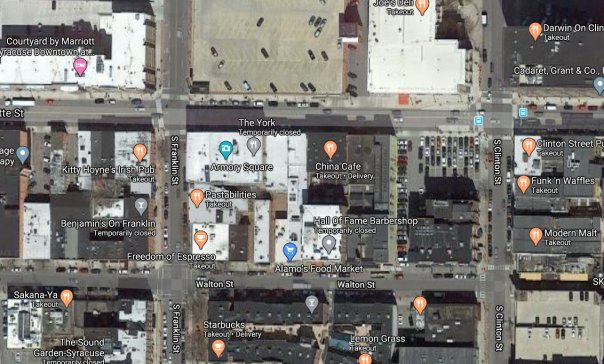
Let’s put some numbers to that. This picture shows part of Armory Square—a spot where lots of people used to pack into tight spaces. But restaurants, shops, and offices only account for about half of the total space in this picture. Sidewalks and tiny Armory Square Park are another eighth of the space. The rest is parking garages, parking lots, parking lanes, and travel lanes. Fully one third of Armory Square is reserved for the movement and storage of cars.

This is so obviously stupid that people have fought against it for years. New buildings have gone up on parking lots, pop up markets have taken over entire streets, businesses have turned parking lanes into outdoor seating, and City Hall is looking at closing one block of Walton Street to cars for good.

.   .   .

Coronavirus only makes all that even more necessary in every city neighborhood—people need space to meet up, to have church, to pass each other on the sidewalk. Syracuse can’t work the old way—ample room for cars, but not enough for people—when we’re all keeping our distance. If it’s going to work at all, then we’re going to have to make more space for people, and the fastest way to do that is to take it back from cars.

The Recipe for BRT

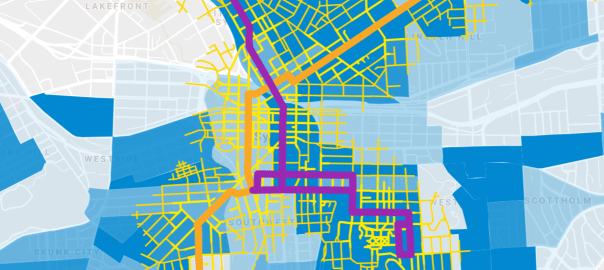
The recipe for good public transportation is simple: (1) run lots of buses (2) in straight lines (3) that connect lots of people (4) to the places where they want to go. Do that, and people will ride.

The Syracuse Metropolitan Transportation Council followed that recipe when it designed two new crosstown bus rapid transit lines (BRT) for Centro. One will run from Eastwood to OCC, and the other will run from Syracuse University to the Regional Transportation Center. Together, these two lines will make Centro much more useful to many more people, and they’ll make Syracuse a better City.

Run lots of buses…

When the bus runs every fifteen minutes, you always know that you won’t have to wait very long for the next one to show up. That’s incredibly freeing because it means you don’t have plan your day around the bus schedule. You can leave the house when you want, and you can head back home when you want. No more worrying about catching the one single bus that can get you where you’re going on time.

Centro’s new BRT lines will run every fifteen minutes minutes all day. It will be a huge improvement over Centro’s current service, and it will make the bus useful for people making all kinds of different trips at all hours of the day.

In Albany, the next Red Line bus is never more than 15 minutes away

…in straight lines…

A straight line is the shortest distance between two points. Buses that travel in straight lines get you where you’re going faster. There’s no need to zig and zag your way across the entire City when you’re just trying to get home.

And speaking of speed, BRT lines in other cities use a few more tricks to make their buses go faster: smart traffic lights, bus lanes, level boarding platforms, fewer stops.

All of this is on the table in Syracuse. The more high-tech options—like integrating the buses with City Hall’s streetlight network—will be a big win for the Syracuse Surge. But it’s the low-tech stuff—running straight down James Street without detouring onto Teall, stopping every ¼ mile instead of every block—that will really make these buses go fast.

salinaborden

…that connect lots of people…

If people are willing to walk about 10 minutes to catch the bus, then the number of people who can ride the bus depends on how many people live within a 10 minute walk of a bus stop. In neighborhoods where lots of people live near a bus stop, lots of people ride the bus.

Eastwood, the Northside, University Hill, the Southside—these are some of the most populous neighborhoods between Buffalo and New York City. Centro’s new BRT lines will be accessible to tens of thousands of Central New Yorkers, just a short walk from their front doors.

…to the places where they want to go

People get on the bus to go places. Good bus service has to pass the places that people actually want to go. It also has to serve a variety of different kinds of destinations if it’s going to attract a variety of riders over the course of the entire day.

There are plenty of places worth going in Syracuse, and these new BRT lines hit a lot of them. Whether it’s to get to one of the 50,000 jobs Downtown, at the Mall, or on University Hill, to get to class at OCC or SUNY ESF, to meet someone for drinks Downtown or on North Salina, to buy fresh food at Price Rite or the Farmers Market, to get to church or to see friends or family anywhere in the City, there will be plenty of reasons for people to ride these BRT lines.

This is a good plan to bring better bus service to Syracuse. It will serve a lot of people. It will get people through the City fast. It will take people to the places they need to go. It will make more opportunities more accessible to more people.

Trolley Tracks and Bus Lines

I used to catch the 58 bus at Burnet and Teall. In my head, this was the Burnet Ave bus—Burnet’s a big street, it’s one of the few that stretches from Downtown all the way out to the city line, and the 58 does run straight along its eastern half from Beech Street to Thompson Road. But it’s really not right to call the 58 the “Burnet Ave line” because west of Beech, the bus zigs and zags along a bunch of different Northside streets before making its way Downtown.

Centro’s bus lines in 2018

I had to memorize all those zigs and zags—they were the only part of the line that didn’t make intuitive sense to me—and I recognized them immediately when I saw this 1917 map of Syracuse’s streetcar system.

Syracuse’s streetcar lines in 1917

Back then, the streetcar line to Eastwood didn’t run straight out James Street. Between State and Sedgwick Streets, it detoured along Hawley, Lodi, Oak, Hawley again, and Elm. That was partially to avoid the big hill on James—streetcars couldn’t handle it with their slippery steel wheels—and partially because that section of James Street was populated by gilded-age robber barons who didn’t ride the trolley.

None of that matters anymore—buses can handle hills, and huge apartment buildings replaced the mansions, making lower James Street one of the heaviest transit corridors in the entire City—so now all the Eastwood buses run James Street’s entire length.

But at the same time, the very fact that a streetcar used to run along Hawley, Oak, Lodi, and Elm means that there’s a lot of housing in that part of the Northside. It’s a far walk from there to Downtown, so the people who moved to that neighborhood 100 years ago clustered along the streetcar line. That housing still exists, people still live in it, many of them chose to live in it because of the existing bus line, and that makes the neighborhood a good place to run a bus.

Look at the rest of Centro’s system map, and you can find similar patterns. The 52’s jagged path up Salina, James, Townsend, Butternut, and Park echoes another long gone Northside streetcar line. The 64 and 74 are almost perfect images of old Westside lines. The South Ave bus’ periodic detours along Bellevue are a vestige of the line that ran out to Strathmore. The streetcar companies often laid those lines for reasons that don’t matter anymore—to avoid hills, to use existing track, to compete with rival transit companies. But the very fact that streetcars did run along those lines has built enough inertia to keep Centro’s buses running along the same streets.

So when the 58 bus took that weird detour, it was bringing me into a complex relationship with the City’s past. That’s not where I had intended to go when I paid the fare, but I can appreciate the journey.

Abolish the Sales Tax

Sales taxes are no way to fund a government. They create all kinds of weird incentives that make City Hall do all kinds of weird things, and—as the current crisis shows—they leave local government helpless just when we need it the most.

Local governments like sales taxes because they’re easy to charge on non-voters. That was the basic rationale for the Destiny USA deal: we got Bob Congel to build something big by agreeing not to charge taxes on him—an influential donor—but the City and County would be fine so long as Pennsylvanians and Canadians paid enough sales taxes at the mall to make up for that lost property tax revenue.

Or remember the 2014 plan to build a new stadium for SU at Washington and University on the land that Cor got when they demolished Kennedy Square? Even though SU doesn’t pay property taxes, that stadium was supposed to generate government revenue by bringing more out of towners into the County and getting sales taxes off their ticket purchases. “Sports tourism” they called it. When that project fell through, the County came up with the Onondaga Lake Amphitheater and justified it with similar logic.

All these schemes attempt to fund local government with tax dollars collected from people who can’t vote here. This requires local government to cater to people from somewhere else, to create ‘experiences’ or whatever that get them to lose a little money while they pass on through.

And that’s a hard pill for a town like Syracuse to swallow. This isn’t a resort town that’s grown up around the idea of showing people a good time while they’re on vacation. Syracuse is, and has always been, a city for workers—a city for the people who live here. It can still be that and make money off of tourism, but that’s a difficult balance to strike, especially when City Hall has a direct fiscal interest in tipping the scales towards turning the City into a better place to visit, but less of an incentive in making Syracuse a better place to live.

Then there are the more prosaically weird incentives. How about this: the sale, maintenance, and repair of personal cars accounts for 14% of sales tax revenue in New York State. When sales tax is your main source of revenue, and when 1 in 7 sales tax dollars comes from people spending money on cars, then local government does have a real incentive to encourage more driving and less walking, bike pedaling, and bus riding.

Local government has that incentive, that is, if it doesn’t care about making life better for the people who elect it. Car dealerships are a nuisance, cars can bankrupt families, and ubiquitous car-ownership means too many tax-sapping city-killing parking lots—a bunch of little facts that all point to the bigger fact that City Hall should be doing everything it can to make life easier for people who don’t own cars. But when your next year’s budget relies on sales taxes generated by car dealers, gas stations, and auto shops, it’s too easy for City Hall to lose sight of that greater good.

Overreliance on sales taxes means that City Hall has greater fiscal interest in the grey asphalt of car dealerships and highway interchanges than it does in green neighborhoods like Park Avenue

And finally, this economic crisis—like every other one that came before it—shows just how insane it is to fund a government with sales taxes since the government is most needed at the very times when people stop buying stuff. Onondaga County is spending huge amounts of money on Coronavirus testing. Centro is transporting essential healthcare workers to the hospitals while also voluntarily forgoing all fare revenue in order to protect its bus operators from infection, and it needed a federal bailout to keep going. Syracuse needs libraries and community centers to help people apply for unemployment, find new jobs, and fill out the census now more than ever, but instead OCPL is laying off staff. This is what comes of using a tax on consumer spending to fund the very services that become most necessary when people don’t have any money to spend.

.   .   .

I don’t know what the better option is. Income tax, payroll tax, land tax, making non-profits pay property tax? There are probably good practical and theoretical reasons to oppose all of them too. But here’s what I do know: sales taxes are bad. They make Onondaga County and Syracuse City Hall do weird things, they get in the way of making the City a better place to live, they all dried up right now exactly when people need local government the most. Can we please try something else.

Coronavirus, the Sidewalks, and Race

The coronavirus has disproportionately hospitalized black people in Onondaga County. The County’s population is 76.5% white, but only 54% of people hospitalized for coronavirus are white. The County’s population is 11.5% black, but 27% of people hositalized for coronavirus are black.

Looking for a possible explanation, the County Executive “speculated that the trend might be due to the fact that African-Americans have, as a whole, larger percentages of diabetes and heart disease, preexisting conditions that can make the virus much worse.”

That checks out. The overwhelming majority of black people in Onondaga County live in a few segregated neighborhoods in Syracuse, and those are the very same neighborhoods where the CDC has found the highest rates of diabetes and high blood pressure.

Why though? Why is it that black people in Onondaga County are so much likelier to have been sick than white people, even before all this started?

The CDC also keeps data on factors (like lack of sleep) that contribute to health outcomes (like diabetes and high blood pressure). Here are maps of obesity, lack of sleep, and lack of exercise.

Put all this together, and you get a pretty stark picture. Black people are segregated into specific neighborhoods where environmental factors like polluted air and lack of access to opportunities for exercise have made it difficult for people to maintain their health, contributing to chronic conditions like diabetes and hypertension which have put them more at risk to contract coronavirus.

So it was a good thing that City Hall had announced its intention to maintain the sidewalks. Better sidewalks are the kind of positive environmental factor that would improve health outcomes by making it easier to get around on foot, making that light exercise a more prominent part of the routine of daily life. This is particularly true in those neighborhoods where people are less likely to own a car and more likely to live within walking distance of job centers like University Hill and Downtown—neighborhoods like the segregated ones where negative environmental factors have made coronavirus so much of a problem today.

But on the same day that we learned of coronavirus’ disparate racial impact, City Hall postponed that plan to maintain the sidewalks because the coronavirus has blown a hole in the municipal budget. City Hall was going to introduce a new frontage fee to pay for that maintenance, but Mayor Walsh explained that “we didn’t feel it would be fair to constituents to bear that burden now.”

But why should it take a new fee to pay for the sidewalks when DPW manages to maintain the rest of the street with money from its regular budget? Why can’t City Hall just redirect some of the road repaving money to fix the sidewalks? Why is the funding so fragile for a public resource primarily used by Syracuse’s poorest residents while the funding for the roads driven on by relatively richer City residents (and County commuters) is so resilient?

Taken together, these environmental conditions that contribute to poor health in black neighborhoods and particularly fragile funding for the mitigation of those conditions amount to an instance of structural racism—a series of seemingly neutral, unrelated, and agentless decisions that conspire to yield inequitable outcomes divided along racial lines.

Clearly, the Mayor isn’t postponing his sidewalk maintenance plan because he’s racist. And clearly, fixing the sidewalks would not, on its own, mitigate coronavirus’ disparate impact on black people in Onondaga County. And that’s the problem with structural racism—when inequity is the unintended effect of boring stuff like appropriations, when no one makes those original decisions for racist reasons, and when unmaking any one of those decisions will only have a slight and delayed effect on the enormous overall problem of racist inequality, then it’s too easy to put anti-racist action off indefinitely.

But we have to take that action now. The truth is that it’s never easy to dismantle the racist structures that hold up our municipal government. The coronavirus may make it seem like now is a particularly bad time to start, but a look at the racial disparity in infections should be enough to prove that Syracuse needs to do this work now more than ever.