All posts by inthesaltcity

Getting Around on Urban Trails

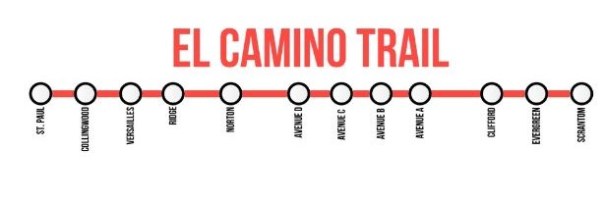
On April 3, the Urban Phoenix tweeted a map of Rochester’s El Camino trail done up to look like a subway line and asked “What if we looked at our urban trails like transit?”

elcaminotrail

A lot of times, urban trails get treated like city parks. They’re destinations for leisure and exercise. When the Onondaga Creekwalk opened up, Sean Kirst wrote about how it was a great way to experience Syracuse’s history, and how Downtown office workers could jog along it during their lunch breaks.

But these trails have the potential to be something more. They are public rights of way where people can walk or bike, so they’re perfect for getting around the city without using a car. Seen that way, urban trails can be another important tool–like public transit–for lifting up life without a car in our cities.

In order to fulfill that potential, urban trails need to do two things.

First, they need to connect relevant destinations, like residential neighborhoods and centers of employment. The Schuylkill River Trail in Philadelphia, PA does this by connecting many neighborhoods with Center City more directly than the City’s street grid does. A lot of other trails just follow whatever right of way the city was able to buy for cheap, even if that right of way doesn’t connect any two places worth going.

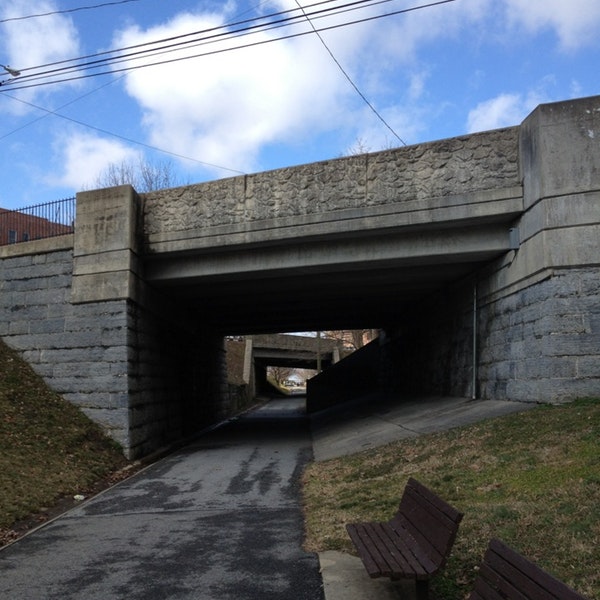
Second, urban trails need to prioritize cyclists and pedestrians whenever crossing the path of an ordinary city street. The Northwest Corridor Linear Park in Lancaster, PA and the Green Area in Syracuse’s Bayberry suburb do this by going underneath existing streets. Another option is to put in a signalized crosswalk like the one that connects the Onondaga Creekwalk to Syracuse’s Near Westside. If an urban trail doesn’t consistently prioritize cyclists and pedestrians, then it’s no more useful to them than a normal sidewalk.

northwestcorridorlinearpark


There are good precedents for building urban trails this way. Copenhagen and Berlin have built elevated “bike highways,” Baltimore, MD’s Jones Falls Trail uses an obsolete road to link several neighborhoods with downtown, and locally, as far back as 1897, Syracuse built specially dedicated bike paths through the City.

Unfortunately, a lot of the newer urban trails in Upstate don’t live up to these standards. Onondaga County wants to connect its Loop-the-Lake trail to a parking lot, but still hasn’t linked it to any Syracuse neighborhood. Likewise, Syracuse’s Creekwalk connects the Destiny Mall, Franklin Square, and Downtown, but no one seems interested in extending it south into the City’s poorer neighborhoods.

All that said, it’s important to remember that urban trails can’t replace transit for the simple reason that a bicycle is different than a bus. Bikes are more physically demanding than buses, and that’s important in cities like Syracuse and Rochester where so much poverty is concentrated in certain city neighborhoods, and so many opportunities for employment are scattered in outer suburbs. A lot of people have to commute further than they can realistically walk or bike, and in those situations the bus is still necessary.

People who don’t own cars have to piece together a bunch of different transportation options just to get around. Sometimes it makes sense to get a ride from a friend, sometimes it’s best to catch the bus, sometimes a cab is necessary. Urban trails can help people solve that puzzle by making it easier to get around town on foot and by bike. To provide that help, though, we’ll need to start looking at our urban trails like transit.

Bus Stops and Parking Spaces in ReZone

In April 2017, City Hall published a draft of the new zoning ordinance that allowed for buildings near to “any type of bus stop, regardless of service level” to build 30% fewer parking spaces than buildings without easy access to transit. That’s was a good idea because it costs money to provide off-street parking, and that’s an unnecessary expense when the people using a building don’t travel by car. When City Hall imposes that expense on a property owner by requiring that a building have more parking than is necessary, that amounts to a tax on pedestrians, cyclists, and bus riders.

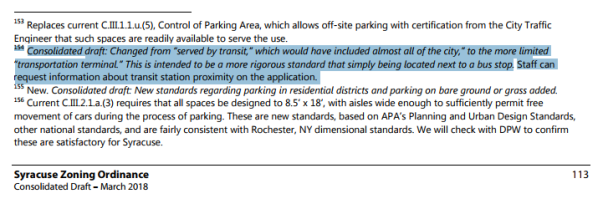
In March of 2018, the City Hall backed away from that good idea. Instead of reducing parking minimums for buildings within a quarter mile of “stations served by transit,” the new draft ordinance published that month talks about buildings within a quarter mile of “transportation terminals.” It’s not obvious what a transportation terminal would be in Syracuse (the Centro Hub, the RTC, the terminal stop for each bus line?), but it’s clear from the explanatory footnote that a transportation terminal is not a bus stop:

transitfootnote

It’s as if City Hall didn’t know that Centro is a viable transportation option in just about every neighborhood in the City, and now they’re trying to limit the benefits that bus service can provide.

In fact, Centro’s pervasive service is a good reason to take the opposite tack and allow greater density at the corner properties on each intersection where a bus stops. Elevating the properties at each bus stop by one zoning district (from R-2 to R-3, say, or from MX-1 to MX-2) would increase the City’s capacity to house people who do not own cars, and that’s right in line with the City’s Land Use & Development Plan:

“This capacity should be preserved by maintaining zoning for density levels in line with the existing built environment, so that over the long-term the City may market its ability to cost-effectively absorb regional population growth—based on existing infrastructure and an urban land-use pattern that lends itself to walkable neighborhoods, local commercial and business services, and efficient transit service.” Land Use & Development Plan, pg 12

Luckily, the City Hall is hosting three information sessions about the new zoning ordinance this week. The first will be on Monday at 6:30 at Nottingham High School, the second will be on Tuesday at 6:30 at Corcoran High School, and the third will be on Wednesday at 6:30 at Henninger High School. Check these info sessions out, learn more about the new ordinance, and ask why City Hall wants make it harder for people without cars to find an affordable apartment in the City.

Congressman Katko’s Local Partisanship

For ten years, the City of Syracuse sent a different representative to Congress every time it had the chance. Until Congressman John Katko beat Colleen Deacon in 2016, the City hadn’t elected an incumbent since Jim Walsh–the current Mayor’s father. It’s a difficult seat to hold onto, and Katko managed to do it by positioning himself as a moderate who could appeal across party lines. This last year, though, has made that a difficult position to maintain–Katko refused to say who he intended to vote for in the 2016 presidential election, and he has hemmed and hawed every time someone has asked about national politics since then.

If only the Congressman would be so boring when it came to local politics. In June, when then-Mayor Stephanie Miner thought about running for his seat, Katko responded by saying that Syracuse suffers from a “plague” of “systematic poverty, record murder rates, crumbling infrastructure, failed schools.” In November when Mayor Miner called out his vote on the tax bill, he talked about Syracuse’s “economic malaise” and it’s “stunning rate of local poverty.” Just this past week, in response to a question about I-81 during a Facebook event with Tim Knauss, the Congressman said, “It’s not just a decision for the City of Syracuse. It’s a decision for the region” and then went on to talk about all of the problems that Dewitt and Skaneateles might have without ever mentioning what the project might mean in the City.

All of this talk has one thing in common–it divides the people that Katko represents between those who live in the City and those who live outside of it. Take his sparing with Miner. She won both her terms with huge majorities and remains popular among city residents, so he can’t actually be appealing to those people when he says she turned the City into a hell hole. He’s playing on the fears of suburban people who are afraid of the City, who believe that it’s a hell hole, and who wouldn’t want anything to do with anyone from there.

He’s doing the same thing with I-81. It’s not a city-suburb issue. Suburban legislators like Al Stirpe and Karin Rigney want the highway out of the City, while some City politicians like Bill Magnarelli and John DeFrancisco want to keep it as a tunnel. Katko ignored all that, though, and talked like everyone’s real concern should be that the City not be allowed to impose any kind of decision on the suburbs.

The Congressman is in a tough spot. He can’t say anything substantive about national politics without appearing partisan and alienating half the district. His solution has been to turn partisan on local issues, betting that he can appeal to the 80% of the district that lives outside the City by making them fear the 20% that live in it. That’s a small thing to do, and we all have to call him out on it and say so.

Uniting Communities through Transit

Back in 2017 when the community was still seriously debating the merits of Consensus’ plan to merge the City of Syracuse with Onondaga County, Centerstate CEO Rob Simpson liked to talk about how a combined city-county would be the second biggest city in New York State. That wasn’t really a very compelling argument since it compared apples to oranges, but it did get at something important: communities with larger populations enjoy political and economic benefits over those with smaller populations, and cities like Syracuse, Cortland, and Ithaca suffer both politically and economically because they each have so many fewer people than other communities in New York State.

An intercity transit service connecting Syracuse, Cortland, and Ithaca would fix this problem by uniting those three cities and their metropolitan areas into a single region large enough to give its residents political and economic advantages that they do not currently enjoy.

Uniting these communities will benefit both businesses and workers. Easier commutes between cities will enable workers from any community in the region to work for businesses in any other community. This will create a single regional labor market that can support growing local businesses and that can also attract large businesses to move into the region. The other side of this coin is that workers will be able to apply for jobs outside of their individual communities, increasing economic opportunity for people living in each community.

That economic integration will also make the region stronger politically. It will mean that good things happening in one community are good for people living in communities across the region, allowing residents and elected officials to advocate with a single voice in State politics. So if Syracuse needs the State legislature to amend its charter to deal with the City’s impending fiscal crisis, Bill Magnarelli and Pam Hunter will be able to count on support from Al Stirpe, Barbara Lifton, and Gary Finch in the State Assembly to make that happen. If we go through something like the Upstate Revitalization Initiative again, the Central New York and Southern Tier Regional Economic Development Councils can work together to submit bids that will benefit the entire region.

By making daily travel between Syracuse, Cortland, and Ithaca easy and routine, an intercity transit service would unite those cities and their metropolitan areas as a single region with a single labor market and a unified political voice. This kind of transformation won’t happen overnight, and it will require cooperation between regional transportation authorities, county governments, other municipalities, and private institutions, but the potential benefits are worth the effort.

This is part of a series about a potential transit service serving Syracuse, Cortland and Ithaca. Here are links to the rest of the series:
Transit Service Between the Airport, Syracuse, Cortland, and Ithaca
Learning from OnTrack
University Students and Public Transportation

University Students and Public Transportation

In 2015 when Centro thought it would have to cut late-night and weekend service, plenty of people turned out for a Syracuse Common Council meeting to tell about how those changes would make their lives harder. The people who got up to speak at that meeting talked about things like working the third shift at hospitals and nursing homes, relying on the bus to overcome physical disability, greenhouse gases, and getting to church on the South Side. Those people represented the political coalition between workers, the disabled, environmentalists, and the poor that supports public transportation in Syracuse today.

University students would be natural members of that coalition. Nationally, students make of 24% of all transit users in urban areas with populations between 200,000 and 999,999. In Syracuse, people living in student neighborhoods like University Hill and the Near Eastside are less likely to own a car and more likely to commute by bus or by foot than people living in other Syracuse neighborhoods of comparable wealth. Syracuse University students ride Centro in huge numbers, particularly to get between South Campus, University Hill, and Downtown. Despite all that, no students got up at that meeting to voice their support for Centro.

Even though no students spoke, the University was a topic of discussion at the meeting. Councilor Khalid Bey asked Centro’s CEO, Frank Kobliski, whether or not Syracuse University paid Centro enough money to cover the operating costs of all those buses that run between University Hill and South Campus. That question got a lot of people grumbling, and one person shouted out, “they have more money than god!” Once Mr. Kobliski had the opportunity to respond, though, he surprised everyone by letting them know that the University overpays for the bus service it gets from Centro.

Syracuse University overpays for its buses because it treats Centro not as a public service, but as a charter bus company. It contracts with Centro to provide free service to its students as they travel between South Campus, University Hill, and Downtown. This means that students ride Centro buses in huge numbers, but they’re not riding truly public transportation.

This dampens student support for Centro. When reporting on Centro, the Daily Orange always distinguishes those special student buses from Centro’s public service. So in 2015 when Centro was considering those late-night and weekend service cuts, the Daily Orange wrote “the direct effect on SU students would remain small,” and no students turned out to advocate on Centro’s behalf. Later that year, when Congress voted to cut Centro’s funding by $12 million, the Daily Orange made the students’ position even more explicit:

“If the mass budget cuts currently facing Centro continue and affect on-campus busing, Syracuse University must take a firm stance to oppose the cuts and defend transportation resources for the university community… However, the university should only offer its support if cuts would directly impact bus service on the SU campus. The university’s priority should be to ensure these resources remain available to those on campus, and it does not have a financial responsibility nor obligation to ensure the bill prevents wide-scale change, affecting the city of Syracuse.”

That’s Centro’s political problem. As long as Syracuse University students receive specialized bus service from the University, they will think of it as a private good to be secured by paying tuition. That stance divides students from the majority of Centro riders who use the bus as a public good that must be secured by political action and advocacy. These opposing stances divide Centro’s natural base of political support and keep a large and powerful bloc of people who rely on transit in Syracuse from acting collectively on its behalf.

It doesn’t have to be this way. Bus riders in Syracuse don’t need to resent University students, and students don’t have to think of their interests as separate from the Syracuse community. Both groups rely on public services like Centro buses, and if they could be a potent political force in Upstate New York if they acted cooperatively.

Intercity transit service could change that status quo by providing a service that’s highly beneficial to Syracuse University and its students, but impossible for the University to build or pay for all on its own. A truly public transportation service connecting Hancock International Airport, the Regional Transportation Center, Centro’s Bus Hub, Syracuse University, Cortland, Cornell University, and Ithaca would benefit both students and transit riders, it would put them both in the same vehicle, and it would give them common cause to advocate for that service.

Both Centro riders and Syracuse University students depend on the presence of public or quasi-public services in a region where the middle and upper classes pride themselves on being entirely independent of such services. The travesty is that the University provides its students with those services at high but hidden cost, and that by segregating those services, the University divides what should be a natural alliance and kills support for truly public services. It will take a lot of work to overcome the institutional barriers that segregate students from City residents, but Chancellor Nancy Cantor took a first step with the Connective Corridor and her Scholarship In Action philosophy. Chancellor Kent Syverud plans to go further by moving student housing from South Campus to the City’s center. A truly public intercity transit service can do more of that same work, strengthening the whole City by aligning the interests of the people who live in it.

This is part of a series about a potential transit service serving Syracuse, Cortland and Ithaca. Here are links to the rest of the series:
Transit Service Between the Airport, Syracuse, Cortland, and Ithaca
Learning from OnTrack
Uniting Communities through Transit

Learning from OnTrack

Last week, this website published a proposal for a new transit service connecting Ithaca, Cortland, and Syracuse. Anyone familiar with the recent history of transit in Syracuse will recognize parts of this proposal from OnTrack, the rail line that ran from the Destiny Mall to Syracuse University during the nineties and thousands. OnTrack was a debacle, poorly planned and poorly implemented, but it was also an encouraging act of faith in the power of transit to improve life in Syracuse. This proposal attempts to learn the lessons of OnTrack in order to avoid its failures while still capitalizing on the potential that made it attractive in the first place.

That potential is the New York, Susquehanna, & Western right-of-way. It’s an elevated rail line that runs through Downtown on its way from Syracuse University past Destiny Mall to the William F. Walsh Regional Transportation Center. At first glance, it looks like a great way to get heavy rail transit for almost no money. Just start running trains on what’s already there, and you’ve got Chicago’s El on a Syracuse scale.

OnTrack didn’t live up to that promise. It never got enough riders to justify its operating costs, and after a few years it stopped running. A lot of people have taken the time to point out all of the problems that kept OnTrack from succeeding–it didn’t run frequently enough, it didn’t run fast enough, and it didn’t run through enough neighborhoods. Without fixing those problems, no transit service running on those train tracks could do what OnTrack tried to do.

Unfortunately, those problems are neither easy, simple, nor cheap to fix. They are the result of real practical constraints.

First, frequency. Most of the right-of-way is single-tracked, so trains running in opposite directions can’t pass each other. That means that only one train can run at a time. It would take that single train about 20 minutes to run between Syracuse University and the Regional Transportation Center or 40 minutes to make the full round trip. That’s no more frequent that Centro’s existing bus service, and it’s much less frequent than the Bus Rapid Transit service that the Syracuse Metropolitan Transportation Council recently recommended for a similar route.

Second, speed. Even though OnTrack only made a couple stops and didn’t have to deal with traffic or stop signs, it took a long looping 4 mile route to get from Downtown to the Mall and the Regional Transportation Center. A Centro bus gets from Downtown to the Regional Transportation Center in less than 3 miles, and so even though it might travel at a lower speed with more stops, its trip wouldn’t take any more time.

That all leads into the third problem, that OnTrack didn’t service residential neighborhoods. The existing track doesn’t run through the densely populated neighborhoods that already support frequent transit in Syracuse, so the only way for passengers from those neighborhoods to get to the train tracks is on a Centro bus. The tracks run within a block of Centro’s hub, so it wouldn’t be hard for people to make the transfer, but since a train running between Downtown Syracuse and the Regional Transportation Center would be neither faster nor more frequent than a bus serving the same destinations, there’s not much reason for a person to walk that block to make the transfer.

Using the existing right-of-way as part of a much larger intercity transit service avoids these problems. First, because its riders will be travelling to destinations not served by existing Centro bus routes, riders have a good reason to transfer from the bus to the train, meaning that the service does not need to pass through densely populated residential neighborhoods to pick up passengers. Second, because a train can make the 65 mile run between Ithaca and Syracuse so much faster than a bus can, it doesn’t matter that they’d run even over the 4 miles between Downtown Syracuse and the Regional Transportation Center. Third, because intercity service doesn’t need to run all that frequently to succeed, a single train running on a single track could provide the service effectively.

Old railroad rights-of-way are precious resources. New political and economic forces make it difficult to build anything like them anymore, so cities like Baltimore, Philadelphia, and Camden have taken their old underused rights-of-way and built new mass transit lines. The New York, Susquehanna, & Western right-of-way could be that kind of asset for Syracuse. OnTrack already showed us what won’t work, so let’s try something new.


This is part of a series about a potential transit service serving Syracuse, Cortland and Ithaca. Here are links to the rest of the series:
Transit Service Between the Airport, Syracuse, Cortland, and Ithaca
University Students and Public Transportation
Uniting Communities through Transit

The New I-81 Tunnel Options are not Compromises

On January 11, syracuse.com published a letter from State Senator John DeFrancisco. In it, Senator DeFrancisco again pushed what he calls the “hybrid option” as a compromise between those who want to get rid of the “unsightly viaducts” and those who want to maintain “efficient movement of interstate traffic.” According to him, that compromise means “tearing down the viaducts and creating a community grid” and then adding “a short tunnel to keep interstate traffic flowing efficiently through the city.”

The Senator has been banging this drum for more than a year, but this is the first time he’s written to the Post-Standard since WSP Parsons Brinckerhoff released its independent report on the feasibility of building a tunnel under Downtown Syracuse. That report was supposed to show exactly how a tunnel+grid design could compromise between the interests of businesses located along I-81’s current path, city resident groups, suburban politicians, and University Hill all while meeting NYSDOT’s standards for the project. That’s a pretty tall order, and this report didn’t fill it.

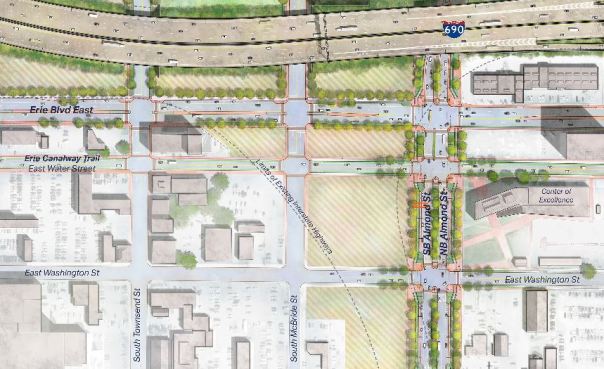
For city resident groups, the point of removing the viaduct is to encourage property development and raise property tax revenues on the east side of Downtown. The viaduct discourages development there because it covers up some land and makes adjacent land unattractive. This is a problem along the viaduct’s entire length, but it’s worst where the viaduct’s curving interchange’s ramps cover multiple full city blocks near the intersection of Almond and Fayette Streets.

All four of the recommended tunnel designs include off-on ramps for a new I-690 exit at Almond Street that recreate this exact problem:

“Providing a direct local-to-interstate connection would be critical to maintaining acceptable levels of service in downtown Syracuse. To provide this connection from the north end of Almond Street, on- and off-ramps would begin and end in a wide center median at the intersection of Almond Street with Fayette Street, and ascend north and west toward over Washington Street, Water Street, and Erie Street, ultimately tying in to I-690 EB and WB. This would necessitate the closure of Washington Street and Water Street due to vertical clearance requirements.”

The report claims that the switch from a highway interchange to highway off ramps “would provide a substantial amount of residual state-owned land for potential disposal north of Fayette Street between McBride Street and Almond Street,” but it’s hard to believe that any developers would be willing to buy that land since the 2nd and 3rd stories of any building built on it would be just yards away from heavy traffic travelling at forty miles an hour.

It’s strange, really, that WSP Parsons Brinckerhoff would include these ramps in all of its designs when NYSDOT didn’t think an exit from I-690 at Almond Street was necessary “to maintain acceptable levels of service in downtown Syracuse.” NYSDOT’s Community Grid plan instead included new exits at Irving and Crouse Avenues, and it kept the on-off ramps parallel to I-690 to leave as much land open for development as possible. The result is more land that’s more attractive for development and more likely to yield more property taxes to fund city services.

interchangecg

Senator DeFrancisco can keep trying to say that he wants a compromise, but he’s going to need to start actually respecting what people would want out of a compromise. It’s not enough to just say the words “hybrid option” and “community grid.” He’s got to actually advocate for a design that benefits the City in the way that NYSDOT’s community grid design can.

Transit Between the Airport, Syracuse, Cortland, and Ithaca

This is a proposal for an intercity transit service connecting the region of Upstate New York that includes the cities of Syracuse, Cortland, and Ithaca. The region currently contains much of the infrastructure and conditions necessary for successful intercity transit, but what service actually exists is infrequent and disjointed. This proposal consolidates and extends existing service to make it more useful and efficient for the region as a whole.

Route
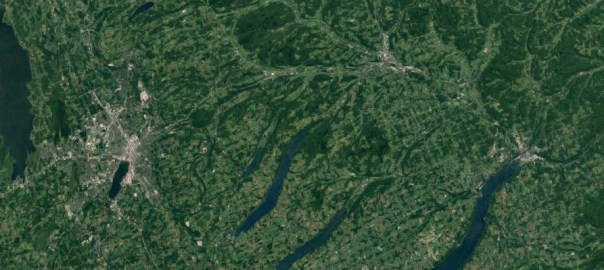
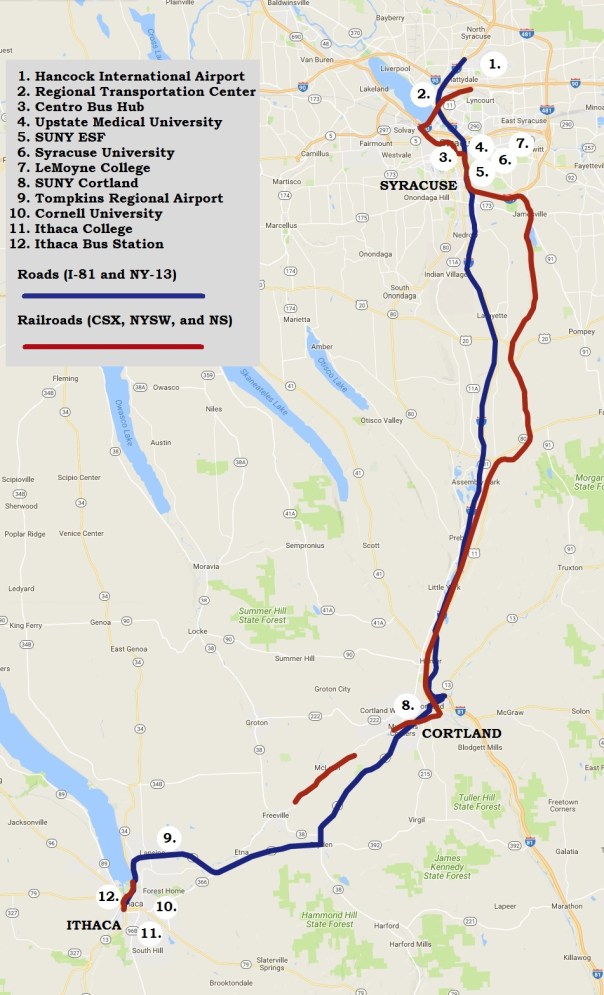
The proposed transit service would run through a corridor approximately five miles wide and seventy miles long. That corridor stretches from the Hancock International Airport (SYR) through Cortland down to Ithaca. From Syracuse to Cortland, the service would run through the relatively flat and straight valleys carved by Onondaga Creek, Butternut Creek, and the Tioughnioga River, climbing 750 feet over the course of roughly 40 miles. From Cortland to Ithaca, the service would follow a much more irregular valley carved by several small streams before descending 400 feet in less than a mile to reach the City of Ithaca on the southern shore of Cayuga Lake.
projectarealabels

There is already a good deal of transportation infrastructure along this corridor. I-81 stretches from SYR to Cortland, and from there vehicles can take NY-13 from Cortland all the way to Ithaca. Vehicles can also turn from NY-13 to NY-366 to pass through Cornell University on the way into Ithaca.

CSX owns a rail line that passes within two miles of the SYR’s passenger terminal. That line continues west through the William F. Walsh Regional Transportation Center (the RTC, Syracuse’s Amtrak and intercity bus station) to the southern end of Onondaga Lake where it connects to the New York, Susquehanna, & Western line. That railroad curves south through Syracuse, passing Centro’s Bus Hub and Syracuse University, and it continues all the way south through Cortland to the hamlet of Munson’s Corners. There is an abandoned railroad right-of-way between Cortland and Ithaca including roughly four miles of unused track near the hamlet of McLean. In Ithaca, Norfolk Southern owns track that runs from the Ithaca Bus Station (an intercity station) north along the eastern shore of Cayuga Lake and connecting to the abandoned right of way that leads to Cortland.

There are a number of regionally significant communities and institutions along the corridor. The cities of Syracuse, Cortland, and Ithaca are each the seat of their respective counties, and each serves as the center of a local transit system. Combined, these three cities and their immediate suburbs are home to more than 500,000 people. More broadly,  the Syracuse-Auburn and Ithaca-Cortland combined statistical areas have a combined population of more than 870,000. There are also seven colleges and universities along the corridor with a combined enrollment of more than 63,000 students as well as two community colleges with a combined enrollment of more than 18,000 students.

Demand
The transit service will enable riders to accomplish two distinct tasks: travelling to or from a transit hub that connects to another intercity transportation service such as Amtrak or Megabus, and travelling between cities within the corridor. There is demonstrated demand for transit service that accomplishes each task.

Transportation to a Hub:
The only intercity passenger train station in the corridor is the RTC in Syracuse. The RTC is also the only bus station in the corridor served by Megabus, and the Centro Bus Hub in Syracuse provides the only intercity bus service to the cities of Oswego and Auburn.

Both the Tompkins Regional Airport in Ithaca (ITH) and SYR provide intercity passenger service. Of these two airports, SYR provides more frequent service to a larger number of cities than does ITH. Flights into and out of SYR are also generally cheaper than those at ITH. People travelling to or from the region by plane often must use SYR even if it would be more convenient to get to ITH.

The service will connect these hubs to three schools with student bodies that need to travel outside of the region frequently. Syracuse University, Cornell University, and Ithaca College enroll a combined total of 50,197 students, 68% of whom are from states other than New York and 18% of whom are from outside of the United States.

Each of those three schools struggles to transport students and visitors to and from the region’s intercity transportation hubs. Syracuse University and Cornell University run their own shuttles to and from SYR at the beginning and end of each semester and holiday break. Syracuse’s service is free, but tickets for Cornell’s service cost $30. Otherwise, Syracuse University simply suggests taking a cab to travel between SYR and the university, or taking Centro between the RTC and the university. Ithaca College offers no transportation to SYR. Both Ithaca College and Cornell suggest that those who need to get either to or from SYR or the RTC can book a ride with the Ithaca Airline Limousine, a private transportation service that can make up to eight runs between Syracuse and Ithaca every weekday and costs $85 for a one-way ticket or $130 for a two-way ticket.

The Syracuse Transit System Analysis (STSA) also identified the need for improved transit service to both the RTC and SYR. The STSA selected the route from Syracuse University to the RTC as a ‘transit improvement corridor’ because of the presence of jobs, carless households, and demonstrated demand for transit along the route. The STSA also recommended the creation of a shuttle service running every half hour between SYR and the RTC to serve airport passengers and employees.

Additionally, other travelers arriving in the region by bus, train, or plane will benefit from improved transit from the intercity transit hubs to destinations such as convention centers and hotels in each city.

Transportation Between Cities:
Centro and Cortland Transit already provide limited intercity transit for commuters. Commuters from Cortland County can catch an express bus to Syracuse from Centro’s Park-N-Ride facility in the Village of Tully. Centro also provides commuter service from both Oswego and Auburn to Syracuse. Cortland Transit runs a commuter service between Cortland and Ithaca.

26% of all workers in Ithaca, Cortland, and Syracuse commute by some mode other than a personal vehicle (public transit, bike, taxi, or on foot). Improved intercity transit between these cities would improve economic opportunity for these workers and encourage intercity commuting. There are 1.3 jobs per household in both Cortland and Ithaca, but only 1.0 jobs per household in Syracuse. Despite the high proportion of jobs to households, median household income is lower in Ithaca ($30,436) than in Syracuse ($31,881) or Cortland ($40,025). At the same time, housing costs are much higher in Ithaca (median property value: $220,000) than in either Syracuse (median property value: $88,800) or Cortland (median property value: $94,200). Workers currently living in Ithaca could more easily move to Syracuse or Cortland for the low housing costs, while people in Syracuse could apply for the relatively more plentiful jobs in Cortland or Ithaca.

Improving transit between Ithaca, Cortland, and Syracuse will increase opportunities for collaboration between the seven colleges and universities in those cities. Currently, each school in Syracuse allows some students to take classes for credit at at least one other school in the city, and Cornell University maintains an exchange program with Ithaca College. Faculty from the seven schools also frequently collaborate on research. Similar programs and cooperation will be possible between schools in different cities when they are connected by reliable frequent transit.

Adjunct professors provide one example of how improved economic opportunity is connected to increased collaboration between the region’s colleges and universities. 26% of the 5,727 faculty employed by the six schools are non-tenure track part time instructors. These adjunct faculty are paid several thousand dollars a semester for each course that they teach. The people who work these jobs often need to teach classes at multiple schools in order to make ends meet. The proposed transit service would broaden the opportunities available adjunct faculty in Ithaca, Cortland, and Syracuse by allowing them to teach more easily at multiple schools in different cities. This would make the region more attractive to recent graduates of all those schools, and it would help the region retain a highly educated workforce.

Additionally, there are unique resources in each city–such as Syracuse’s hospitals and specialized medical centers–that will attract riders from elsewhere along the proposed transit line.

Existing Service
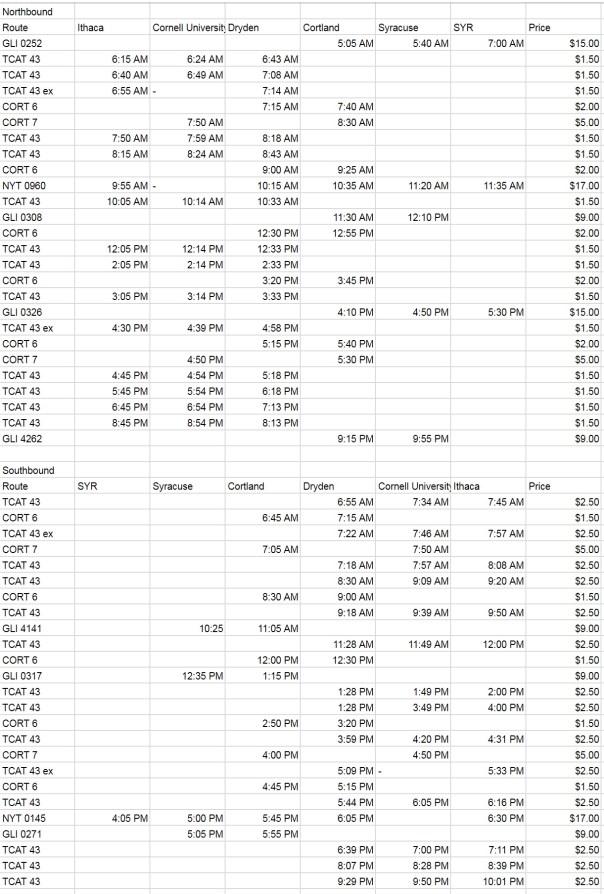
Currently, two intercity bus lines (Greyhound and New York Trailways) and three local transit authorities (Centro, Cortland Transit, and TCAT) provide service along the corridor. Many of these services overlap, making it possible to travel a great distance within the corridor by making transfers at important junctions. Here is a table of all connecting weekday service currently available within the corridor.
connectingservice

Although these different bus services can take a rider pretty far, it is very difficult to travel the corridor’s entire length. New York Trailways offers service once a day in each direction between Ithaca and SYR, and it is possible to use regional transit to travel from Ithaca to SYR at only one other time on any weekday. Here is a table of all connecting weekday service from Ithaca to SYR currently available within the corridor.

endtoendtimetable

Using currently available service, a rider trying to get between SYR and Ithaca will have to pay either $16.50 or $17.00 to take a ride lasts between 100 and 205 minutes.

Proposed Transit Service
Stops:
The proposed transit service should run from SYR to the Ithaca Bus Station and make intermediate stops at the RTC, the Centro Bus Hub, Syracuse University, the Cortland County Office Building (Cortland Transit’s main transfer point), and Cornell University.

Stops at the Centro Bus Hub, Cortland County Office Building, and Ithaca Bus Station will enable residents of all three cities to transfer between Centro, Cortland Transit, TCAT and the proposed transit service. By making these stops, the proposed service will be able to transport people to and from their homes.

Stops at SYR, the RTC, and the Ithaca Bus Station will enable people travelling to or from the region by train, plane, or bus to to transfer between those transportation modes and the proposed transit service. By making these stops, the proposed service will connect the region to a national transportation system.

Stops at the Centro Bus Hub, Syracuse University, Cortland County Office Building, and Cornell University will enable people to reach the centers of employment in all three cities. By making these stops, the proposed service will be able to transport people to and from their jobs.

The service could also make additional stops at the Village of Tully, Tompkins Cortland Community College, and/or ITH in order to allow local transit authorities to eliminate some existing service and redirect funds to support the proposed service.

Mode:
The proposed transit service should operate as either a bus line or rail line. Much of the infrastructure necessary for either mode is already in place, and each option has its own advantages and disadvantages.

As a rail line, the proposed transit service would follow a roughly 70 mile long route from SYR to the Ithaca Bus Station with intermediate stops at the RTC, the Centro bus hub, Syracuse University, and Cortland. The line would follow 48 miles of existing rights-of-way from the RTC to Cortland and in Ithaca, and it would require 22 miles of new rights-of-way between the RTC and SYR, and between Cortland and Ithaca.

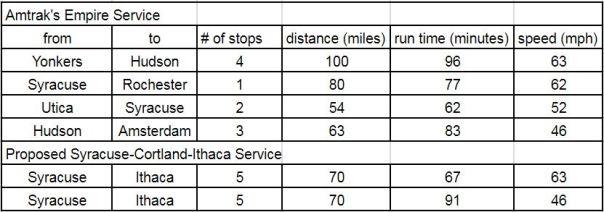
A rail line could run at high speeds unimpeded by traffic. Amtrak trains run at speeds between 46 and 67 mph on similar stretches of track elsewhere in Upstate New York. At those speeds, a train would complete the entire run between SYR and the Ithaca bus station in 67 to 91 minutes. That’s significantly faster the 120 to 150 minutes that a bus would take to make the same run.
railspeedcomparison

As a bus line, the proposed transit service would follow an approximately 68 mile route from SYR to the Ithaca Bus Station with stops at the RTC, Centro Bus Hub, Syracuse University, Cortland County Office Building, and Cornell University. The line would follow I-81 from SYR to exit 11 at Cortland, making stops at the RTC, the Centro Bus Hub, and Syracuse University on the way. From exit 11, the line would follow NY-13 through Cortland and Dryden before taking NY-366 to Tower Road and Cornell University. From Tower Road, the line would continue through Ithaca to the Ithaca Bus Station.

Operating the proposed transit service as a bus line eliminates the need to purchase, build, or negotiate for any inch of right-of-way. This would make the proposed transit service much less expensive upfront. Using existing roadways also would allow the transit service to stop at Cornell University, a stop that is inaccessible to rail because of the steep grade that separates the university from the Ithaca Bus Station. Finally, because existing roadways can accommodate two-way traffic, multiple buses could run along the line simultaneously, allowing for more frequent service. This would be impossible for a rail line because almost all of the existing rail infrastructure is single-tracked, meaning trains running in opposite directions cannot pass each other.

Schedule:
A rail service could make the round-trip in 180 minutes. Running continuously from 6:00 am to 9:00 pm, a train could make five round-trips between SYR and the Ithaca Bus Station. At higher speeds, a train could make the round-trip in less time, allowing for more runs in the same amount of time.

A bus service could make the round-trip in 270 minutes. Running continuously from 6:00 am to 7:30 pm, 2 buses could make six trips from SYR to the Ithaca Bus Station and six trips from the Ithaca Bus Station to SYR. More buses could make more runs in the same amount of time.

Operating on these or similar schedules, the proposed transit service would facilitate intercity commuting, and it would facilitate transfers to other intercity buses, trains, and planes.

Fare Structure:
The proposed transit service should charge zone-based fares with significant discounts for multi-ride or monthly passes. This fare structure will allow the proposed transit service to compete for both regular commuters and for riders travelling between cities infrequently. Here are two potential ways to divide the proposed transit line into zones with one-way fares that can compete with all currently available transportation options.
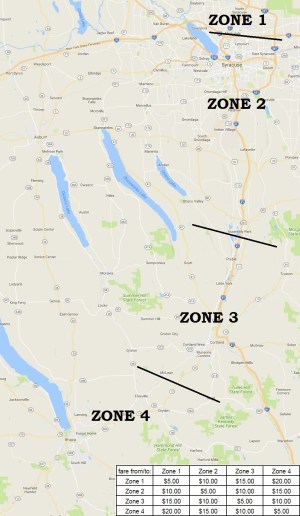
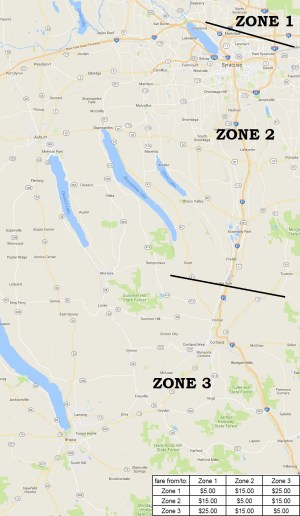
farestructure1 farestructure2

Conclusion
A transit service between Ithaca, Cortland, and Syracuse would benefit the entire region by connecting centers of population, employment, local transit, and intercity transportation. Such a service would build on the region’s strengths by facilitating travel to and between its many academic and research institutions, making them more attractive to students and scholars from outside the region, and more accessible to workers from within the region.

The main obstacle to establishing this service is cooperation. The service would run through, and require the support of, three different counties, three different cities, three different transportation authorities, many more towns and villages, and several large private institutions like Cornell University and Syracuse University. Very few of these entities have regular cause to work together, but this transit service has the potential to get them to cooperate on a single project, to start thinking of each other as part of a unified region with common goals and interests. That would be a big change in Upstate New York, and it would be the best thing this transit service could do.


For more reading on this proposal, click the links below:
Learning from OnTrack
University Students and Public Transportation
Uniting Communities through Transit
SMTC’s Plan for Better Bus Service

On November 2, the Syracuse Metropolitan Transportation Council held its final public information session about the SMART1 study. That study looks at the possibility of improving bus service along specific corridors in the Syracuse metropolitan area. It is the first of multiple planned studies that will recommend specific service improvements to Centro based on the Syracuse Transit System Analysis that SMTC produced as a supplement to NYSDOT’s work on I-81.

SMART1_Public_Meeting_3_Presentation_11217-page-001

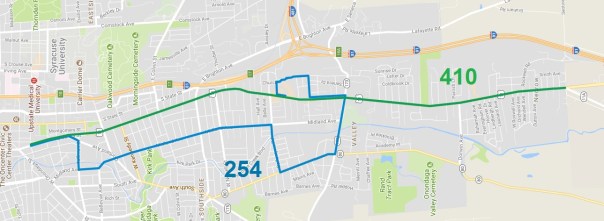
The SMART1 study focuses on bus service from Eastwood to OCC and from the train station to SU–these are two of the six high-priority transit corridors identified in the STSA. For each corridor, the SMTC analyzed low, medium, and high levels of improvement. The low level increases the number of buses running along existing routes, builds new shelters at the bus stops, and gives buses priority at traffic lights. The medium level runs even more buses along new routes in the corridor, removes some bus stops, builds new shelters at the remaining bus stops, and buys new buses. The high level does everything that the medium level does, but it also puts in bus lanes where streets are wide enough to accommodate them.

For both corridors, SMTC recommends that Centro build the medium level of improvement. That means buses running every 10 to 15 minutes along James St/South Ave, and along Salina St through downtown to SU. It means no transfer for people riding either route crosstown. It means new buses and shorter travel times. That’s all good.

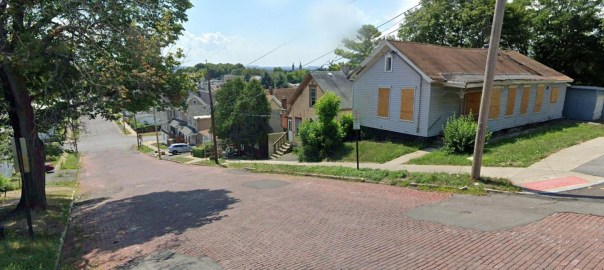
It’s also good that the SMTC hasn’t recommended the high level of improvement. In order to build bus lanes between SU and the train station, Centro would have to run the new bus route along Solar St instead of N Salina St. That’d cut down on travel times, but it would send the bus through a bunch of planned and existing luxury apartment complexes instead of through the Northside. Given that choice, it’s better that the bus run through a neighborhood where it’s needed, even if that means it has to deal with some traffic.

Now it’s up to Centro to act on these recommendations. It’ll require a lot scheduling of work–the SMTC’s recommendations don’t go into details like when the buses should actually run, how these new routes will connect with existing routes, or what should happen to minor routes like the 21 or 28 that run through these corridors but serve other neighborhoods too. It’ll require a lot of cooperation–some of these improvements, like priority at traffic lights, can only come if Centro works with City Hall to make them happen. It’ll require a lot of money–those new buses and bus shelters will cost money up front, and Centro will have to hire more drivers and pay for more repairs if it’s going to offer more frequent service. Those are all steep hills to climb, but they’re well worth climbing. Call Centro and tell them you want these changes. Call City Hall and tell them you want them to help Centro make these changes. Call your state reps and tell them you want the State to help pay for these changes.

Centro:
315-442-3400
CEO@centro.org

Mayor Stephanie Miner:
315-448-8005
Mayor@syrgov.net

Common Council:
Councilors’ Contact details are available here

Senator John DeFrancisco:
315-428-7632
jdefranc@nysenate.gov

Senator Dave Valeski:
315-478-8745
valesky@nysenate.gov

Assemblymember Bill Magnarelli:
315-428-9651
MagnarW@nysassembly.gov

Assemblymember Pam Hunter:
315-449-9536
HunterP@nysassembly.gov

The Mayor’s Temperament, and What’s Best for the City

On Tuesday November 7, the City of Syracuse elected Ben Walsh to be its next mayor.

Voters chose Walsh, in part, because of his temperament. Just about all of the people who endorsed him brought it up. On November 5, the Post-Standard published the results of a poll showing that twenty percent of voters were going to choose the candidate with the best temperament for the job.

People liked that he’s not combative. Helen Hudson, President-Elect of the Common Council, called Walsh a “calm, quiet spirit,” and Common Councilor-Elect Joe Driscoll said that Walsh could “put aside the often petty, personal bickering and division that has too long dominated our collective efforts.”

This is an issue because Mayor Stephanie Miner’s personal relationships with County Executive Joanie Mahoney and Governor Andrew Cuomo have soured over the last eight years. People in Syracuse have watched it happen, and they’ve seen cooperation between the City, the County, and the State fall apart on projects like the new SU stadium, consolidation, and State Aid to Municipalities. The City is almost out of money, and it’s going to have to work with both the County and the State to avoid bankruptcy. People wanted a mayor who wouldn’t let personal animosity get in the way of that work.

There’s a mistake in this line of thinking, though. The City hasn’t failed to work with the County and the State just because the Mayor doesn’t get along with the County Executive and the Governor. All three governments answer to voters with conflicting interests, and those interests are more important that the personal feelings of any elected official.

Take the stadium proposal from back in 2014. Mayor Miner asked the State for money to replace all of the City’s water mains because the constant breaks were draining the City’s budget and messing up people’s lives. Governor Cuomo is worried about the effect that State taxes have on New York’s business climate, so he doesn’t like to spend State money on projects that do not help that image. He proposed that the state would pay to build a new stadium for SU on vacant state-owned land in Syracuse, with the hope that the development would generate enough sales tax revenue to pay for the City’s water main repairs. That plan didn’t work for the City, though, because it would have increased infrastructure costs immediately without any guaranteed increase in tax revenue because SU doesn’t pay property taxes. So the project never went forward because the State and the City had mutually exclusive goals, but people acted like the problem was really that Mayor Miner doesn’t get along with Governor Cuomo.

This pattern has repeated in a lot of big local projects: the City demands what it needs, the County and the State demand something different, cooperation breaks down, and it all gets blamed on personalities.

Syracuse has real needs. They’re deep and painful to look at, and they make everything more complicated, but whoever’s Mayor is going to have to demand that they’re met. Ben Walsh won 54% of the City-wide vote, but the the six districts with the highest concentrations of public housing, the six districts where those needs are greatest, he only got 20%. The people living in those places aren’t looking for a Mayor who’ll make quick deals with the County and the State. They need a Mayor who’ll advocate for them when the Governor tells Syracuse to “fix your own pipes,” or when the Suburban-Dominated Consensus Commission tries to turn Syracuse into a “debt-district.” They need for Ben Walsh to do what’s best for them, even when that means rejecting the County and the State.