Category Archives: Planning

Building for Equal Opportunity

When a big developer comes to Syracuse and asks for a break on paying their property taxes, that’s an opportunity. City Hall can use the promise of a tax break to negotiate for that developer to do something good for Syracuse.

City Hall used to miss these opportunities all the time. Anybody willing to build in the City could get a tax break without promising to do anything to benefit the community. In the past couple of years, though, City Hall has started asking for more. Recent projects have traded tax breaks for new rent-controlled apartments and promises to hire city residents for construction jobs.

That change is good. It means that Syracuse is becoming more valuable, and that City Hall is using its leverage over the people who want to exploit that value. It also means that City Hall can get more creative about how it uses tax breaks to benefit the community.

Here’s one idea: use tax breaks to concentrate new building in areas with good bus service.

People who get around by riding the bus do not have equal access to opportunity in Syracuse. A lot of employers are beyond Centro’s reach, and that keeps a lot of willing and able people from getting and holding a job. A lot of new quality housing has the same problem.

It’s in the community’s interest to fix this situation–to make more jobs and more housing accessible to bus riders–and that’s going to mean more building in places that support quality bus service.

So the next time some developer comes looking for a tax break to build a new apartment or office in Syracuse, City Hall can use that opportunity to get that project built in a place that bus riders can get to. It’s a new use for an existing policy tool, and it will give more people equal access to opportunity in Syracuse.

Who’s the parking for?

Syracuse’s draft zoning ordinance requires properties used for different kinds of things to have different numbers of parking spaces. 1-family houses must have 1 parking space, grocery stores must have 1 parking space for every 300 square feet of floor space, golf courses must have 2 parking spaces for every hole, and so on.

The draft ordinance also includes mechanisms that can reduce those requirements in certain situations. Properties located in certain zoning districts and properties located on bus lines can reduce the total number of required parking spaces by anywhere from 15% to 50%, properties located nearby public parking lots and properties with street parking can count those spaces towards their total requirement, and so on.

A single property can qualify for more than one of these parking requirement reductions. If a barber shop would normally need 4 parking spaces, but it qualifies for a 50% reduction because of it’s zoning district, and there are 2 on-street spaces along its property line, then those two reductions combine to reduce the barber shop’s parking requirement to 0 spaces.

At least, that’s how it would have been before City Hall capped the total cumulative reduction for any property at 75% in the March 2018 revision of the draft ordinance. Now, as a result of this new cap, that barber shop would still need to find space on its lot for at least 1 off-street parking space.

This cap will have a huge effect on the housing market in Syracuse’s inner neighborhoods. These neighborhoods are mostly zoned R-2 or higher, meaning that they’re full of 2 and 3-family houses. Residential properties like those must have 1 parking space per dwelling unit (a 2-family home needs 2 spaces, a 3-family home needs 3 spaces, and so on). In previous drafts of the zoning ordinance, these homes could meet their parking requirements with on-street spaces. As of March 2018, however, because of this new 75% cap, the draft ordinance requires that every residential structure that can house at least 2 families have at least 1 off-street parking space.

This cap won’t affect any of Syracuse’s outer neighborhoods. Those neighborhoods are zoned almost entirely R-1, so they are made up of 1-family houses, each of which is only required to have 1 parking space. Once you account for the street-parking space out front of each of those houses and apply the new 75% cap, then each house is required to have .25 parking spaces. The draft ordinance rounds that down to 0.

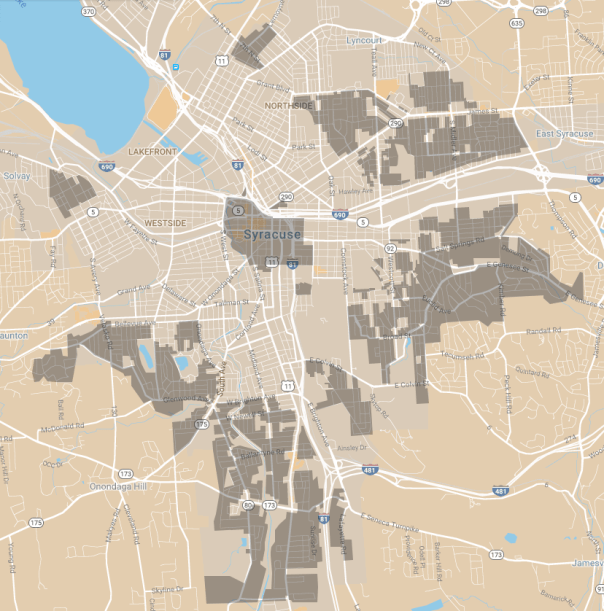
The result is that in areas zoned R-1, all new residential development will be exempt from parking requirements, while in areas zoned R-2 or higher, a lot of residential development will not be exempt from parking requirements (Downtown is also exempt from all parking requirements).

image
Areas where all residential development is exempt from parking requirements

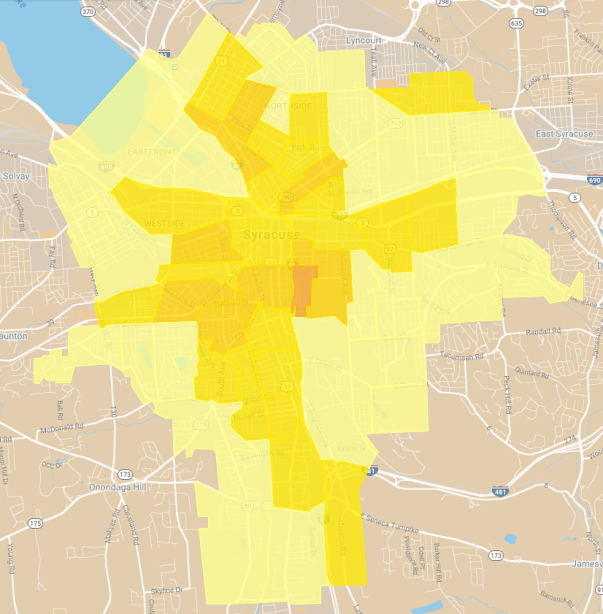
Syracuse’s inner neighborhoods are some of the best places to live in the entire County if you’re trying to make a life without a car. Neighborhoods like Hawley-Green and the Near Westside have relatively good bus service, a mix of businesses within walking distance, and easy access to the jobs Downtown and on University Hill. That’s why the people living in those neighborhoods are much more likely to go without a car than the people living in Syracuse’s outer neighborhoods like Strathmore and Meadowbrook.

image (1)
Percentage of carless households by census tract

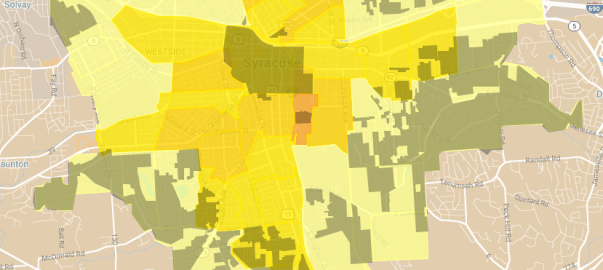
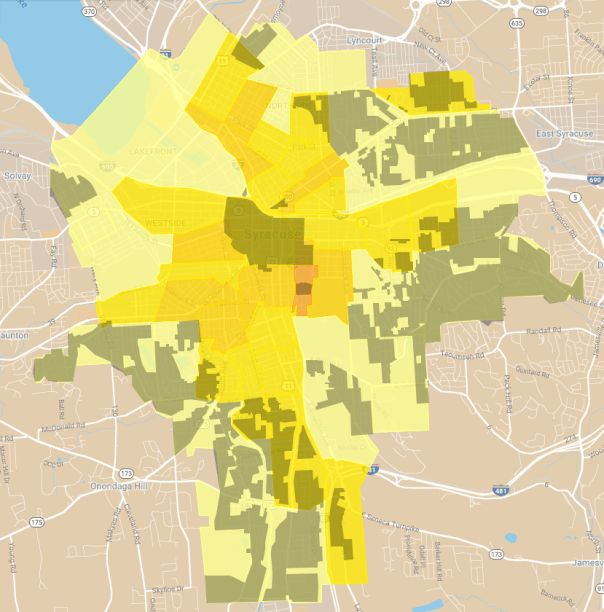
When you combine these two maps, it becomes clear just how insane the draft ordinance’s minimum parking requirements are. They require off-street parking for the people least likely to own cars, but they don’t make similar demands of the people most likely to own cars.

image (2)

City Hall needs to amend the draft zoning ordinance to fix this problem. They could remove the 75% cap on parking minimum reductions. If a property is on a bus line and nearby a public parking lot, it makes sense to give the property owner credit for having set up in a spot where off-street parking isn’t necessary. The arbitrary 75% cap is just a way of saying that people in Syracuse shouldn’t try to make the best use of shared resources, and that’s not a message worth sending in a city that doesn’t have enough resources as it is.

City Hall could also amend the draft zoning ordinance to say “When measurements of the number of required spaces result in a fractional number, the fraction shall be rounded down to the nearest whole number.” For example, a project requiring 2.25 spaces would only actually have to build 2 spaces, and a project requiring 2.75 spaces would also only actually have to build 2 spaces. Even with the 75% cap, this would make 1-family, 2-family, and 3-family houses eligible for exemption from any parking requirements.

City Hall could also count on-street parking spaces in front of a property towards the total required number of spaces for any property after applying the 75% cap on parking minimum reductions. Allowing on-street parking to substitute for off-street parking in this way would allow 1-family houses and small scale apartments to meet their parking requirements without having to build off-street parking.

Those small changes would do a lot to make the zoning ordinance better, but it’d really be best to just trash parking requirements entirely. They’re awful, ham-fisted solutions to a problem best solved by individuals. If a developer builds an apartment without off-street parking, they’ll get tenants who don’t own cars or who don’t mind finding on-street parking. Other people who value off-street parking will pay a little extra to rent or buy some other housing that includes a place to store a car. There’s no reason for parking lots to line James and Salina Streets when so many of the people living there don’t drive, and there’s no way that eliminating parking requirements will get people living in Meadowbrook to give up their driveways and garages.

That might be too much to ask in a town as car obsessed as this one. Whatever–any of those more technical fixes would be good enough. All that matters is that this new zoning ordinance not make it even harder to make a life in this City without a car.

Preserving Housing Opportunity in Syracuse’s Neighborhoods

On City Hall’s new color-coded zoning map, strictly residential neighborhoods are shades of yellow while neighborhoods with housing, businesses, and other institutions are different shades of blue. So far, City Hall has published three new drafts of this map, and each one has less blue and more yellow.

The change has been driven by community concerns about corner stores. In an interview with WAER, Assistant Zoning Director Heather Lamendola said “a lot of concerns stemmed around what has been dubbed a ‘corner store,’ and the adverse effects that the activity there might have on the adjacent residential neighborhoods.” In an interview with the Post-Standard, Mayor Walsh specifically mentioned “a corner store going in down the street from you” as something that concerns him.

People living in many of Syracuse’s neighborhoods have good reason to be wary of corner stores, and it’s good that people in power are listening to those concerns, but City Hall’s particular response goes too far, and it threatens to limit housing opportunity in Syracuse’s neighborhoods.

That particular response has been to take a lot of properties that were originally zoned as part of the light blue MX-1 district, and to switch them to the yellow R-2 district. City Hall has made this switch in several neighborhoods.

Changing all of those properties from MX-1 to R-2 will keep out corner stores, but it will also restricts a lot of other activity. Here’s the table of allowable uses for those two zoning districts:

MX-1 R-2
Residential Uses 1 Family Allowed Allowed
2 Family Allowed Allowed
Multi-Family Allowed with permit
Live/Work Allowed
Boarding House Allowed with permit
Public Uses Assembly Hall Allowed Allowed
Civic Building Allowed
Cultural Institution Allowed
Public Safety Facility Allowed Allowed
School Allowed Allowed
Park Allowed Allowed
Community Garden Allowed Allowed
Commercial Uses Private Club Allowed with permit
Beverage Cafe Allowed
Restaurant Allowed
Bed and Breakfast Allowed Allowed with permit
Office Allowed
Retail Allowed

Of all the differences between MX-1 and R-2, the most important have to do with housing. On MX-1 properties, you can have single family homes, two family homes, three- four- and five- family homes, apartment buildings, live/work homes, and boarding houses. R-2 properties on the other hand, only allow for one and two family homes. The switch from MX-1 to R-2 limits the variety of housing types in these neighborhoods, and that makes it harder for a variety of people to find a place to live.

Fortunately, there’s a simple way for City Hall to keep out corner stores without limiting people’s housing options. Here’s that same table of allowable uses with the R-4 and R-5 Districts included:

MX-1 R-2 R-4 R-5
Residential Uses 1 Family Allowed Allowed Allowed Allowed
2 Family Allowed Allowed Allowed Allowed
Multi-Family Allowed with permit Allowed Allowed
Live/Work Allowed Allowed Allowed
Boarding House Allowed with permit Allowed
Public Uses Assembly Hall Allowed Allowed Allowed Allowed
Civic Building Allowed Allowed
Cultural Institution Allowed
Public Safety Facility Allowed Allowed Allowed Allowed
School Allowed Allowed Allowed Allowed
Park Allowed Allowed Allowed Allowed
Community Garden Allowed Allowed Allowed Allowed
Commercial Uses Private Club Allowed with permit Allowed with permit Allowed with permit
Beverage Cafe Allowed
Restaurant Allowed
Bed and Breakfast Allowed Allowed with permit Allowed with permit Allowed with permit
Office Allowed Allowed with permit
Retail Allowed

Like R-2, zoning districts R-4 and R-5 do not allow corner stores. Like MX-1, zoning districts R-4 and R-5 allow multi-family housing, and district R-5 allows boarding houses. If City Hall is really committed to keeping corner stores out of the neighborhood by banning retail, it could at least let people provide themselves with all of the different kinds of housing allowable in the MX-1 district by zoning these lots as R-4 or R-5. It’s done just that in Hawley Green, where several blocks of Green and Gertrude Streets have been changed from MX-1 to R-4 as City Hall has revised its zoning maps:

Corner stores will not be able to move into these parts of the neighborhood, but at the same time, people will still have many different opportunities to find a place to live.

The zoning ordinance should allow for growth and flexibility. A landlord should be able to turn a two-family home into a three-family home if there’s enough people looking for housing to justify the cost of making that change. When individual people can make small adjustments like those, Syracuse will be able to respond to inevitable and unpredictable changes in population, income, demographics, and community needs in the coming decades. That’s what will make Syracuse a welcoming and resilient community.

Bus Stops and Parking Spaces in ReZone

In April 2017, City Hall published a draft of the new zoning ordinance that allowed for buildings near to “any type of bus stop, regardless of service level” to build 30% fewer parking spaces than buildings without easy access to transit. That’s was a good idea because it costs money to provide off-street parking, and that’s an unnecessary expense when the people using a building don’t travel by car. When City Hall imposes that expense on a property owner by requiring that a building have more parking than is necessary, that amounts to a tax on pedestrians, cyclists, and bus riders.

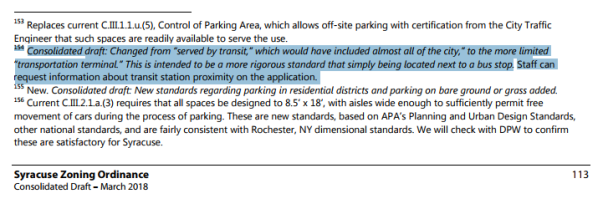
In March of 2018, the City Hall backed away from that good idea. Instead of reducing parking minimums for buildings within a quarter mile of “stations served by transit,” the new draft ordinance published that month talks about buildings within a quarter mile of “transportation terminals.” It’s not obvious what a transportation terminal would be in Syracuse (the Centro Hub, the RTC, the terminal stop for each bus line?), but it’s clear from the explanatory footnote that a transportation terminal is not a bus stop:

transitfootnote

It’s as if City Hall didn’t know that Centro is a viable transportation option in just about every neighborhood in the City, and now they’re trying to limit the benefits that bus service can provide.

In fact, Centro’s pervasive service is a good reason to take the opposite tack and allow greater density at the corner properties on each intersection where a bus stops. Elevating the properties at each bus stop by one zoning district (from R-2 to R-3, say, or from MX-1 to MX-2) would increase the City’s capacity to house people who do not own cars, and that’s right in line with the City’s Land Use & Development Plan:

“This capacity should be preserved by maintaining zoning for density levels in line with the existing built environment, so that over the long-term the City may market its ability to cost-effectively absorb regional population growth—based on existing infrastructure and an urban land-use pattern that lends itself to walkable neighborhoods, local commercial and business services, and efficient transit service.” Land Use & Development Plan, pg 12

Luckily, the City Hall is hosting three information sessions about the new zoning ordinance this week. The first will be on Monday at 6:30 at Nottingham High School, the second will be on Tuesday at 6:30 at Corcoran High School, and the third will be on Wednesday at 6:30 at Henninger High School. Check these info sessions out, learn more about the new ordinance, and ask why City Hall wants make it harder for people without cars to find an affordable apartment in the City.

The New I-81 Tunnel Options are not Compromises

On January 11, syracuse.com published a letter from State Senator John DeFrancisco. In it, Senator DeFrancisco again pushed what he calls the “hybrid option” as a compromise between those who want to get rid of the “unsightly viaducts” and those who want to maintain “efficient movement of interstate traffic.” According to him, that compromise means “tearing down the viaducts and creating a community grid” and then adding “a short tunnel to keep interstate traffic flowing efficiently through the city.”

The Senator has been banging this drum for more than a year, but this is the first time he’s written to the Post-Standard since WSP Parsons Brinckerhoff released its independent report on the feasibility of building a tunnel under Downtown Syracuse. That report was supposed to show exactly how a tunnel+grid design could compromise between the interests of businesses located along I-81’s current path, city resident groups, suburban politicians, and University Hill all while meeting NYSDOT’s standards for the project. That’s a pretty tall order, and this report didn’t fill it.

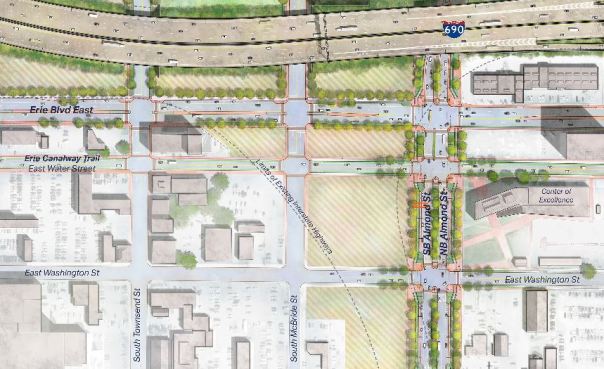
For city resident groups, the point of removing the viaduct is to encourage property development and raise property tax revenues on the east side of Downtown. The viaduct discourages development there because it covers up some land and makes adjacent land unattractive. This is a problem along the viaduct’s entire length, but it’s worst where the viaduct’s curving interchange’s ramps cover multiple full city blocks near the intersection of Almond and Fayette Streets.

All four of the recommended tunnel designs include off-on ramps for a new I-690 exit at Almond Street that recreate this exact problem:

“Providing a direct local-to-interstate connection would be critical to maintaining acceptable levels of service in downtown Syracuse. To provide this connection from the north end of Almond Street, on- and off-ramps would begin and end in a wide center median at the intersection of Almond Street with Fayette Street, and ascend north and west toward over Washington Street, Water Street, and Erie Street, ultimately tying in to I-690 EB and WB. This would necessitate the closure of Washington Street and Water Street due to vertical clearance requirements.”

The report claims that the switch from a highway interchange to highway off ramps “would provide a substantial amount of residual state-owned land for potential disposal north of Fayette Street between McBride Street and Almond Street,” but it’s hard to believe that any developers would be willing to buy that land since the 2nd and 3rd stories of any building built on it would be just yards away from heavy traffic travelling at forty miles an hour.

It’s strange, really, that WSP Parsons Brinckerhoff would include these ramps in all of its designs when NYSDOT didn’t think an exit from I-690 at Almond Street was necessary “to maintain acceptable levels of service in downtown Syracuse.” NYSDOT’s Community Grid plan instead included new exits at Irving and Crouse Avenues, and it kept the on-off ramps parallel to I-690 to leave as much land open for development as possible. The result is more land that’s more attractive for development and more likely to yield more property taxes to fund city services.

interchangecg

Senator DeFrancisco can keep trying to say that he wants a compromise, but he’s going to need to start actually respecting what people would want out of a compromise. It’s not enough to just say the words “hybrid option” and “community grid.” He’s got to actually advocate for a design that benefits the City in the way that NYSDOT’s community grid design can.

The Difficulty of Finding Compromise on I81

This past week, both Central New York’s federal and state legislators have made noise about I81. The region’s congressional delegation sent a letter to Governor Andrew Cuomo asking that NYSDOT not focus on money when deciding how to replace the current viaduct. Then, Senator John DeFrancisco and Assemblyman Bill Magnarelli held a contentious press conference where they claimed that traffic would get really bad if NYSDOT doesn’t spend the money to rebuild I81 along its current path through Downtown.

This decision should be about more than money. New York State spends a lot of money on cosmetic frills, and it shouldn’t turn cheap when it comes to a project as important as this one. Governor Cuomo and Senators Schumer and Gillibrand have repeatedly said that once the community unites behind a proposal, they’ll find the money to build it.

Unfortunately, money isn’t what’s gotten in the way of consensus on this project. The problem has been that different interest groups want mutually exclusive results from whatever NYSDOT builds after it demolishes the current viaduct. It will be difficult for any design to satisfy city resident groups who want to improve the area around Almond Street, businesses who benefit from proximity to interstate exits, suburban politicians who want to keep vehicle traffic concentrated in the City, and University Hill interests who want easy interstate access and room to expand.

So far, NYSDOT’s plans to replace the viaduct have split these four interest groups into two camps. Plans for a new tunnel or viaduct keep traffic concentrated on I81’s current path and have satisfied suburban politicians and interstate businesses. However, because these plans include lots of on/off ramps and a 4-way interchange between I81 and I690, they also use up a lot of land around Almond Street, sever local streets, and make the area undesirable for development. Those problems have led city residents and University Hill interests to oppose the viaduct and tunnel options.

Plans for a street-level option make the area around Almond Street more attractive and maintain easy access to University Hill from the interstate, satisfying city residents and University Hill interests. However, routing through traffic around the City also sends more cars to the suburbs, and it diverts traffic from businesses located along I81’s current route between the I481 interchanges (Dunk and Bright, DestinyUSA, 7th North Hotels).

Senator DeFrancisco and Assemblyman Magnarelli represent interests on both sides of this divide, and they hope that a hybrid tunnel/street-level option can unite the community. The ‘hybrid’ idea first popped up in 2014 when DestinyUSA began pushing the Access Syracuse Plan.The-Access-Syracuse-Plan-MODIFIED-v2-8-25-14

This plan maintained I81’s current path almost exactly, but it buried the interstate between Van Buren and Townsend Streets. North of Townsend Street, the interstate continued as a depressed highway with bridges carrying State, James, Willow, and Salina Streets over top of it. North of Salina Street, the interstate linked up with its current depressed route and continued unchanged. The real compromise of this plan was that it eliminated much of the interchange between I81 and I690, thus freeing up all that land around Almond Street and keeping the entire local street grid intact.

However, there were serious problems with the Access Syracuse Plan. It didn’t meet NYSDOT’s standards because it eliminated the I81/I690 interchange and because it maintained the current viaduct’s tight curves. It is also unlikely, that University Hill interests would accept the plan because, in order to maintain the local street grid, it removed exits and decreased interstate access to the Hill. This will be a problem for any tunnel, according to Doug Mankiewicz of the University Hill Corporation: “Tunnels are generally good for getting through things… They’re not so good at getting to things, so if the goal is to get to downtown, to get to University Hill, to get to the lakefront–the basic problem with tunnels is, when you’re trying to get to something, they’re not so good.”

As it stands, everyone is waiting for the final report from WSP-Parsons Brinkerhoff, the independent firm that the State hired to revisit the tunnel option. All politicians involved seem to hope that the report will contain a detailed plan for a tunnel that will satisfy all local parties. However, since that would mean a tunnel that doesn’t interchange with I690, such a proposal would not meet NYSDOT’s standards for the project. It’s also unclear how a tunnel could both provide easy access to University Hill while also maintaining the local street grid, since the on/off ramps of any exit would cut into city streets.

Whenever the report does come out and it becomes clear that no option can meet NYSDOT regulations and satisfy all local interest groups, then we’ll see what everybody really thinks. Are Senator DeFrancisco and Assemblyman Magnarelli looking to discredit the street-level option in order to justify the cost of maintaining I81’s current path? Will Senators Schumer and Gillibrand get funding for a project even if it doesn’t make everybody happy? Does Syracuse University care more about access to the interstate or developing an ‘campus-city’ to attract new students? Can local interests outweigh NYSDOT’s regulations in the final design?

Regardless of any of this, public pressure can force politicians to do the right thing. Call them all up and tell them what about this project matters to you.

Bike Lanes on Euclid Avenue

On July 11, the Post-Standard reported that Syracuse’s DPW had requested almost $935,000 to repave Euclid Avenue between Comstock and Westcott Streets. The City of Syracuse has been mulling the idea of painting bike lanes on this stretch of Euclid Avenue for a few years now, and the DPW’s request is just the latest step in what has been an extremely slow process.

This request makes it look like city government prefers to provide basic services in some neighborhoods rather than others. As the Post-Standard notes, the city government can only afford to pave about 2 miles of streets a year, and, according to the DPW’s own scale for measuring street quality:

Euclid was rated a seven out of 10 in 2015, according to the city’s public data. That’s better than most streets in the city.

Chris Baker, the reporter who wrote this article later tweeted that Euclid Avenue is in better shape than the streets “anywhere south of downtown”–a reference to the City’s most visible public housing projects and its most concentrated black neighborhood.

It’s impossible to look at this plan for Euclid Avenue and ignore Syracuse University’s influence. In its recently published Campus Framework, the University emphasized the importance of creating ‘gateways’ to campus, and it specifically called for this kind of work on Euclid Avenue:

Along Comstock Avenue and Euclid Avenue, new cycle lanes and streetscape improvements signal arrival to a campus district.

In the past, when the University wanted to make some change to University Avenue and Walnut Park, city government just turned those public resources over to this private entity in exchange for money. If city government is repaving Euclid Avenue in response to pressure from the University, then we should be thankful that at least this time the street is staying in public hands. It’s also possible that city government agreed to do this work in the negotiations that led to the 2016 Service Agreement, or in return for the money that the University spends to subsidize Centro.

Apart from any questions about who’s paying for this paving, the street’s new design also shows how the proposed zoning ordinance can influence seemingly unrelated issues in city neighborhoods. All of this talk about bike lanes got real momentum when the DPW published its 2014 Euclid Avenue Parking Study. That report surveyed demand for on-street parking along Euclid Avenue and proposed different bike lane designs that would maintain the necessary number of on-street parking spaces. That kind of evidence-based demand study is a good way to make decisions about parking, but runs up against a zoning ordinance that regulates parking without considering evidence at all.

On the most recent draft of the City’s zoning map, all of this stretch of Euclid Avenue is zoned as MX-1. As the Post-Standard notes, the vast majority of properties along this stretch of Euclid Avenue are multi-family apartment buildings. According to the most recent draft of the new zoning ordinance, multi-family residential properties that are zoned MX-1 are required to provide 1 off-street parking space per apartment. The draft allows that “On-street parking spaces along the property line may be counted to satisfy the minimum off-street parking requirements, if approved by the Zoning Administrator.”

All of that is to say that it doesn’t matter whether or not people use the on-street parking along Euclid Avenue–if DPW paints new bike lanes in such a way that they remove on-street parking in front of residential properties, the property owners will have to build new off-street spaces in order to meet the new zoning code. By effectively requiring property owners to pave their backyards, this bikelanes project will influence landlords’ willingness to renovate their properties, it will influence the uses to which those properties can be put, and it will even frustrate the County’s efforts to keep rainwater out of the city sewer system.

City issues are interrelated. The DPW wants money to repave a road, but the causes and effects of that request are difficult to trace. In this case, that request has to do with city government’s money problems, Syracuse University’s long range plans to attract students, and the proposed zoning ordinance–it’s about a lot more than potholes and bike riders.

ReZone Syracuse and Neighborhood Centers

The main objective of ReZone Syracuse, a project to rewrite the City’s zoning ordinance, is to “facilitate the implementation of the Syracuse Land Use & Development Plan 2040 (LUP), a component of the City’s adopted Comprehensive Plan 2040.” As of the most recent draft of the new zoning ordinance and map, ReZone fails to do this evenly across all of the City’s neighborhoods. In order to fully implement the Land Use Plan, ReZone needs to allow more residential density in select neighborhoods.

The City’s Land Use Plan focuses on Syracuse’s existing ‘neighborhood centers’–clusters of businesses and institutions served by major bus lines and surrounded by residential development. These are places, like Westcott Street and North Salina Street, that grew up in the 19th and early 20th centuries when people relied on streetcars to get around town.

Along with limiting off street parking and encouraging mixed-use development, the Land Use Plan suggests revising the zoning ordinance to allow high density residential development within a quarter mile (or 5 minute walk) of the neighborhood centers:

“Enable and encourage higher-density housing within the pedestrian-shed of mixed-use corridors and neighborhood nodes, placing people within walking distance of neighborhood centers.” Land Use Plan, pg 32

“Support and encourage high-density residential projects on upper floors of corridor buildings, and on properties adjacent to the commercial corridors to promote more foot traffic, interaction and vitality, as recommended by the Land Use Plan. (This may call for Zoning changes as well as selectively incentivizing residential projects when market conditions do not.)” Comprehensive Plan, pg 23

Dense residential development is necessary to sustain the businesses, institutions, and bus lines that make these neighborhood centers what they are. Without a lot of people living within walking distance, businesses in Syracuse’s neighborhood centers will rely on customers who travel by car from other neighborhoods or municipalities. That means more land used for parking lots, which makes the entire neighborhood center less walkable and discourages bus use, and the whole thing falls apart.

ReZone does not fully implement this recommendation. Comparing the map of proposed land uses from the Land Use plan and ReZone’s first draft map, it’s clear that the City intends to allow increased residential density (indicated on the Land Use map by yellow and pink, and indicated on ReZone’s map by yellow and blue) in some neighborhoods but not others.


Particularly, the blocks around the James Street neighborhood center in Eastwood are zoned almost entirely as R-1–single family detached houses on lots at least 40 feet wide and setbacks at least 30 feet deep. This is the opposite of “higher-density housing,” and it is totally inconsistent with the City’s Land Use and Comprehensive Plans.

It doesn’t take much effort to find two maps in the Land Use Plan that explain ReZone’s decision to keep Eastwood low-density.


ReZone’s draft map allows for higher residential densities in neighborhoods with high concentrations of vacant buildings and land, which is to say that ReZone proposes to increase residential density in poor neighborhoods.

If it makes sense to allow developers to build multi-family housing around the City’s neighborhood centers (it does), then ReZone should reclassify the blocks within a quarter mile of James Street as R-2 or denser. Revising the zoning ordinance in this way isn’t going to change anything overnight. Allowing apartment buildings on the blocks adjacent to James Street isn’t going to bring a huge wave of construction to Eastwood. But there’s no reason to leave existing density limits in place around neighborhood centers when the City’s own Land Use Plan recommends doing just the opposite.

Syracuse University’s Campus Framework and the City

On May 15, Syracuse University published its Campus Framework. This document “is meant to guide future potential development and decision-making” on both the University’s “physical campus and the surrounding area” until 2037. The plans for the campus’ “surrounding area” will have a direct impact on the City’s Near Eastside.

The last forty years show how Syracuse University’s building programs can either help or hurt the neighborhoods that abut the campus. During the 1970s and 80s–a period that the Framework calls “Strategic Investment”–Syracuse University closed public streets on University Hill and built new dorms on South Campus in order to remove students as much as possible from the City. The most visible project from this period is Bird Library, a concrete bunker built on top of what had been a public park and which cut off the intersection of Walnut Avenue and University Place.

Euphemistically, the Framework describes all of this building as “introspective”–it was really just an attempt to wall the campus off from the City. As the University separated its campus from the surrounding neighborhoods, it also discouraged students from living in city communities and contributing to their well-being. This ‘introspection’ added to the City’s myriad problems during these decades.

From the 1990s until 2014–a period that the Framework calls “Campus + City”–Syracuse University outgrew the wall that it had built along Waverly Avenue, and it had to locate new facilities further and further from the insular campus quad. Eventually, the University complemented this physical expansion with new services and initiatives that benefited both students and city residents. The most visible project from this period is the Connective Corridor, a free public bus route running from a university building in Armory Square to the main campus on University Hill.

Practical and economic factors forced the University to expand and expose itself to the City, but programs like the Connective Corridor, the Near Westside Initiative, and Say Yes to Education had a genuine positive impact on the community. Nancy Cantor, the University Chancellor who drove much of this new development, saw the University as an ‘Anchor Institution’ that could provide employment, capital, philanthropy, and a community vision for the City of Syracuse. She understood that city problems, if left unsolved, could eventually become university problems, so it was in the University’s interest to work for the benefit of the entire community. The two would succeed or fail together.

The Framework proposes to meld the ideas that guided campus development during these two periods. Like the “Campus + City” period, it looks for space to grow beyond the campus’ traditional boundaries, but like the “Strategic Investment” period, it seeks to draw a line between that new growth and the surrounding neighborhoods. The next period of campus development–which the Framework calls “Campus-City”–is ambivalent about about the University’s relationship to the City, but it should ultimately benefit the neighborhoods that surround the redeveloped campus.

According to the Framework, the chief challenge of the Campus-City period will be to consolidate the physical expansion of the Campus + City period while regaining the insular feeling achieved during the Strategic Investment period:

Syracuse University’s close physical connection to the city is an asset for partnerships and campus vibrancy; yet, it also creates challenges for an identifiable, clear sense of campus arrival. While the historic Campus on the Hill occupies a clearly defined area south of the Einhorn Family Walk, the University’s many other buildings within the Campus-City Community are not clearly defined.

It’s not enough that university buildings stretch down the northern slope of University Hill–those individual buildings must create a “clearly defined area” that campus visitors can enter or exit through “gateways.” That area’s definition should consist of “strong architectural design” communicating “University presence” and achieved through renovation of existing buildings and redevelopment of underused land.

The northern slope of University Hill lacks definition because it’s covered with surface parking. The University owns many of these lots, and the Framework proposes that it construct new dormitories on most of them. By designing these buildings all at once, the University can unify their facades and extend the campus’ clearly defined area all the way north to Harrison Street.

There is an economic incentive here as well. The University is in some financial trouble, and it can’t afford to keep buying up more land every time it needs to construct a new building. By more fully developing the land that it already owns, the University can add thousands of square feet of classroom and residential space without purchasing any more real estate.

Despite the insularity inherent in any plan to create “gateways” (entrances that imply barriers), this plan should benefit the neighborhood north of Harrison Street. First, by moving all of the dorm space from South Campus to University Hill, the University will bring an enormous buying population within walking distance of a struggling retail market. That will support the businesses along Genesee and Fayette Streets, and it will draw new businesses to the neighborhood, putting more daily errands and jobs within walking distance for the people who already live there.

Second, the decision not to buy any more land means that the University will not actively displace nearby residents. The majority of people living in the neighborhood rent their homes, so they’d be particularly vulnerable if the University continued to buy up land. This also means that there will be less total demand for land in the surrounding neighborhoods, and that will keep rents down.

Third, the Framework’s proposed upgrades to the Centro system will benefit everybody who rides the bus. After the University helps Centro implement the technology necessary to support “Real-Time Bus Arrival Information” and a “Bus Locator App,” Centro can turn around and offer those services to all of its riders. The Framework also proposes “Free Centro” for students–a subsidy that would boost ridership figures and automatically increase Centro’s state aid under the State Transit Operating Assistance funding formula.

Local government has work to do to capitalize on this opportunity. Just like the Strategic Investment period, the University still wants to control the public spaces within its campus. These include streets like University Place–long closed to through traffic and recently turned into a footpath–and parks like Walnut Park–a quarter of which is covered up by Bird Library, and which the Framework discusses as if it belongs to the University. City Hall needs to hold the line and keep public spaces public. That makes the difference between an insular campus and a Forbidden City on University Hill.

The State or SUNY Upstate or whoever it is that’s responsible also needs to let go of the land where Kennedy Square used to stand. The original plan for the site–displacing poor families in order to build a state-run luxury “neighborhood”–was bad, and it probably won’t ever get built. The land has sat vacant for four years, but developers are building new apartments along its edges. To more equitably distribute the benefits of land ownership, the State should allow City Hall to subdivide that land into normal-sized lots, and then it should sell those lots off to private developers who can build apartment buildings, stacked flats, single family homes, office buildings, and retail space on this prime real estate between the University and Downtown Syracuse.


The Westcott Neighborhood enjoys all kinds of advantages because of its proximity to Syracuse University. Students and professors live alongside families without any formal relationship to the University. Between subsidized apartments, cheap apartments, luxury apartments, affordable houses, and expensive houses, rich people and poor people all can find a place to live. The neighborhood has good transit, two grocery stores, and an active business district, allowing people to meet their daily needs without owning a car. It’s a place where all kinds of different people can make a good life.

The plans described in the Framework can bring the same benefits to the neighborhood north of Harrison Street. For all of its abstract discussion of architectural definition and efficient land use, the plan amounts to this: the University will move a lot of student housing from South Campus to the parking lots along the main campus’ northern fringe. That will instantly increase the area’s population without driving up its rents, and that means more money circulating through the neighborhood. If City and State government handle this change well, the result will be a larger, denser, healthier neighborhood between University Hill and Downtown Syracuse.

The University is asking for comments from the on the Framework. You can submit them at this link.

Form-Based Zoning

Syracuse’s Proposed Zoning Ordinance contains a section that regulates certain aspects of building form. Form-based ordinances are meant to “promote high quality building design,” but legislating design is tricky, and this draft fails to focus on the kind of design that matters most. The City should adopt rules that support community interaction rather than rules that dictate taste.

One of the draft ordinance’s many regulations governs building rooflines:

Buildings shall be designed to avoid any continuous roofline longer than 50 feet. Rooflines longer than 50 feet shall include at least one vertical elevation change of at least two feet in height.

It’s not clear exactly how this supports the zoning ordinance’s mission, but you have to imagine that the people who wrote it had buildings like One Park Place in mind–big boring rectangles that feel out of place among Syracuse’s beautiful old buildings. However, some of those beautiful old buildings in Downtown Syracuse also have long unbroken rooflines.

The length of a roofline is a measurable indication of the architectural style of a building, but that single measurement can’t tell you whether a building is ugly, or–more to the point–whether people will think it’s ugly in thirty years. The dilemma here is that an ordinance cannot be both strict enough to guarantee taste and loose enough that a small staff of zoning employees can easily enforce it:

This draft tries to strike an important balance between raising the bar for design while recognizing that staff capacity limits the City‘s ability to effectively administer and enforce too many new standards.

This particular regulation errs on the side of enforceability, so while its authors might have intended that it give us more buildings with interesting roofs and outlines like City Hall or NiMo, it’s not specific enough to guarantee that. Instead we’re getting buildings, like the Amos Extension, that satisfy the ordinance in the cheapest possible way.

The Syracuse Zoning Board should focus, instead, on building forms that make it easy for people to interact as a community. This means buildings that let people communicate across the property line. It means forms that allow people to experience the interior space of a building from the exterior space of a sidewalk, and vice versa. It means stitching the public and private realms together. That’s a lofty way to talk, but all it really means are windows and doors that face the street, minimum setbacks, first-floor retail, and parking lots placed behind buildings. It’s very simple, easily enforceable, and more likely to succeed than legislated taste.

Luckily, Syracuse’s proposed form-based zoning ordinance contains regulations like these that will encourage community interaction. The sections on “Building Placement and Orientation,” “Primary Entrance Orientation,” “Building Entrances,” and “Transparency” are all reasonable and only need minor tweaking to focus their purpose. Other sections concerning things like “Building Materials,” “Mechanical Equipment Screening,” “Facade Colors,” and “Vertical Articulation” are unnecessary and should be cut out. These revisions will put the focus squarely on form-based zoning’s true goal: community.