Syracuse can be a hard place to navigate. The City is big, it’s streets intersect at weird angles, and it’s just very easy to get turned around and lost. In a place like this, it’s helpful to have a way of simplifying things—some mental tool that makes the City understandable and makes people feel comfortable and in control as they move around within it. BRT can provide Syracuse with just such a tool—the network diagram.
The highways already do this for car drivers. There are people who understand the City entirely in terms of highway exits. Name any spot, and they can tell you how to get there from the nearest exit. Ask for directions to any location, and they’ll tell you how to get from where you are to the nearest onramp, how to take the highway from there to the appropriate exit, and then how to get from that exit to wherever you’re going. It may not be the shortest or fastest route, but for someone who understands the City through the highways it will be the most intelligible route.
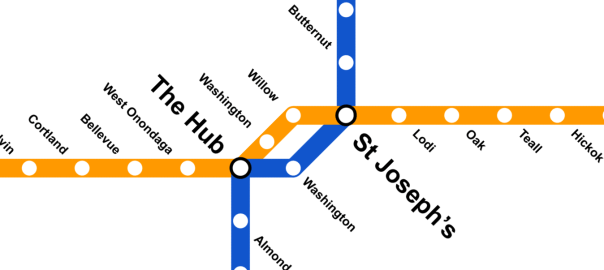
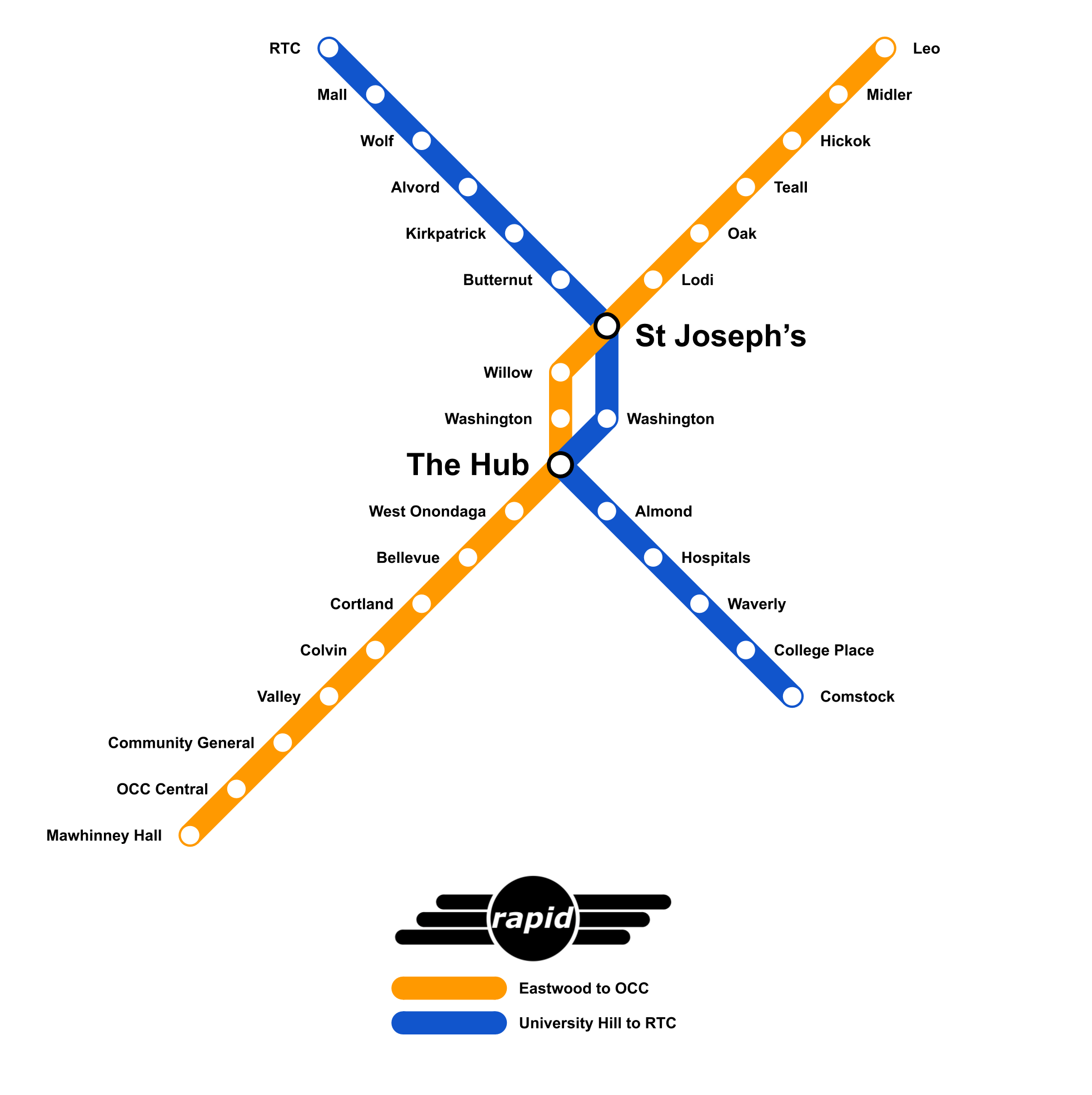
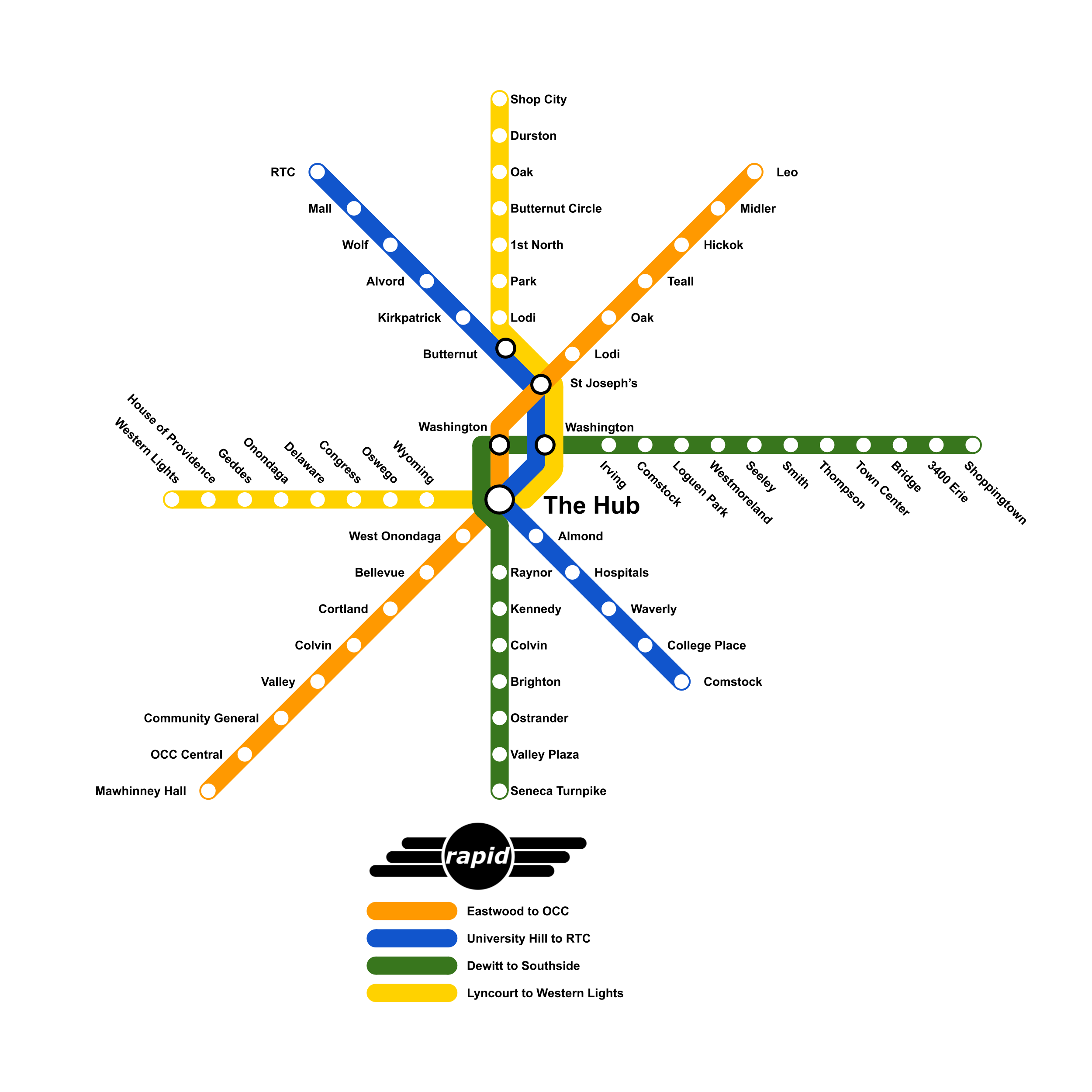
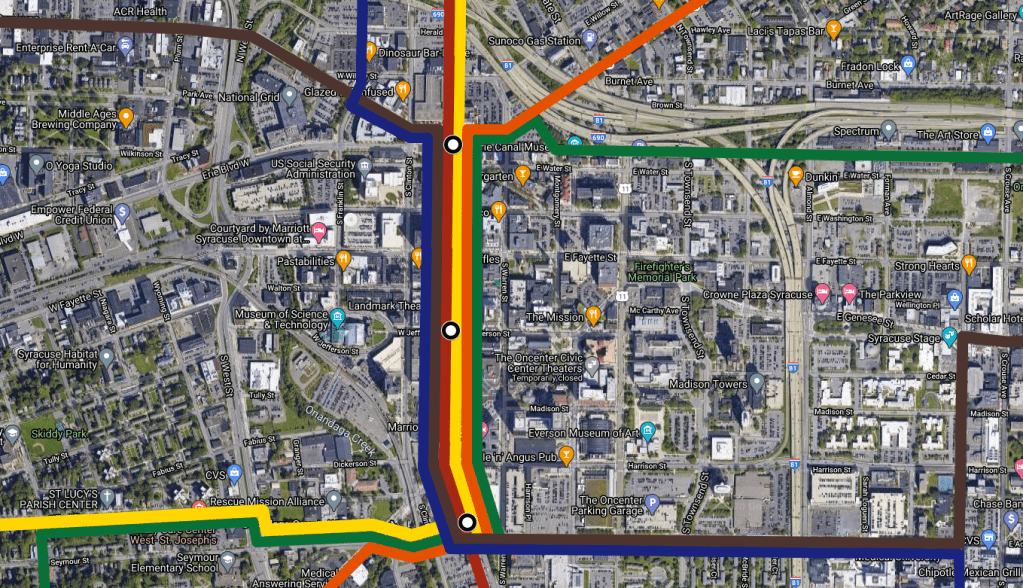
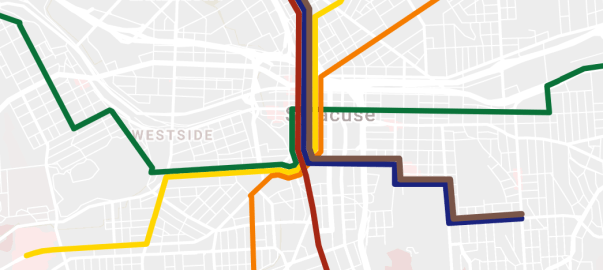
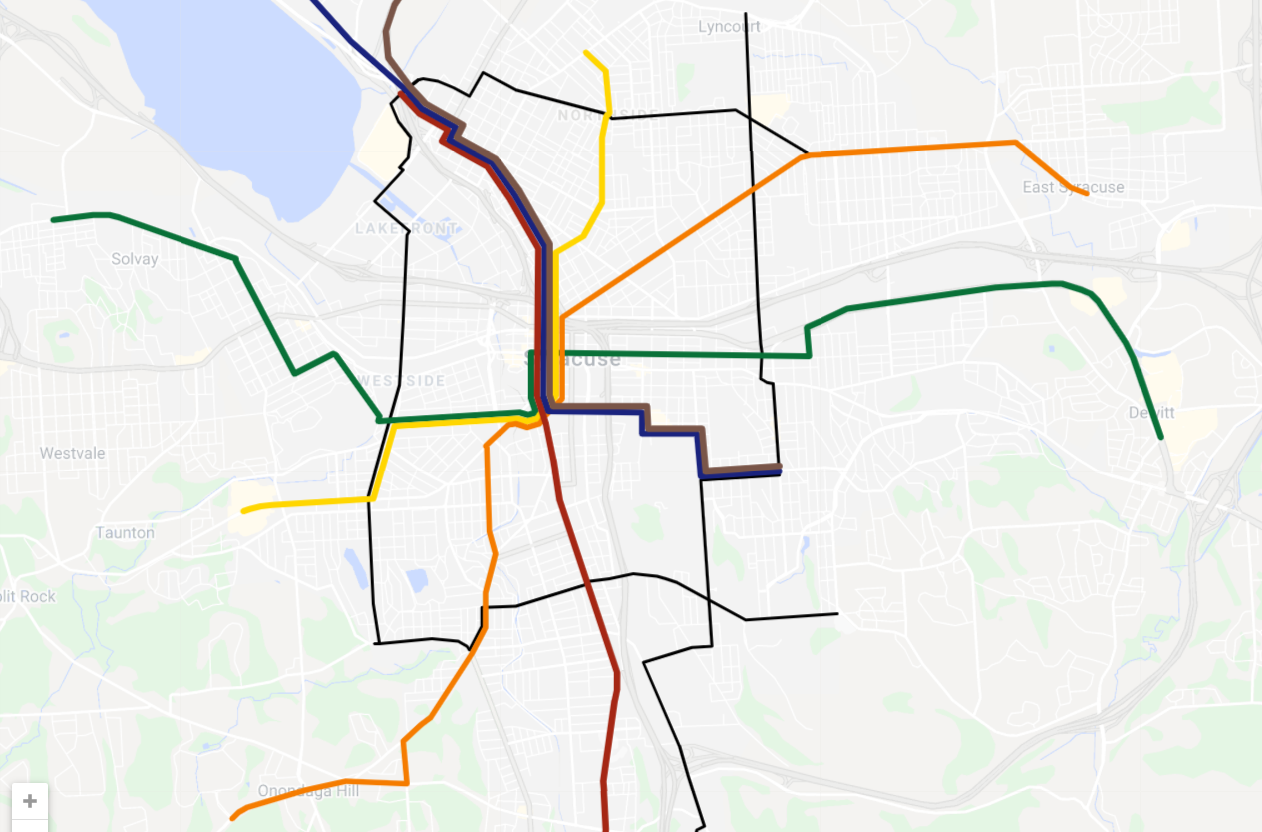
BRT could give us a similar simplifying diagram based on high frequency transit routes. Here’s an idea of how it could look:
It’s not actually so simple to get from the RTC to SU as this diagram suggests—the bus operator is going to have to make more than three turns—but from the perspective of a passenger on the Blue Line, it’s as easy as boarding and exiting the bus at the correct station stops.
If these transit lines are useful enough that people can ride them as their primary mode of transportation in the City, then knowing your way around town is as easy as remembering the relationships between the network’s different station stops. How to get from Eastwood to Crouse Hospital? Just catch an OCC-bound Orange bus, transfer to an SU-bound Blue bus at either St. Joseph’s or the Hub, and get off at the Hospitals station stop. This simple diagram becomes a key to understanding the City as a whole.
And after these two first lines prove their worth, Centro should extend BRT to more of the City, running new lines to different neighborhoods, making more of the City accessible and intelligible to people through public transit.
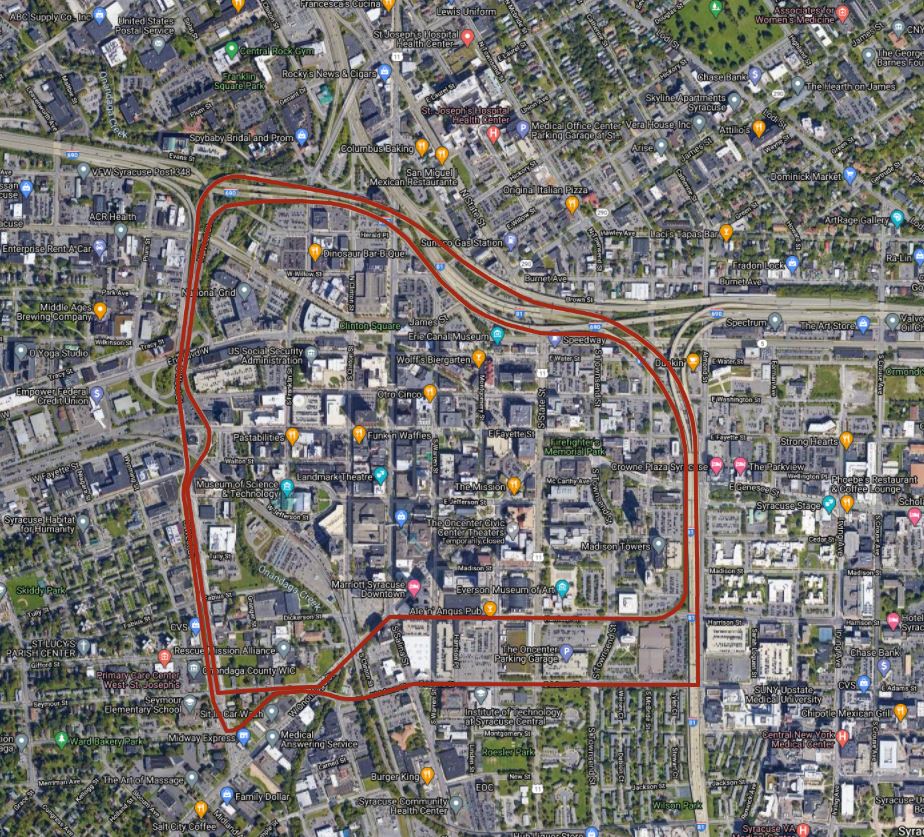
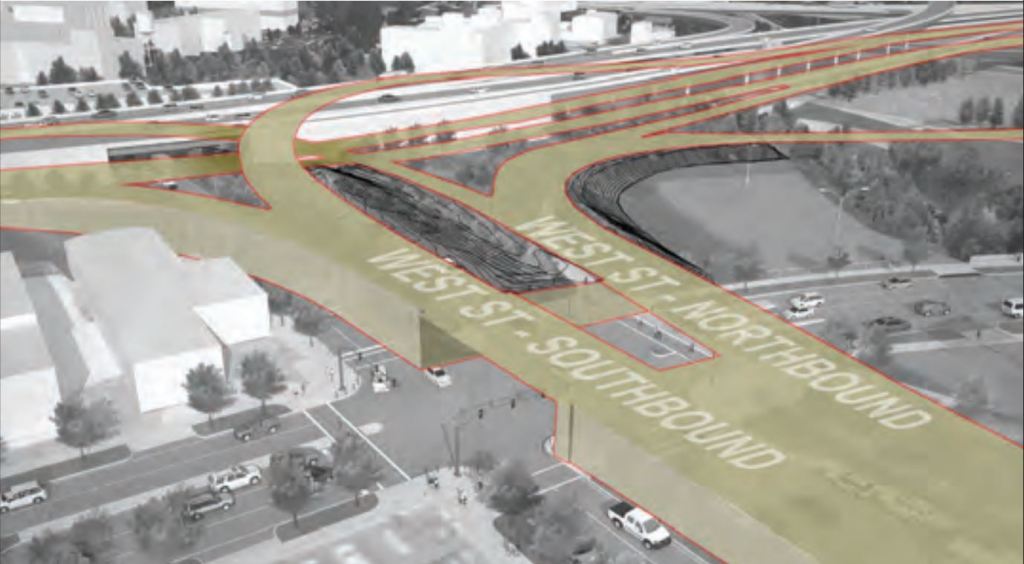
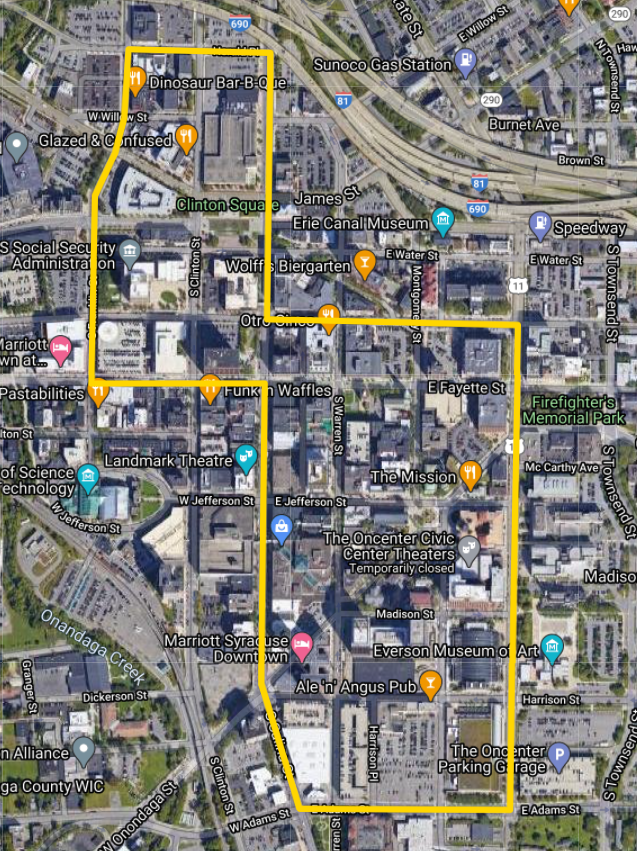
The I81 viaduct is part of the interstate highway system, but it’s also one piece of a high-speed traffic loop that encircles Downtown. Once it’s torn down, that loop won’t function the way that it’s supposed to, and that will give Syracuse a fantastic opportunity to reclaim West, Harrison, and Adams Streets as local streets rather than surface-level highways.
Early plans for Syracuse’s interstates included connecting highways on Townsend, West, and Adams Streets. These would have formed an Inner Loop like the one that Rochester is currently removing.
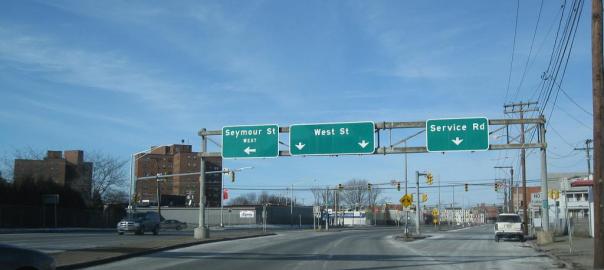
Syracuse never managed to build that full loop, but it came close. Coming off 690, West St feels one hell of a lot like an interstate until you hit the traffic light at Fayette. No buildings front the new curvaceous block of Shonnard Street that Connect West to Adams. Harrison and Adams are significantly wider than any city street should be—more than twice as wide as 81 in places—and people speed up and down them like they are highways.
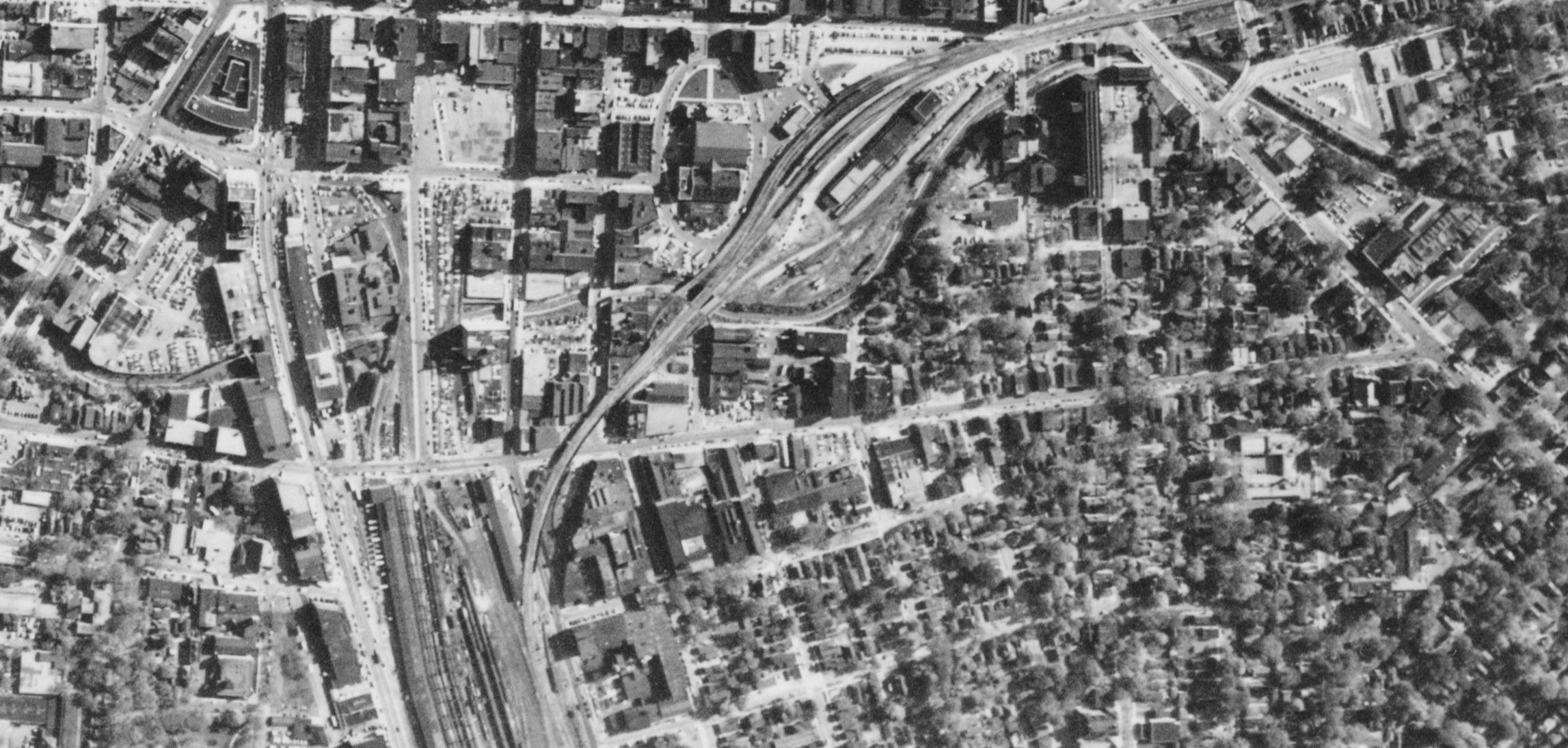
In 1955 businesses, factories, and homes lined West Street. In 2020 it’s a barren highway
The thing is, this quasi-loop won’t make much sense after the viaduct’s gone. Harrison and Adams are 4 lanes wide because they handle all of the car traffic going to-and-from 81’s main Downtown exit. Pretty soon, that exit won’t exist, and those streets won’t get nearly enough traffic to justify their width. And if Harrison and Adams aren’t going to feed the interstate anymore, then it doesn’t make very much sense for West Street to feed them either, so it doesn’t need to be 6 lanes wide.
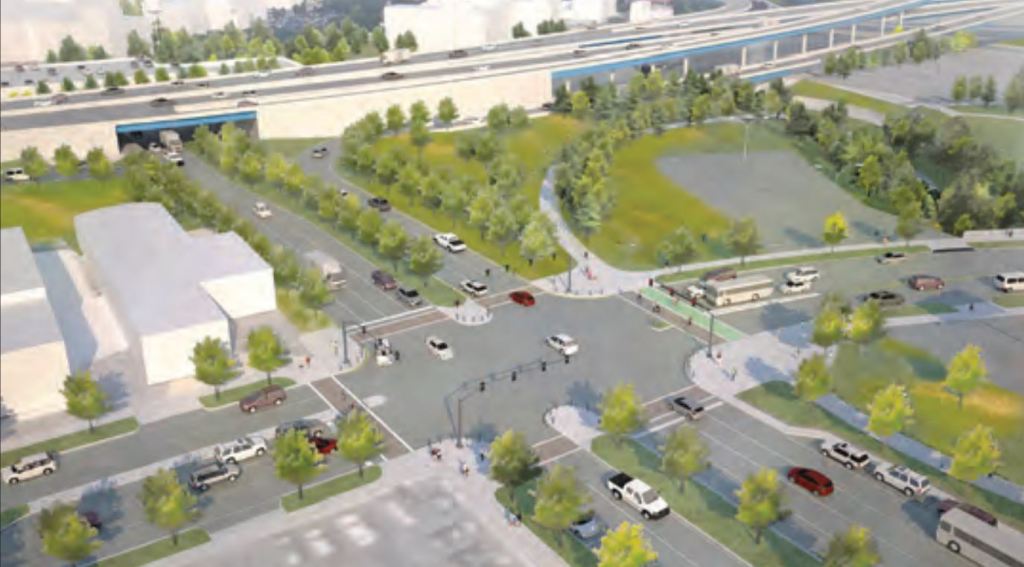
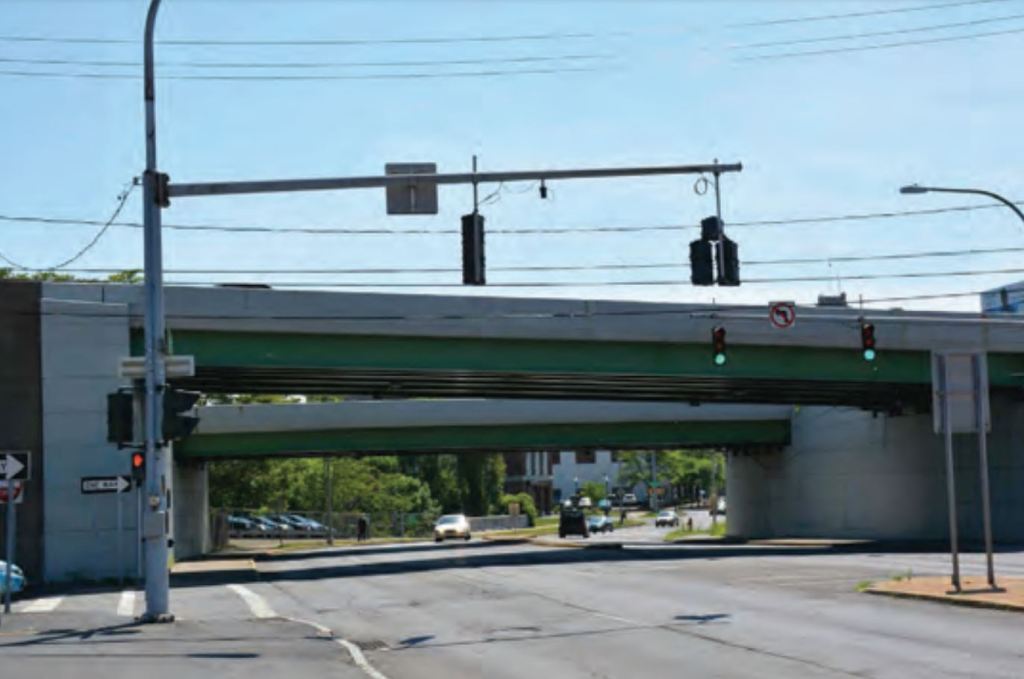
NYSDOT and City Hall both understand this, which is why the DEIS included some big changes to West, Harrison, and Adams Streets. The biggest is that they’re getting rid of the West Street onramps to 690. That will slow traffic on both West and W Genesee, and it will free up space for an extension of the Creekwalk. They’re also going to convert Harrison and Adams from one-way race tracks into two-way streets—an adjustment that will encourage car traffic to obey the speed limit and make those streets safer for people on foot and on bike.
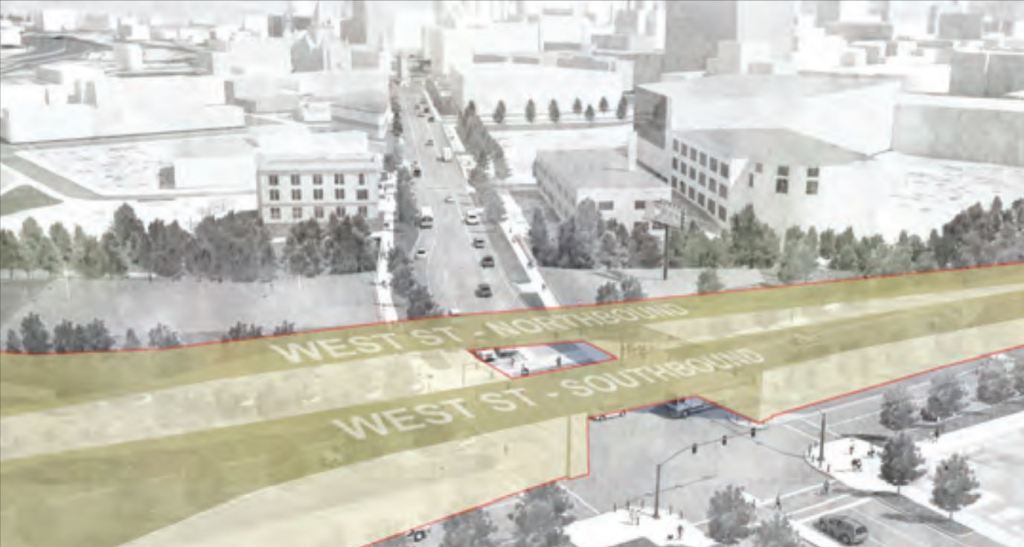
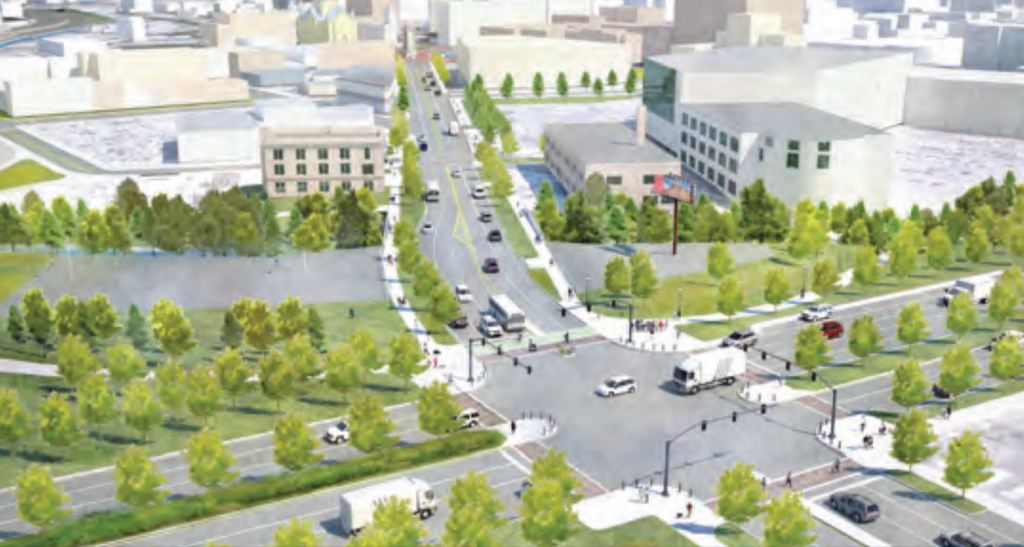
But they should go even further than that. If those streets aren’t going to feed the highways anymore, then there are plenty of other highway-like features that should also go away. West Street doesn’t need its full cloverleaf interchange with Erie Boulevard—one connecting ramp in each direction is plenty for low-speed traffic. West Street also doesn’t need to be a divided highway south of Fayette—it can go back to being a 2-lane street without any problem, and Marcellus, Jefferson, and Tully Streets can all get signalized crosswalks where they intersect.
Harrison and Adams should both be 2-way streets and they should be a lot narrower. And although they won’t lead to a highway onramp anymore, they will still lead to Centro’s Hub, so some of that extra space should go to bus lanes.
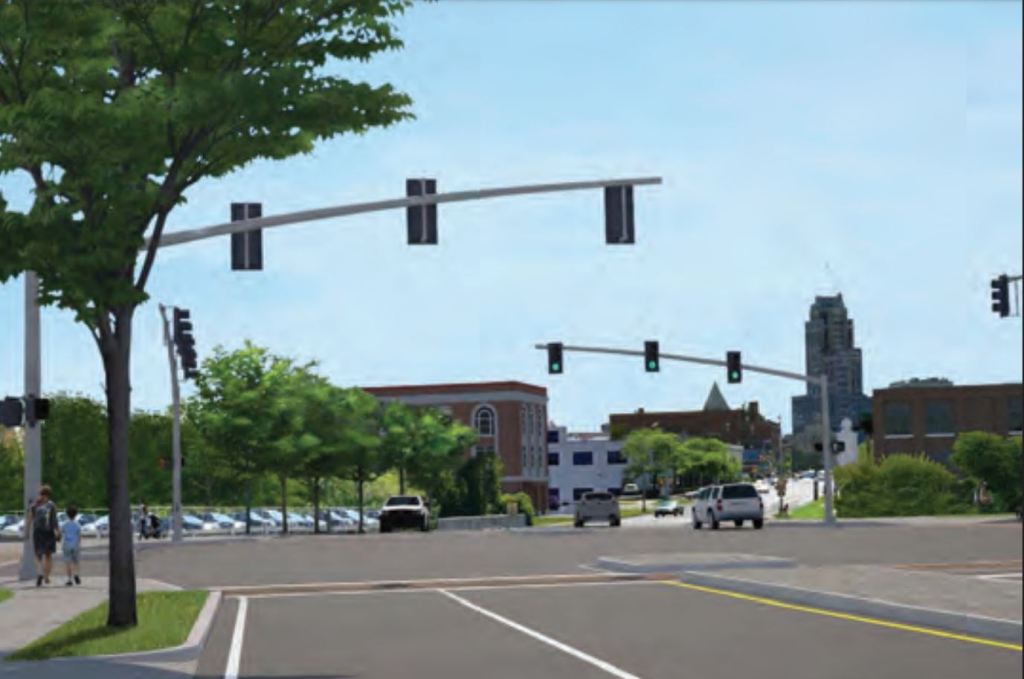
Imagine West Street’s extra lanes turned into park space, new buildings along Erie Boulevard where the cloverleaf used to be, a seamless transition from Armory Square to the Near Westside, and bus lanes linking Onondaga Street, Downtown, and University Hill
The highway-ization of Syracuse’s local streets has been a disaster for the City. West, Harrison, and Adams Streets all used to be thriving business districts that linked their neighborhoods to Downtown. Now all are asphalt moonscapes that no one wants to cross. Getting rid of the viaduct will change Syracuse’s street grid in a way that will allow the City to take those streets back, to make them function the way that they used to—connecting the City’s neighborhoods instead of dividing them.
Centro’s new CEO, Brain Schultz, wants to start running a “Downtown Circulator.” That could mean two different things—one good, one bad—and what form this plan takes will say a lot about whether or not this new CEO is up to the task of building the kind of public transit system that Syracuse needs and deserves.
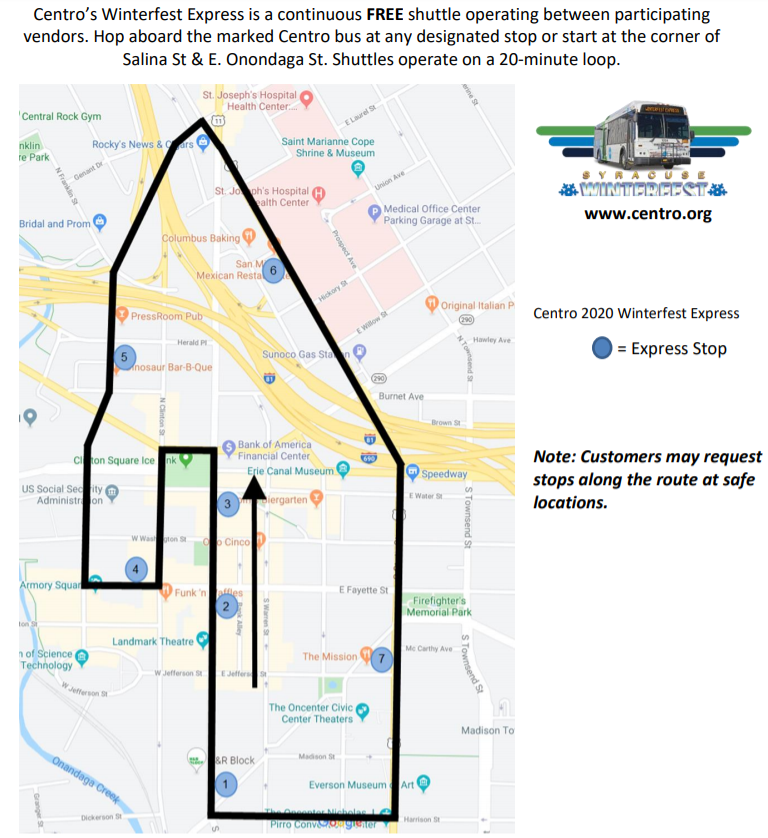
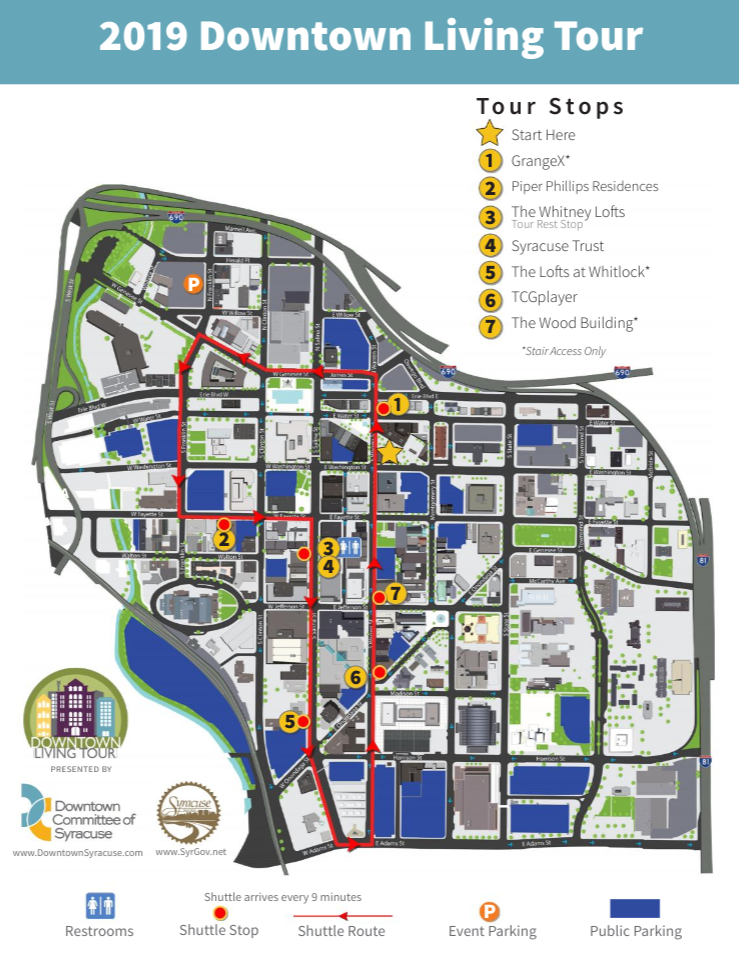
Centro hasn’t provided many details, but it sounds like they’re considering a new bus route like what they run for Winterfest and the Downtown Living Tour—one that will run in a rough circle and provide door-to-door service for several specific destinations.
“Mr. Schultz’s ambitious vision includes a Downtown Circulator bus to help the growing number of Syracuse residents easily move from one end of the city to the other, including service to the soon-to-be-opened Salt City Market.”
This kind of service is almost never useful because very few people will wait for the circulator to show up. If only one bus is running the loop, then time spent waiting for it to pick you up will account for more than half of the length of most trips. That makes a circulator extremely unhelpful for the kinds of short trips that are supposed to be its focus. Want to get from the Clinton Square tree lighting to Armory Square for a drink? Waiting for the circulator could take anywhere from 0 to 13 minutes, but it’s just 7 minutes by foot. Why wait when it’s faster to just walk?
The essential problem is that a bus route designed to serve a single neighborhood as small as Downtown is necessarily very short, but a route like that is too short to be useful to the people in that neighborhood. Centro was clear, they want a bus route that’s useful for people trying to move around Downtown, but if they try to do that by targeting the service too exclusively on Downtown they’ll end up with something that’s not even useful for that narrow purpose.
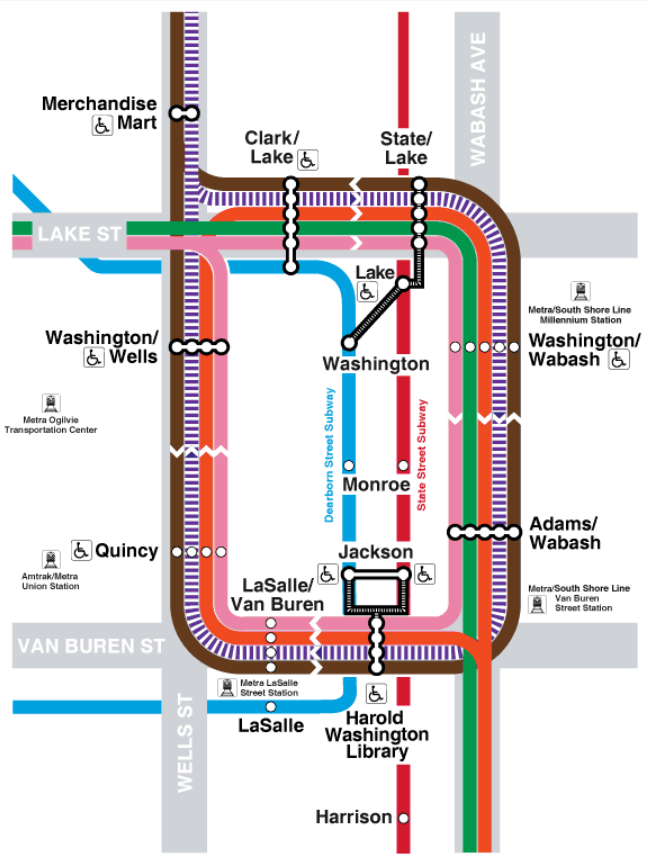
A better model is the Chicago Loop (a piece of transit infrastructure so iconic that they call the central part of the city The Loop instead of Downtown). There, multiple elevated rail lines meet and run along a set of common tracks that loop around the city’s center, all serving the same 8 stops. If you’re in the Loop and trying to catch any one of these trains, any station will do. That means less walking for riders, it means that businesses that want access to transit can locate anywhere in the Loop, and it means that the trains don’t get overwhelmed by people all trying to board at a single downtown stop.
All those benefits improve service for everyone who rides any of these trains—most of whom are travelling to or from a station outside the Loop—but they’re structured in a way that also creates specific benefits for people who are riding between stations within the Loop. All those lines serving the same stops means that a train is never more than a couple of minutes away. That’s the kind of frequency that makes the Loop useful for people just making short trips between its closely-spaced stations.
6 BRT lines converge to create a high-frequency Downtown corridor where the next bus is never more than a couple minutes away
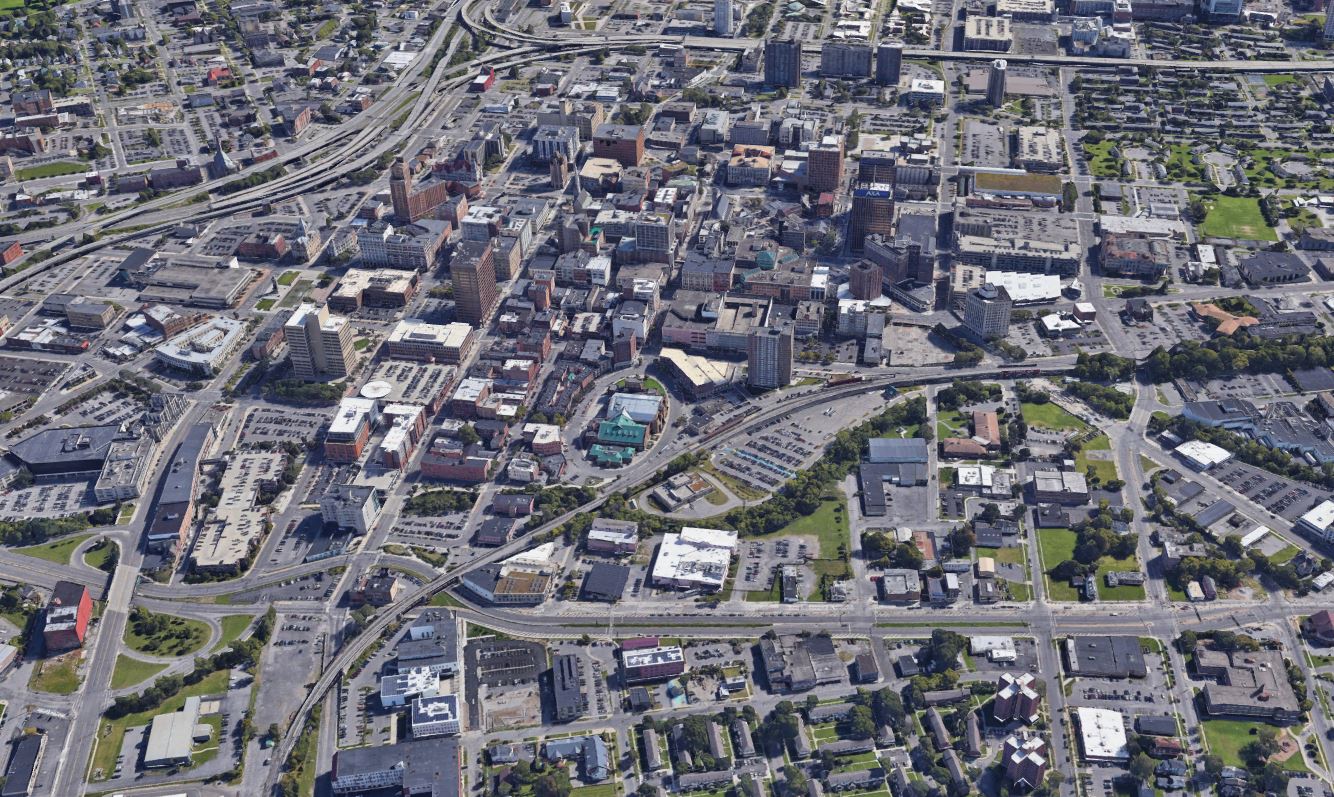
The Chicago Loop is a good model for running useful transit in Syracuse’s compact city center. It would be simple to modify existing plans for a Bus Rapid Transit network so that every line serves multiple common Downtown stations—Clinton Square, Salina/Jefferson, and the Hub, say. This would put all of Downtown within easy walking distance of every single BRT line, and it would allow riders to access any BRT line from any Downtown station.
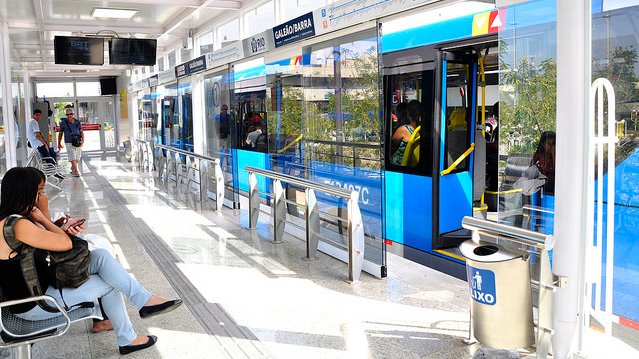
This would also create a Downtown corridor with extremely frequent service. Say there are 6 BRT lines and each runs every 12 minutes. That means service every 2 minutes. With such short wait times, it actually would actually make sense to ride the half mile from Clinton Square to the Hub, especially if it were cold or rainy and the short wait for a bus could happen in a safe, climate controlled station.
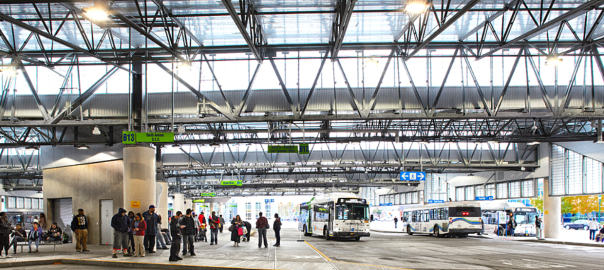
BRT station in Rio de Janeiro
The difference between these two models is that the downtown circulator tries to do one extremely specific thing for a very small group of people and fails, while the Chicago Loop is about improving the entire transit network in such a way that it works for everybody, including that small group of people that the downtown circulator was supposed to serve.
The way that Centro hired Brian Schultz has raised a lot of questions. Is he fully focused on Centro? Does he have the qualifications to run a transit agency? Is he the right person for the job? How he chooses between these two models as he implements this new Downtown service—and, hopefully, a lot of other service improvements as well—will go a long way to answering those questions.
Public transportation is a public service—like libraries and municipal water—and riding the bus shouldn’t feel any more degrading than checking out a book or drinking from the tap. Too often, it is. There are so many small things that make riding the bus unpleasant—things that are unnecessary, that don’t really save any money or make the service and more useful—things that would get fixed if people with power took riders’ time, comfort, and convenience seriously.
Centro doesn’t value its riders’ time. The system is designed to be able to get a person from anywhere in the urbanized area to anywhere else, but it’s not designed to do that within any set period of time. Buses are routinely late and for no good reason. Operators watch riders while they pay the fare instead of pulling away from the curb once a rider gets on board, buses don’t go fast enough between stops, bunched buses rumble along as a pair. All of those little delays could just go away if Centro’s culture prioritized speed, but it doesn’t, and that’s because Centro does not prioritize riders’ time. The schedule might say that you can get to your sister’s house by 2:00 so that she can leave the kids with you and get to her meeting at 2:30 on time, but the schedule’s no guarantee. The schedule might tell you to drop what you’re doing and get to the bus stop at 7:47, but you could end up waiting there until 7:59 and that’s just how it goes.
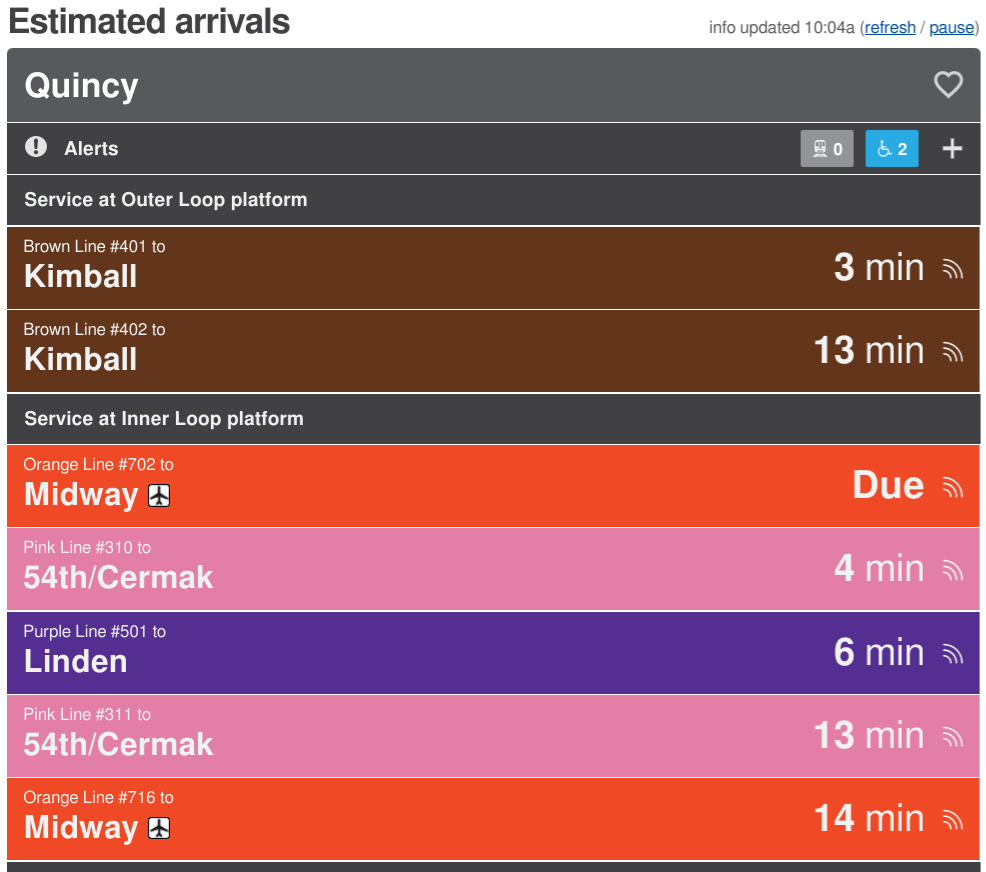
And if a bus is going to be 12 minutes late, Centro should let you know. They have the technology to know where every bus is on its run and to predict how far away it is from any point. In other cities, the transit authority uses that technology to display real-time arrival info at the bus stop so that riders know when to expect their ride. This makes the waiting less stressful because you know that a bus really is coming, and you know when to expect it. Putting real-time arrival displays at bus stops wouldn’t do a thing to make the buses show up sooner, but it would make waiting at the stop less stressful for riders, so Centro should do it.
And while you’re waiting, you should at least be comfortable. Why are so many bus stops such unpleasant places to spend time? So many are just a sign in the ground with no protection from the sun or rain, nowhere to sit, and no easy place to stand when there’s snow on the ground (and forget rolling up to most of Centro’s ‘handicap accessible’ stops in a wheelchair). If the bus is the best way for you to get where you’re going, then this is just one of the things you have to deal with, but you shouldn’t have to, and Centro should care enough to do something about it.
Centro can get away with ignoring this stuff because none of it is likely to change the material considerations that make public transportation a practical or impractical means of getting around town for any particular person, so none of it is likely to make someone change their decision about whether or not to ride the bus. But that really shouldn’t matter because these are the kinds of things that make a person feel respected or not, and no one deserves to be disrespected just because they’re riding the bus.
Talk to non-bus-riders about Centro, and eventually they’ll say something to the effect of “you know a specific challenge that we have in Syracuse is that bus ridership is associated with socio-economic class, and so the question is how do we get people of all classes to ride the bus. How does Centro get me to leave my car at home?”
That question comes from a good place. Public transportation is a public service, and it should be no more stigmatized than checking out a library book or drinking water from the tap. Asking where that stigma comes from and how to eliminate it is good.
But instead of asking how better bus service will work out for me specifically, it’s better to work from the other end and think about who is most likely to benefit from improvements to Syracuse’s public transportation system.
Getting around on Centro takes time. Slow buses meander through City neighborhoods, and they run so infrequently that getting to and from anywhere includes a lot of wait time—you might only need a half an hour to shop for groceries, but if there’s an hour gap between runs, then an hour is how long you’re going to be spending at Tops.
This depresses ridership because it limits the number of places that any bus rider has time to get to in a day. Riding Centro to and from Tops takes so much time and effort that it’s often practically impossible to then ride Centro to and from the doctors office, a PTA meeting, your aunt’s house. Forget trying to run an errand by bus after getting off from work.
Run faster, more frequent service, and ridership will increase immediately because the people who have to plan their whole entire day around running one errand by bus would all of a sudden have the time to ride the bus two or three or four places.
***
Some people can’t or won’t abide Centro’s current inconvenient service, and they avoid it at all costs by walking and or biking around town. That’s not always convenient either, especially if you’re going very far, the sidewalks are busted up, and it’s snowing. Or maybe they bought a car, but can’t really afford to fill the tank or to keep it fixed up.
BRT can offer these people a better option: a service that’s safer, more convenient, and more economical than what they’re doing now.
Run faster, more frequent service, and ridership will increase because more people will start riding the bus instead of walking 3 miles to work.
***
In the long term, better bus service builds its own ridership by making it possible for more people to build lives that include the bus.
Imagine a person moving to Syracuse from Boston to start a new job. They might make enough to be able to comfortably afford a car and a house with a garage, but they didn’t drive in Boston and would be happy to use public transportation in Syracuse if it was convenient enough. BRT can offer that convenience, and it can precipitate a series of major decisions—apartment or house, city or suburb, car payment or no—that lead that person to ride the bus because they have built a life where riding the bus makes sense.
Or imagine a kid moving out from their parents’ house into their first apartment and needing to provide their own transportation for the first time in their life. Right now, that might mean getting a place with a parking spot and buying a crappy used car. With BRT, it could mean finding an apartment near a station.
Run faster, more frequent service, and ridership will increase in the long term because more people will choose to build lives that account for and rely on the bus.
So to go back to that original question—”how will BRT get me to leave my car at home?”—the answer is that it might not. If your family owns multiple cars, if you don’t live within a short safe walk of a bus stop, if your neighborhood is so spread out that it can’t support good bus service, then there’s not a lot that Centro can do to create a service that will work for you.
But there is so much that Centro can do to create a service that works for so many more people. Faster, more frequent service will get more people riding the bus more often. Better bus service will get current bus riders riding more often, it will get new people to ride the bus, it will make life better for people who rely on the bus in their daily lives, and it will come from making that way of living more attractive to more people.
Syracuse is getting a huge improvement to its transportation system. Three interlocking projects pursued by three different levels of government are making it safe, easy, and convenient to travel by bike around the metro area. The Creekwalk, Loop the Lake Trail, and Erie Canalway are fantastic projects that will make Syracuse a better place to live.
Syracuse’s topography poses unique challenges to people trying to get around town by bike. It’s a hilly city, and the easiest route between any two points follows the level valleys that criss cross town. Those routes are flat, so they’re good for biking.
But, paradoxically, these routes are also often very bad for biking because they see so much car traffic. These streets have often been widened to accommodate 4 lanes of car traffic (but not enough for two lanes of bike traffic), and cars whiz along them at unsafe speeds that repel people who aren’t travelling with the protection of a 2-ton steel cage.
There’s no good way around this. You can’t just bike on a quieter street that’s parallel to Erie—there isn’t one! Bikers have to choose between exposing themselves to bodily harm on dangerous streets, riding on busted up sidewalks (when they exist and are clear of snow), or pedaling up and down extremely steep hills. This basic logic applies to major crosstown corridors across the City, and it’s a major barrier to mobility.
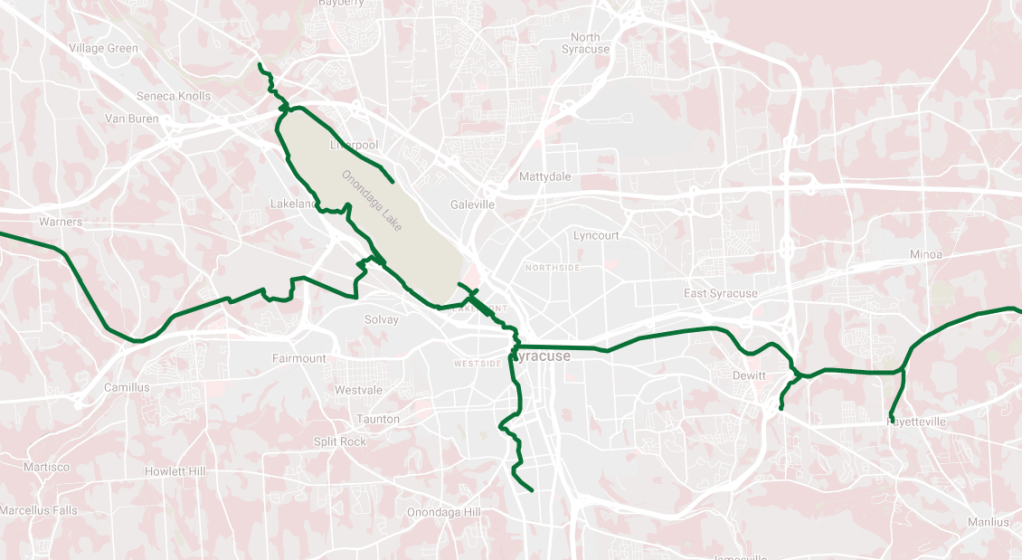
The Canalway, Loop the Lake Trail, and Creekwalk combine to form a single protected biking and walking trail that stretches across the Couny
The Creekwalk, Loop the Lake Trail, and Erie Canalway remove that barrier by putting dedicated bike (and foot!) paths along those major routes. These paths are almost fully separated from car traffic, so they’re safe, and they follow level water routes, so they’re easy to bike on.
And what’s more, they’re connected! Anyone who can get to any of these trails can get to all of them. That puts so much of the region within safe and easy biking distance of so many people.
This is a transportation game changer. Where biking across town used to require strong legs and a high tolerance for physical danger, now it will be safe and convenient. That’s good for people who already bike around (like the workers who ride from the Northside to Baldwinsville at night), and it will open up a new option for people who might have been put off of biking before. The result is a better City that offers more options for everybody.
And it makes even less sense when you know that City Hall has left its car-lane plowing program intact. So even my tiny redundant street will get plowed before the sidewalks on Geddes, even though way more people walk on those sidewalks than drive on my street.
The only way this can make sense is if City Hall doesn’t think people really need to use the sidewalks as much as they need to drive cars. If sidewalks are for recreation, maybe, a good way to ‘get your steps in,’ but not for the real business of transportation. If that’s true, then the people walking with cars on slick streets in winter are taking an unnecessary risk, and City Hall can’t take responsibility for that.
That’s probably a pretty good description of how City Hall’s leaders use sidewalks, but it doesn’t apply to the City at large. More than a quarter or all Syracuse households do not own even one single motor vehicle. Syracuse ranks 12th nationally for highest pedestrian commute share. The Syracuse urban ranks 55th nationally for per capita transit use. People use the sidewalks because they have to, and in the winter people walk in the street because City Hall pushes them there.
And so—like libraries, pools, and bike lanes—sidewalk maintenance gets treated like an ‘amenity’ because the people who control it have insulated themselves from the conditions that make that service a necessity for tens of thousands of people living in the City. That’s how City Hall can cut its plowing program and still pretend that it’s preserved all of the services that people ‘really need.’
In public transportation, service frequency depends on bus speed. The faster buses go, the more times one operator can make a run in a single shift. Since the vast majority of operating cost is taken up by operator salary, that means higher service frequencies for little to no extra money. And since higher frequencies are the best way to make public transportation more useful to more people, Syracuse should be doing everything it can to make Centro’s buses go faster.
Nationwide, transit buses travel an average of 12 mph. Buses go so slow because they spend so much of their time not going at all—between sitting at red lights and pickup up/dropping off riders, buses in NYC only spend half their time actually moving. Reduce time spent stuck at reds and time spent letting people on and off the bus, and Syracuse can have faster—more frequent, better—public transportation.
Transit Signal Priority lets traffic lights know when a bus is approaching
There are a few ways to do this. The most obvious is bus lanes. Give buses their own space on the street, and cars won’t get in their way. That means no waiting for traffic to pass before pulling away from the bus stop, no getting stuck behind somebody illegally parked at the curb. All this requires is some paint, and it will speed buses up immediately.
Transit signal priority is another way to speed up buses. That technology lets traffic lights know when a bus is approaching, and it adjusts the light cycle to speed up bus travel times—either turning green a little faster or staying green a little longer to let the bus through. City Hall has talked about implementing this technology with its newly acquired streetlight grid, and it would be a perfect smart city technology to deploy as part of the Syracuse Surge.
New payment technologies can also speed the bus up. Paying the fare on the bus takes a couple seconds, and that time really adds up when a lot of people get on the bus all at the same time. Riders have to look for exact change, they have to request a transfer, they have to wait for the fare box to spit their pass back out. While they’re doing all that, the operator has to monitor them, and the bus isn’t moving. Other cities have much faster payment methods—like touchless RFID cards, mobile pay, and offboard fare collection—that let people board much faster so that the bus can spend less time hanging out at the curb.
All of these infrastructure and policy improvements complement network redesign strategies that will also increase service frequency with little to no added operating cost. Take the lineup: it confines service to infrequent bunches throughout the day. That’s bad for frequency from a scheduling standpoint (spreading the service out evenly over the course of the day would yield better frequencies), and it causes traffic that slows buses down (putting 20 buses on the street all at one time creates way more traffic congestion than Downtown normally sees, and those buses get in each other’s way and slow each other down). Getting rid of the lineup would improve frequency in both cases.
Or take spines: the idea of running multiple bus lines on a single street near the center of the network. That multiplies the service frequency on the spine, and it makes all of that speed-boosting infrastructure more effective because improvements to a single street benefit multiple bus lines. Running all of the northbound lines as a spine up North Salina would give that street frequent service and it would make it easier to build this kind of speed-boosting infrastructure.
If Centro is going to improve its service, it’s going to have to find ways to make the buses go faster. That will mean working with City Hall to build infrastructure like bus lanes and transit signal priority, and it will mean adopting innovative technology like mobile fare payment. Combine improvements like those with a redesigned network and schedule, and Syracuse will have more frequent service that gives more people more access to more opportunity.
Frequent service frees transit agencies to run better, more efficient networks. Centro’s current network is designed around the lineup—a tool that facilitates transfers in when the buses don’t run very often. But there are other design tools—like the spine—that can turn that infrequent service into the high-frequency, high-quality transit system that Syracuse needs.
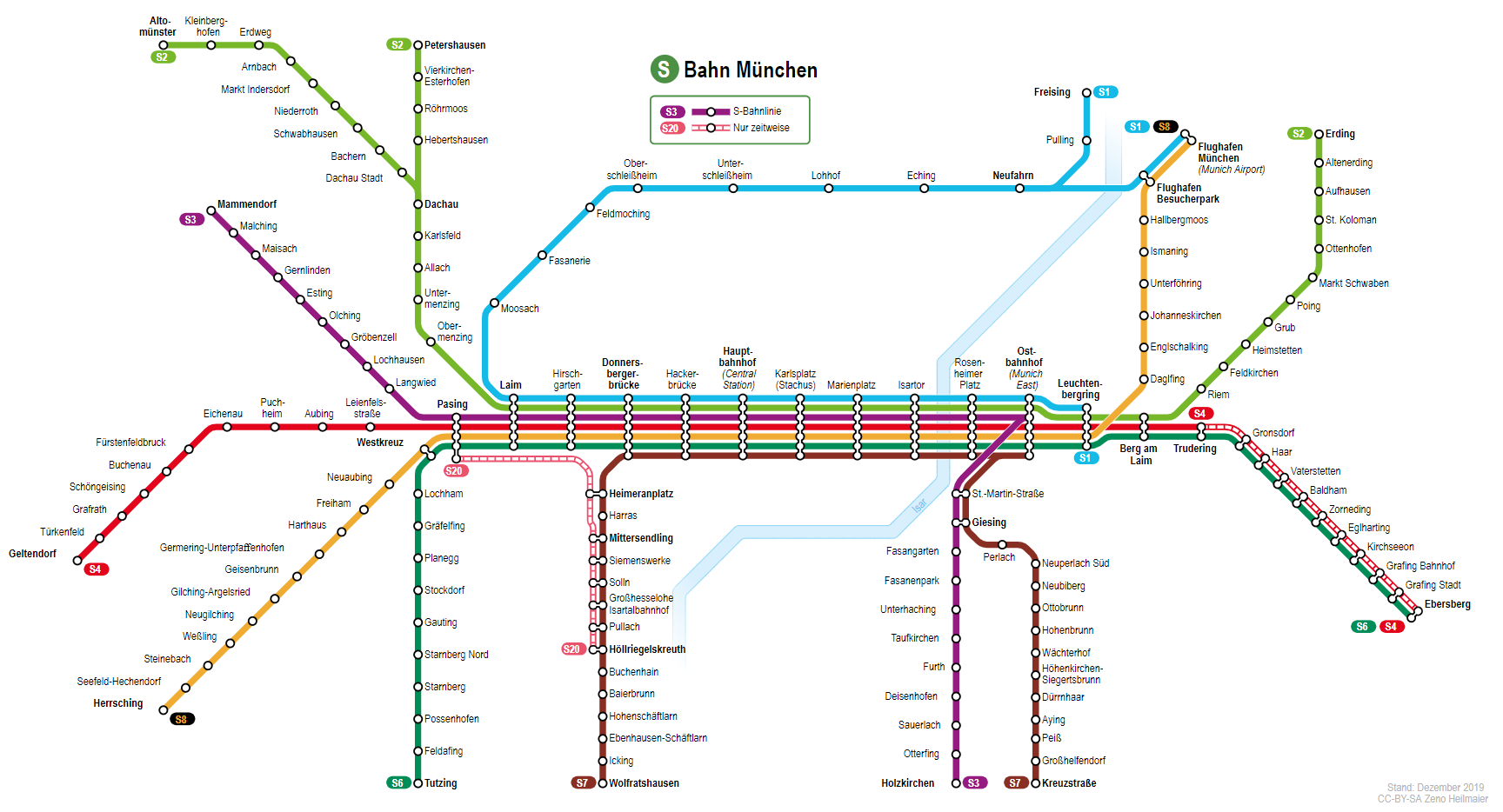
Riders on Munich’s spine-based network can catch any one of 7 different trains to get through the middle of town. Because so many trains serve the same stations, the next one is never more than 4 minutes away.
A spine is a string of stops all served by multiple bus lines. Anyone travelling along the spine can catch any of the different buses that serve it even though all of those buses might have different final destinations. So someone riding from Downtown to James and Lodi, for instance, can catch either the 23 or the 80 bus because both bus lines are identical as far as that person is riding.
Spines multiply service frequency. If a spine is served by four different bus lines, each of which run every 40 minutes, then the spine sees a bus every 10 minutes—that’s the difference between the kind of lackluster service that Syracuse has now and the quality service that it needs.
Centro doesn’t make much use of spines because its network is designed around the lineup. Buses from multiple lines all get to, and leave from the Hub at the same time. This facilitates transfers, but it makes spines impossible—if all of the buses serving a spine left the Hub together, they’d just show up in bunches of four every 40 minutes instead of spreading their service out to arrive every 10 minutes.
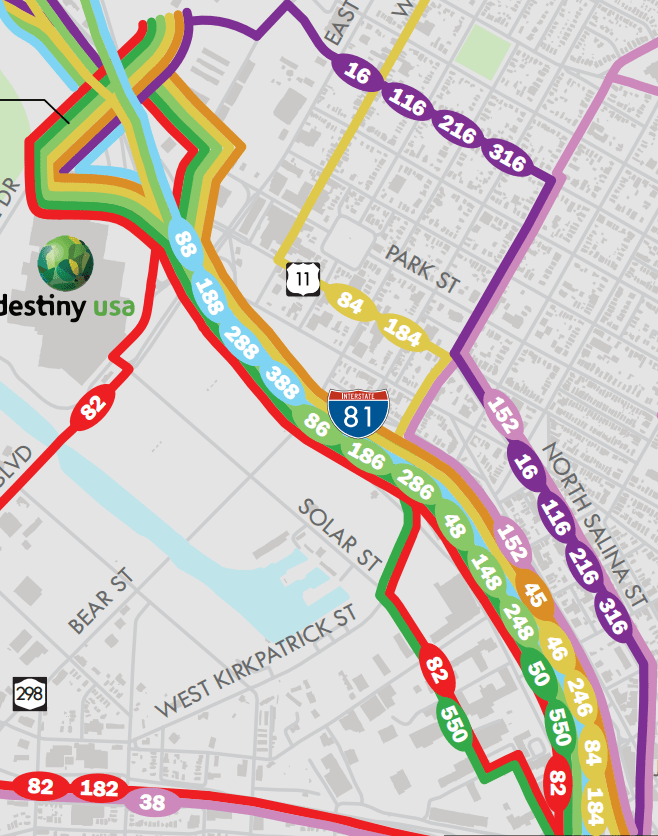
Get rid of the lineup, and a spine-based network could redefine public transportation in Syracuse. Take the service between Downtown and the Mall. The STSA identified that corridor as a good candidate for high-frequency service, and SMTC planned a BRT line for it. Buses should run up and down North Salina Street every 10 minutes all day.
Centro could offer that service with the buses it’s running now. The 16, 46, 48, 50, 84, 86, and 88 bus lines all run from Downtown up past the Mall and the RTC, but they spread their service out over multiple parallel routes. If Centro operated all of those bus lines as a spine running up North Salina, it could provide service every 10 minutes from 5 am to 1 am every single weekday.
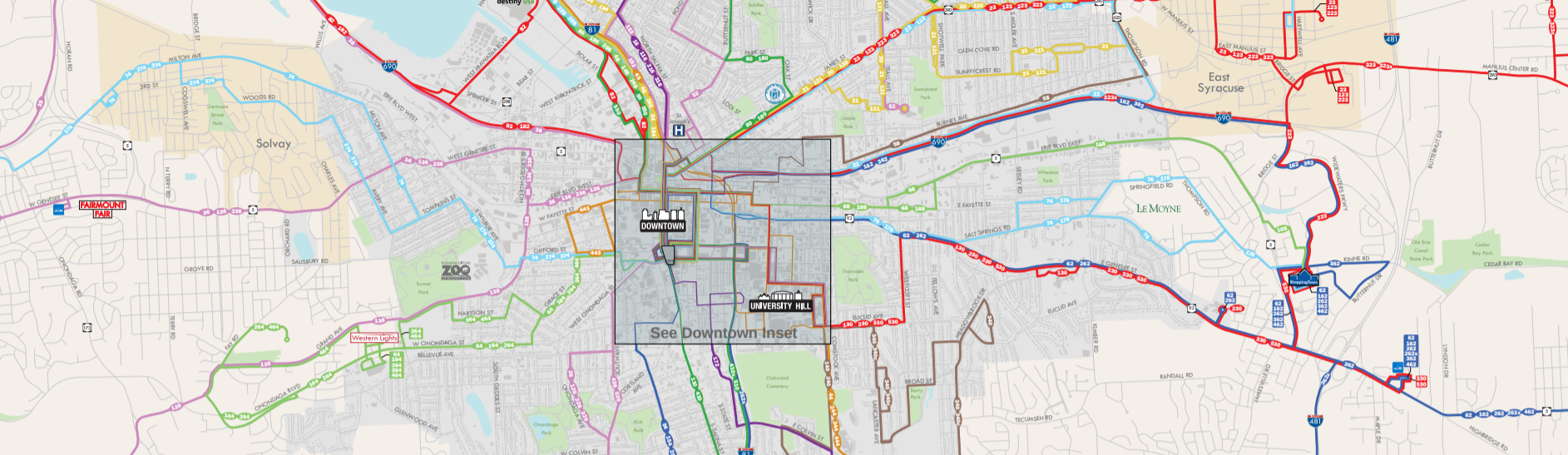
STSA Transportation Corridors
In fact, the six ‘transit improvement corridors’ from the STSA lend themselves well to a spine-based network, with spines providing extremely frequent service up N Salina, University Hill, and Gifford St. Run these BRT lines in spines, and the city center would see service running as frequently as every five minutes.
Spines are a great way to get high-quality, high-frequency bus service. They are service multipliers, doubling or tripling service frequencies without any added cost. They could turn Centro’s existing barely adequate service into the kind of transformational public transportation that Syracuse needs.
Frequent bus service makes more of the City more accessible, but it also saves money. Citywide transit systems only work when people can easily switch between different buses to reach any point in the network, but low-frequency service—like what Centro currently offers—requires enormous inefficiency in order to facilitate transfers. More frequent service can pay for itself—at least in part—by eliminating that waste.
Transit networks benefit from transfers. All alone, a bus line only connects a small part of the City, but as part of a full network, that one bus line can help anyone get anywhere they need to go.
Transfers, though, take time. A rider can show up at their stop right on time to catch the first bus, but they have a lot less control over how long they’ll have to wait for their connecting bus at the transfer point. When the buses don’t show up all that often, a rider can end up waiting an hour or more for their second bus. That’s enough to put a lot of people off of riding the bus at all.
Centro facilitates transfers by running every single bus through the Hub. A person riding any bus can transfer directly to any other bus at that one single point, so it never requires more than one transfer to reach any bus stop in Centro’s entire network.
This ‘hub-and-spoke’ system also allows Centro to minimize the amount of time a rider spends waiting for their connecting bus. Centro times its different bus lines to meet at the Hub all at once roughly every 40 minutes throughout the day. It’s called a lineup, and it makes transferring quick and easy—anybody can transfer between any of the dozen or so buses at a lineup with just a few minutes wait.
But although the lineup is the best way to facilitate transfers in a low-frequency bus network, it is enormously inefficient. If a dozen buses are all going to meet at a single point at a single time, then bus stops near the center of the network will see bunching (when two or more buses reach a stop at exactly the same time) before and after lineups. This is most obvious at stops right next to the Hub (like Salina and Jefferson), but it’s a problem as far away as James and Oak. 76 buses run from that stop to the Hub between 5:30 am and 12:21 pm every weekday (or 1 bus every ~15 minutes), but 9 times a day Centro intentionally sends 2 bunched buses from that stop all 1.75 miles to the Hub. That doubles the cost of serving lower James Street nine times a day without adding any benefit for riders.
Relatedly, the hub-and-spoke network requires all bus lines to start at the Hub even when that makes no sense. Centro runs buses along Grant Blvd, Teall Ave, Geddes St, Colvin St, and Rt 31. These corridors don’t fit easily into the hub-and-spoke network because they don’t point towards Downtown—Centro has to shoehorn them in by combining them with other lines that do go Downtown. So the Rt 31 bus is really just a detour on the route to Oswego, the Grant Blvd bus zigs and zags across the Northside to make its way to the Hub, and Teall doesn’t get the service it really needs along its full length. All of these fudges add extra miles and extra expense to each bus run, and none of it would be necessary if not for the lineup.
Run buses more frequently, and none of this waste is necessary. When buses run every 10 minutes, riders never have to wait more than 10 minutes for their connecting bus. That makes the lineup unnecessary because transfers are quick and easy no matter when a rider reaches the transfer point. And it makes the hub-and-spoke network unnecessary because quick transfers are possible wherever two bus lines intersect.
The lineup is necessary and useful in a system where the buses only run once an hour, but it limits the kind of service that Centro can offer, and it makes that service more expensive than it needs to be.
Frequent service will free Centro from the logic of the lineup. It will make new kinds of bus routes possible (a line running from Lyncourt to South Campus along Teall and Westcott, a line running from Corcoran to the train station along Geddes, a line running from Liverpool to Hancock Airpark along Taft), and it will make the entire network cheaper to run.











 inthesalt.city