By Alex Lawson
The City of Syracuse’s decision to discriminate between tenants and homeowners in its zoning code has created an extremely strange problem: physically identical residential buildings maybe be considered different uses—and therefore be subject to different zoning regulations—according to the history of their ownership and renovation, and depending on the economic class of their occupants. Our previous post outlined several instances of this issue at a high level, but this post will dig into the details of how City Hall’s new zoning scheme yields such strange outcomes in the case of 1- and 2-unit dwellings.
As ReZone was originally written and passed in 2023, 1-unit dwellings and 2-unit dwellings were listed as two different zoning ‘uses.’ ‘Uses’ are categories to which zoning regulations apply. Saying that something is a 2-unit dwelling means that it is subject to certain dimensional standards, parking regulations, and is allowed to operate in certain zoning districts that are the same for all other 2-unit dwellings.
In 2024, City Hall amended the zoning code to add the additional zoning uses:
– 1- and 2-unit dwelling, not owner occupied
– 1- and 2-unit dwelling, commercial conversion
In 2025, City Hall split those uses into four new uses:
– 1-unit dwelling, not owner occupied
– 2-unit dwelling, not owner occupied
– 1-unit dwelling, commercial conversion
– 2-unit dwelling, commercial conversion
Under the City of Syracuse’s current zoning code, 1- and 2-unit dwellings in Syracuse are sorted into 6 separate uses for the purpose of applying zoning regulations:
– 1-unit dwelling
– 1-unit dwelling, not owner occupied
– 1-unit dwelling, commercial conversation
– 2-unit dwelling
– 2-unit dwelling, not owner occupied
– 2-unit dwelling, commercial conversion
(The City of Syracuse Zoning code further distinguishes detached and attached owner-occupied 1-unit dwellings as separate uses. It does not make the same distinction among rented 1-unit dwellings which introduces additional administrative problems).
The split between 1- and 2-unit dwellings is obvious—simply count the number of units in a building. This is a long-established distinction and is common to zoning codes across New York State.
The difference between ‘normal’ 1- and 2-unit dwellings and the four new use categories has to do with whether the occupants of the dwelling own or rent it. ‘Normal’ 1- and 2-unit dwellings are those that are owner-occupied while any rented 1- or 2-unit dwelling is either ‘not owner-occupied’ or a ‘commercial conversion.’ This is extremely uncommon in modern zoning, and there does not appear to be any other municipality in New York State that distinguishes between rented and owner-occupied dwellings as a matter of zoning.
The code makes the additional distinction between rented dwellings that have not been physically modified to increase the total number of bedrooms in the unit and those which have. The former are classed as either 1- or 2-unit dwellings, not owner occupied while the latter are 1- or 2-unit dwellings, commercial conversion.
Changes to zoning rules for 1- and 2-unit dwellings will have a significant impact on housing in the City of Syracuse. These two types of housing account for 3 out of every 5 homes in Syracuse. Regulating these homes in a way that treats tenants differently from owner occupants is also significant. The majority of Syracuse’s residents are tenants, and 3 out of every 8 Syracuse tenants live in a 1- or 2-unit dwelling. These zoning changes affect tens of thousands of homes and families.
Here are all of the ways that this new distinction imposes different conditions on tenants than on homeowners.
District-level restrictions on Commercial Conversions
Proposed revisions to Syracuse’s zoning code would require special use permits for 1- and 2-unit commercial conversions in zoning districts MX-1 and MX-2. Commercial conversions can only be created by modifying an existing structure to increase the number of bedrooms available for rent, so this effectively requires a special use permit for certain kinds of renovation.
Special use permits require multiple public hearings and votes by both the City Planning Commission and the Common Council to be approved. Because ‘commercial conversion’ refers to the renovation of a dwelling unit to increase the number of bedrooms if and only if the dwelling is occupied by tenants, a special use permit is not required for identical renovations made by owner occupants.
The requirement for special use permits is doubly problematic in light of recent changes to the special use permit application process. As the zoning law was formerly written, special use permits ran with the land. Once one was granted, it remained in force until and unless City Hall revoked it. Under recently adopted changes, special use permits expire every 30 months. Special use permits automatically renew unless City Hall’s Department of Neighborhood and Business Development decides that it has a problem with the property in question (or unless NBD forgets to mail the renewal). This creates a situation where a tenant might be forced to vacate their home because of a paperwork mistake made by either their landlord or by City Hall.
The code also bans commercial conversions in zone MX-3 even though 1- and 2-unit dwellings—both owner occupied and tenant occupied—are allowed in that district by-right.
Additional restrictions on Commercial Conversions
In any zoning district, 1- and 2-unit commercial conversions are subject to major site plan review. This process includes review of the renovation by City Hall staff as well as a public hearing and vote by the City Planning Commission. Staff and Planning Commissioners would examine the proposed modification to the dwelling unit and review whether the proposal conforms with zoning regulations concerning the ratio of bedrooms to common space and an additional required off-street parking space for every new bedroom created by the renovation. Again, because ‘commercial conversions’ are definitionally tenant occupied, these zoning requirements do not apply to owner occupied 1- or 2-unit dwellings being modified in identical ways.
The requirements for a minimum amount of common area are “over and above” those contained in the NYS Property Maintenance Code. These additional interior dimensional requirements only apply to renovations made to rented housing and not to owner occupied housing that is modified in exactly the same way.
The additional parking requirements also only apply to tenant occupied housing, despite the fact that, in Syracuse, tenants are less likely than homeowners to own cars. 38% of renting households do not own a car compared to just 6% of homeowning households. 11% of homeowning households own 3 or more vehicles compared to just 3% of renting households. It is nonsensical to adopt a policy that imposes additional offstreet parking requirements on tenants because they are tenants.
Requiring additional off-street parking spaces for dwellings occupied by tenants but not for physically identical dwellings occupied by homeowners is based on a discriminatory assumption concerning family makeup. City Hall believes these offstreet parking spaces are necessary because tenant households are made up of multiple adults who all drive whereas homeowning households are made up of adults and non-driving children. This gross oversimplification ignores the obvious fact that many children in homeowning households become car drivers themselves before moving out and that many large nuclear families with children rent their housing.
Nonconformities
The zoning code includes a section on ‘nonconformities’ that regulates how the code applies to preexisting structures and uses that do not meet the current code’s standards. ‘Nonconformities’ are generally allowed to persist but are subject to restrictions on their maintenance and expansion. These regulations are exceedingly important as the current code considers most of Syracuse’s prewar neighborhoods nonconforming.
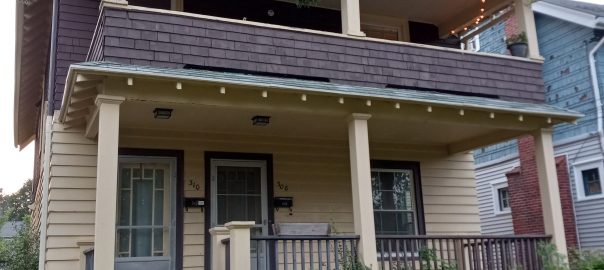
Regulations for nonconformities privilege owner occupied housing over tenant occupied housing, further entrenching the code’s discrimination against tenants. One extremely common nonconformity is a 2-unit dwelling sitting on a lot zoned R1. There are more than 1,500 of these structures in Syracuse—many were built as 2-family houses in the late 19th and early 20th centuries and were only problematized by modern exclusionary zoning.
Syracuse’s current zoning code accommodates these houses under a set of provisions for “Two-Story Single-Unit Dwellings Converted to Use as a Two-Unit Dwelling.” (Despite the name, these provisions also apply to purpose-built 2-unit houses). The code allows these structures to operate as legal conformities (and are thus exempt from the restrictions imposed on nonconformities) if and only if they are owner occupied. Tenant-occupied 2-unit dwellings in R1 districts remain nonconformities subject to all attendant restrictions. Owner occupants would not be allowed to sell their 2-unit dwellings to a landlord or rent out both units to tenants as that would constitute a change from a conforming to a nonconforming use.
The code also allows the construction of 1-unit dwellings on newly created nonconforming lots in any zoning district that otherwise allows 1-unit dwellings. The code does not allow the construction of 1-unit, non-owner occupied or 1-unit, commercial conversion dwellings on these same lots, so any dwelling constructed under this provision could only be occupied by a homeowner—tenants would not be allowed.
Taken together, City Hall’s amendments to its zoning code create a system of self-contradictory zoning regulations where identical buildings occupied as dwellings may be subject to different rules depending on the specific history and economic class of the occupants of the structure. A 4-bedroom 1-unit dwelling that was originally built with 4-bedrooms would be allowed districts R1, R2, R3, R4, R5, MX1, MX2, and MX3 without any required off street parking or special use permit regardless of whether or not it was owner or tenant occupied. The same would be true of a 4-bedroom 1-unit dwelling that gained its 4th bedroom through some renovation made by an owner-occupant sometime in the past. If a landlord made the exact same renovation, however, the dwelling would be required to have an offstreet parking space, it would require a special use permit in zones MX1 and MX2, and it would not be allowed in zone MX3. Required offstreet parking spaces, special use permits, and the ban from zone MX3 would all go away if the landlord sold the property to an owner-occupant. It is not clear how City Hall would handle the situation if the owner-occupant then decided to move to another house and rented this one out.
This also creates situations where individual homes may be available to owner occupants but not tenants or vice versa. Here are circumstances where that would be true:
A 1- or 2-unit commercial conversion in zoning districts MX1 or MX2 loses its special use permit. The dwelling would then no longer be able to be rented to tenants but could only be occupied by homeowners.
A 1- or 2-unit rented dwelling in any zoning district is modified to add an additional bedroom but due to impervious coverage or other dimensional standards is unable to add newly required off street parking. The rented dwelling would then be out of compliance with the zoning code but could revert to compliance if sold to an owner occupant.
A 1- or 2-unit rented dwelling in zoning district MX3 is modified to add an additional bedroom. This makes the unit a commercial conversion, a use not allowed in that district, and it cannot be occupied by tenants but may be occupied by a homeowner.
A 2-unit dwelling in zoning district R1 is owner-occupied and thus qualifies as a legal conforming use. If the owner moved out of the structure, a tenant could not rent the vacant unit.
A 1-unit dwelling built on a newly subdivided nonconforming lot could only be occupied by a homeowner, not a tenant.
Classifying renting and owning housing as different uses also creates the possibility of banning renters or owner-occupants from entire zoning districts. The current code does not do this, but City Hall’s distinction between tenant and owner occupied housing as different zoning uses is an innovation in New York State zoning law that could be used for more overtly discriminatory purposes. In communities across New York, NIMBYs loudly campaign against multifamily housing because they do not like tenants or rental housing, and it is unfortunately easy to imagine municipalities using this new tool to ban rented single-unit housing from exclusionary neighborhoods that already ban any kind of multifamily housing.
On top of all these reasons that discriminating between tenants and owner occupants is bad policy, there’s also good reason to think it’s illegal. Despite the sustained interest from many exclusionary municipalities in excluding tenants, no other municipality in New York State has enacted Syracuse’s new scheme of discriminating against them directly. Maybe that’s because nobody has ever thought of it, but it’s more likely because discriminating against tenants contradicts the principle that “zoning is concerned with the use of land, not with the identity of the user.” Courts in North Carolina and New Jersey have already ruled that this kind of scheme violates their state constitutions. Maybe Syracuse’s new zoning code will lead the New York State Court of Appeals to do the same.