Sync—the new bikeshare network that launches on Tuesday—tackles three barriers to biking in Syracuse.
First, Sync makes biking cheaper. Bikes are one of the least expensive ways to get around, but, between the upfront cost and maintenance costs, it’s easy to sink $100 into even a cheap used bike. If that bike gets stolen or damaged, that investment’s gone. Sync will insulate riders from that risk because if a bike gets stolen or damaged, it’s on GotchaBike—the operator—to absorb that cost, not the rider.
Second, Sync makes biking simpler for people who move frequently. Bikes are big and they don’t pack well. Moving them between apartments is a pain, especially if you don’t own enough furniture to justify the cost of renting a moving truck. Frequent moves keep a lot of people from buying a bike at all, and that means that a lot of people in Syracuse—a city where 25% of the population moves at least once a year—don’t ride. Sync will allow people to bike without having to deal with all that.
Third, Sync makes biking easier physically. There are a lot of hills in Syracuse—University Hill, Tipperary Hill, Prospect Hill, and a bunch of others that don’t even have names. Biking across town almost always means going up at least one hill, and that’s pretty hard for a lot of people. Sync’s bikes all have electric motors that will ‘flatten’ those hills, making it easier for everybody to ride up them.
Right now, these different challenges keep different kinds of people from biking in Syracuse. By addressing all of them, Sync is giving a broad group of people access to a new option for getting around the City.
In Syracuse, local politicians are doing all they can to expand economic opportunity. At the same time, politicians in the State government are working to eliminate New York’s carbon footprint by 2050. These two groups of politicians—along with the activists and organizations that support them—should partner to advocate for better public transportation in Syracuse. A high-quality regional-wide service would expand economic opportunity by making more jobs more accessible to more people, and it would fight climate change by taking cars off the road. Working together as a pro-transit coalition, groups interested in each of these outcomes would provide Centro with the political support it needs in order to make this kind of service a reality.
The Status Quo
As it stands, Centro has very little political support. Nobody at the City, County, State, or Federal level values bus service enough to shift money from highways to public transportation, so every year Centro has to go begging for the money just to keep its buses running. That gets enough people riled up that Albany will push a couple million dollars Centro’s way—just enough to fill the deficit—and then the exact same thing happens all over again the next year
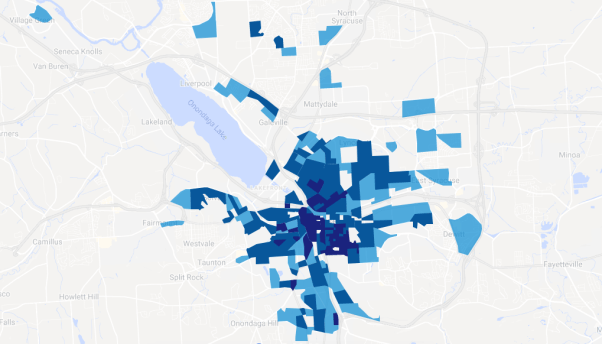
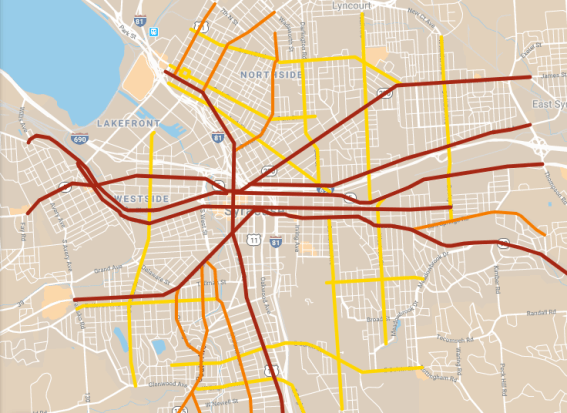
Without the political power to fund service improvements, Centro has crafted its planning process to make them impossible. SMART1—the most recent proposal to improve public transportation in Syracuse—focused almost exclusively on service within the City. That’s because when Centro plans transit service, it uses demand models that look like this:
According to this model, enough people live and work in the blue areas to justify improved transit service. The light blue areas can justify rapid buses, the medium areas can justify light rail, and the dark blue areas can justify heavy rail.
But this demand model assumes that any new transit service has to justify its existence by first attracting a certain number of riders. That means that good service can only run where lots of people already ride the bus, ignoring the fact that people choose to ride the bus in those areas because Centro runs relatively good service there. It also means that the areas where people don’t use public transportation can’t get better service even though low ridership is caused, at least in part, by how bad the service is right now. By ignoring the effect that the quality of service has on ridership, Centro is able to justify its barely passable service, and it avoids politically impossible requests for more funding. The result is too little economic opportunity and too many cars on the road.
A coalition of economic opportunity and environmental advocates could turn that logic on its head. When you recognize transit as a necessary tool in the twin fights against poverty and climate change, low ridership is a challenge to overcome rather than a sign to give up. The emerging pro-transit coalition should respond to low ridership by improving service in order to make more jobs more accessible and to better compete with car travel. Those improvements would attract more ridership, getting more people to work and taking more cars off the road.
Transit for the Whole Region
It’s not easy to run attractive transit service in suburbs where people and jobs are spread thinly over a very large area, but in the book Transport for Suburbia, Paul Mees describes how Zurich’s network of city rail lines and suburban bus routes accomplishes the task by making connections between the trains and buses simple, convenient, and cheap. Easy connections integrate each line into the larger network. That allows public transportation to cover the entire metropolitan area, and it gives riders the same freedom that they’d have in a private car.
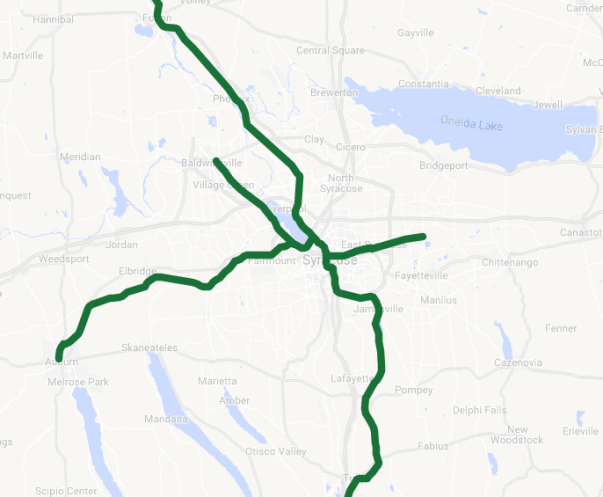
For Centro, that could start with a fast frequent regional rail system connecting Syracuse to Auburn, Fulton, Oswego, and Cortland. Much of the infrastructure already exists parallel to the slow infrequent coach buses that Centro already runs.
Regional rail lines connecting the cities and suburbs of the metropolitan area
Complemented by well-timed connecting bus lines—extending to Ithaca, say, or linking suburban communities and job centers along major roads like Route 31 and Taft Road—this service would open the entire region to travel without a car, increasing economic opportunity and reducing carbon emissions at the same time.
Political Support is Fundamental
This service—or something like it designed by actual transportation planners—won’t come cheap. It will cost money to acquire new rights of way, to buy new buses and trains, to hire enough operators to run them frequently, to time them precisely.
For Centro’s entire history, that kind of spending has been unthinkable. The money will have to come from the State or from the Federal Government, and that means that it will have to come at the expense of some other government program—highways, maybe. Good public transportation is a political choice, and it can’t come about unless people with power value it more than they value the other things that also require government funding.
That may finally have changed. Now that the environment and economic opportunity have moved up to the top of the agenda in Syracuse and in New York State, there may finally be a coalition broad enough and powerful enough to make public transportation a priority in this City. We can finally stop treating public transportation like a ‘program’ that’s only funded grudgingly, when all other options are exhausted and only at the bare minimum. Can we finally stop spending billions on highway expansion while ignoring million dollar plans for better bus service. We can finally take public transportation seriously as an opportunity to achieve New York’s loftiest goals.
In Syracuse, people ride the bus to get all over the City for all kinds of reasons. Centro needs to run a service that fits their needs by connecting the entire City. One way to do that would be to run more buses between different neighborhoods, even if that meant running new lines that avoid Downtown altogether. Another option, though, would be to just run more buses more frequently on the lines that already exist.
Right now, to get from the corner of South Ave and Bellevue to Syracuse University, you have to take a bus up into Downtown and then catch a University bus at the Hub. The whole trip covers 2.5 miles, and you spend about 13 minutes on the bus.
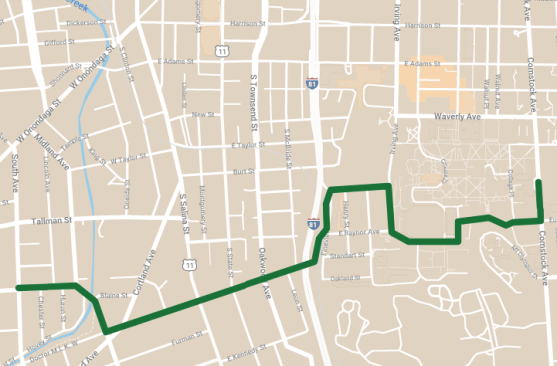
A new crosstown line along Bellevue, MLK, and Euclid would make that trip much more direct. You’d only need one bus, that bus would only travel 1.9 miles, and it’d only take about 10 minutes. That’s 23% less time spent actually riding the bus—not too bad.
The bulk of a Centro trip isn’t spent riding the bus, though. Just to ride the 15 minutes between any given neighborhood and Downtown, it’s common to have to wait 30 or 40 minutes at the stop. If that Bellevue-MLK-Euclid bus only ran once an hour, the true average trip time would be 40 minutes—10 minutes riding the bus and an average of 30 minutes spent waiting for it to show up in the first place. At that point, it’s just about as fast to cross that distance on foot.
So while it’s good to shave minutes off of the time that riders spend on the bus, the best way to make Centro more convenient is actually to shorten waiting times. That means more buses running on each line with shorter headways.
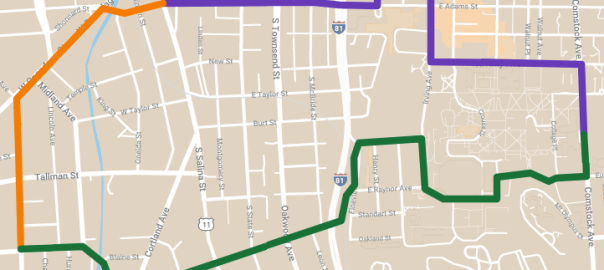
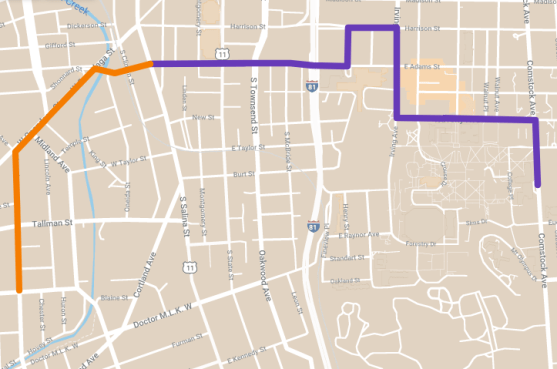
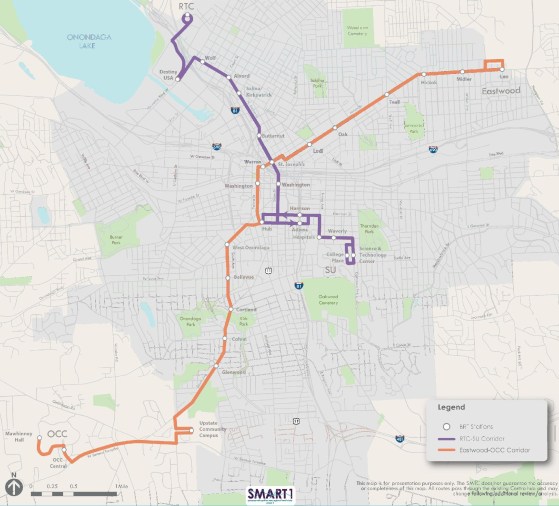
Centro and SMTC have proposed to do just that. In their SMART1 plan, they talked about crosstown buses running from Eastwood to OCC, and from SU to the RTC every 15 minutes all day. That kind of service is unheard of in Syracuse, and it would do a lot to connect different parts of the City together.
SMART1 BRT Lines
Those short headways would reduce the average trip from South Ave to SU to 28 minutes—a 7.5 minute wait at Bellevue, a 4.5 minute ride to the Hub, a 7.5 minute wait for the connecting bus, and an 8.5 minute ride to SU. That’s 30% faster than the direct route on the less frequent Bellevue-MLK-Euclid bus would be, even with the extra distance and the need to transfer at the Hub.
Obviously, the best option would be for Centro to offer both. Then, someone waiting at South Ave and Bellevue could just catch whichever bus came first, no matter whether it was headed up South Ave or east on Bellevue.
These two options represent a tradeoff, though. Frequent service is only possible if Centro concentrates its resources on key lines. Every bus running on east on Bellevue is not running north on South Ave, and if Centro were to start running new lines without new money, then it wouldn’t be as able to run frequent service on its major lines. Too many new crosstown routes could, at that point, actually make it more difficult to get across town on a bus.
Syracuse needs better bus service. Syracuse needs bus service that connects different parts of the City, that makes it easier and convenient for people to get around town. There are different ways to do that, but one of the easiest would be to just run more buses more frequently along major lines.
In Syracuse, most major streets lead Downtown. Salina, James, Burnet, Erie, Genesee, Fayette, Onondaga—all of them are good for getting into and out of the city center.
Most other major streets at least point towards Downtown, even if they don’t reach it. Midland, South Ave, Wolf, Court, and Butternut all end in neighborhoods outside of Downtown, but they all join up with a roughly parallel street that does reach the city center.
When so many major streets—the ones lined with businesses, the ones running through close-knit neighborhoods—lead Downtown, it makes a lot of sense to run bus lines on all of them and to make all those lines intersect at one spot Downtown at regular intervals. It’s it’s the simplest way to connect all of those different neighborhood main streets, and it’s exactly what Centro does.
But there are plenty of major streets in Syracuse that don’t point towards Downtown at all. Brighton, Geddes, Park, Grant, Oak, Teall, and Westcott are all good streets to run a bus on, but none of them has its own line. Grant Boulevard runs from Eastwood to the train station and Mall, passing through heavily populated parts of the Northside where many people do not own cars. The 80 and 52 buses each run along Grant for a couple of blocks, but it’s impossible to get from one end of that street to the other by bus because Centro won’t run a bus line that doesn’t get its riders to the Downtown Hub.
The result bad for bus riders in two ways. Buses like the 80 and 52 try to do two contradictory things (go Downtown and serve Grant Boulevard), and they end up doing neither very well. If you’re taking one of these buses to Downtown, then those zigs and zags that it makes on parts of Grant (and also Park Street) are a waste of your time.
The 52 and 80 buses zig and zag across the Northside
At the same time, riders can’t actually use these buses to get along a street like Grant. This makes it really inconvenient to get between two points on one side of town—between Eastwood and Westcott, say, or between Grant Village and the Mall—because you have to go all the way Downtown to make the transfer.
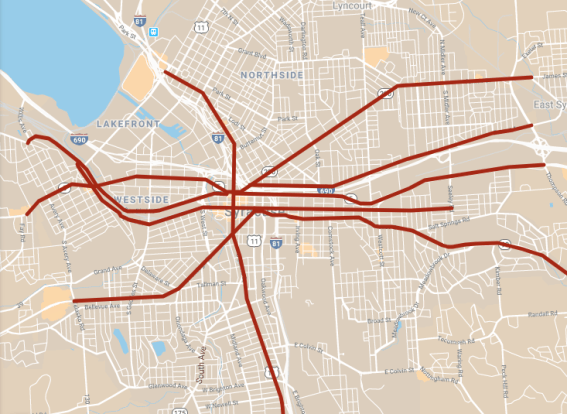
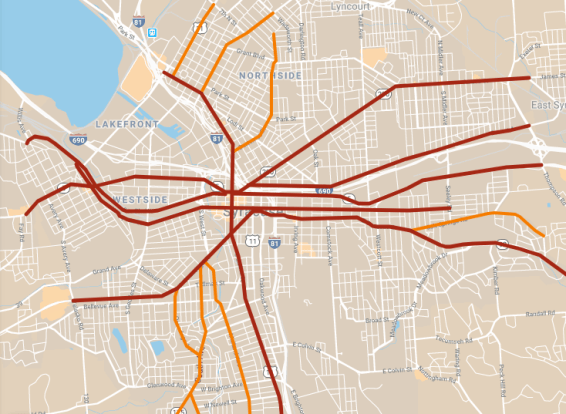
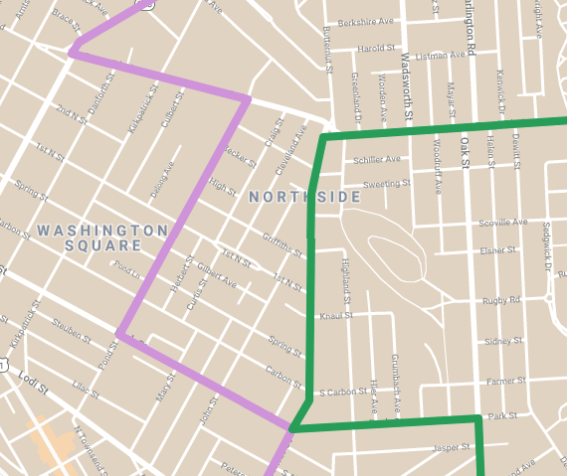
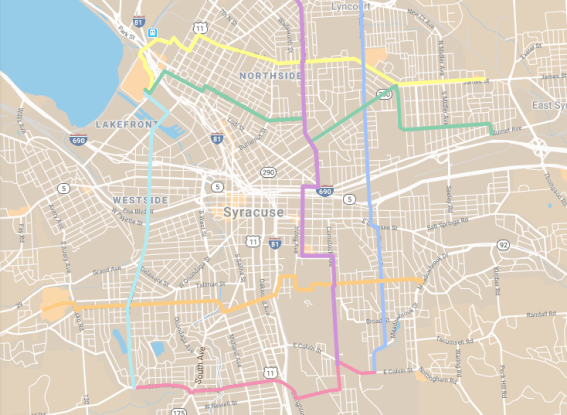
Centro could fix both problems with new bus lines that follow these streets without ever trying to get downtown. Taking Centro’s existing jogs and deviations as a starting point, here are some potential crosstown lines that never go Downtown.
These bus lines (or ones like them) would make it much easier to get around town. That’s obviously true if you’re traveling along one of these lines (from Skunk City to the Mall, say), but it’s also true for people transferring between two lines. Imagine trying to get from the corner of Colvin and Salina to OCC. Currently, you’d have to ride more than a mile north (away from where you’re going) to connect with the South Ave bus that will take you to OCC. The full trip is 5.5 miles. If there were a bus running East-West on Brighton, though, you could walk ⅓ mile to catch it, ride west to South Ave, connect to the OCC bus there, and reach campus in less than 3.5 miles.
Going out of your way to transfer
Making the transfer on your way
At the same time, these lines would make the Centro’s existing lines more useful by allowing them to run in straight lines. Some James Street buses take an extra 12 minutes to get Downtown because they detour along Teall. A bus running along Teall from Lyncourt to Westcott would eliminate the need for that detour and make Centro’s James Street service faster, more efficient, and more useful to people actually trying to get Downtown.
The 21 bus does 2 things poorly
2 buses could do each thing well
Right now, Centro is trying to “fill in service gaps” with some money that it just got from New York State. The most egregious gaps in Syracuse’s bus service are temporal—even the busiest lines have service gaps that last more than an hour during the middle of the day—and Centro needs to fill them first.
The next gaps that need filling are the ones on Brighton, Teall, Westcott, Geddes, Grant, Bellevue. Crosstown bus lines on those streets would make it easier, faster, and simpler to get around Syracuse by bus. Combined with the SMTC’s planned BRT service, these new lines would make it easy to live in Syracuse without a car.
At the March 22 hearing on public transportation in Syracuse, State officials asked Centro CEO Rick Lee why more people don’t ride the bus. Lee responded that Syracuse is a 20-minute city—overbuilt car-infrastructure and a spread-out population mean that there’s very little traffic, so people who can afford to own a car choose to drive. Magnarelli immediately interjected with “I hope it stays that way.” Rick Lee laughed kind of nervously and muttered ‘no comment.’
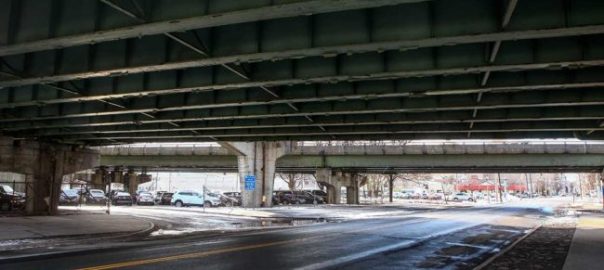
This exchange laid bare the absurdity of Centro’s public stance on I81. Centro has refused to take a position on the biggest transportation project that its service area has seen in 50 years, pretending that no matter what happens, Syracuse’s bus service will chug right along. That’s a nice thought, but it’s stupid. The viaduct is an impediment to bus service now, and replacing it with the Grid will make Centro more useful to more people.
Currently, the 30, 58, 62, 68, 76, and Connective Corridor buses all run in the area around the 81/690 interchange. That’s 40 acres of barren land where very few people (often no people at all) get on or off the bus.
Running a bus through the I81 dead zone is a lot like running a bus along an unpopulated stretch of rural road—it adds expense without making the bus more useful to anybody. Centro can’t avoid the I81 dead zone—like it could shorten a rural route—since people need to cross it to get between Downtown and the Eastside.
So the dead zone needs to disappear. That means making it into a place where people live and work—where people will get on and off of all those buses that already run on its streets.
All of that new building will allow more people to live and work in a part of the City that already has pretty good bus service (and could get even better service), so the bus will be a good option for more people in Onondaga County to get around. That’s how Centro can benefit from the I81 project, and that’s why Centro needs the Grid.
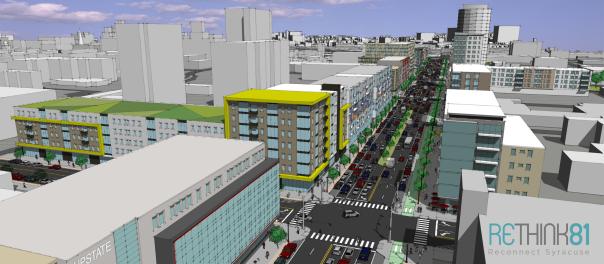
On April 22, NYSDOT (finally) released its plans for the I81 viaduct in Downtown Syracuse. The highway’s coming down, and it’s staying down. This is good news for the City, but it’s not the end of the process. NYSDOT still has to finalize its designs, hire contractors, and actually do the work. Syracuse needs to stay engaged to ensure that this process results in a better more equitable city.
NYSDOT’s plans should also direct the City’s attention to the future. Removing the viaduct means rebalancing Syracuse’s citywide transportation network to elevate walking, biking, and busing—not just driving. The DEIS includes some of the new infrastructure necessary for that rebalanced transportation system, but, because NYSDOT confined itself to the area immediately adjacent to the existing highway, its plans are just the beginnings of a truly citywide system. It’s up to the City to build out the rest.
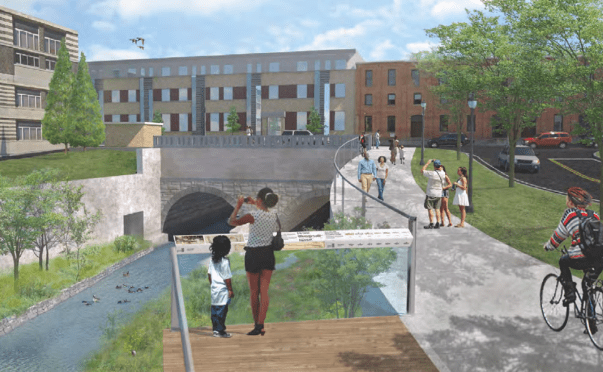
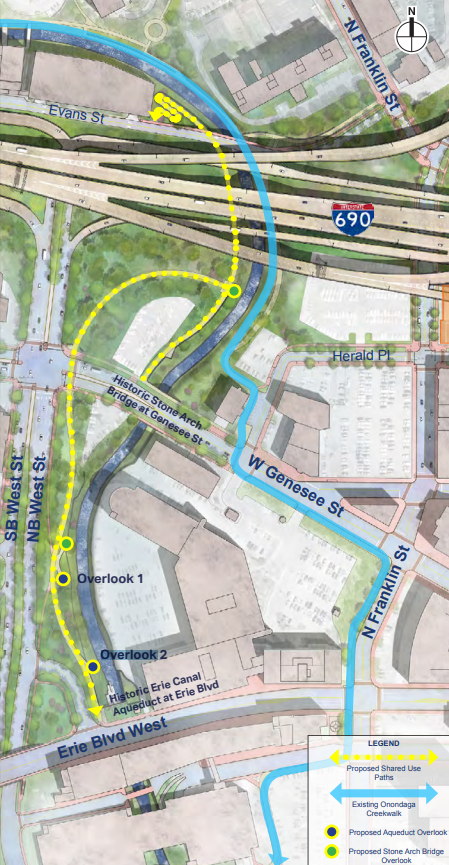
Take the planned addition to the Creekwalk. That new trail will follow the creek’s west bank from Erie Boulevard to Evans Street, it will provide new views of the old Erie Canal culvert, and it will actually be useful for people getting between the Westside and Franklin Square.
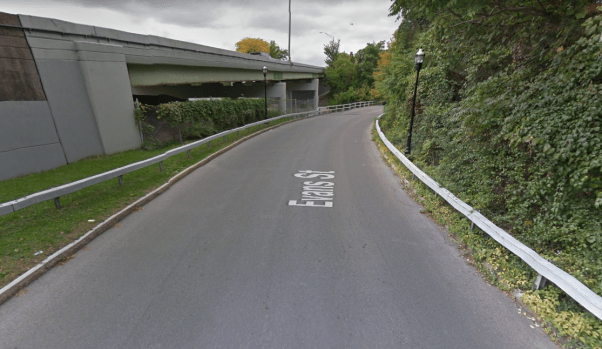
But Evans Street has no sidewalks where it connects with this new trail. It’s just a blind curvy street—not a good place for people to walk. If the new trail is going to actually be useful for people getting around on foot, Evans Street needs new sidewalks.
Or look at this plan for a bike lane for State Street:
“A two-way raised cycle track would be provided on the west side of State Street between James Street and Erie Boulevard. A shared use (bicycle and pedestrian) path would be installed between Erie Boulevard and the Empire State Trail on Water Street”
That’s a great adjustment to a street that will see a lot less car traffic once it stops feeding the highway, and a raised cycle track is far superior to a lot of the bike infrastructure that Syracuse has now, but NYSDOT’s planned track only runs for 2 blocks. At one end, the track will connect to the Canalway Trail, but at the other it just stops at a big car-dominated intersection.
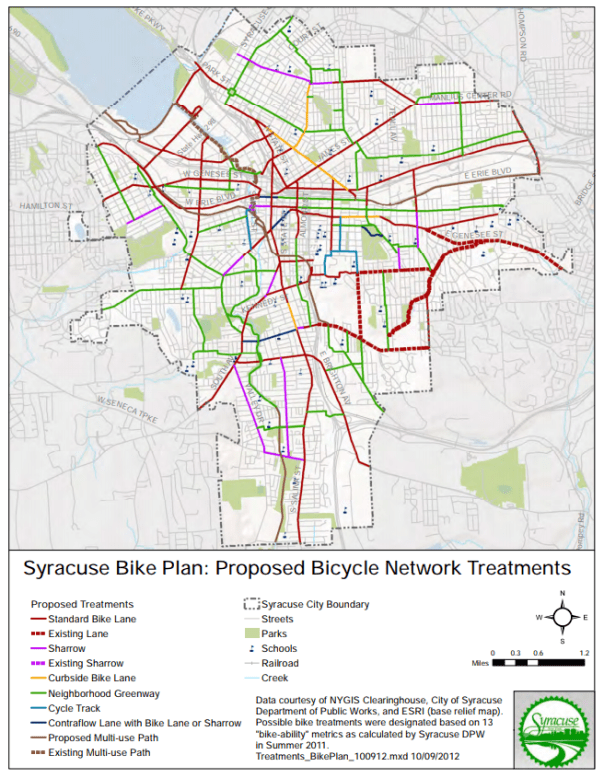
City Hall’s 2012 Bike Plan included bike lanes for both State and James Streets at this intersection. If they existed, then NYSDOT’s 2-block cycle track could actually be useful to someone trying to get across town by bike.
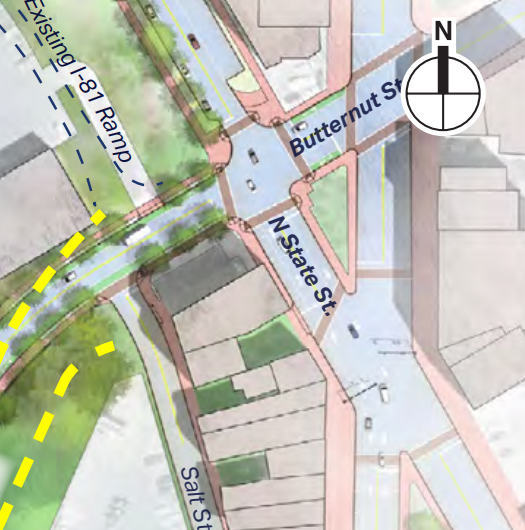
A few blocks north, NYSDOT’s plans to remove the northbound highway onramp from the Butternut Street bridge will mean a lot less traffic at the intersection of Salina, State, and Butternut Street.
That’s good news for Centro, whose eventual BRT network should make that intersection a major transfer point for Northside buses. NYSDOT is offering to “coordinate with Centro on potential street improvements (transit amenities such as bus stops and shelters, bus turnouts, and layover and turnaround places) in the project limits to enhance and support access to Centro’s transit initiatives”—what a great opportunity for Centro to build a high quality transfer station built with somebody else’s money! It’d be hard to make that ask now, though, because, as it stands, there isn’t a transfer station planned for that intersection because there aren’t even any planned BRT lines that could intersect there. Centro needs to get a move on with it’s BRT network before this opportunity slips away.
The decade-long fight over the I81 has been a fight over what kind of city Syracuse is going to be. One that caters to car-owners over everybody else, or one that balances and incorporates the different needs and habits of everybody who lives in and uses the City. Hopefully, this DEIS means that fight is over. The challenge now is to actually remake Syracuse in that image. These three projects are just examples of ways to do that—the DEIS is full of other starts and suggestions. The important thing is to act on them and make Syracuse into the city that it needs to be.
The mall was the defining issue of the 2000s—like I-81 is of the 2010s—and a lot of people are still bitter that Syracuse gave away so much public money in exchange for ridiculous and ultimately unfulfilled promises (an aquarium, an imitation Erie Canal Village, a hotel shaped like grass).
the promise
the reality
For those people, this news is the ultimate ‘I told you so moment’ and a dream come true: the opportunity to unmake the mistake of subsidizing the mall in the first place, wiping the slate clean and allowing a new thing to happen at the mouth of Onondaga Creek.
That’s not going to happen. If Shoppingtown’s taught us anything, it’s that doomed malls die slow deaths. And anyway, as Rick Moriarty reported, it’s all probably just a play by Pyramid Companies to get a better rate on their mortgage.
Even if the Mall were to fail, that wouldn’t be a great thing for the City. Destiny has centralized retail in the Syracuse metro area, and that benefits the City proper by making public transportation more effective and by giving City Hall leverage in negotiations with the County.
Centralized Retail
Macy’s only has one store in the Syracuse market, and that store is at Destiny. The same is true for Lord & Taylor, JC Penney, and dozens of other retailers. If those stores weren’t located at Destiny, they’d be somewhere else in the County—probably somewhere in the suburbs like Penn-Can, Shoppingtown or Great Northern. Destiny beat all of those other locations out, and it pulled their tenants into the City.
Transportation
If you get around in a car, then it doesn’t much matter whether Macy’s is in Clay or Cicero or DeWitt or Syracuse. This is a 20-minute-city, after all. If you get around by bus, though, it matters a lot. Neither Clay nor Cicero nor DeWitt can support good bus service, but Syracuse can, and Destiny has some of the best bus service in the entire County.
That good service has made the Mall the most popular bus stop in Centro’s network by far. That matters because the Mall is a major center of employment—especially entry-level employment. Getting all those jobs within reach of all those buses is exactly the kind of thing that economic development should do, and it’s a rare, major, unsung success in this town.
Negotiating Power
City Hall and Onondaga County just renewed the sales tax sharing agreement that Joanie Mahoney and Stephanie Miner negotiated in 2010. A lot of people want to hold that agreement up as a symbol of increased cooperation and goodwill between the City and its suburbs, but it’s really a symbol of the City’s growing economic power.
The basic question is this: should City Hall charge and collect its own sales tax within the city limits, or should it leave that up to the County in exchange for a cut of the County-wide revenues? If there’s not much retail activity in the City, then there’s little sense in giving up even a small cut of the County-wide revenues. The County understands this, and it used to be able to get City Hall to accept a small sliver of sales tax revenue. City Hall negotiated from a weak position and got screwed.
Now that Destiny has drawn so much retail activity into the City, though, City Hall has a much stronger position in those sales tax negotiations, and that empowers the Mayor to get a better deal.
. . .
The Mall has a rocky relationship with the City. It’s tricked Syracuse out of a lot of property tax revenue at a time when City Hall needs all the money it can get. It closed the door on the possibility that Downtown would ever be a major retail destination like it was 60 years ago. It’s currently trying to get a $3,600,000,000 hole bored through Syracuse for no good reason.
But the Mall has also been good for the City in ways that don’t get much attention. By centralizing the metro area’s major retailers, it put a lot of jobs within access of public transportation. By bringing that retail activity within the city limits, it has strengthened City Hall’s negotiating position with the County.
Syracuse needs better bus service that empowers all kinds of people to meet all their different daily needs. One of those daily needs is getting to work. In a recent hearing on the effectiveness of public transportation in Syracuse, Assemblymember Pam Hunter addressed that directly when she asked about how Centro could overcome the spatial mismatch—the fact that a lot of jobs are located in the suburbs, but her constituents in the City can’t get to them.
That’s usually how people talk about the spatial mismatch: Jobs are in the suburbs and people who need jobs are in the City, so the solution is to get those people transportation to the suburbs. But running more buses out to the suburbs is no solution because that will just take buses away from existing routes in the City—routes that serve more people more efficiently than a line in the suburbs could.
A better solution is to eliminate the spatial mismatch by encouraging employers to locate where people already live and where the buses already run.
Consider this exchange between Kevin Schwab of CenterState CEO and Senator Rachel May. Schwab told a story about how a business located on Taft Road is difficult to reach by bus and how one of its bus-riding employees has to walk two miles from the bus stop to get to work. Schwab used this anecdote as evidence that Centro should run a bus line along Taft Road. Senator May agreed that it’s difficult for bus riders to get to work in the suburbs, but she also suggested that this company, if it wanted to be able to hire people who don’t own a car, should have set up shop closer to a bus stop. Schwab responded that employers have a hard time finding suitable sites near existing bus lines.
Suitable means cheap. Centro’s best service is in the County’s urbanized center, but the land in the center costs more money, is divvied up into smaller parcels, and is more often polluted than land on the County’s edges.
For a lot of employers, these costs are just too high a price to pay for the benefit of being able to hire bus riders. 70 years of subsidies for private cars and disinvestment in public transportation has marginalized bus riders to the point that they’re too small a portion of the labor market to sway employers’ behavior. Car drivers, on the other hand, have no problem getting employers to take on the enormous costs required to provide free parking.
It’s a question of power. Car drivers have more power over where employers choose to locate than do bus riders. The result is the systematic exclusion of bus riders from employment opportunity. In this City, that’s systematic racial and economic exclusion, it causes poverty and segregation, it hurts the entire region’s economy, and it needs to end.
In the short term, City Hall and Onondaga County can do their part by supplementing bus riders’ power with incentives for employers to locate on bus lines and/or within walking distance of economically disadvantaged neighborhoods. There is plenty of empty land on the Lakefront, at the Inner Harbor, Downtown and along Erie Boulevard where Centro runs good service (and plans to run even better service), and many of these sites are already under SIDA or OCIDA control. Steering economic development to these sites should be a part of County Executive Ryan McMahon’s PIE agenda (poverty, infrastructure, economic development).
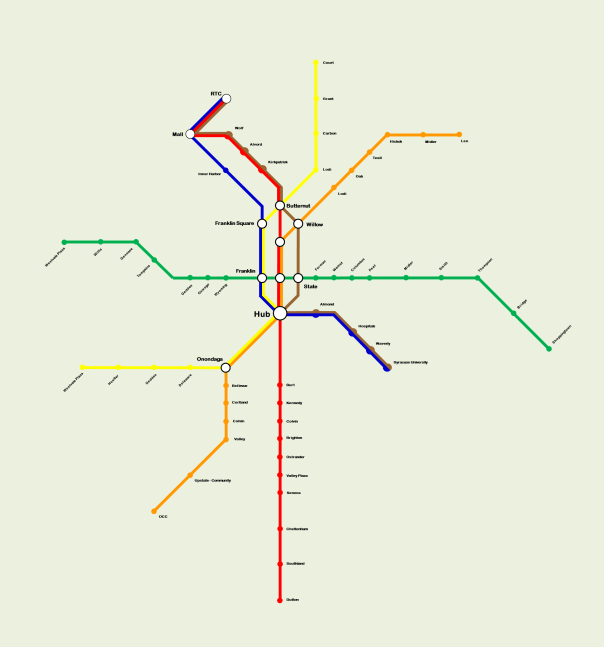
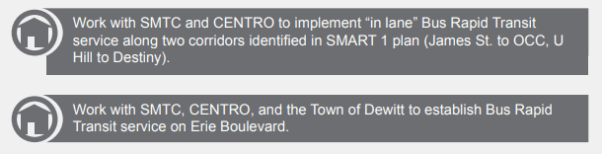
In the long term, bus riders will need structural changes to the region’s transportation system in order to gain power in the labor market. Centro needs new investment to provide all-day frequent service that covers enough of the City that many different people can meet all their daily needs. That will make life without a car more feasible for more people, grow Centro’s ridership, empower bus riders in the labor market, and force employers to respond to that newly empowered constituency’s needs. That means building out the two BRT lines that SMTC planned in its SMART1 study, and it means expanding on that study to develop the full BRT network described in the STSA.
There are too many people in Syracuse who can’t get work because the jobs that are available are out in the suburbs and out of reach for people who ride the bus. This travesty is called the Spatial Mismatch, and it’s a problem of power—bus riders don’t have the power to force employers to respond to their needs by locating in places accessible by bus. The solution is to build bus riders’ power. In the short term, this means using economic development to incentivize development on existing bus lines. In the long term, this means investing in Centro so that more people ride the bus as part of their daily lives, increasing bus riders power over employers’ decisions about where to locate.
During a March 22 hearing on public transportation in Syracuse, local legislators asked over and over again why Centro isn’t doing more to get people to work. Assemblymember Pam Hunter asked how more frequent service would help her constituents if it didn’t give them access to jobs in the suburbs, State Senator Rachel May asked why Centro doesn’t use smaller vehicles to provide tailored service for specific employers, and Assemblymember Bill Magnarelli went so far as to suggest that employers should pay Centro directly to get better service for their employees. Through the entire hearing, these legislators assumed that the point of public transportation is to get workers to their jobs—an assumption that Rick Lee, Centro’s CEO, affirmed when he described public transportation as a series of routes that get people to and from work.
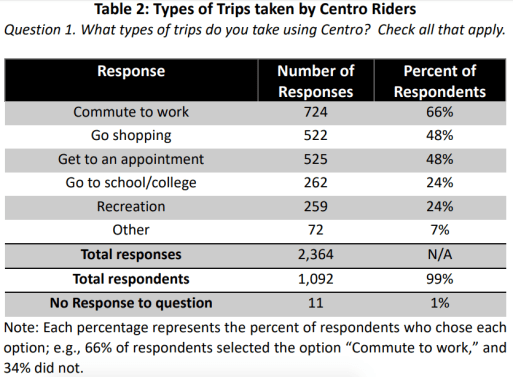
That’s an understandable assumption and an understandable focus. The issue at top of so many people’s minds is getting and keeping a job, and a lot of people need Centro in order to do that. One third of people living in Syracuse do not own a car, and two out of every three people who responded to SMTC’s 2018 survey ride the bus to get to work.
But that’s not all the bus is for. That same survey showed that one of every two people ride the bus to go shopping, one of every two use it to keep appointments, one of every four ride Centro to get to school, and one of every four ride the bus for ‘recreation.’
People in Syracuse who commute by bus choose to do so because, for them, it is the best option—in many cases, the only real option—for traveling any kind of distance in the City. People who ride the bus to work also ride the bus to get around the City to do the various things they do every day, and Centro needs to meet all those needs.
That survey also showed that one third of people who ride the bus do not use it to get to work at all. These might be people who walk, bike, or carpool to work. It might be people who are retired or who are too young to have a job. It might be people who work from home or who do necessary work in the home even if nobody pays them for it. It doesn’t matter why they’re not commuting by bus, what matters is that the bus is still an important part of their daily lives, those lives have value, and Centro needs to meet their needs too.
It’s never a bad thing to ask about how any government service can fight poverty in Syracuse. People in the City need paying jobs, and they need to be able to get to those jobs. But that narrow focus on commuting misses the full and necessary role that Centro plays in so many people’s daily lives.
Buses need to run where people will ride them—sometimes for work, but also for school, for groceries, for appointments, for church, or whatever else it is that some person needs to get done in their day. When Centro provides reliable frequent service to those neighborhoods, then businesses and people seriously concerned about bus access will choose to locate in them. Buses-for-commuting will be the same as buses-for-shopping and buses-for-visiting-family, because the bus will be a viable means to living daily life. After all, that’s what buses are for.
ReZone—City Hall’s complete rewrite of its zoning ordinance—assumes that Centro will run some kind of Bus Rapid Transit service in the future. The current draft ordinance includes special zoning around public “transportation terminals,” and the project’s guiding document refers to a “TOD overlay” within .25 miles of BRT stations. SMTC and Centro have planned two potential BRT lines already—and ReZone needs to account for those plans—but Centro needs to get a move on and finish planning the rest of its BRT network before City Hall adopts ReZone as law. Otherwise, Syracuse runs the risk that its new high quality bus service serves neighborhoods where restrictive zoning will limit its success.
The 2014 Syracuse Transit System Analysis identified four other potential BRT corridors, and Mayor Walsh’s transition team identified half of one of those (Downtown to Dewitt) as a priority for his administration.
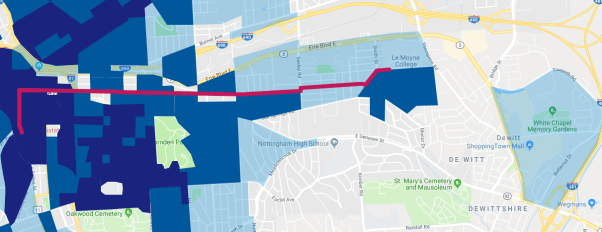
BRT service running on Erie Boulevard out to Shoppingtown Mall would pass within walking distance of all the new housing along Genesee Street on the Near Eastside, it would run through other older Eastside neighborhoods, and it would connect those residential areas to major employment centers Downtown and along Erie Boulevard.
This map shows the potential BRT route in red, and it shows Jobs and Persons Per Square Mile—a measure that indicates how many people might use public transportation in an area—in shades of blue. Areas that are not shaded do not have enough people and jobs to support BRT service.
Lots of people already ride the existing 168 bus along Erie Boulevard, so that’s a good route to upgrade with shorter headways and faster runtimes. The Mayor’s transition team probably also chose to single out that route because a new BRT service could run in fully separated bus lanes in Erie Boulevard’s wide median.
But there are problems running BRT service on Erie Boulevard. There is no housing on any of the enormous parcels that line the street from Beech Street all the way out to DeWitt. All that land is zoned for commercial use only—no housing is allowed. Erie Boulevard runs down the middle of a deep valley, so anybody living in the housing that is nearby has to walk up a steep hill just to get home from the bus stop. Shoppingtown Mall—the line’s eastern anchor—is dying, and there are no concrete plans to turn it around. It might not even be possible to put bus lanes in the Erie Boulevard Median because of the State’s plans to use that space for the Canalway Trail.
Given all that, the City’s Eastside might be better off if that BRT service ran on Fayette Street instead. That would bring better bus service to neighborhoods where a lot of people don’t own cars. It would also connect LeMoyne College to the rest of Centro’s BRT network. Ending the line at LeMoyne instead of at Shoppingtown would also shorten the route by 35%, allowing Centro to run more buses more frequently for less money.
Centro could also split the difference between these two options by running the line along Fayette to LeMoyne and then continuing it out to DeWitt along Erie Boulevard, say, or by turning onto Erie at Seeley or Columbus Avenue (like the existing 168 bus does). Those are decisions for actual transportation planners to make in consultation with Centro, the City, and the public, but let’s get them made.
Choose where the bus will go and where it will stop. Then, the ReZone team can make the changes it needs to—like lifting the ban on housing along Erie, or allowing more mixed-use development in Salt Springs—if that BRT service is going to succeed. The clock on ReZone is ticking, and Syracuse needs better bus service now.









 inthesalt.city