The Reimagine the Canals Initiative—a statewide brainstorming session that asks ‘how can we make more money off the Erie Canal?’—threatens to reduce one of Upstate’s most valuable pieces of infrastructure into a tourist attraction.
The initiative follows last year’s Reimagine the Canals Competition. The judges of that competition thought that the Canal was most useful as a site for waterfront development and beer festivals. It also follows the Governor’s other big ideas for Upstate communities like Syracuse: amphitheaters, gondolas, year-round fairs—all schemes to attract tourists.
Tourism is a seductive economic development strategy. It could work literally anywhere, it gets out-of-towners to pay local sales and hotel taxes, and it flatters consultants and politicians from outside of the community by assuming that a place like Syracuse would be better off if it would just cater to their upper-class tastes.
But the Erie Canal isn’t just sitting there, useless, waiting for us to reimagine a reason that tourists might want to visit it. The Canal is a statewide flood control system. It’s necessary to the survival of dozens of Upstate villages, towns, and cities, and it will become even more necessary as climate change makes the flooding up here more frequent and more destructive.
The people who actually run the Canal understand this. Thankfully, they’re at least getting the initiative’s leaders to consider flood mitigation, irrigation, and environmental remediation alongside the flashier tourism proposals. Help them out by telling the Initiative that you value the Canal for what it actually does for the state. You can submit your comments at this link.
Ever since NYSDOT came out in favor of the Grid, Town of Clay Supervisor Damian Ulatowski has been spreading a real ugly idea around Onondaga County. He’s been telling anyone who will listen that the suburbs’ “voices are not being heard.”
When Ulatowski says that, he doesn’t mean that all the communities along I81 should have a say over what happens to the viaduct—he’s never lifted up voices from Binghamton, Harrisburg, Roanoke, or Knoxville. And he also doesn’t mean that all the different governments in Onondaga County should be working more closely together—he opposed Consensus in 2016. And clearly he doesn’t mean that decisions made in any one community should account for their effects on other communities—he’s never cared one bit how Clay’s sprawl reduces opportunity for people living in the City.
What Ulatowski means when he says “our voices are not being heard” is that the suburbs should have control over what happens in Syracuse. He believes that the City exists for the benefit of the suburbs, and that the people living in Syracuse can only be trusted to make decisions as long as they accept that fact.
It’s an ugly idea—laced with racism and paternalism—and it’s been hiding behind bland words like “compromise” and “cooperation.” We need to call it out. When people living in Manlius say that I81’s future should be decided by public referendum, ask why they think they should get to participate in that vote. When hotel owners in Salina say that the needs of the suburbs outweigh the needs of the City, ask what kind of messed up scale they’re using. When Damian Ulatowski says that his voice isn’t being heard, tell him you can hear him fine, it’s just that he’s not saying anything worth listening to.
As the Republican Party digs in to defend the President, Congressman John Katko is losing control of his carefully crafted image as a ‘moderate.’
It used to be that Paul Ryan would help Katko maintain that image by allowing him to cast meaningless protest votes against unpopular Republican legislation. That’s what happened in 2017 when Katko’s party tried to repeal Obamacare. Republicans had a big enough majority to make it happen even though Katko voted against them. Ryan let him—and 19 other vulnerable Republican representatives—cast that symbolic vote so that Katko could come off looking like he was defying his party without actually doing anything to protect his constituents’ health insurance.
That’s all changed now that the Republican Party has decided to defend the President at all costs. Just last week the President told four congresswomen—one an immigrant, three native-born, all American citizens—to “go back” to the countries that they “originally came from.” Katko should have condemned that statement immediately because it’s the right thing to do, because he represents the 40,000 immigrants and refugees that live in his district, and because it would have been an easy way to maintain his image as a ‘moderate’ without actually opposing any of the Republicans’ disgusting immigration policies. Instead, Katko rallied to the Republican flag—putting out a statement that disagreed with the President’s style but not the substance of what he said. When the House voted to call that racism out, Katko fell into line behind the President.
Katko won’t actually challenge the National Republican Party on any issue, so he’s needed their help to cultivate a ‘moderate’ image in Central New York. That help isn’t coming anymore, and it’s getting harder and harder for him to disguise party loyalty as ‘moderation.’ Sooner or later, he’s going to have to make a real choice.
City Hall is trying to make it easier for more people to get around by bike. Great. Now only if they’d make it safer for more people bike in the City too.
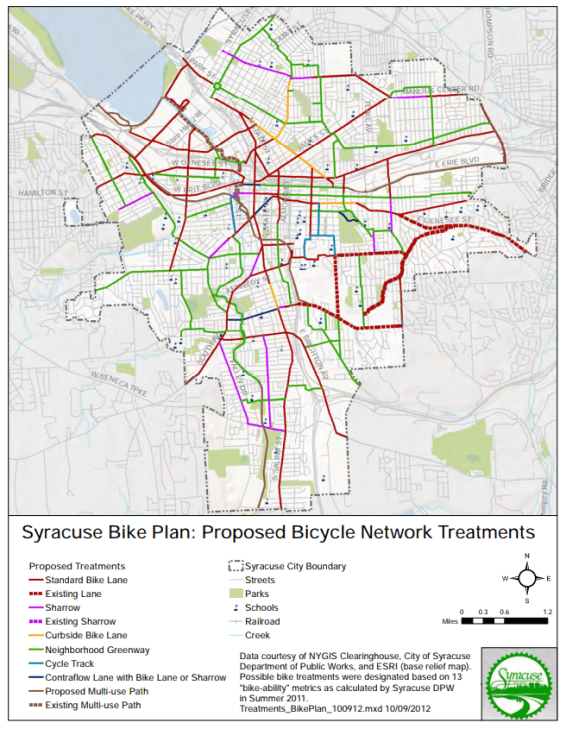
There is very little dedicated space to bike on Syracuse’s streets. What space has been carved out—a protected track on part of University Ave, unprotected lanes on a few other streets—is disconnected and half-hearted. It’s definitely not the full bike network that City Hall drew up in its comprehensive plan.
But City Hall isn’t doing a whole lot to make that network a reality. Even when DPW repaves a street that’s part of the Bike Plan, they’re not painting bike lanes. Amazingly, according to transportation planner Neil Burke, that’s on purpose:
“If we are doing one block of a street, and it’s on the bicycle master plan, we’re not going to roll-out full-fledged bike lanes just for one block. What we like to do is take more of a corridor approach connecting destinations instead of one block at a time. It can be slow to materialize, but what it does give us is usable infrastructure instead of just checking a box.”
That would make some sense if City Hall was actively working to build those corridors and connect those destinations, but they’re not. They’ve left it up to other institutions—normally New York State or Syracuse University—to decide where the City’s bike lanes will run, and that’s left Syracuse with bike infrastructure that’s helpful to get from Albany to Buffalo or from Westcott to the University, but not much of anywhere else.
There are two obvious ways for City Hall to build a bike network that works for the whole City. First is to start building the Comprehensive Plan’s bike network whenever possible. DPW is repaving Brighton Ave between Thurber and State Streets. The Comprehensive Plan says that spot should have bike lanes, so DPW should paint them on once it’s done with the paving. It’d only be a few blocks of bike lanes, but those few blocks would get people biking on Brighton, raise awareness of City Hall’s stated intention to paint lanes all the way from South Ave to Seneca Turnpike, and build the political support that City Hall needs in order to make that full buildout a priority.
Second, there should be bike lanes on every single street that has a bikeshare station. It’s insane to provide people with bikes to ride without a safe place to ride them. Those streets are all already part of the comprehensive plan, and the bikeshare stations’ very existence proves the need, so just go out and paint the lanes.
It’s great that Syracuse has a bike share. It’s great that there’s a new way for people to get around the City without a car. But a pushing bikes without building bike lanes is asking for trouble. People need to be able to use that bikeshare—and they need to be able to ride their own bikes—safely, separated from cars. The comprehensive plan already shows what that would look like. Now City Hall has to actually make it happen.
Sync—the new bikeshare network that launches on Tuesday—tackles three barriers to biking in Syracuse.
First, Sync makes biking cheaper. Bikes are one of the least expensive ways to get around, but, between the upfront cost and maintenance costs, it’s easy to sink $100 into even a cheap used bike. If that bike gets stolen or damaged, that investment’s gone. Sync will insulate riders from that risk because if a bike gets stolen or damaged, it’s on GotchaBike—the operator—to absorb that cost, not the rider.
Second, Sync makes biking simpler for people who move frequently. Bikes are big and they don’t pack well. Moving them between apartments is a pain, especially if you don’t own enough furniture to justify the cost of renting a moving truck. Frequent moves keep a lot of people from buying a bike at all, and that means that a lot of people in Syracuse—a city where 25% of the population moves at least once a year—don’t ride. Sync will allow people to bike without having to deal with all that.
Third, Sync makes biking easier physically. There are a lot of hills in Syracuse—University Hill, Tipperary Hill, Prospect Hill, and a bunch of others that don’t even have names. Biking across town almost always means going up at least one hill, and that’s pretty hard for a lot of people. Sync’s bikes all have electric motors that will ‘flatten’ those hills, making it easier for everybody to ride up them.
Right now, these different challenges keep different kinds of people from biking in Syracuse. By addressing all of them, Sync is giving a broad group of people access to a new option for getting around the City.
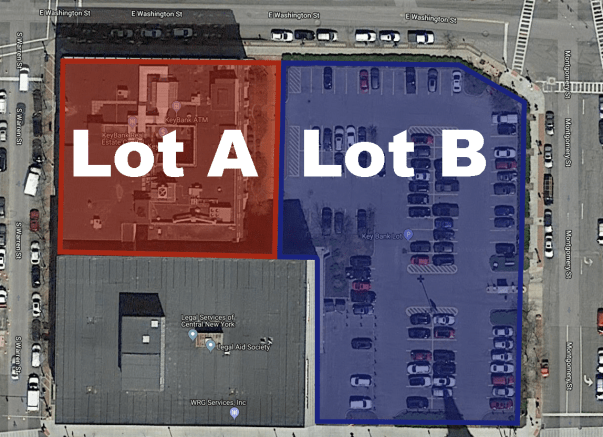
Property owners enjoy a de facto tax break when they waste valuable land Downtown by using it as a parking lot instead of something more productive. Take these two lots on the 200 block of East Washington Street. Lot A is a Bank and Lot B is a surface parking lot.
City Hall says that Lot A is worth $362,000 and Lot B is worth $1,071,000. Despite that, TIMWIN LLC, the owner of Lot B, pays $47,904.87 in annual property taxes while KeyBank, the owner of Lot A, pays $133,739.39—almost 3 times a much.
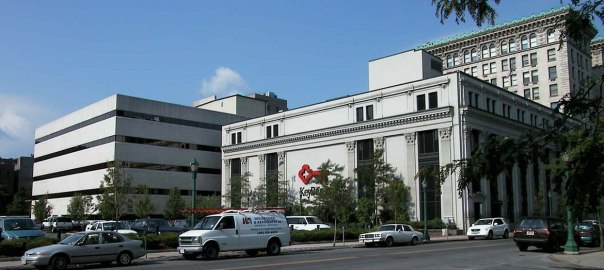
KeyBank pays so much more even though its land is worth so much less because it’s actually putting its land to good use. Lot A has an actual building on it—a four story bank branch. City Hall assesses the value of that full property—the land plus the building—at $3,134,000. Meanwhile, the full value of Lot B is only $1,094,000 because TIMWIN is letting it languish as a parking lot.
This is a problem across Downtown. Property owners just sit on valuable land without doing much at all to improve it. They make the City worse off, and they get a tax break for doing it.
The solution is to tax parking lots as if they were developed. The building on Lot A increases the lot’s value by 866%. Put a surchage on Lot B’s tax bill as if it were developed to the same intensity, and TIMWIN LLC would have to pay $395,676.48—more than 8 times as much as they do today. To make that payment, TIMWIN LLC would have to actually develop the property so that it could generate more revenue.
That new development could take a lot of different shapes—housing, retail, office, space, whatever—but anything would be better than a parking lot. Tax reform can make it happen.
Chol Majok’s victory in Tuesday’s Democratic primary marked both the beginning of a new era and the continuation of a long tradition in Syracuse’s politics.
This City has welcomed more than 10,000 refugees and immigrants in the past two decades. They’ve come to Syracuse from places like Somalia, Burma, and Bhutan. Majok himself is from Sudan, and he will be the first member of this most recent wave of immigration to hold elected office in the City.
That’s a good thing. Immigrants are making Syracuse a better place, and they deserve better representation in City Hall. More will follow Majok’s path, making local government more reflective of the people it serves, bringing new perspectives to the table, and letting the members of Syracuse’s newest communities know that they have just as much of a right to this City as anybody else.
But Syracuse’s history of welcoming the stranger goes back more than just two decades. Over the past two centuries, people have migrated to Syracuse from Germany, Ireland, Italy, the American South, and so many other places in search of a better life. Members of all of those communities have eventually gone on to hold elected office at City Hall, and that has always been a good thing for the City.
Chol Majok came to this City in 2001 as a refugee. He has been able to build a life here, to raise a family, and to contribute to the community. Now he’s going to sit on the Common Council and help guide the City to a better future. Syracuse has always thrived when it has embraced new people.
In Syracuse, local politicians are doing all they can to expand economic opportunity. At the same time, politicians in the State government are working to eliminate New York’s carbon footprint by 2050. These two groups of politicians—along with the activists and organizations that support them—should partner to advocate for better public transportation in Syracuse. A high-quality regional-wide service would expand economic opportunity by making more jobs more accessible to more people, and it would fight climate change by taking cars off the road. Working together as a pro-transit coalition, groups interested in each of these outcomes would provide Centro with the political support it needs in order to make this kind of service a reality.
The Status Quo
As it stands, Centro has very little political support. Nobody at the City, County, State, or Federal level values bus service enough to shift money from highways to public transportation, so every year Centro has to go begging for the money just to keep its buses running. That gets enough people riled up that Albany will push a couple million dollars Centro’s way—just enough to fill the deficit—and then the exact same thing happens all over again the next year
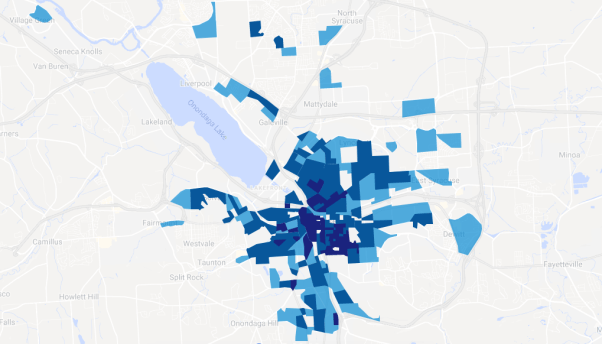
Without the political power to fund service improvements, Centro has crafted its planning process to make them impossible. SMART1—the most recent proposal to improve public transportation in Syracuse—focused almost exclusively on service within the City. That’s because when Centro plans transit service, it uses demand models that look like this:
According to this model, enough people live and work in the blue areas to justify improved transit service. The light blue areas can justify rapid buses, the medium areas can justify light rail, and the dark blue areas can justify heavy rail.
But this demand model assumes that any new transit service has to justify its existence by first attracting a certain number of riders. That means that good service can only run where lots of people already ride the bus, ignoring the fact that people choose to ride the bus in those areas because Centro runs relatively good service there. It also means that the areas where people don’t use public transportation can’t get better service even though low ridership is caused, at least in part, by how bad the service is right now. By ignoring the effect that the quality of service has on ridership, Centro is able to justify its barely passable service, and it avoids politically impossible requests for more funding. The result is too little economic opportunity and too many cars on the road.
A coalition of economic opportunity and environmental advocates could turn that logic on its head. When you recognize transit as a necessary tool in the twin fights against poverty and climate change, low ridership is a challenge to overcome rather than a sign to give up. The emerging pro-transit coalition should respond to low ridership by improving service in order to make more jobs more accessible and to better compete with car travel. Those improvements would attract more ridership, getting more people to work and taking more cars off the road.
Transit for the Whole Region
It’s not easy to run attractive transit service in suburbs where people and jobs are spread thinly over a very large area, but in the book Transport for Suburbia, Paul Mees describes how Zurich’s network of city rail lines and suburban bus routes accomplishes the task by making connections between the trains and buses simple, convenient, and cheap. Easy connections integrate each line into the larger network. That allows public transportation to cover the entire metropolitan area, and it gives riders the same freedom that they’d have in a private car.
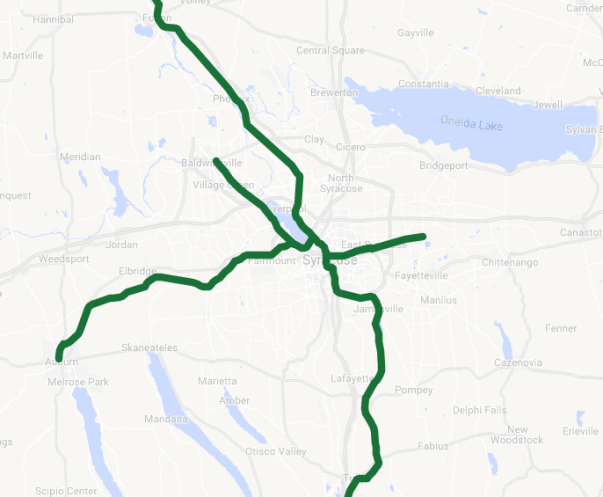
For Centro, that could start with a fast frequent regional rail system connecting Syracuse to Auburn, Fulton, Oswego, and Cortland. Much of the infrastructure already exists parallel to the slow infrequent coach buses that Centro already runs.
Regional rail lines connecting the cities and suburbs of the metropolitan area
Complemented by well-timed connecting bus lines—extending to Ithaca, say, or linking suburban communities and job centers along major roads like Route 31 and Taft Road—this service would open the entire region to travel without a car, increasing economic opportunity and reducing carbon emissions at the same time.
Political Support is Fundamental
This service—or something like it designed by actual transportation planners—won’t come cheap. It will cost money to acquire new rights of way, to buy new buses and trains, to hire enough operators to run them frequently, to time them precisely.
For Centro’s entire history, that kind of spending has been unthinkable. The money will have to come from the State or from the Federal Government, and that means that it will have to come at the expense of some other government program—highways, maybe. Good public transportation is a political choice, and it can’t come about unless people with power value it more than they value the other things that also require government funding.
That may finally have changed. Now that the environment and economic opportunity have moved up to the top of the agenda in Syracuse and in New York State, there may finally be a coalition broad enough and powerful enough to make public transportation a priority in this City. We can finally stop treating public transportation like a ‘program’ that’s only funded grudgingly, when all other options are exhausted and only at the bare minimum. Can we finally stop spending billions on highway expansion while ignoring million dollar plans for better bus service. We can finally take public transportation seriously as an opportunity to achieve New York’s loftiest goals.
Last week City Hall released the final draft of its new zoning ordinance and zoning map. This new draft includes some big changes on parking, transit oriented development, and housing opportunity.
Parking
City Hall should eliminate parking minimums entirely. They’re regressive, expensive, polluting regulations that subsidize car ownership at the expense of the poorest people living in Syracuse.
ReZone’s final draft doesn’t go that far, but it does reduce parking requirements significantly, particularly for residential properties. In the March 2018 draft, almost all types of residential building were required to provide one parking space for each housing unit. The final draft eliminates that requirement for 1-family houses, accessory dwelling units, and boarding houses, and it reduces that requirement to .5 spaces per unit on properties that can house three or more families. (Strangely, the one space per unit rule still applies to 2-family houses, but only if they’re built on a lot of more than 5,000 square feet).
The final draft also does make it easier for all types of properties (residential, commercial, and mixed) to get around these baseline parking requirements. It includes a 30% reduction for properties within 1000 feet of a bus stop (you can read more about earlier versions of this exemption here and here) and a new 15% reduction for properties that provide space to park 1 bike for every 4 cars. Crucially, it allows individual properties to combine multiple reductions (the March 2018 draft had capped the total cumulative reduction at 75%), and it rounds the required number of parking spaces down to the nearest whole number (so a 3-family house—which would need 1.5 spaces—only has to provide 1 space, not 2).
The only bad change in this draft’s parking regulations is a new requirement that any property making use of these exemptions must apply for a special use permit or site plan. That means that there will be a public hearing where NIMBYs might show up to demand that the City look out for the interests of car-owners instead of everybody else. Here’s hoping the Planning Commission has the spine to tell them ‘no.’
Transit Oriented Development
Centro doesn’t currently run any kind of rapid transit, but they’re working on it. The SMTC proposed two BRT lines in 2017, and Mayor Walsh’s transition team proposed a third when he took office. When that new service starts running, as many people as possible need to be able to live and work near those lines.
Proposed BRT lines
This new draft will make that more possible. The Eastside BRT line will probably run in the Erie Boulevard Median—a route that will take it past miles and miles of parking lots. This draft changed many of those lots—at least on the south side of the street—from Commercial to either MX-2 or MX-3. That incentivizes mixed-use infill, it will bring any new development to the property line, and it will limit the amount of off-street car parking on those lots.
March 2018
June 2019
The northern end of the proposed SU-RTC line has similar problems—there’s a lot of empty space around the RTC and not a lot of housing. The March 2018 draft would have banned anybody from living there, but this new draft allows multi-family housing to be built on all of the empty space north of Park Street and Hiawatha Boulevard.
And finally, this draft changed a bunch of properties around the intersection of South Ave and Valley Drive—a proposed stop on the Eastwood-OCC line—from MX-2 to MX-3. That change allows for taller buildings which means more people will be able to live and work right at a BRT stop.
Housing Opportunity
City Hall’s Land Use & Development Plan—the document that was supposed to guide the ReZone project—called for letting more multi-family housing in more neighborhoods. That would have allowed Syracuse to accommodate a greater variety of people, and it would have made the City’s neighborhoods more resilient in the face of demographic and economic change.
So it’s bad that each new draft of the ReZone map has banned multi-family housing from more of the City. That will lead to either depopulation or displacement, and it’s a totally unnecessary response to neighborhood demands to keep commercial development out of residential areas.
This new draft continues that unfortunate trend. It switched dozens of properties along Teall and Euclid Avenues from MX-1—a zoning classification that allows multifamily housing—to R-2—a zoning classification that bans multi-family housing. This change will make these areas less walkable, less affordable, and less able to support quality bus service.
Teall, March 2018
Teall, June 2019
Euclid, March 2018
Euclid, June 2019
On the other hand, this draft restricted commercial development in neighborhoods like University Hill and Westcott without restricting housing opportunity. It did this by changing parts of those neighborhoods from mixed use zoning to R-4 or R-5—purely residential classifications that still allow multi-family housing.
March 2018
June 2019
There are other changes—clarification on rowhouses, tweaks to the height restrictions—but these are the big ones. They will determine who can live where, how people will get around, what neighborhoods become. Those are high stakes—Syracuse has to get this right.
In Syracuse, people ride the bus to get all over the City for all kinds of reasons. Centro needs to run a service that fits their needs by connecting the entire City. One way to do that would be to run more buses between different neighborhoods, even if that meant running new lines that avoid Downtown altogether. Another option, though, would be to just run more buses more frequently on the lines that already exist.
Right now, to get from the corner of South Ave and Bellevue to Syracuse University, you have to take a bus up into Downtown and then catch a University bus at the Hub. The whole trip covers 2.5 miles, and you spend about 13 minutes on the bus.
A new crosstown line along Bellevue, MLK, and Euclid would make that trip much more direct. You’d only need one bus, that bus would only travel 1.9 miles, and it’d only take about 10 minutes. That’s 23% less time spent actually riding the bus—not too bad.
The bulk of a Centro trip isn’t spent riding the bus, though. Just to ride the 15 minutes between any given neighborhood and Downtown, it’s common to have to wait 30 or 40 minutes at the stop. If that Bellevue-MLK-Euclid bus only ran once an hour, the true average trip time would be 40 minutes—10 minutes riding the bus and an average of 30 minutes spent waiting for it to show up in the first place. At that point, it’s just about as fast to cross that distance on foot.
So while it’s good to shave minutes off of the time that riders spend on the bus, the best way to make Centro more convenient is actually to shorten waiting times. That means more buses running on each line with shorter headways.
Centro and SMTC have proposed to do just that. In their SMART1 plan, they talked about crosstown buses running from Eastwood to OCC, and from SU to the RTC every 15 minutes all day. That kind of service is unheard of in Syracuse, and it would do a lot to connect different parts of the City together.
SMART1 BRT Lines
Those short headways would reduce the average trip from South Ave to SU to 28 minutes—a 7.5 minute wait at Bellevue, a 4.5 minute ride to the Hub, a 7.5 minute wait for the connecting bus, and an 8.5 minute ride to SU. That’s 30% faster than the direct route on the less frequent Bellevue-MLK-Euclid bus would be, even with the extra distance and the need to transfer at the Hub.
Obviously, the best option would be for Centro to offer both. Then, someone waiting at South Ave and Bellevue could just catch whichever bus came first, no matter whether it was headed up South Ave or east on Bellevue.
These two options represent a tradeoff, though. Frequent service is only possible if Centro concentrates its resources on key lines. Every bus running on east on Bellevue is not running north on South Ave, and if Centro were to start running new lines without new money, then it wouldn’t be as able to run frequent service on its major lines. Too many new crosstown routes could, at that point, actually make it more difficult to get across town on a bus.
Syracuse needs better bus service. Syracuse needs bus service that connects different parts of the City, that makes it easier and convenient for people to get around town. There are different ways to do that, but one of the easiest would be to just run more buses more frequently along major lines.