All posts by inthesaltcity

Replacing connections removed by urban renewal

When the Syracuse Police Department moves its main offices out of the Public Safety Building on State Street, City Hall should build a path through the property to reconnect Downtown with the neighborhoods immediately to its east.

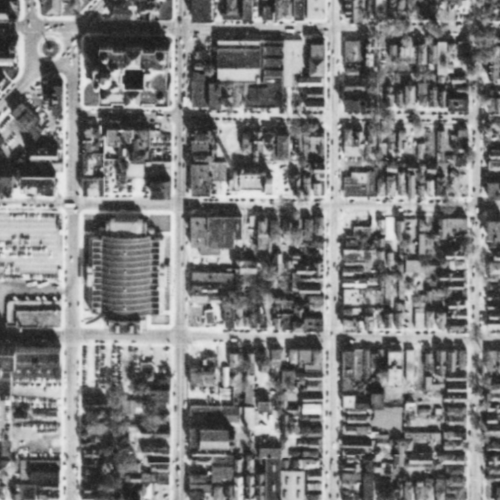
City Hall built the present Public Safety Building as part of an urban renewal project explicitly designed to cut Downtown off from Syracuse’s close-in residential neighborhoods. It did this most effectively by totally demolishing one such neighborhood—the 15th Ward—and by closing short local streets better suited to pedestrian traffic than long-distance car commuting. South of Genesee Street, five local streets used to enter Downtown from the east. Today, only two—Harrison and Adams—are left, and both are too wide and carry too many cars driving too fast to be a safe and pleasant route for anybody travelling by bike, foot, or mobility device.

If I-81’s removal is going to really change the way people get around town—and it must—then City Hall needs to find ways to reestablish those lost connections. Piercing the superblocks around the Public Safety Building is a good place to start. All three of the lost east-west connections—Jefferson, Cedar, and Madison Streets—were removed to build Presidential Plaza and the Courthouse/Public Safety Building/Justice Center/Everson Museum complex.

street grid removal for urban renewal superblocks

Traces of each remain. The tree-covered walk along the north side of the Everson fountain follows Madison Street’s path. Privately-owned Presidential Court sits where Cedar Street used to run. Eastbound traffic on Genesee Street runs south of Forman Park on what used to be the easternmost block of Jefferson Street.

But although there are pieces of all these old streets, they are disconnected and do not form a path between University Hill and Downtown. Urban renewal superblocks, highway offramps, and a distinct lack of crosswalks all conspire to create a sort of pedestrian black hole between State, Genesee, Harrison, and Almond Streets.

traces of Cedar Street between Montgomery and Almond Streets

I-81’s demolition and the police department’s move out of the Public Safety Building present the opportunity to restore connections to Downtown. First, City Hall should pierce the State Street superblock by building a path across it in the area of the present Public Safety Building (the remainder of the large site can be redeveloped with homes and commercial space, some of which should front the path). Second, City Hall should work with NYSDOT and Sutton Real Estate Company—the owner of Presidential Court—to reopen connections across the Presidential Plaza superblock by linking Presidential Court with Almond Street. Third, City Hall and NYSDOT should install crosswalks and traffic lights on Almond, Townsend, and State Streets where those streets intersect reestablished east-west connections.

These are the kinds of interventions Syracuse needs to reconnect neighborhoods divided by urban renewal. The City has been carved up by highways and superblocks, and people getting around on foot, by bike, or with a mobility device have too few direct, safe options for travelling between neighborhoods. A new route through the Public Safety Building property would help reconnect small safe streets like Madison, Jefferson, and Cedar and play an important part in a larger network of safe routes across the whole City.

Centro’s post-pandemic ridership recovery

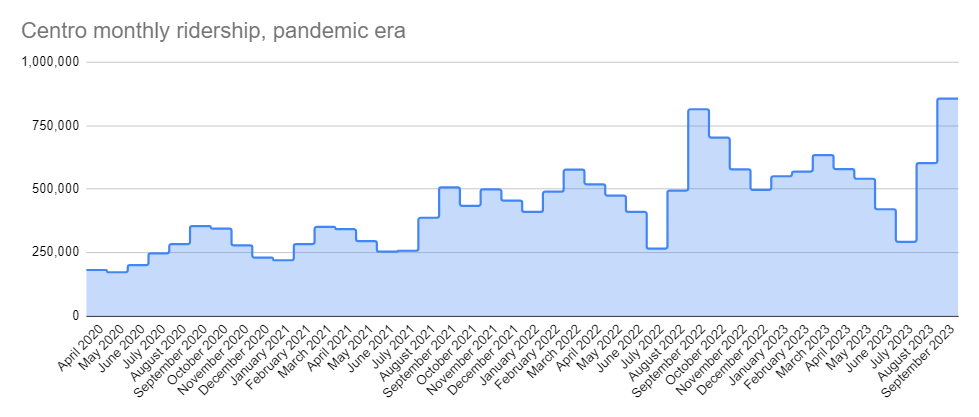
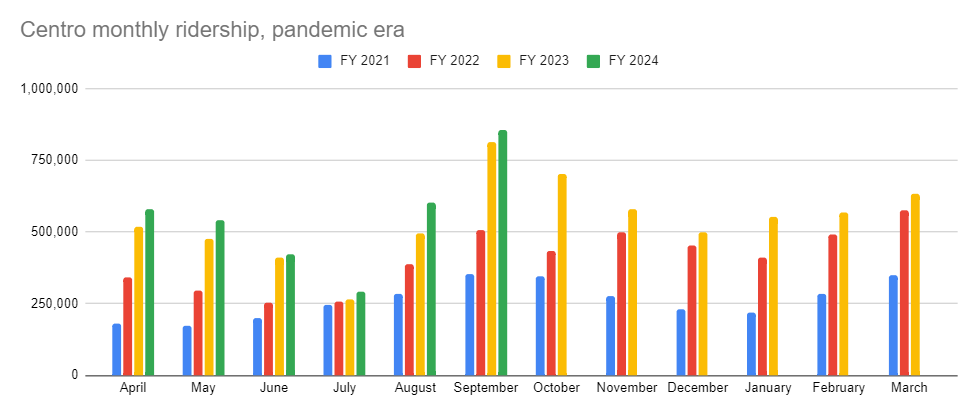
More people rode a Centro bus in September 2023 than in any month since October 2019. That marks the first time post-pandemic monthly transit ridership in Syracuse has exceeded any pre-pandemic mark.

This is good news for Centro, but the ridership trends leading up to September tell a slightly more complicated story about the state of transit in Syracuse. We still have a ways to go just to get back to our pre-pandemic (and barely adequate) status quo, but Centro is changing its service in ways that put them on the path to providing the quality transit service Syracuse needs and deserves.

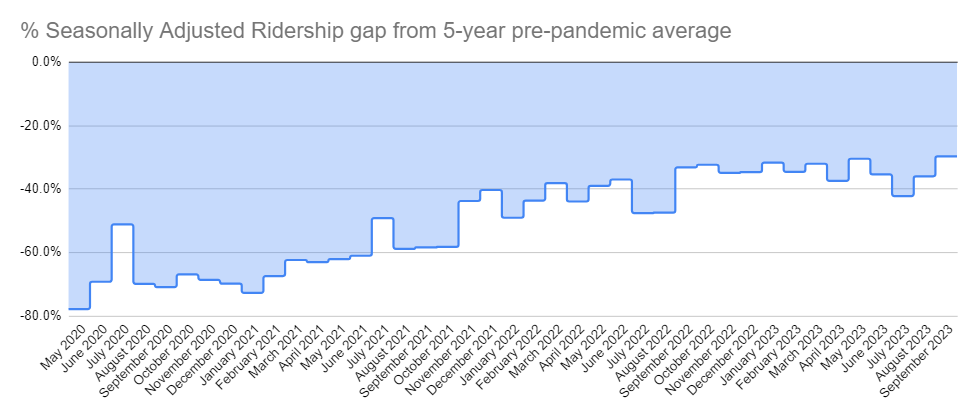
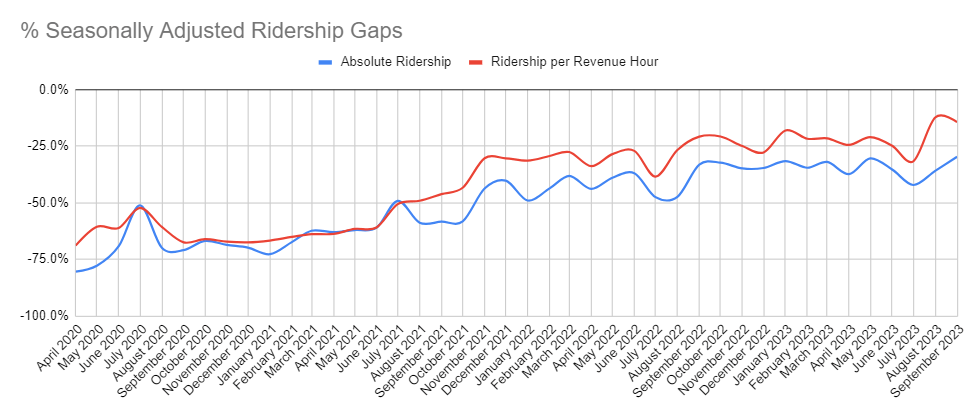
In the five years leading up to the pandemic, Centro’s monthly ridership averaged about 850,000. In the first months of lockdown, ridership dropped to about 200,000. Ridership has grown steadily—with allowances for seasonal variation—since then. Every single month since April 2021 has seen higher ridership than the same month of the previous year, and in September 2023, monthly ridership hit 857,415—higher than the pre-pandemic average, and the highest monthly total since October 2019.

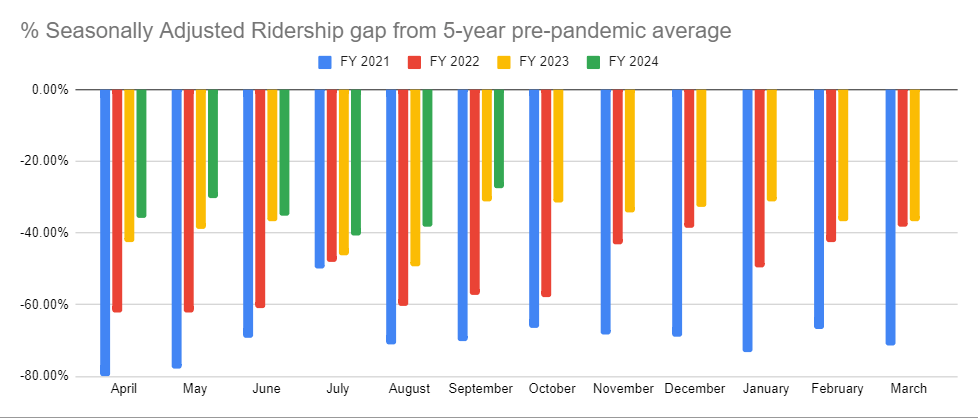
However, Centro’s monthly ridership follows a pretty regular cycle, and September has always been the highest ridership month of the year (the NYS Fair and the beginning of the academic year both bring a lot of riders). In the five years before the pandemic, average September ridership was just over 1,200,000, so if we’re comparing apples-to-apples, September 2023’s ridership was 30% below the pre-pandemic norm. That’s still smaller than any other post-pandemic month’s seasonally adjusted gap (or, the percentage difference between current ridership and the average ridership for that same month in the five years preceding the pandemic), but it’s far from a full recovery.

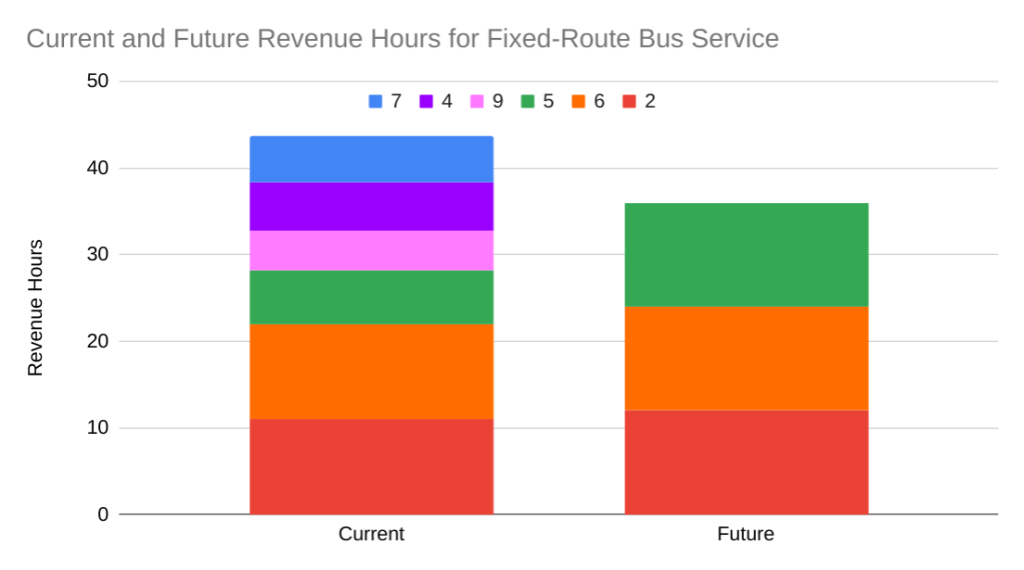
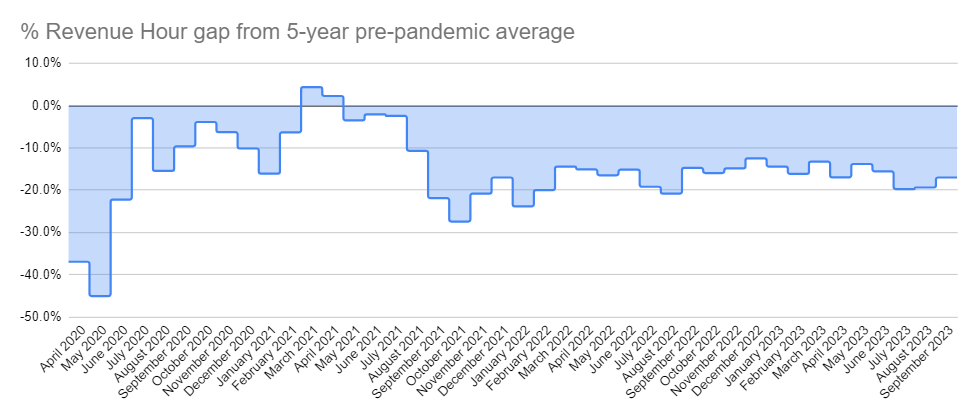
It’s not totally fair to compare today’s absolute ridership to pre-pandemic months, though, because Centro has fewer buses on the streets than they used to. Ever since the Summer of 2021, Centro has not been able to hire enough operators to run its regular service. Revenue hours (the total amount of time Centro buses are available to riders) are consistently 1/8 to 1/5 below the pre-pandemic norm, and that decrease in service has depressed total ridership. Better to compare ridership per revenue hour (a measure of transit efficiency) to get a sense of how much the service is being used. That measure shows September 2023 at just 14% below the pre-pandemic norm.

Ridership per revenue hour has outperformed total ridership because Centro has focused its scarce resources on high-ridership routes. When the staffing crisis hit, the first service cuts came from low-ridership lines. That allowed Centro to preserve more service on higher-performing lines through populous neighborhoods. If Centro had simply cut service evenly across the board, today’s total ridership would be even lower.

The same logic should guide Centro’s approach to its network redesign: enhance service in the places where people ride the bus most to get the biggest increases in ridership.

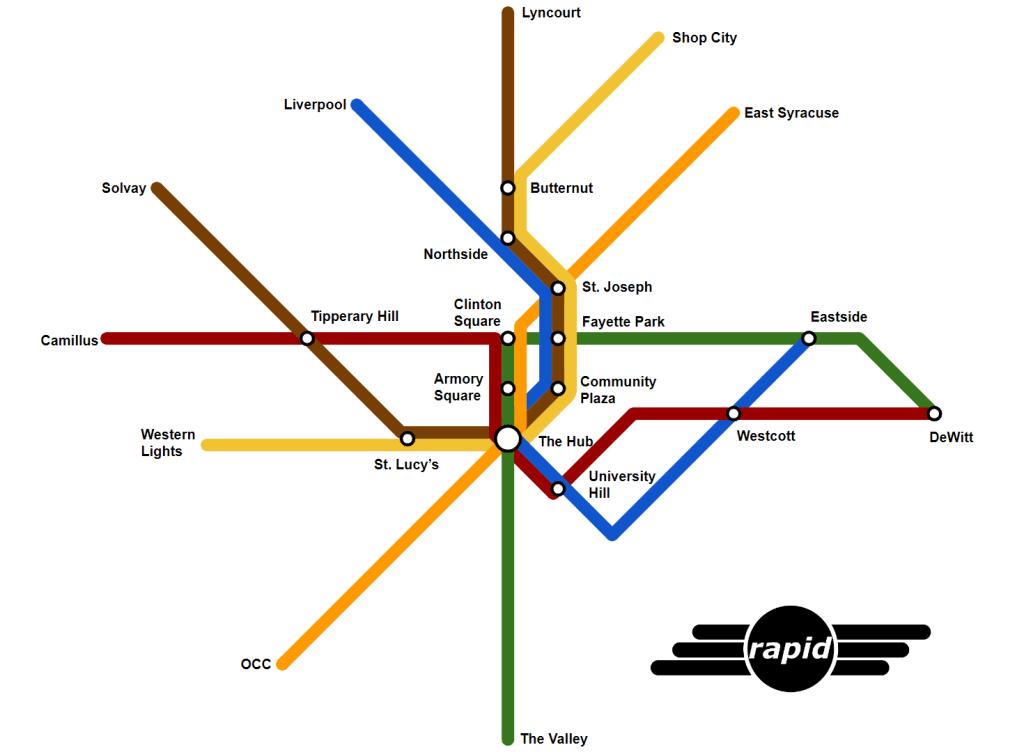
outline of a citywide high-frequency BRT system

Centro still has a ways to go to get ridership back where is was before March of 2020. It has even farther to go to provide Syracuse with the kind of transit service we really need. But the system’s steady recovery, and Centro’s commitment to focusing resources where they’ll do the most good, gives hope that they’re on the right path.

Big new apartment buildings are good

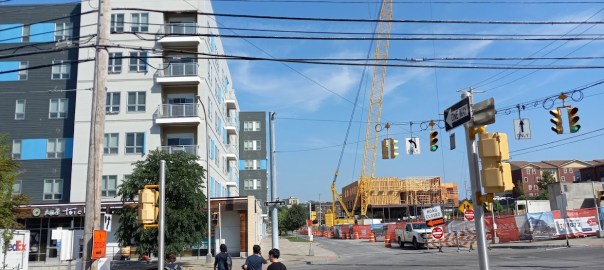
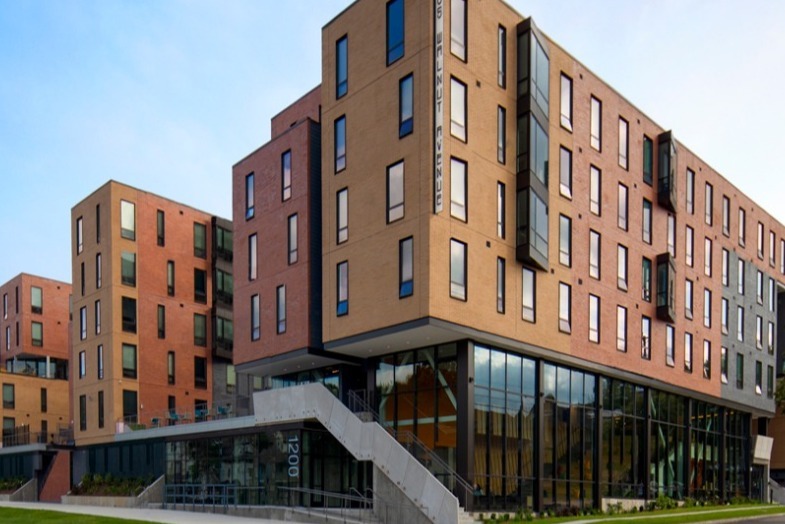
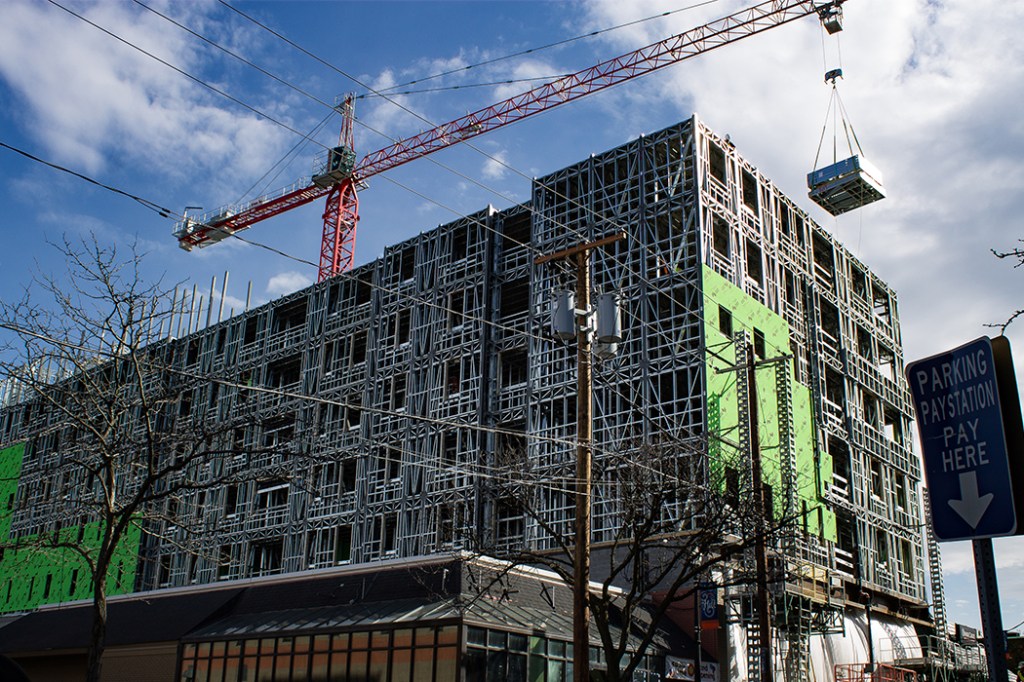
The large apartment buildings going up around University Hill expand housing opportunity in surrounding neighborhoods, and that’s a good thing. 

These buildings—505 Walnut, Theory Syracuse, The Marshall, UPoint, etc—attract a lot of scorn because they’re big, new, expensive, and primarily marketed to university students. ‘Why’ a lot of people ask ‘do we need more luxury student apartments when so many people in this town struggle to pay the rent?’

The short answer is that we don’t need them—students do. Students are people, and they need housing just like anybody else.

A more complicated answer is that we (anybody trying to secure housing in Syracuse) need these new apartments because students need them. To see why, it’s helpful to think about how university students differ from other tenants in the City.

First, they are often willing and able to pay more in rent than many other Syracuse tenants. Syracuse University and LeMoyne College charge students between about $900 and $1,550 per bedroom per month for on-campus housing. Student loans and/or family savings cover that cost, but those sources of income can also be used to rent off-campus housing too. Compared to the on-campus options, splitting the $4,500 rent on a 6-bedroom apartment with five other roommates is a pretty good deal—even though that’s well out of reach of any large family that might also want an apartment that size—and a lot of student tenants jump at the opportunity.

Second, they are geographically constrained. A good number of students move to Syracuse for school, don’t have much information about the City, and don’t have the time or ability to chase down Craigslist leads all over town. Students tenants also often need to be able to get to their campus without a car, and that means finding housing within walking or biking distance or on a bus line that goes to campus. All of this means that student tenants are a sort of captive market for University-area landlords, and that gives those landlords the power to set their rents at prices student tenants will pay.

Third, they evict themselves. Landlords value the ability to get rid of tenants who can’t pay high rent or are loud or demand basic maintenance or need reasonable accommodations for a disability or whatever. Landlords cherish easy evictions, but tenants who want long-term housing stability have some—not enough, but some—rights that allow them to fight off eviction and stay in their homes. Student tenants, however, often voluntarily move every year and are almost guaranteed to vacate the apartment after two years, so landlords who exclusively rent to student tenants never get ‘stuck’ with someone they consider to be a ‘problem tenant.’

If you’re a tenant looking for a relatively inexpensive, long-term home, you do not want to be competing with student tenants for an apartment. Lot of landlords would prefer to rent to student tenants, and they can usually screen you out by just charging more than you can afford.

This is also a problem for prospective homebuyers. When building new housing isn’t an option, landlords looking to rent to tenants will simply buy existing housing—including 1 and 2-family homes commonly purchased by owner-occupants—and operate it as rental units. If you’re trying to buy a house for yourself, you do not want to be competing with landlords who rent to student tenants. They often have better access to financing and are often willing to pay more because the rent can cover a pretty big mortgage payment.

So it is a very good thing for most Syracuse tenants and prospective homebuyers that a few big landlords are building big new apartment buildings specifically for student tenants, and lots of student tenants are choosing to live in those buildings. Because of those big new buildings, fewer student tenants are competing with non-student tenants for apartments in the older neighborhoods around Syracuse University, and fewer landlords are competing with prospective homebuyers to purchase older housing to rent to students in those neighborhoods too. 

Clearly, Syracuse’s housing problems are a lot bigger than “student tenants shape the rental market in ways that increase housing purchase and rental prices on and around University Hill,” and while big new student-targeted buildings can help solve that problem, they can’t solve every housing problem in the City.

But what’s great about these big new apartment buildings is that they do actually solve a real problem in Syracuse, they do it while generating new tax revenue (even when SIDA grants a PILOT), and they have done it by converting parking lots and vacant buildings in the City’s center into new homes.

The Governor’s Housing Plan and Upstate’s Need for New Housing

Governor Kathy Hochul’s goal of building 800,000 new homes in New York in the next decade is good. We need new housing—a lot of it—in communities all across New York State for all kinds of different reasons, and her New York Housing Compact will help build a lot of new housing. As proposed, however, her plan might only make an impact Downstate. We need this statewide housing policy to build new homes in communities like Syracuse too,

In a place like Syracuse, we need new housing for at least three big reasons: the housing stock we have now doesn’t meet people’s modern needs, a lot of it’s in terrible shape, and certain neighborhoods don’t have enough housing for all the people who’d like to live there. The housing we’ve got now doesn’t fit the housing we need, and this mismatch is bad for affordability, it’s bad for public health , and it’s bad for racial and economic segregation.

Downstate has a lot of the same problems, but they are all conditioned by the overwhelming demand for housing down there. They need new housing for all of the reasons we do, but they also need a lot more housing in order to alleviate their sever housing shortage and make room enough to accommodate all the people who want to live there.

The Governor’s proposal is designed to address the New York City metro area’s housing shortage more than the statewide need for new housing. Its central policy is a builder’s remedy—basically a streamlined permitting process for new construction in instances where exclusionary zoning blocks new housing. It’s a policy that will definitely help Downstate, but which could also address the need for new housing in Upstate’s metropolitan communities, like Syracuse, where exclusionary zoning contributes to our housing problems.

But that builder’s remedy only goes into effect if there’s little or no new housing construction in a particular municipality. Downstate, projects can take advantage of the remedy when proposing new construction in a municipality that’s seen less than 3% growth in its total housing stock over a 3-year period. Upstate (in this instance, anywhere not served by the MTA), the builder’s remedy doesn’t go into effect unless new housing construction falls below 1% in any municipality over a 3-year period.

In Syracuse, that 1% threshold will probably work out to about 200 new housing units per year. In Salina, it’s more like 50. In DeWitt, about 40. These are tiny numbers, and they are well below what we need to build in order to actually address the problems that new construction can solve.

There’s a lot to like about the Governor’s housing proposal. The design of the policy is sound. The full plan also includes other good things like a new lead testing and remediation program and more funding for mixed-income housing Upstate.

But the plan’s core goal—to build hundreds of thousands of new units—won’t do much Upstate if the builder’s remedy only works in municipalities with New York City-sized housing shortages. We need either lower targets for new construction, or some other metric—like a shortage of affordable housing—to trigger the policy if it’s going to make a difference in a place like Syracuse.

BRT, a Timeline, and a Network Redesign

Centro’s recent Bus Rapid Transit announcements are fantastic news for Syracuse. We need better bus service to better connect people and neighborhoods, and BRT is the best way to make that happen.

The actual content of these announcements confirms a lot of what we’ve known for a long time. Centro’s first two BRT lines will run on the routes identified in the SMART1 study, they will run faster by stopping less, riders will board at stations rather than just a pole in the ground. This is all good.

But the announcements also contained two new pieces of information worth highlighting: a timeline for the service to start, and Centro’s intention to pair BRT with a network redesign.

A timeline

While it’s always seemed inevitable that Centro would do something like BRT sometime, there’s never been an actual timeline on it. Ever since SMTC published its SMART1 study, Centro has been dealing with a series of crises (a funding gap, Covid, hiring problems, etc), and designing and implementing a new service has never been the top priority. It was always a part of the long range plan, and Centro was always working on it, but the service was never imminent.

Now we know these buses will be on the streets by 2026. It is a big deal for Centro to say this publicly because they wouldn’t commit to a timeline if they weren’t confident they could keep it. Now that Centro’s made that promise, it is clear for the very first time when we can expect to actually board a BRT bus.

Network redesign

But BRT isn’t all they’re promising. Centro’s doing that and “the most comprehensive review of our Syracuse route system in more than 20 years.” This is also very good.
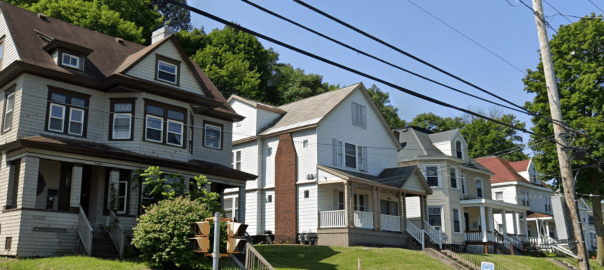
Centro’s bus routes follow lines laid out for the streetcars back in the 1800’s. They’ve been extended and stretched and kinked to try and keep up with changes in the community since then, and the results have not always been pretty. Buses slowly zig and zag across neighborhoods, they make detours, they run at irregular infrequent intervals. The whole system is so complicated and so fragile that people rarely try to understand how to use it to go more than one or two specific places.

A network redesign will allow Centro to look at the whole system and rework it to be faster, more frequent, more reliable, and more understandable.

Taken together, both these pieces of new information are great news for Syracuse and Central New York. We need better public transit, and that need is only more urgent since the Micron announcement. Centro has a real vision of the transit system this community needs and deserves, and they are ready to build it.

Save81’s Environmental Nihilism

Of all the lies, half-truths, and obfuscations being peddled by the most recent iteration of the Save81 crowd, the biggest whopper might be their contention that I81 is good for the environment and that making it bigger will decrease greenhouse gas emissions. This is laughably wrong, but it’s helpful to have the opportunity to explain exactly how tearing down the viaduct and building the Community Grid will help in the fight against climate change, and to expose how bankrupt Save81’s version of “environmentalism” is.

Save81’s basic argument is this: the best way to reduce greenhouse gas emissions from cars (America’s #1 source of climate pollution) is to let them drive as fast as possible while making sure they have to brake as little as possible because cars get better gas-mileage on uncongested freeways than they do on local streets. Therefore, they claim, building a newer bigger viaduct is the environmentally friendly option because it will let cars drive faster.

This is wrong-headed for so many reasons (induced demand congests highways after they’re widened, eliminating any emissions “savings” per trip, for instance), but the main issue is that Save81 fails to account for how tearing down the viaduct and building the Community Grid will give people more and better options when they choose where to live, and those choices will reduce greenhouse gas emissions by taking cars off the highway and eliminating many car trips entirely.

Highways cause more driving by destroying the centers of communities and spurring suburban sprawl. Transportation is America’s #1 source of climate pollution because our interstate highway system has demolished walkable, bikeable, transit-oriented neighborhoods and replaced them with car-dependent sprawl in metropolitan areas across the county.

A neighborhood paved over

Tear down I81, and Syracuse will become a more environmentally sustainable community by giving more people the option of living in neighborhoods with more sustainable—and more freeing—transportation options. The viaduct takes up so much space—and blights so much more—in the very center of town where thousands of people used to live, and where thousands more want to live now. This spot is smack dab in the middle of the region’s biggest, densest job center. It’s an area served by decent public transportation, an area where it is very possible to get around without firing up an internal combustion engine (and even if someone did drive from McBride Street to Harrison Street for work everyday, they’d still emit less carbon than if they started their trip in Manlius).

Tear down the highway, rebuild those thousands of homes, and a lot of people who might otherwise have had to find housing on the sprawling, car-dependent, farm-killing exurban fringe will instead be able to make a life in the walkable, bikeable, transit-oriented city center. That’s how the Community Grid will reduce greenhouse gas emissions and combat climate change.

At root, Save81’s faux-environmentalist argument is built on the cynical belief that we can’t make things better. They say that a once-in-a-generation infrastructure project to shift the geography of transportation and housing in Onondaga County won’t really change anybody’s behavior. They reject the notion that our community has the power to remake itself into a better, more equitable, more sustainable place. Nobody who calls themselves an environmentalist—who’s really committed to combating climate change—should give this kind of environmental nihilism a minute’s thought.

Where to spend the marginal transit dollar

If you gave Centro one dollar to improve service, where would you get the most bang for that buck? Where would a marginal improvement in service—more frequency, more speed, better reliability, new service—have the greatest positive impact for the greatest number of people? Where would better bus service result in the greatest increase in ridership?

This is a good clarifying question when talking about how to improve Centro, because it confronts the reality that there are a lot of ways Centro needs to improve, but a constrained budget means Centro can’t fix all of its problems at once.

We need a public transit system that connects every major employment and population center in the County with fast, frequent, reliable service in order to make public transit a truly viable option for people. That means hugely improved service on Centro’s core routes through BRT, and it means decent service to big suburban destinations like Micron and the airport. But since Centro doesn’t have the resources to do all of that right now, which service improvement is most important? Choosing to solve one problem means leaving others unsolved, so we’ve got to prioritize and make the fixes that will improve the most people’s lives first.

The answer to this question—and it’s an obvious answer when the question is framed right—is that Centro would do the most good by investing any new funding to improve service on high-ridership corridors like James Street and South Salina. Those are the places where lots of people already ride the bus, where a lot more people could easily walk to a bus stop, where homes and destinations are relatively close together and easy to connect with a bus line. Run BRT-style service every 10 minutes in places like those, and Centro would get a lot of new riders and existing riders would ride a lot more (more than you could ever hope to get from a new bus line to the airport).

So as Onondaga County prepares for new population growth and thinks about how its transportation system can accommodate a few thousand more people moving around, keep this in mind: of the many steps we need to take to get from where Centro is now to where it needs to be, the first one should be investing in the communities where bus ridership works best—densely populated, mixed-use, city neighborhoods.

Transit, Traffic, and Growth in the Northern Suburbs

Micron’s proposal to build a large factory on Route 31 in Clay has a lot of people talking about public transit in the northern suburbs, but Onondaga County will need better planning to guide population growth so that public transit can actually work out there.

The northern suburbs can’t accommodate much more population growth with their current transportation network. These areas were almost entirely rural until pretty recently, and their road network doesn’t have the capacity for much more than a rural population. There are only a small handful of roads that cross the enormous area between Syracuse and the Oneida River, and as single-family development has converted farms to suburban sprawl where every adult makes every single trip in a car, those roads have gotten very congested. Onondaga County predicts another 4,000 homes will be built in this area in the next few years, and if every adult living in all of those new homes also makes every single trip to the grocery store, to work, to school, in a car on those same overtaxed rural roads, the traffic is going to be terrible.

Public transit can help. With fast, frequent, reliable transit service, people won’t need to use their car every time they leave the house. That gives people the option to avoid dealing with traffic, and it reduces traffic by taking cars off the road. Giving people this decent option is the only way to accommodate significant population growth without strangling the northern suburbs with car traffic.

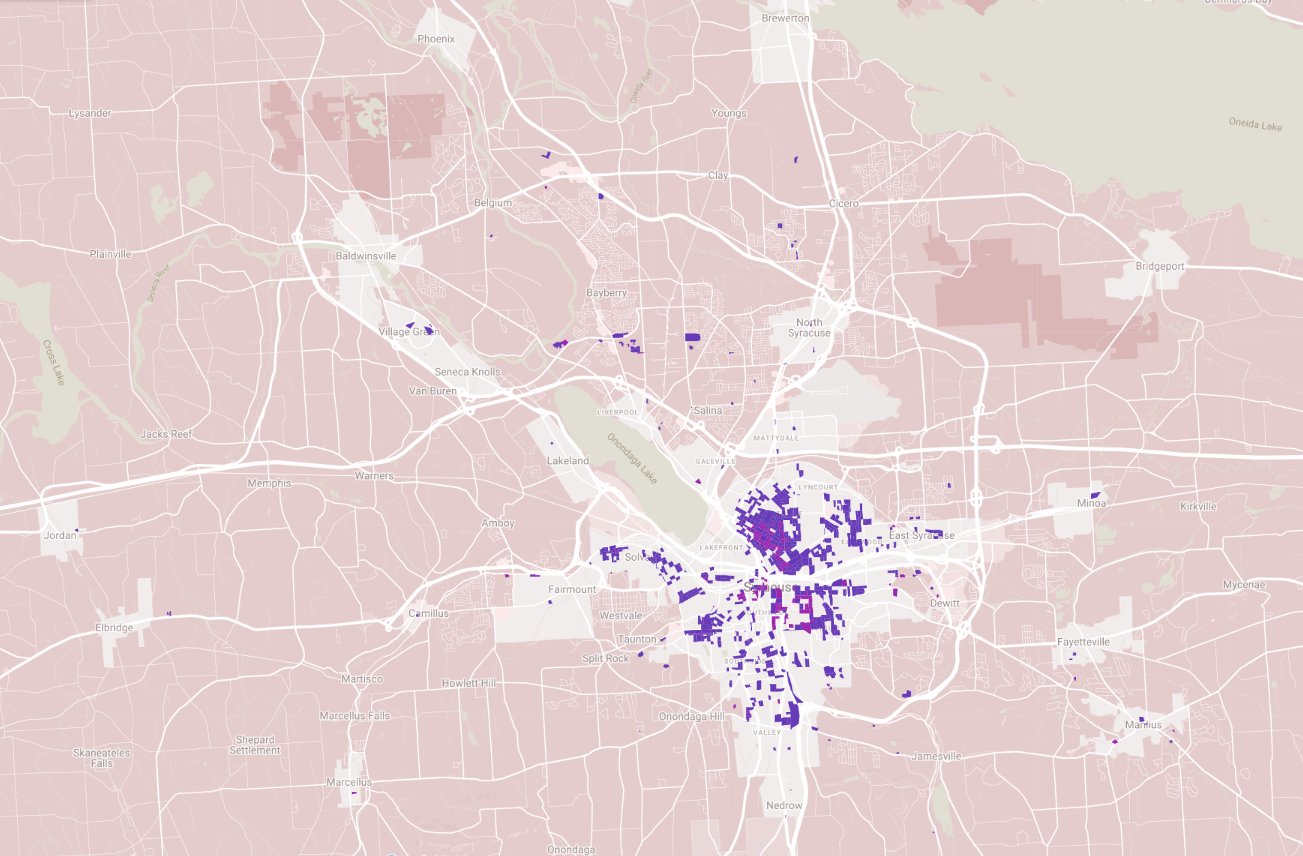
But public transit needs population density to really work. There are a lot of different factors that influence transit ridership—the street grid, household income, building form, land use—but population density is one of the biggest. As a rough estimate, the land within walking distance of a transit stop needs at least 10,000 people per square mile in order to generate enough ridership to justify useful high frequency transit service.

Here are all of the blocks in Onondaga County with that level of population density. The overwhelming majority are in the City, and just a few are in the northern suburbs. Right now, there just aren’t enough people living near enough to any bus stop to justify high frequency bus service up there.

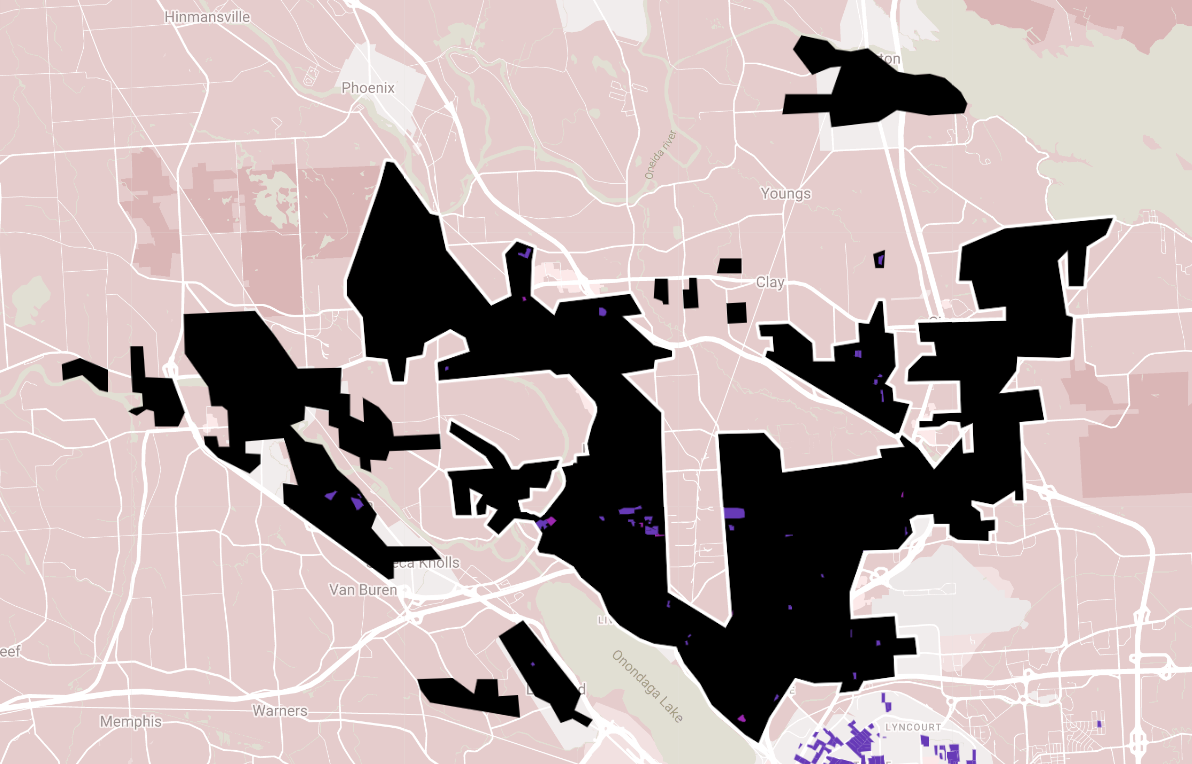
This isn’t a problem that goes away just by increasing the County’s population. The northern suburbs are already pretty heavily populated—way more people live in Clay than in high-bus ridership city neighborhoods like the Northside—but that population lives in sprawling suburban development that can’t support decent public transit. The map below shows the rough extent of existing residential development in the northern suburbs in black with transit supportive densities in purple. Thousands of acres have already been developed in a way that simply cannot support decent transit service. Huge yards separate neighbors from each other, apartment bans force small households into huge houses, single-use zoning makes it impossible for people to walk to neighborhood shops. This is car-only, traffic-causing development.

There’s still a lot of space up there to build homes for a lot more people, but the kinds of neighborhoods and the kinds of homes that get built in the next 50 years have to be different from those that have been built in the last 50 years if the northern suburbs are going to avoid the kind of terrible traffic that you see in sprawling cities like Atlanta. The northern suburbs need mixed-use neighborhoods where people can walk to neighborhood businesses and community institutions. They need a diverse mix of housing types like apartments and rowhouses and walkups and single-family homes of different sizes. That’s the only way to make transit work, and it’s the only way to accommodate population growth without creating terrible traffic.

Commuting to City Hall

The administration’s plan for an employee parking shuttle shows that City Hall needs to provide people with better options for getting to work. 

In last week’s common council meeting, the administration described an increasingly untenable situation where there simply aren’t enough parking spaces for every municipal employee to be able to store their car right next to City Hall. Prime spaces are distributed according to status rather than need, and employees with disabilities are forced to make a dangerous walk over icy unmaintained sidewalks during the winter. The administration’s solution is to pay $100,000 for a jitney service that will save some employees from that six-block walk between their parking garage and their offices.

This is a failure of management, and it’s no surprise municpal employees want it fixed. Specifically, it’s a failure to recognize the constraints and strengths of City Hall’s Downtown location. It’s impossible to provide the suburban ideal of a convenient parking space for every single employee in a high-value, space-constrained location like Downtown. But it’s also possible to leverage Downtown’s truly multi-modal transportation network to make that suburban ideal irrelevant. Syracuse can’t offer what only the suburbs have, but—to quote the Mayor—the “suburbs don’t have what Downtown Syracuse offers.”

Luckily, City Hall isn’t the only employer to face this exact problem, and others in Syracuse and across America have developed a set of strategies to address it. Here are a few simple solutions that City Hall could easily implement to take advantage of Downtown’s natural strengths and fix its employees’ transportation problems.

Provide parking and a shuttle on cheaper land outside the CIty’s center

Parking at the Washington Street garage is expensive because it’s in a prime location within easy walking distance of much of Downtown. You’re paying for convenience, but if municipal employees don’t actually find it convenient and require a jitney to get from the garage to their offices, then City Hall shouldn’t pay the premium price for that walkability.

Instead, run that jitney to some other site where people can park for cheaper. That’s what the other large Syracuse employers who provide a shuttle service from their employee parking do. St Joe’s uses the Mall’s overflow lots, Upstate uses vacant land next to 690, SU uses a gravel lot next to an abandoned quarry. Parking takes a lot of space, and it’s best to provide it where space is cheap. This new jitney service is a good opportunity to do that.

Fare Free Transit

Nobody who commutes by bus needs a parking space, and the bus can bring people closer to City Hall’s front door than any municipal parking lot.

That’s why it is stupendously common for employers in other cities to buy transit passes for their employees. It saves employers money on parking and it’s a great perk that allows employees to move around the city even when they’re not going to and from work.

Centro’s MAX passes retail at $624 annually (cheaper than a Downtown parking space), and City Hall might be able to negotiate that number down for a bulk order. They could work out a deal similar to SU’s where employees flash their ID as they board and City Hall settles the bill with Centro later.

Bike Parking

City Hall provides essentially no bike parking. The one sorry bike rack out front of the building is a schoolyard style that’s difficult to lock to and easy to steal from. Better bike racks or secure bike storage inside the building would give employees peace of mind to ride their own bikes to work.

Of course, it’s possible to bike to work in Syracuse without owning a bike at all. Veo’s bike share is a convenient service that allows people to bike—or scoot—around town without having to worry about maintaining a bike or keeping it safe from thieves. City Hall could easily cover Veo’s modest user fees for employees who want to use the service to commute.

No matter whether employees ride their own bike or a shared bike to work, there are going to be days where they might need to change clothes and take a shower upon arrival. Shower facilities for bike commuters are becoming more and more common in large workplaces, and although they’re often thought of as an employee amenity, in fact they save employers money by lessening the demand for expensive employee parking spaces.

Parking Cash Out

All of this will save City Hall money, and it’s only fair that those savings be shared with the employees who help create them. City Hall should get a real handle on how much it spends on parking per employee (if this jitney service gets up and running, it’s about $2000 annually at the Washington Street garage), and offer that sum as a bonus to people who voluntarily give up any claim to a municipal parking spot.

Not only is this fair, it also gives individuals the most flexibility to choose how to get to work. The bus doesn’t run by your house and it’s too far to bike? No problem. You can carpool with a co-worker or get a ride from a friend and still take advantage of the parking cash out and free up space for people who need it more.


All of these different strategies have the same effect: a decrease in the number of cars that need to be stored in immediate proximity to City Hall. That will save a lot of municipal money, it will free Downtown land for better use, and it will also make parking easier and fairer for municipal employees who need to drive to work because people who choose other modes will free up prime spaces right next to City Hall.

Transit to Suburban Jobs

There’s not much doubt that Centro will run a bus line to the new computer chip factory on Route 31 when it opens. What’s not so clear is how good the service will be, or if it will meaningfully improve anybody’s life.

Centro designs its service—particularly suburban service—as a kind of social safety net. It’s designed for people to have to ride because they are too poor to afford a car, and because they have no other option they’ll put up with the bare minimum of service—a handful of buses a day in each direction.

This model is fatally flawed. Nobody has to ride the bus. Everybody—even people who don’t own cars—has other mobility options like catching a ride with a friend or family member, taxi services like Blue Star or Uber, and ad hoc jitney services. Centro can’t rely on ridership from everybody who can’t afford a car, because there are many other low-cost options for getting around. It has to outcompete all of them too.

And bare-bones, safety-net service simply can’t outcompete a taxi or a jitney or a ride from a friend when it comes to commuting. This kind of service offers riders one bus—one single chance—to get to work on time. If you miss it because your kid needs extra help one morning, because the bus never came, or because sometimes everybody just runs a few minutes late, you’re at least out of a day’s pay and at most out of a job. That’s simply too big a risk for anybody to take every single day, and so even people who can’t afford a car will spend a lot of money on cab fare to avoid it. The stakes are just too high.

For Centro to run a successful service that people will actually use, they have to eliminate, or at least mitigate, that risk by running more buses. Frequent service—a bus every 10 to 15 minutes—gives people multiple options to make it to work so every single morning isn’t weighed down by the possibility of economic ruin. You try to catch the bus that gets you to the job with 15 minutes to spare, but if you miss that one then the next bus still gets you to work 5 minutes before you clock in. You can keep your job even if your morning doesn’t go exactly to plan.

Frequent, practical, competitive transit service costs money. Centro has to pay their operators, they have to pay for gas, they have to maintain a bigger fleet of buses. Uplift Syracuse estimated that upgrading Centro’s 8 best-performing lines to truly frequent service would cost about $8 million per year, and that was before Covid made it so much harder to hire new bus operators.

And since Centro doesn’t have nearly enough money, they rightly direct their funding to frequent service where it will do the most good: corridors where lots of people live, work, shop, worship, etc. That means James Street, Salina Street, Genesee Street, Butternut Street, Erie Boulevard, South Avenue. Centro’s best-performing lines are in the City where traditional development patterns are well suited to frequent transit service. There are currently no corridors outside the City that come anywhere near Syracuse’s levels of population and job density, and that’s why there is no decent bus service to the suburbs that anybody can rely on to get to work.

It might be possible to change that. Onondaga County just posted its first decade of meaningful population growth since 1970, and all indications are that our community will continue to grow. Those new people need somewhere to live, and there’s plenty of room for them in the urbanized area at the center of the County. More housing and mixed-use development along major suburban corridors like Old Liverpool Road, Milton Avenue, and Route 5 would create the conditions to necessary to support frequent transit service—lots of people and lots of places for them to go—and that same frequent transit service could be a reliable option for people trying to get to suburban jobs.

So here’s what it will take for Centro to run truly useful transit service to suburban employers like Amazon or Micron: lots more money, lots more housing, and much better planning. The entire County needs better bus service. Everybody needs access to all of the opportunities in this community, and this is how we can make it happen.