City Hall should build new housing on the Near Eastside, and a lot of that new housing should be rowhomes. Rowhomes combine the benefits of both single-family and multi-family housing and they are a perfect housing solution for the growing Near Eastside.
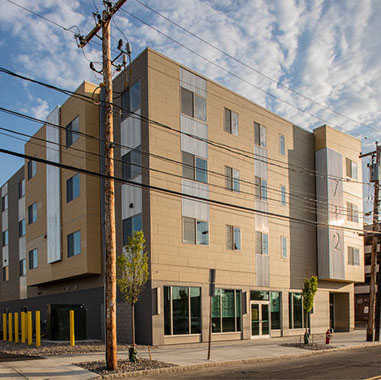
Over the past few years, private for-profit developers operating on the Near Eastside have been building one basic kind of housing: the midrise apartment block. These buildings can fit a lot of homes in a neighborhood, and all those people help support more local businesses and better public services.
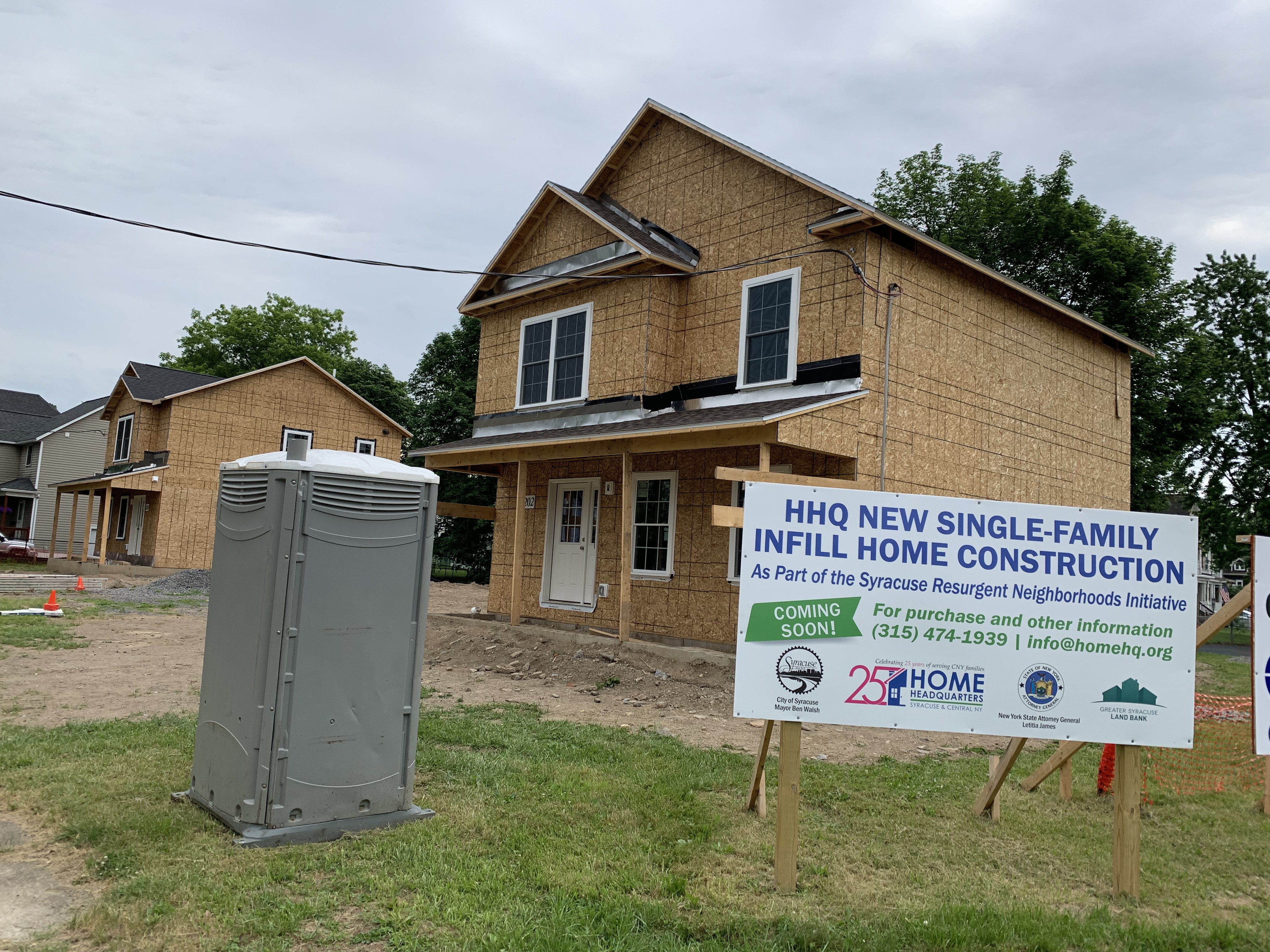
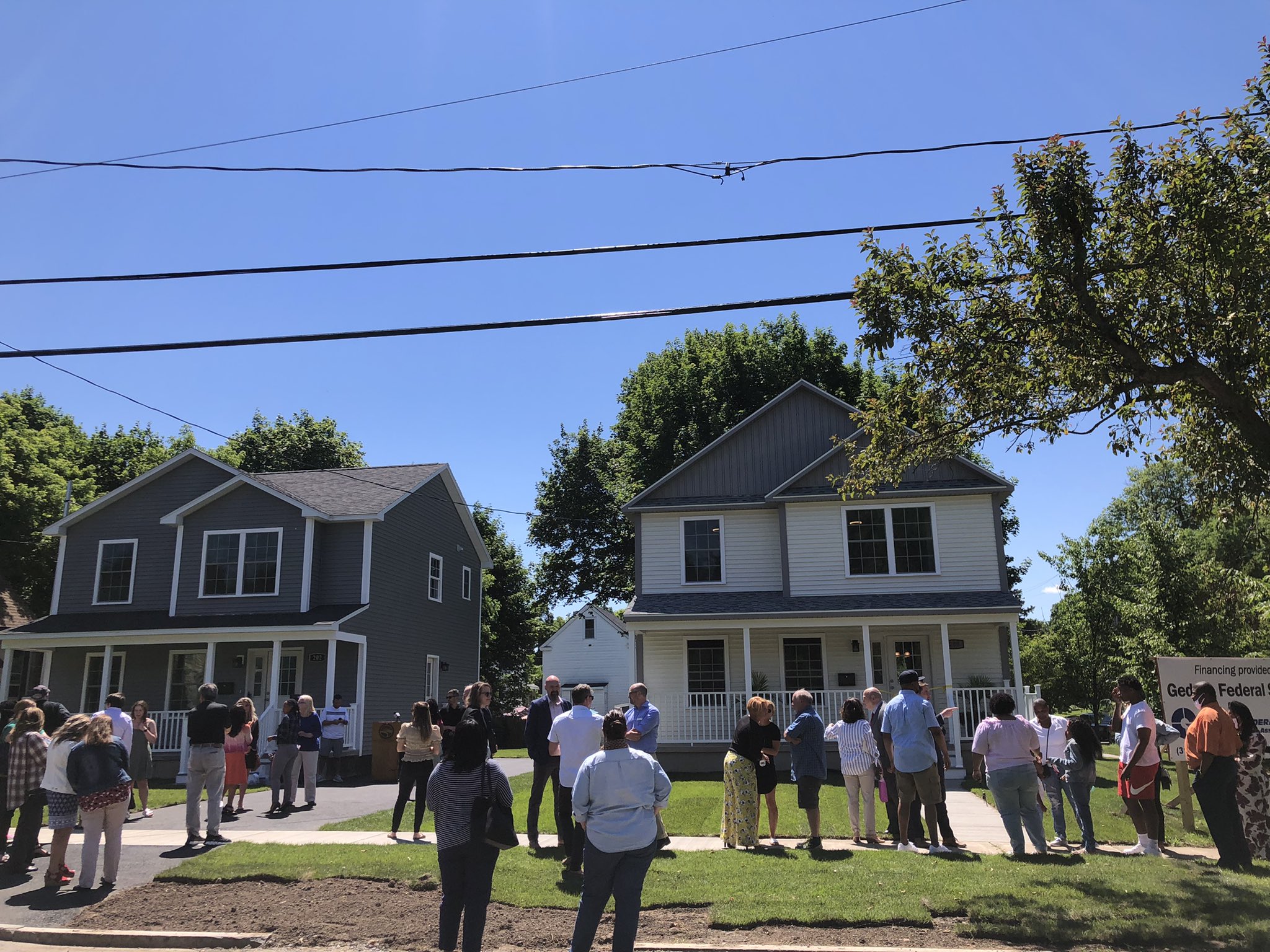
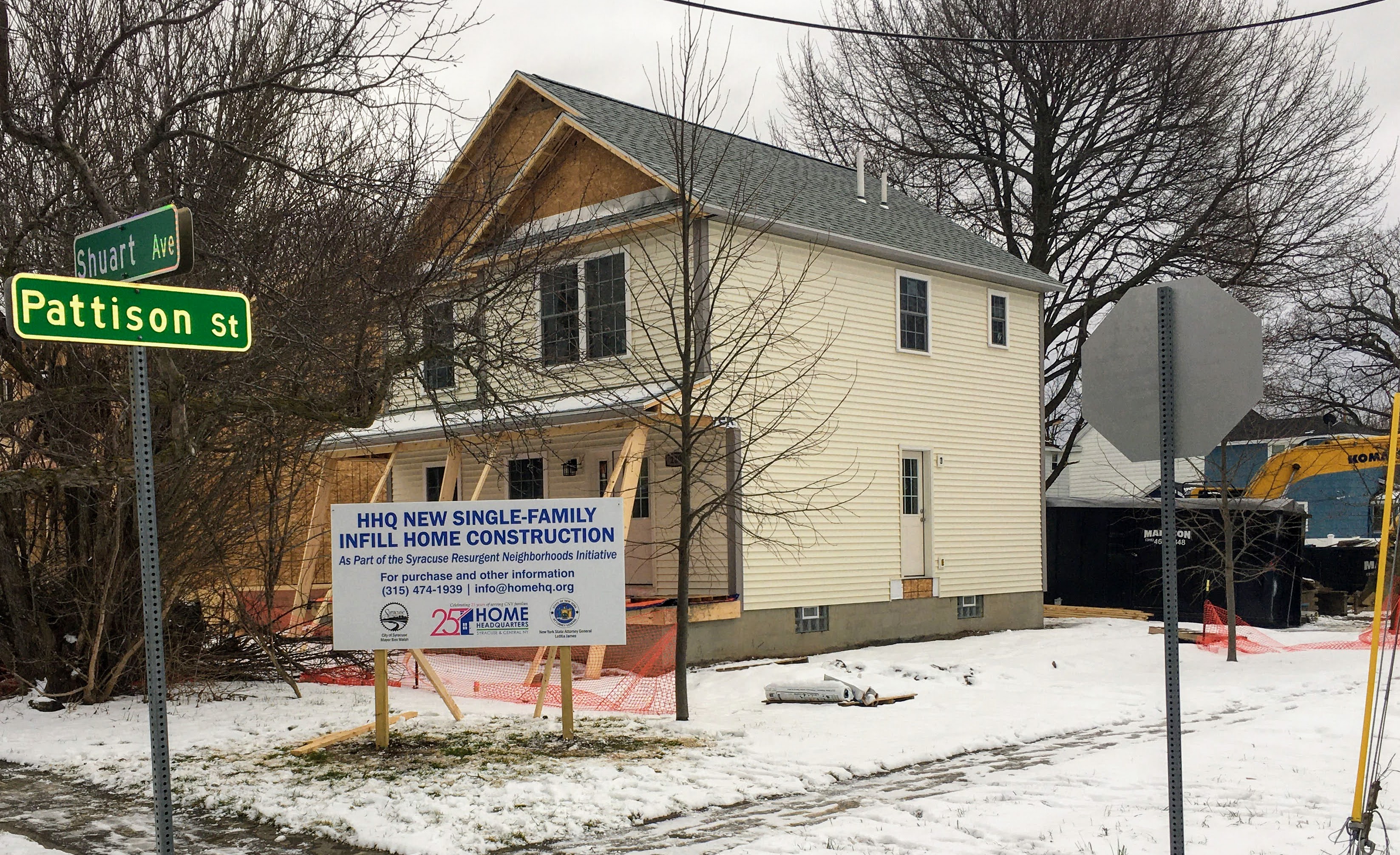
In the past couple of years, City Hall’s Resurgent Neighborhoods Initiative has built a very different kind of housing in other City neighborhoods: single-family houses with large front, side, and backyards. These buildings give people a little bit of private outdoor space, they encourage a sense of ownership of the block, and they provide people with the opportunity to own their own home.
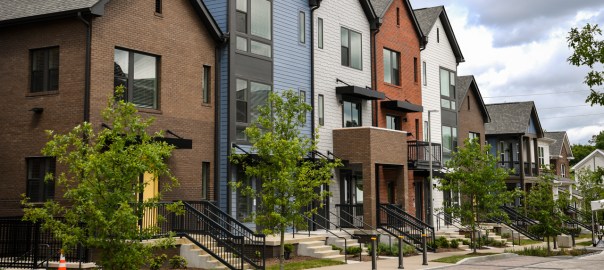
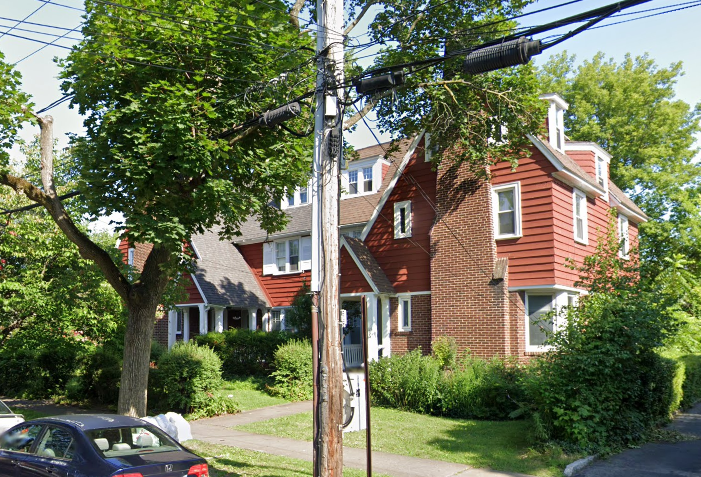
Rowhomes—houses on narrow lots that share sidewalls with neighboring houses—combine all these benefits. Like large apartment buildings, they can house lots of people and support vibrant growing neighborhoods. Like detached single-family homes, they provide small yards and opportunities for home ownership.
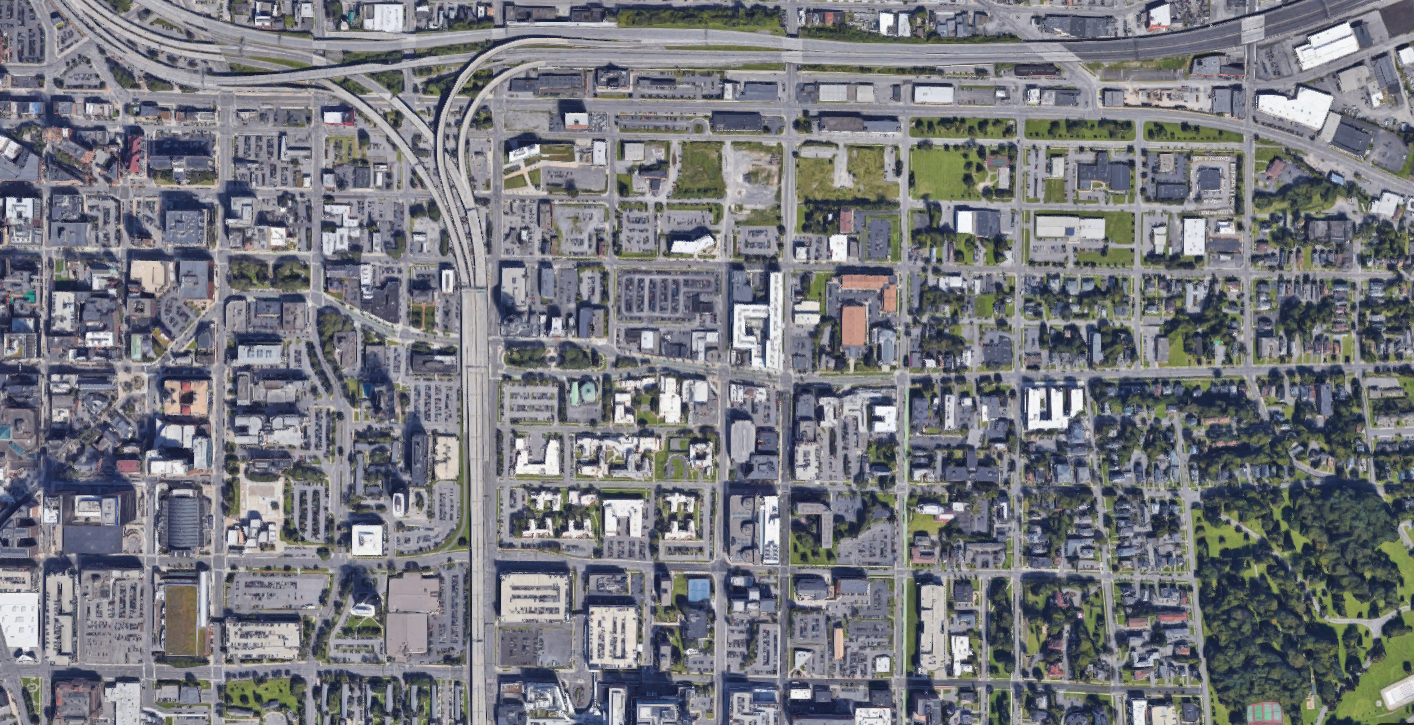
To see how rowhomes would help bring these benefits to the Near Eastside, just look at the block bounded by Water, Washington, Almond, and McBride Streets. It’s currently almost completely covered by a tangle of two elevated highways, but the I81 project will remove that interchange and transfer the land back to the community. That block could easily fit 80 rowhomes, so there would be room for 80 families to own a home on a single block of this high-opportunity neighborhood.
Of course, it’s not currently legal to build rowhomes in Syracuse. The City’s antiquated zoning code prohibits them, and ReZone would still maintain that ban by requiring what it calls “attached single-family” houses to sit on overly large lots that rob rowhomes of some of their chief benefits. Before City Hall adopts the new zoning ordinance, it should amend ReZone to allow rowhomes to be built on lots as narrow as 15’ wide and as small as 750 square feet. These standards would simply allow City Hall to build rowhomes similar to those that already exist in other Syracuse neighborhoods.
Rowhomes hit a housing sweet spot: they make room for lots of people to live in a neighborhood, and they also provide families with private yards and the opportunity to own a home. Syracuse could use more rowhomes, and City Hall should build them on the Near Eastside.
The Near Eastside needs more new housing, and it needs that new housing to be affordable for families with a range of incomes. Recent private for-profit development is providing housing for households at the top of that range, but it will take public and not-profit development to meet the needs of the rest of the community. City Hall should actively guide new housing construction in order to serve the public’s interest by making the neighborhood’s restoration equitable and sustainable.
In the private for-profit housing market, rents in new buildings are higher than those in older buildings. New buildings have to cover costs—to buy land and materials, to pay construction workers—that older buildings paid off a long time ago, and private for-profit developers cover those costs with relatively high rents. New construction on the Near Eastside is being driven almost entirely by private for-profit developers, and so it is much more expensive than older housing across the City.
In a different world where City Hall hadn’t destroyed almost all of the neighborhood’s preexisting housing, this would be less of a problem. New, private, for-profit buildings would still be expensive, but they would be surrounded by thousands of older homes whose mortgages were already paid off and whose owners could compete for tenants by lowering rents. In such a neighborhood, the construction of new housing—with newer appliances, better HVAC, and more amenities—could even help to reduce rents in older buildings by luring the richest tenants away.
But we don’t live in that world—City Hall did destroy almost all preexisting housing between Montgomery and Beech Streets—so there aren’t many cheap homes just east of Downtown, and no amount of private, for-profit, new construction will change that in your lifetime or mine. This is a problem City Hall will have to fix by directing the construction of not-for-profit housing on behalf of the public.
When the public builds housing, it doesn’t need to cover upfront costs solely with income from rents and sales. Instead, it can draw on the municipal budget to meet those costs with the understanding that—once you account for the full range of public benefits that flow from restoring a neighborhood in the City’s center—the public will come out better in the end. Those benefits include increased sales taxes from new businesses, increased property taxes in surrounding neighborhoods, savings on social and emergency services, savings on asphalt maintenance, better outcomes for SCSD students, expanded transportation options, and—most importantly—more people who need homes in Syracuse will have them.
A lot of land on the Near Eastside is already controlled by some public entity—be it City Hall, Syracuse City Schools, SUNY Upstate, or NYSDOT. The I81 project should include an agreement between those public entities to build new housing on that land on behalf of the public, NYSDOT should provide funding to build that new housing in the I81 budget, and that new housing should be made available at prices affordable to households making a wide range of incomes. This is the only realistic way to serve the public’s interest by restoring the Near Eastside sustainably and equitably.
Before urban renewal, tight-knit neighborhoods right next to Downtown provided housing and opportunity for tens of thousands of people. Now, most of those neighborhoods are mostly parking lots and home to very few people. In order for the Community Grid to succeed, Syracuse must restore those neighborhoods.
Urban renewal hit the 15th Ward/Near Eastside worse than any other neighborhood. That’s a product of City Hall’s racism (the 15th Ward was home to 8 of every 9 Black people living in Syracuse at midcentury), and it’s important to note that Urban Renewal wasn’t a one-time event. City Hall began mass demolition of Black families’ homes in the 1930’s, and it’s continued into the 21st century with the willful neglect and destruction of Kennedy Square.
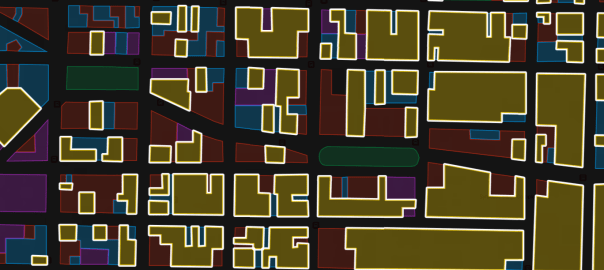
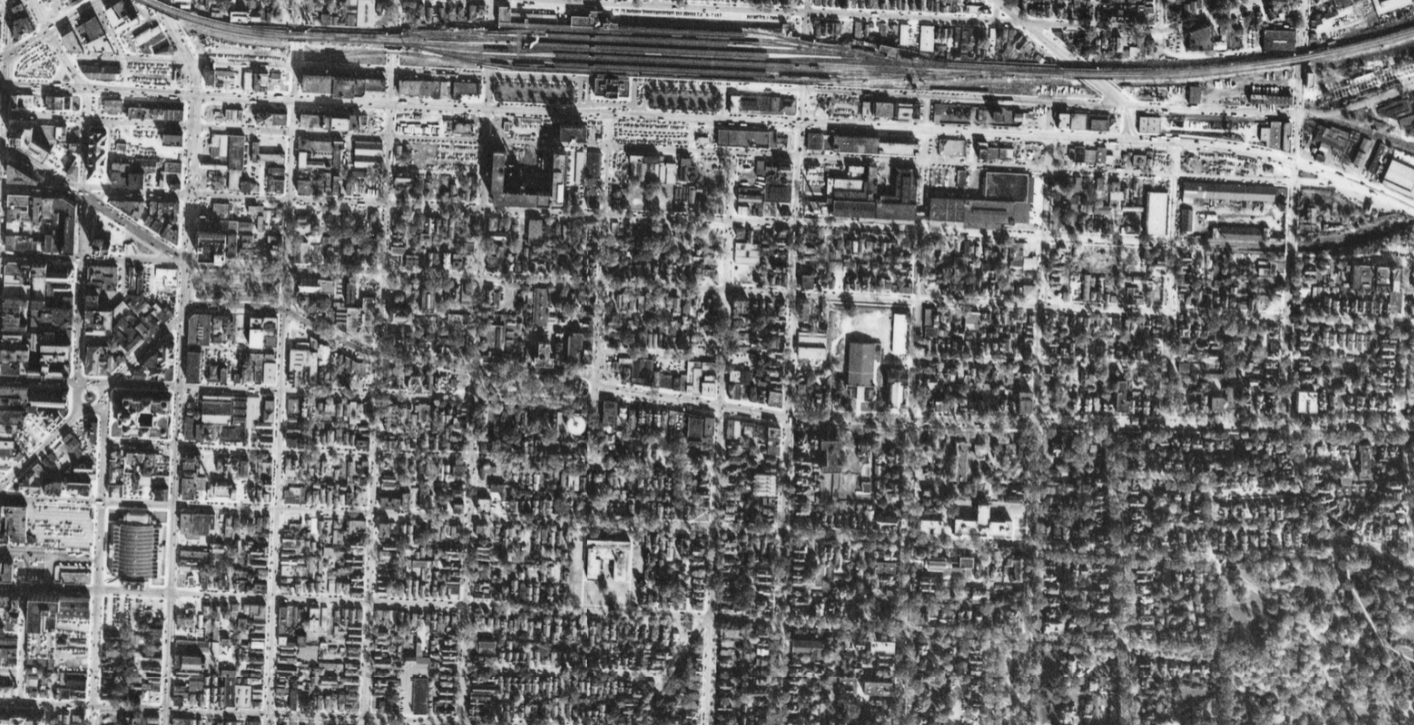
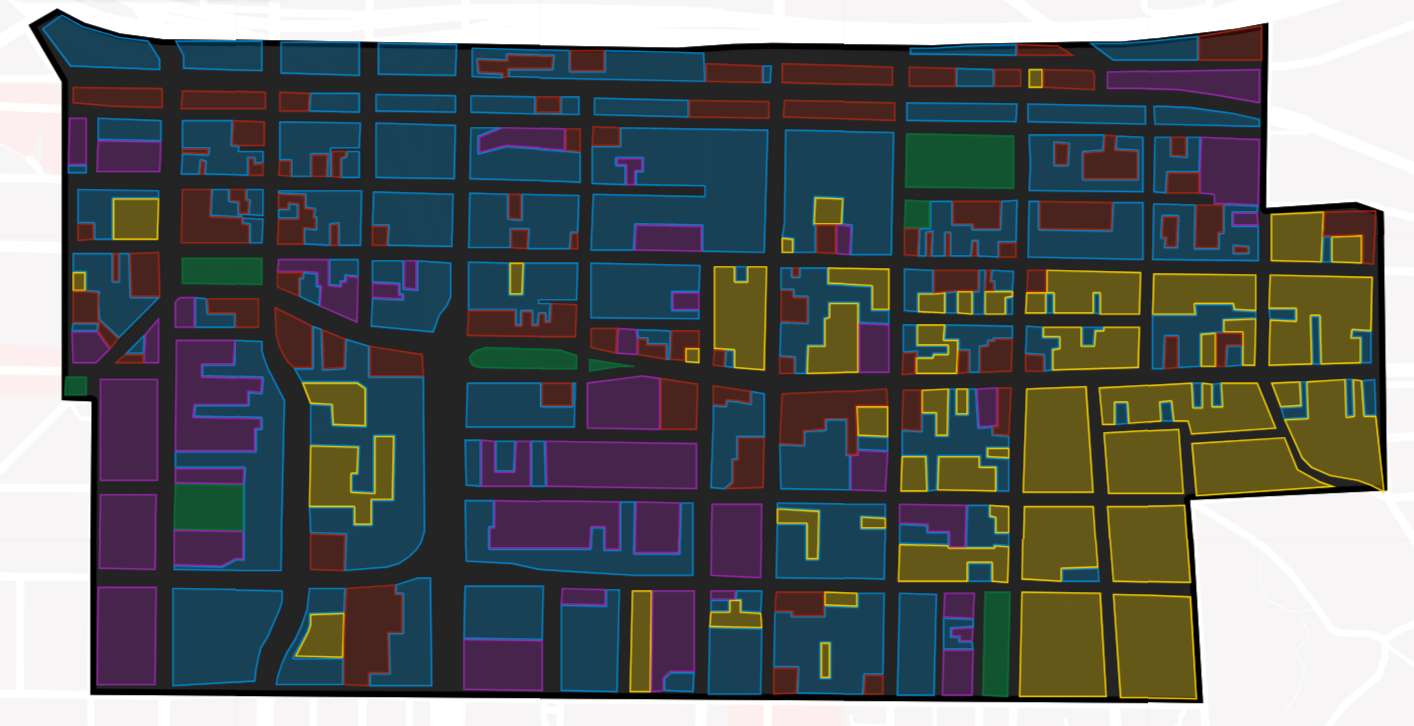
These maps show how land uses changed just east of Downtown between 1953 and 2021. Areas shaded yellow are housing (including mixed-use buildings), red are commercial, purple are institutional (churches, schools, hospitals, etc), blue are parking and vacant land, and green are parkland.
In 1953, the vast majority of this neighborhood was covered in housing, but it was also served by many small businesses, schools, churches, and synagogues. Small streets laid out before the Civil War cut the land up into small blocks, making the neighborhood easier to get around on foot.
By 2021 the neighborhood was dominated by vacant land and parking lots. Entire blocks of housing have been demolished, and many small streets have been either eliminated (Renwick, Washington, Irving, Cedar, McBride, Jefferson, Madison) or widened (Harrison, Adams, Almond, Townsend) in order to make the area easier to drive around at the expense of people on foot.
As a result of all these changes, the population of the Near Eastside fell from 14,646 in 1950 to 5,656 in 2020—a drop of 61%. With that huge loss of people, the neighborhoods has lost most of its character as well. Few children mean there are no more schools, most houses of worship have either closed or followed their congregants to some other neighborhood, and the local businesses that sustained the neighborhood’s permanent residents have been replaced (if at all) by office buildings staffed by commuters.
This neighborhood has transformed from a place where people can make a good life into a space that serves residents of other neighborhoods who come and go in cars.
The Community Grid is Syracuse’s opportunity to unmake these mistakes. We’re removing the highway, and the new street grid can be designed in a way that supports walking, biking, and transit, small businesses, new housing, and repopulation. It’ll take more than transportation planning to right urban renewal’s wrongs, but if Syracuse pursues that goal intentionally, we can restore these neighborhoods and create good places for people to make their lives in the City.
In a recent letter to the editor, James Albanese—a member of the Columbus Monument Corporation—described Syracuse’s Columbus Monument as a ‘privately’ funded statue. Writing of the importance of the monument as a physical object located in a prime public space, Mr. Albanese says:
“being there connects us with our immigrant ancestors, who after a 15-year effort to privately fund and erect this work of art felt that they were finally being integrated into the local community as equals.” [emphasis added]
Mr. Albanese chose these words carefully to corroborate the Columbus Monument Corporation’s argument that City Hall cannot remove the statue because the monument properly belongs to the ‘people of Syracuse.’ In his telling, the monument was paid for with private money, so no public body—like City Hall—can decide to remove it.
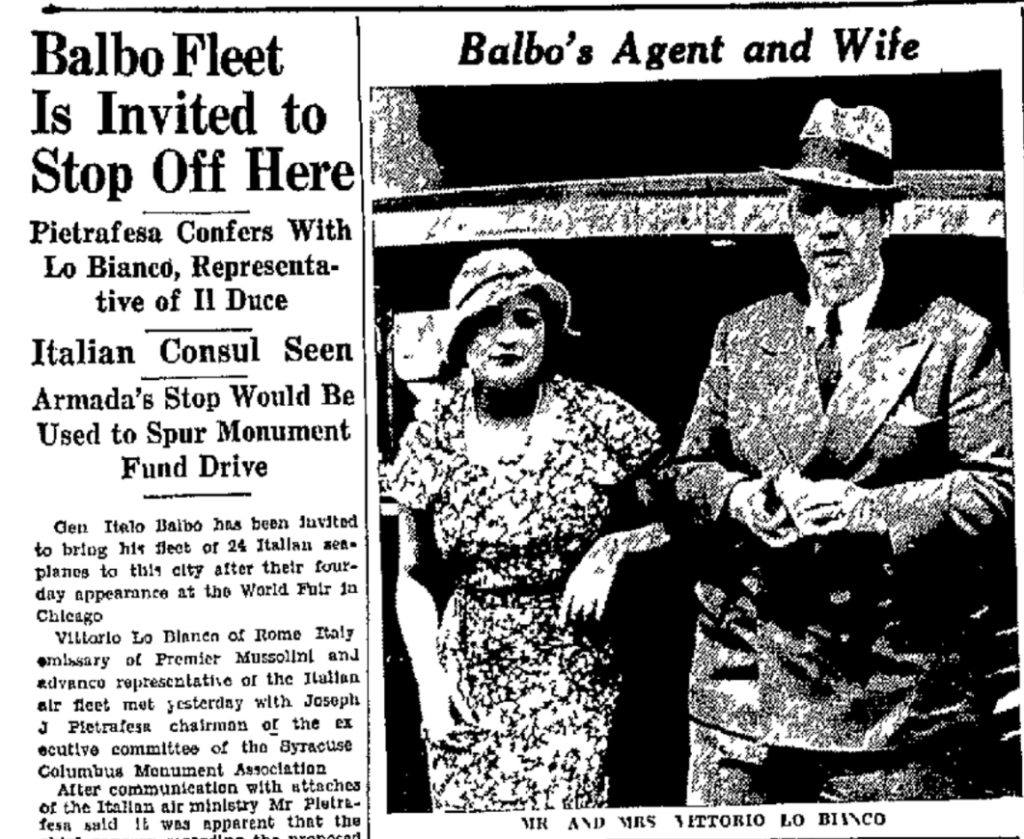
But that’s not true. Although the original Columbus Monument Association attempted to privately fund and erect the monument in the 1920’s and 30’s, that effort came up short. In the end, the purchase, shipment, and construction of Syracuse’s Columbus Monument relied on public money supplied by the City of Syracuse, New York State, and Italy’s national government, and Benito Mussolini even had a hand in designing the monument itself.
The problems started with the Depression when the dollar’s value fell relative to the Italian lira. Despite raising an impressive sum to hire Italian sculptor Renzo Baldi, the worsening exchange rate meant the Columbus Monument Corporation didn’t have enough money to actually ship the monument from Italy to Syracuse.
“The occasion of the proposed visit of the transatlantic squadron here would tie in with a campaign of the monument association to raise additional funds for the Columbus monument”
Once the pieces of the monument were all actually in Syracuse, a private firm—the Mondo Construction Company—was supposed to put them together. However, City Hall took over the job of actually erecting the monument in 1934 in order to “help defray expenses.”
Syracuse’s Columbus monument was not a purely private venture. Local, state, and national governments helped design, fund, and construct the monument, it sits in a public right of way, and it was ritually presented to the City of Syracuse at its dedication in 1934. The public put the monument up, and the public has every right to decide to take it down.
Syracuse should build bus lanes on specific high-traffic streets as part of the I-81 project. Giving buses dedicated space on city streets makes public transit faster,cheaper, and more reliable, and it’s an important step towards building a transportation system that works for everybody.
But bus lanes weren’t included in NYSDOT’s draft plans for I-81, and they weren’t even part of SMTC’s design of Centro’s planned BRT lines. Even though bus lanes (and preferably, separated bus lanes) are considered necessary for any project to call itself BRT, Centro isn’t asking for any dedicated street space for its buses.
There’s some sense to that. Syracuse doesn’t have the same level of traffic congestion that makes dedicated bus lanes so essential and successful in cities like New York and Boston, and it’s better to focus on other infrastructure improvements—like signal priority and level boarding platforms—that will have a greater impact in Syracuse.
But even though dedicated bus lanes shouldn’t be Centro’s top priority, there are at least three good reasons they should still be part of the I-81 project.
Centro buses are often held up by congested car traffic
FIrst, Centro buses do get stuck in traffic. It doesn’t happen on every bus route, and it doesn’t happen all hours of the day, but there are plenty of times that buses moving through the middle of town get stuck behind a bunch of cars, and that sucks.
Centro should make it a priority to build bus lanes in the specific places where excessive car traffic slows buses down.
Adams Street has ample room for bus lanes
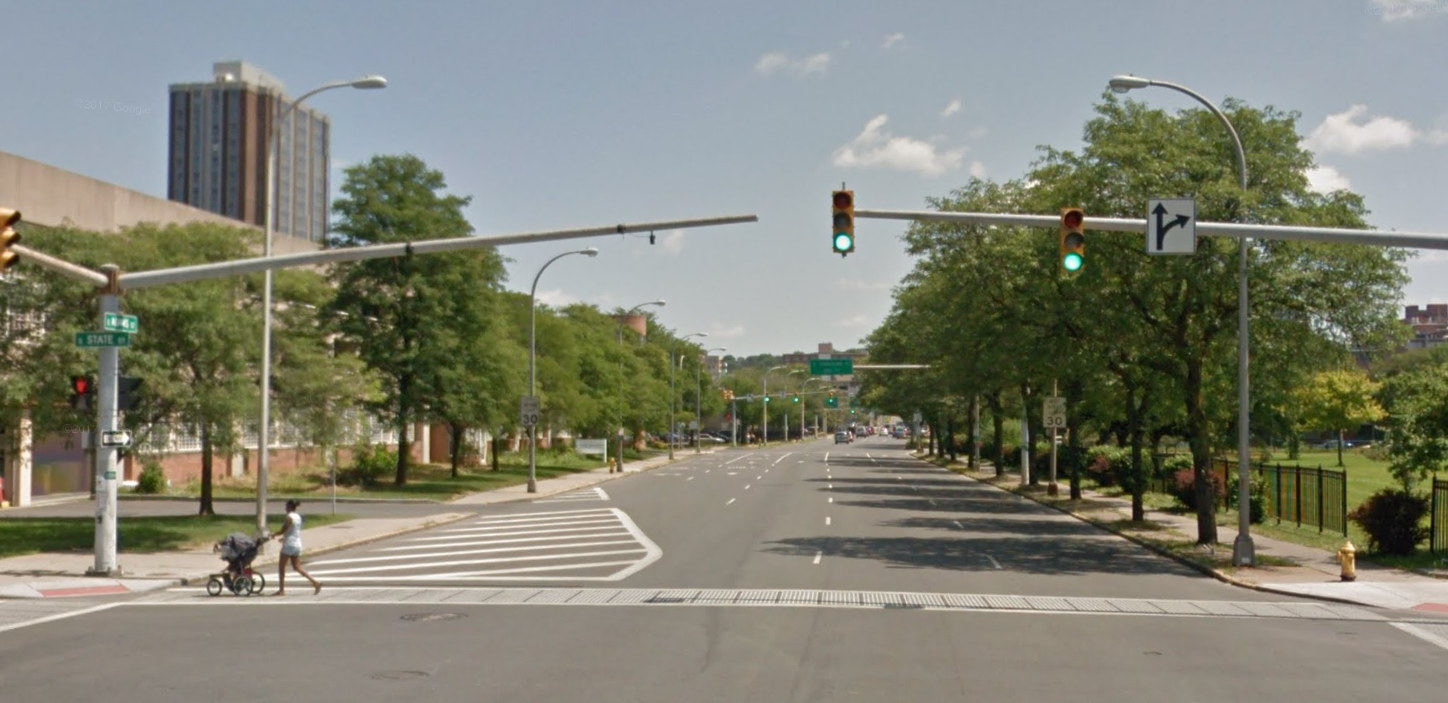
Second, there’s plenty of room for bus lanes already. The places where Centro most needs its own dedicated running lanes just so happen to be overly-wide traffic sewers leading to and from 81’s off and onramps. Parts of James, State, and Adams Streets are 5 lanes and more than 60’ wide. That’s crazy!
These streets have enough room to build dedicated bus lanes without needing to do the costly work of moving a single curb. Just repurpose some of that ample existing street space by painting it bright red with a sign that says “bus only” and call it a day.
These bus lanes would be useful even before BRT is fully implemented, and they should be included in the I81 project.
Third, it’s important to claim that space for public transportation now before doing so becomes politically difficult. Removing the 81 viaduct will temporarily reduce car traffic on these overbuilt streets, but the project will also open up new space for new homes and businesses in the City’s center. When new people move into the center of town, they’ll build their lives around whatever transportation system Syracuse provides. If there’s still mediocre bus service and lots of room for cars, they’ll drive everywhere and create all kinds of new traffic congestion that’ll slow the buses down and make public transportation even less appealing to new residents.
And if Syracuse waits until the buses really are bogged down in terrible traffic, it will be too late to build bus lanes because the drivers bogging down the buses will scream bloody murder at the idea of giving any of ‘their’ space to public transportation. Better to get ahead of that problem now by laying the groundwork for a transportation system that can handle population growth—a transportation system built on high-capacity modes like walking, biking, and public transportation.
This is an opportune moment. Downtown is riven by a few overly wide streets clogged with traffic shunting to and from the highways. When 81 comes down, the excess space on those streets will be immediately—but only temporarily—up for grabs. Syracuse should turn that space into bus lanes as part of the I81 project in order to secure fast reliable public transportation now so that the City’s center can handle population growth in the years ahead.
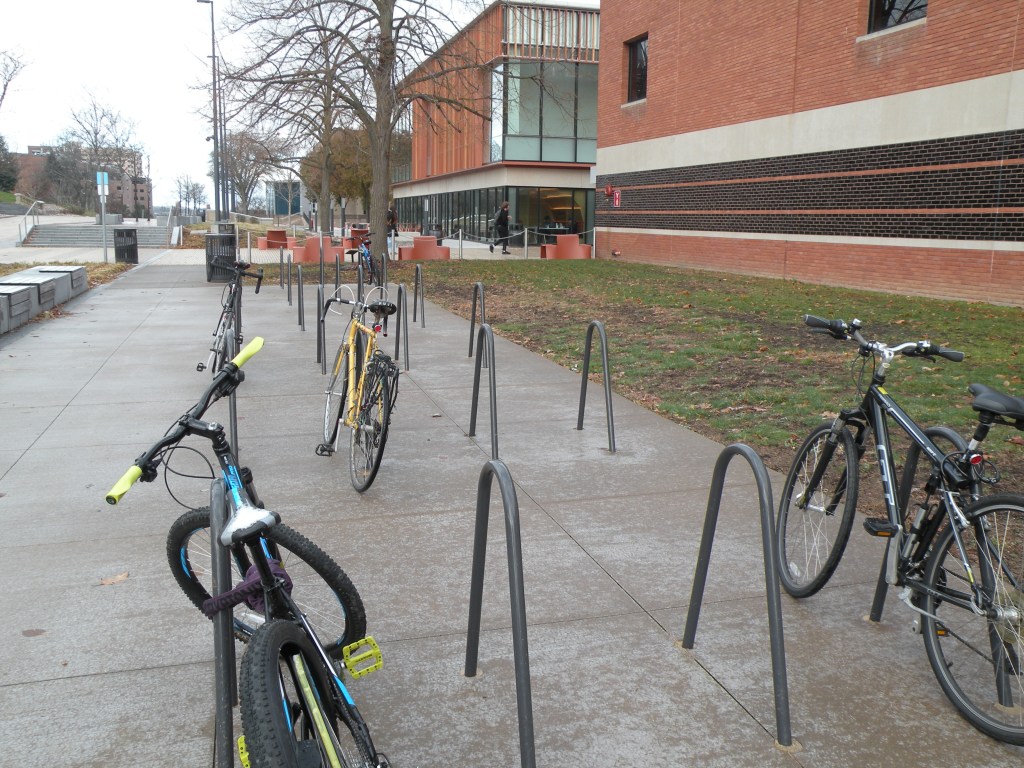
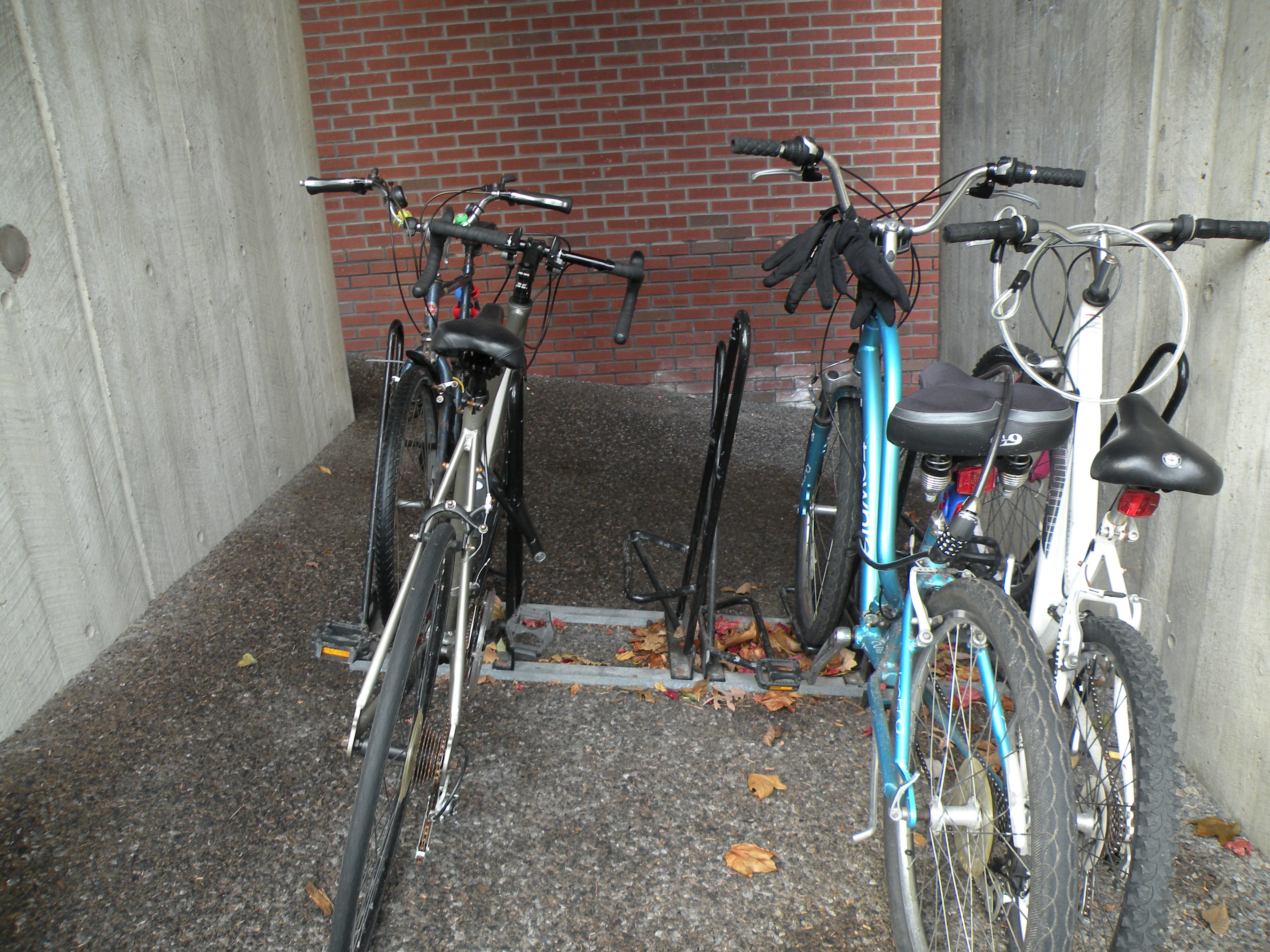
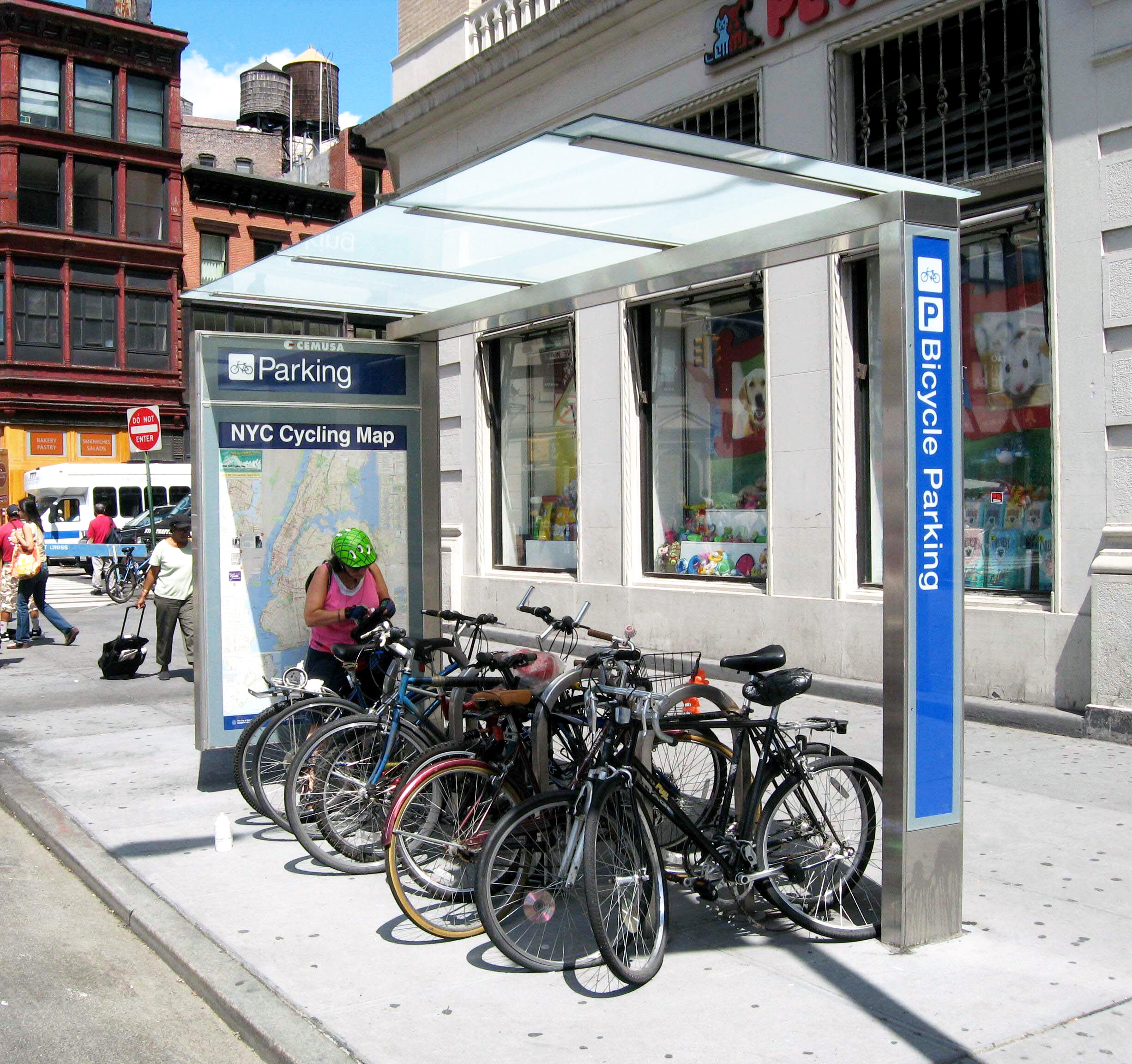
Syracuse needs better bike storage. It’s no good biking somewhere if there’s nowhere to put the bike once you get there. Right now, there’s almost no place in Syracuse with dedicated bike storage for more than one or two people at a time. Bike riders make it work by locking to street signs, fences, benches, etc., but this isn’t a scalable solution. If Syracuse is going to see a meaningful shift to biking, we need better places to store all the bikes.
This concrete pad has enough racks to store 48 bikes. The same space could fit 3 parked cars
University Hill shows how impactful this can be. There’s simply not enough room for every student, professor, and staff member to bring a car onto Syracuse University’s and ESF’s campuses without demolishing half the academic buildings (compare University Hill to Downtown, which did demolish half its buildings to make space for car storage). Bikes (along with quality transit to campus and abundant housing within walking distance of campus) let people get to work or class without needing to bring along a 2-ton steel box that they need to stash somewhere.
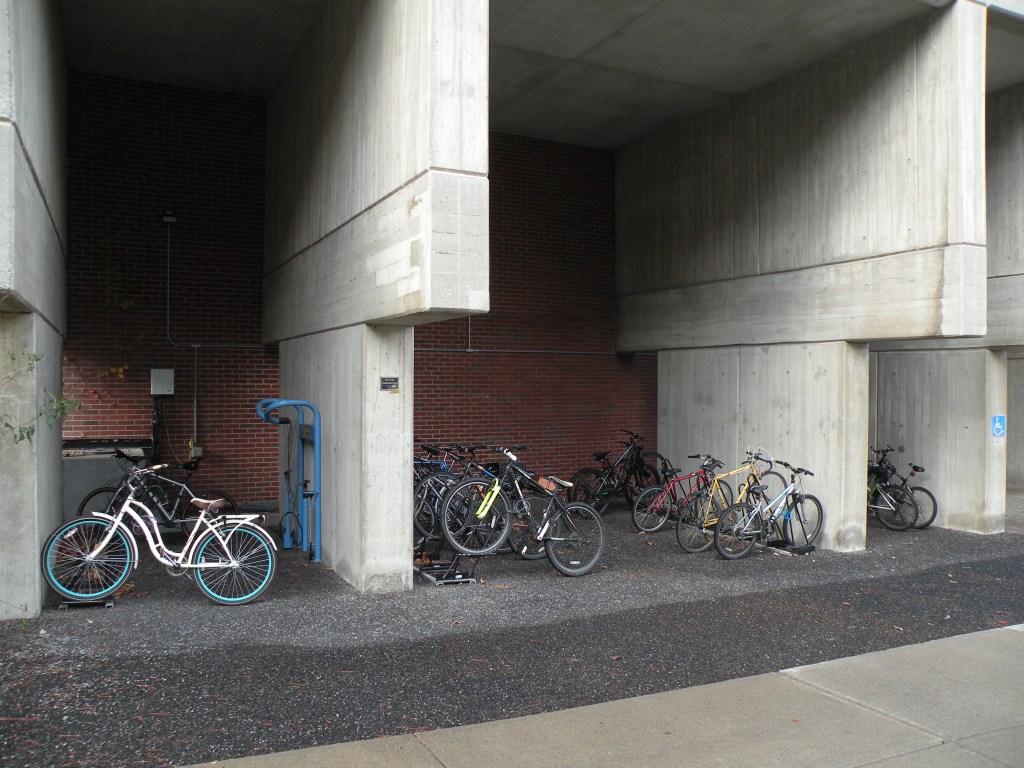
ESF handles bike storage better than SU. To see how, look at the north side of Illick Hall. It’s ‘shark fin’ bike racks are more secure than the traditional racks that SU uses, and they pack more bikes into a smaller space. ESF also placed these racks beneath the building’s overhang to keep bikes out of the elements, and there is a publicly available bike pump and tool set to handle minor repairs.
Here are three lessons from ESF and SU’s bike storage facilities. First, they are abundant. Although many people bike to campus, there’s almost always enough space for another person to lock up their bike.
Second, they are secure. The bike racks on University Hill are sturdy and designed to be locked to a bike’s frame (rather than just the wheel, like the sorry schoolyard-style bike rack outside of City Hall). ESF’s ‘shark fin’ racks are particularly well-designed in that they make it easy to use a single lock to secure both the frame and the front wheel while fitting more bikes into less space.
Third, they are out of the way. These bike racks have their own dedicated space where they don’t get in the way of pedestrians. That’s a much better situation than you find Downtown, where a bike locked to a street sign can easily fall over and block the sidewalk.
this otherwise unusable space is room enough for 7 bikes
City Hall can learn these lessons and implement similar bike storage strategies in other parts of Syracuse where a shift to bike transportation would yield similar benefits.
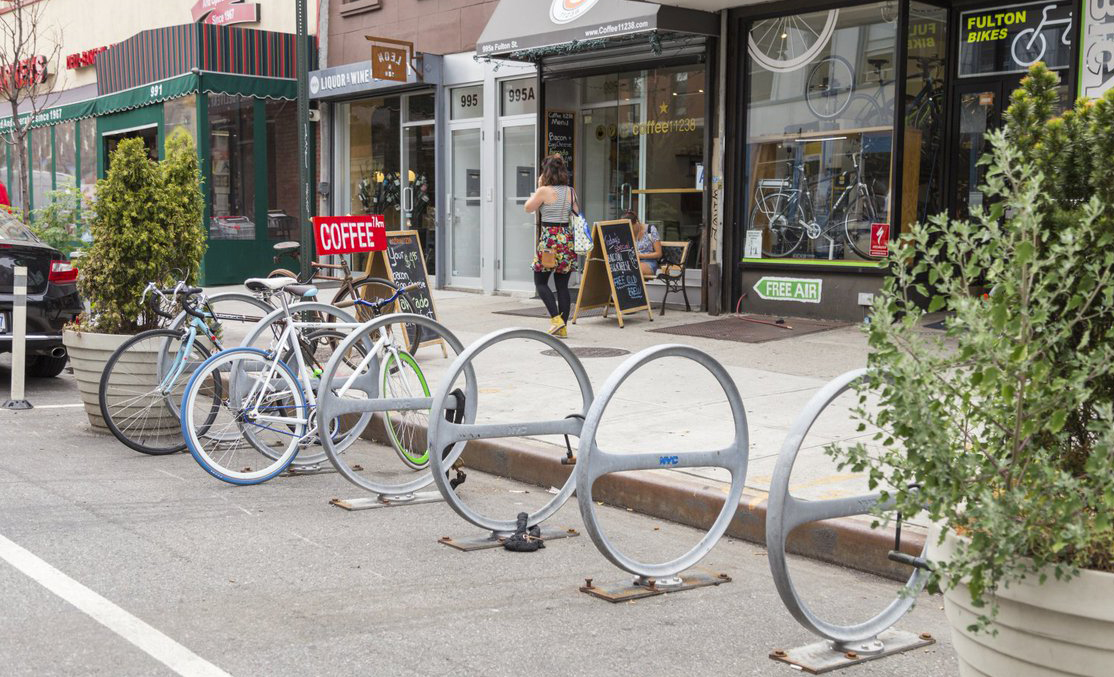
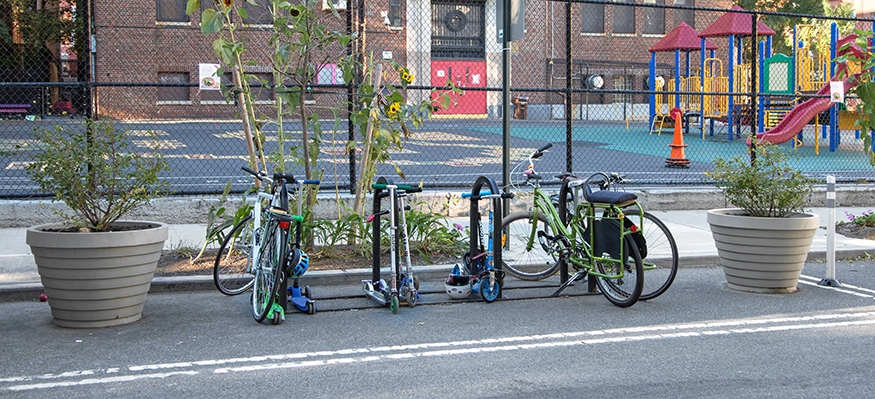
A simple, easily implemented, scalable solution is to build bike corrals below the curb at crosswalks. Bike corrals are just a set of closely-spaced bike racks (enough for 4-8 bikes) protected by bollards or planters. By placing them along the curb at crosswalks, City Hall would improve street safety by reducing the effective length of the crosswalk and by ‘daylighting’ these intersections so that pedestrians and car drivers can see each other. In this way, bike corrals work like curb extensions, but they’re significantly less expensive to construct and they bring the added benefit of quality bike storage.
This simple intervention could make a big impact in places like Downtown and neighborhood centers where lots of people tend to congregate and excessive car storage wastes valuable space that could be put to better use.
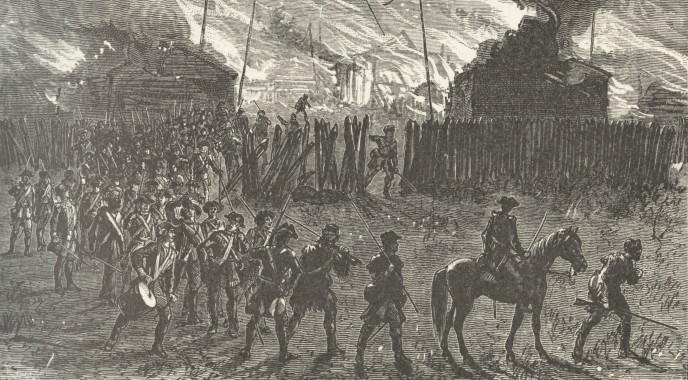
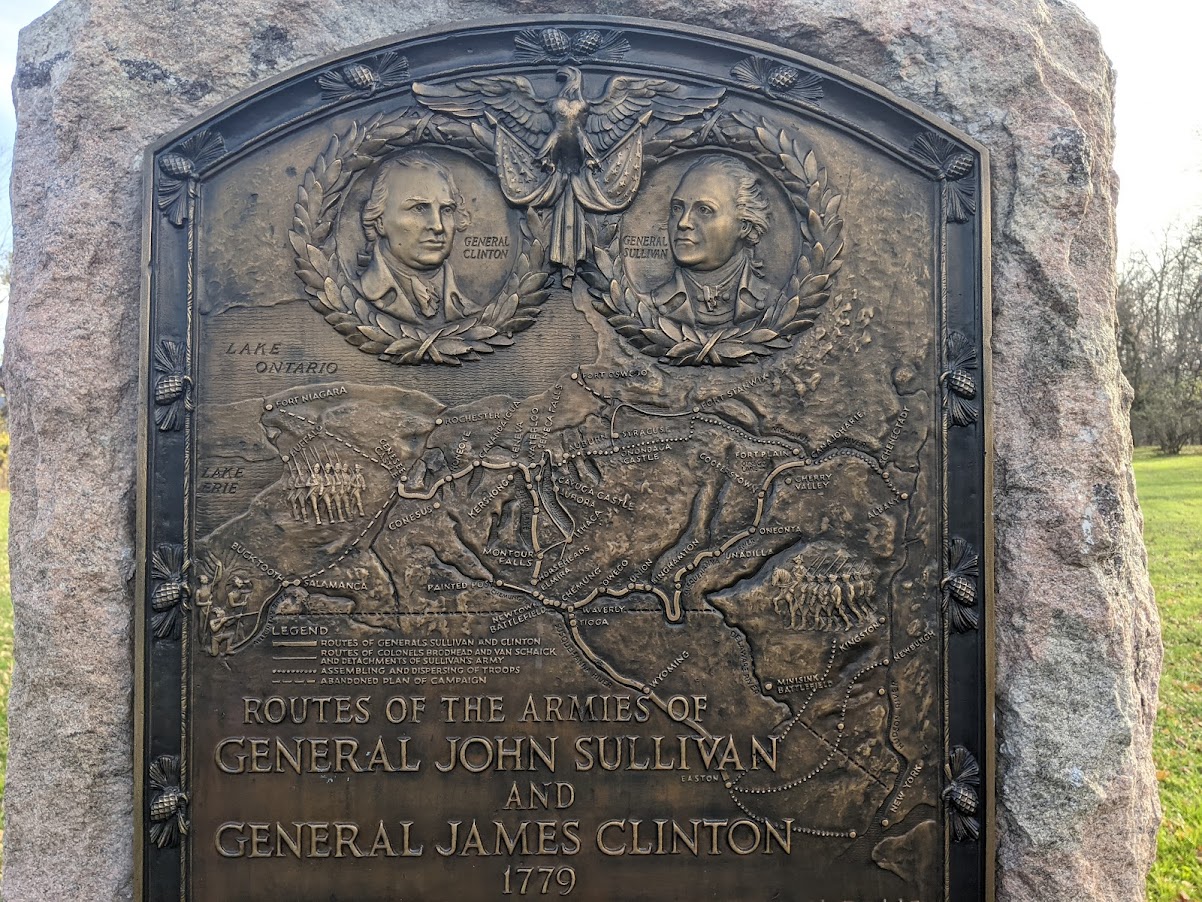
There are monuments in Syracuse City Parks that commemorate an act of genocide carried out by the United States Government against the Onondaga Nation in April of 1779. These monuments memorialize the Van Schaick Expedition—a part of the infamous Sullivan-Clinton campaign—which passed from Fort Stanwix, through the present-day City of Syracuse, on its way to destroy Onondaga settlements to the south. Colonial soldiers killed or captured Onondaga men, women, and children and destroyed their crops and homes.
The Van Schaick Expedition was despicable, it does not deserve our veneration, and City Hall should remove these monuments from its parks.
The Sullivan-Clinton campaign was a series of military expeditions in which professional soldiers from the Continental Army destroyed Haudenosaunee settlements across the state. In George Washington’s words, the purpose of the campaign was to “chastise and intimidate” the Haudenosaunee. In the words of another officer involved with the campaign, the purpose was “to extirpate those hell hounds from off the face of the earth.” Because of its scorched-earth tactics designed to eliminate entire communities, experts consider the Sullivan-Clinton campaign an act of genocide.
Colonel Goose Van Schaick led the campaign’s raid against the Onondaga. Here is a first person account of that raid, written by Lieutenant E. Beatty of the Fourth Pennsylvania Regiment and quoted from Onondaga’s Centennial by Dwight H. Bruce:
“21st, this morning set of about Day Break, on the same line of march and west about 6 Miles when we halted, Capt. Graham with his Compy. Was sent forward as an advance party, then proceeded on to the Onandaga lake, about 8 Miles in length and 4 in Breadth, waded an arm of it, about 4 foot deep, and 200 yards wide, and came to Onandaga creek, small but deep, had to cross it on a log.
Capt. Graham’s Co., Just as he had crossed the creek, caught an Indian who was shooting Pidgeons, and made him prisoner. And we got some Information from him, then proceeded on till we come within about one Mile of the Town, when we Rec’d. word from Capt. Graham that he had caught on Squaw and killed one, and he taken two or three children and one White man, and one or two made their escape and alarmed the town.
The Col. Immediately sent me forward to order him on as quick as possible, and make as many prisoners as he could, and he would support him with the main body. I overtook him at the first town, and delivered my orders, and he Immediately pushed on about two miles to the Next town, where he made a small halt and took a great many prisoners, soon after Major Cochran with Capt. Gray’s Compy. came up and ordered me to stay with the prisoners and their two Compys. to push on to the next town, about one mile forward, which they did, and made more prisoners and killed some, particularly a Negro who was their Dr. they then plundered the middle town where I was.
Capt. Bleekers Compy. had come up by this time, and left the main body at their first town; we then collected all our prisoners, plundered this town and set fire to it, then marched of to the main body, which lay at the first town; we stayed there about 8 hours and killed some five horses and a Number of Hogs, & plundered their houses, and set fire to them, and Marched of about 4 o’clock, in the same line of march as we came, only the front changed. and a Compy. to guard the prisrs. Who was to march between they two colums;
marched on about 2 Miles from the town down the Onand’ga creek, when about 20 Indians who Lay concealed on the opposite side of the Creek fird upon us, but the Rifle Men soon Dispersed them, killing one of them, we then marched on and crossed the Onandaga Creek in two places, for fear the enemy should attack us, but we met with no interruption, crossed the arm of the lake, and encamped by the side of the lake about 8 Miles from the town. We killed about 15, took 34 Prisoners, Burned about 30 or 40 houses, took 2 stand of Coulors, and we had not one man killed or wounded—”
This account of events comes from one of the perpetrators of genocide. Other accounts contain more graphic details of the soldiers’ violence. By the 1800’s, white settlers in Syracuse telling the story of the raid would specify that the soldiers killed “large numbers” of Onondagas in the creek as they tried to swim to safety, and that the soldiers “hung and quartered” the Black man they found living with the Onondaga. According to the Peace Council, Onondaga oral histories tell that the soldiers also raped Onondaga women.
Clark’s Onondaga reports when the white settlers came to this part of the County for the first time in 1789, they took over the remnants of an “extensive Indian orchard” that was still abandoned 10 years after Van Schaick had burned part of it. The settlers learned this history from the Onondaga still living in the area who provided them with shelter when they first arrived.
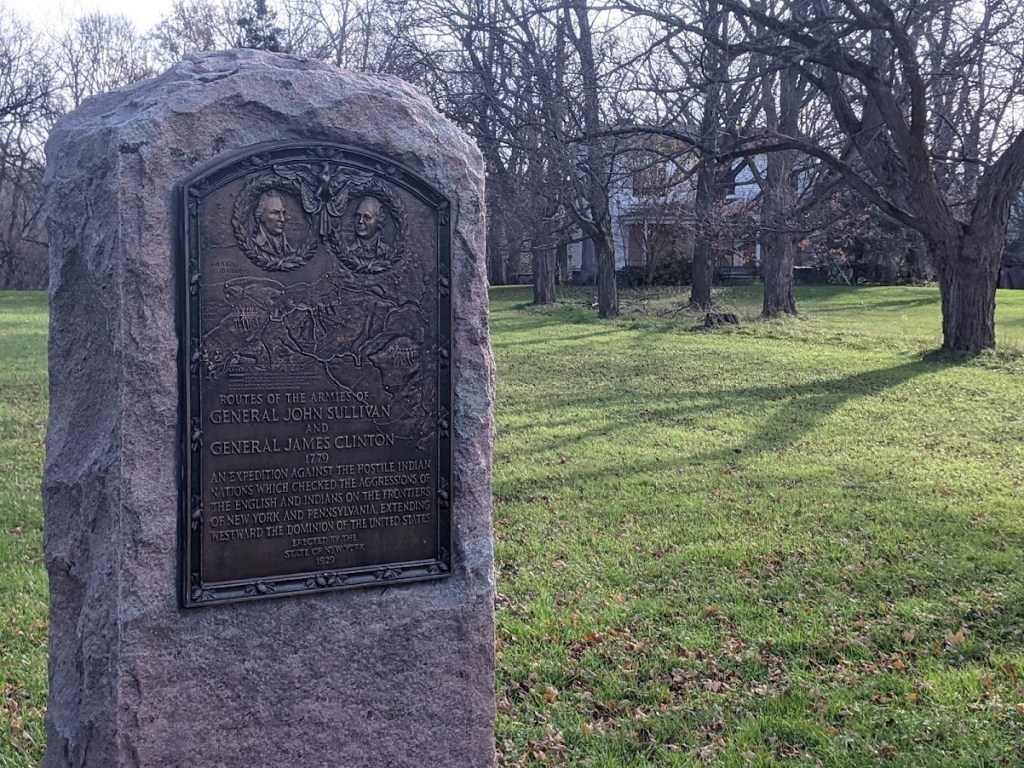
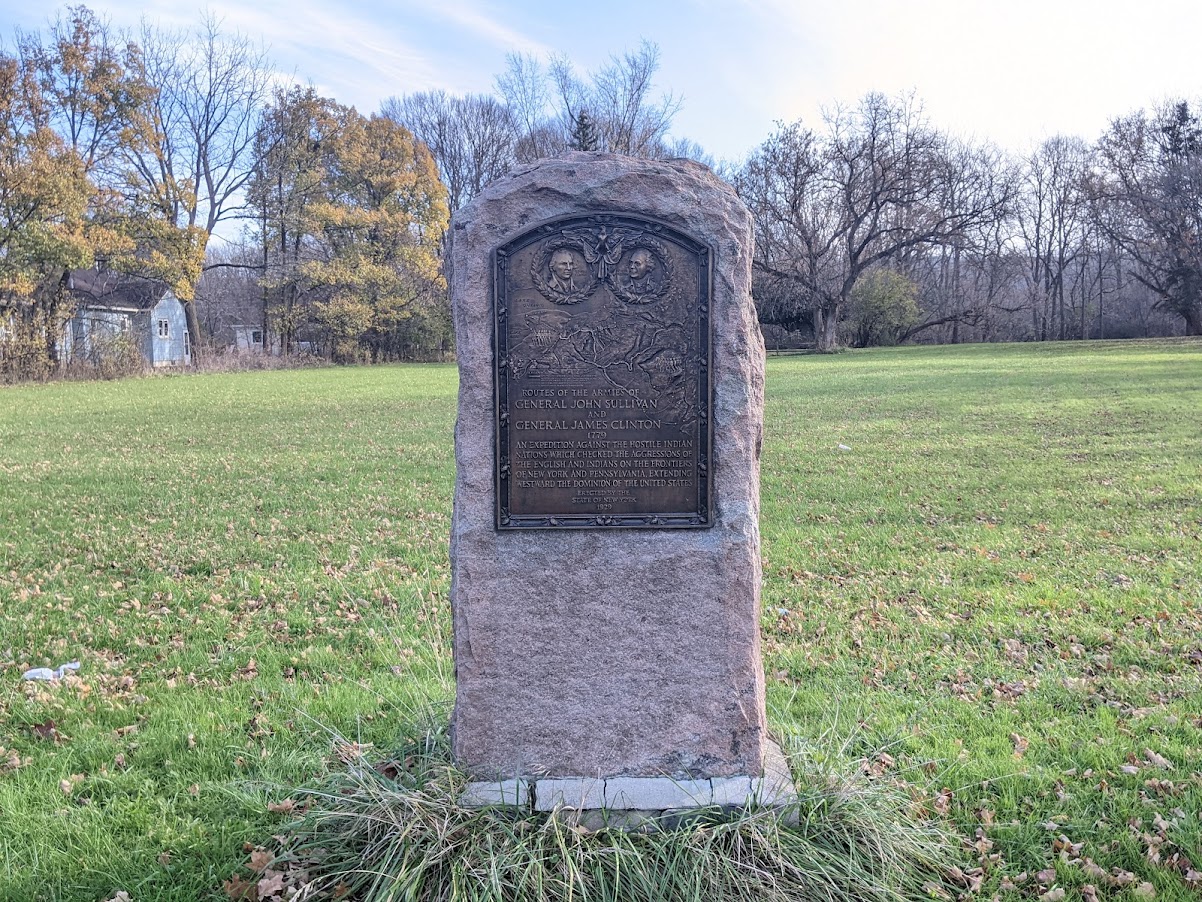
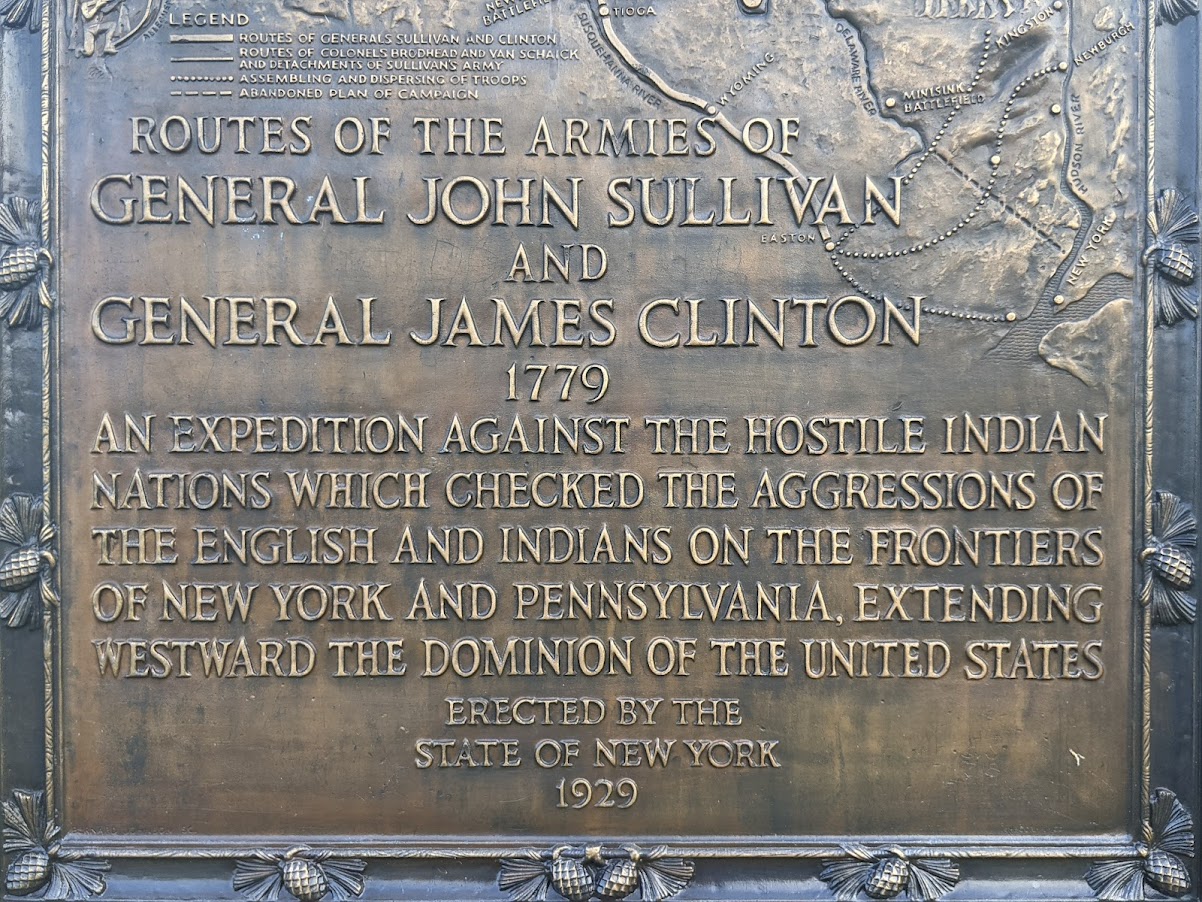
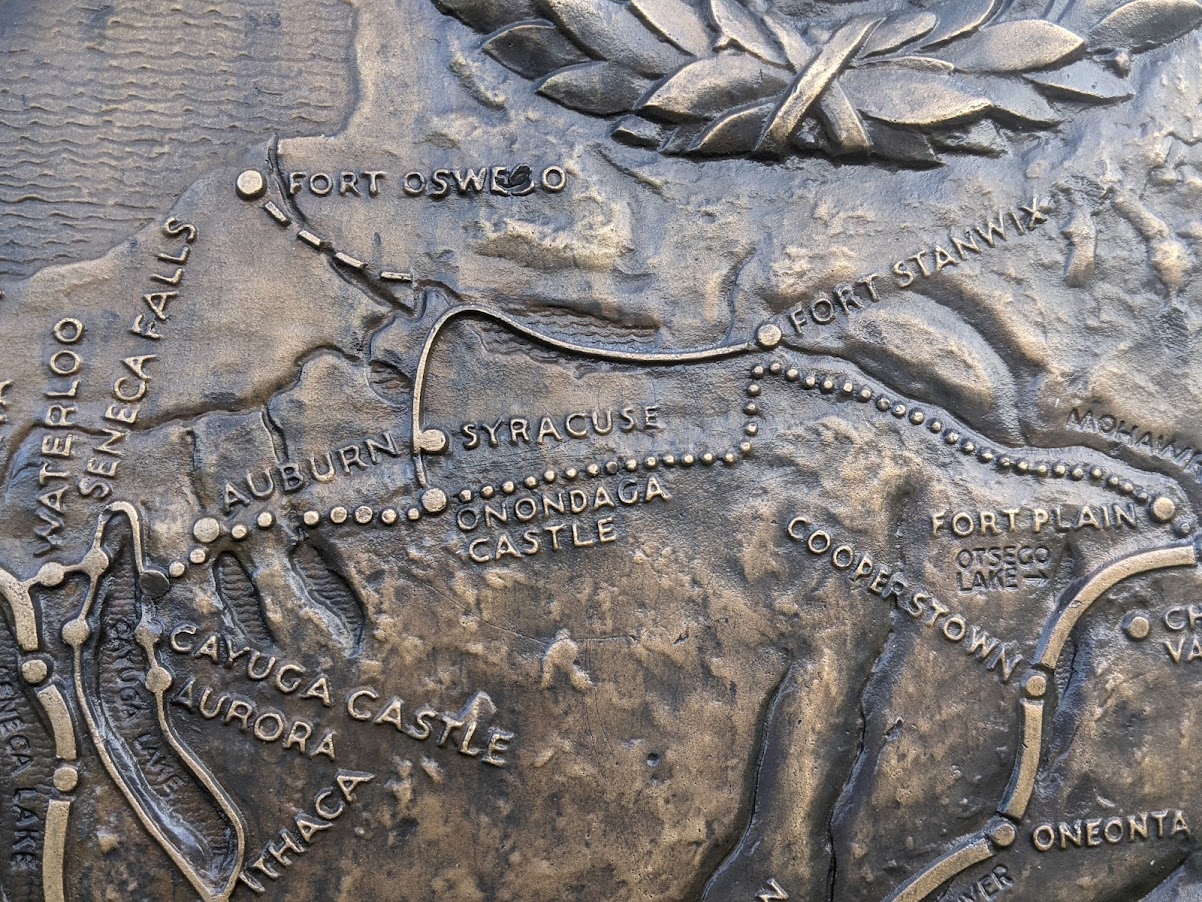
New York State erected Syracuse’s first monument to the Sullivan-Clinton Campaign in 1929. That was the 150th anniversary of the campaign, and identical monuments were placed across the state. The monument depicts the Campaign’s multiple expeditions on a map of New York State. The Van Schaick Expedition is clearly marked and is shown passing through present-day Syracuse to “Onondaga Castle.”
This monument sits on a large privately owned piece of land on Valley Drive across from Onondaga Valley Cemetery.
When New York State built its monument, people in Syracuse understood that this was not an event worth commemorating. There had been some preparations for a celebration of the “Raid” on Sunday April 21, 1929, but the Syracuse Herald reported “lack of interest and delay in attempting to bring about the celebration are given as reasons for its postponement.” The Herald also noted that:
“The celebration has never been encouraged by the Onondaga Historical Association. Officers of that organization contend that the attack on the Onondagans was unjust. The Indians who are now part of the Onondaga community have had traditions handed down to them telling of the barbarity of the American troops. Officers of the historical association urge that there is nothing to celebrate and that the anniversary might better be forgotten.”
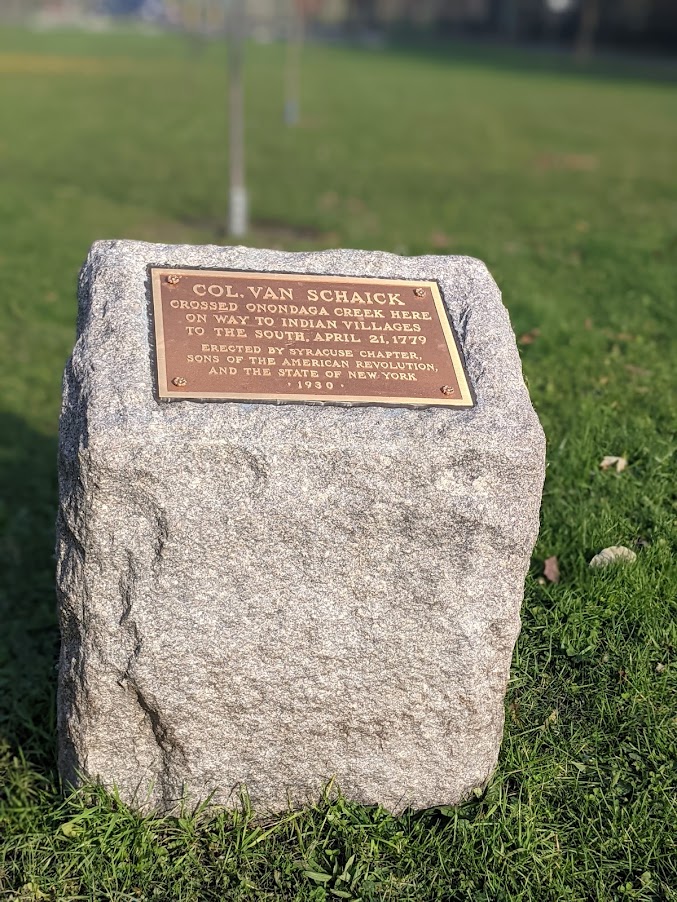
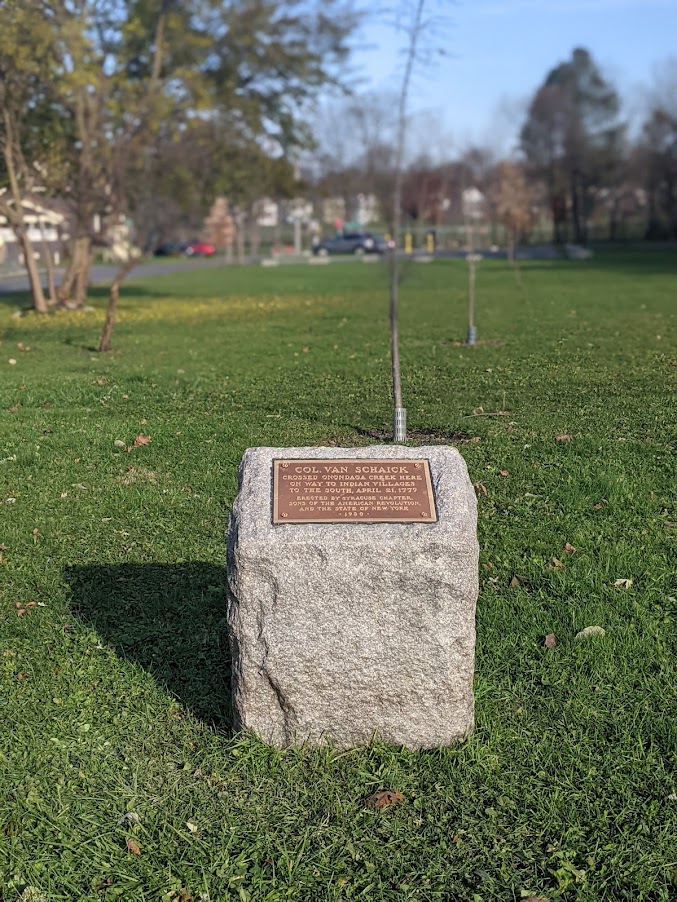
Unfortunately, the Sons and Daughters of the American Revolution did not take this advice, and the very next year they erected two monuments to Van Schaick’s raid on City-owned parkland. One is on West Colvin Street between Onondaga Creek Parkway and Hunt Avenue. It reads:
Col. Van Schaick crossed Onondaga Creek here on way to Indian villages to the south, April 21, 1779
The metal plaque has recently been replaced, so someone (likely unaware of the history) is actually maintaining this monument to genocide.
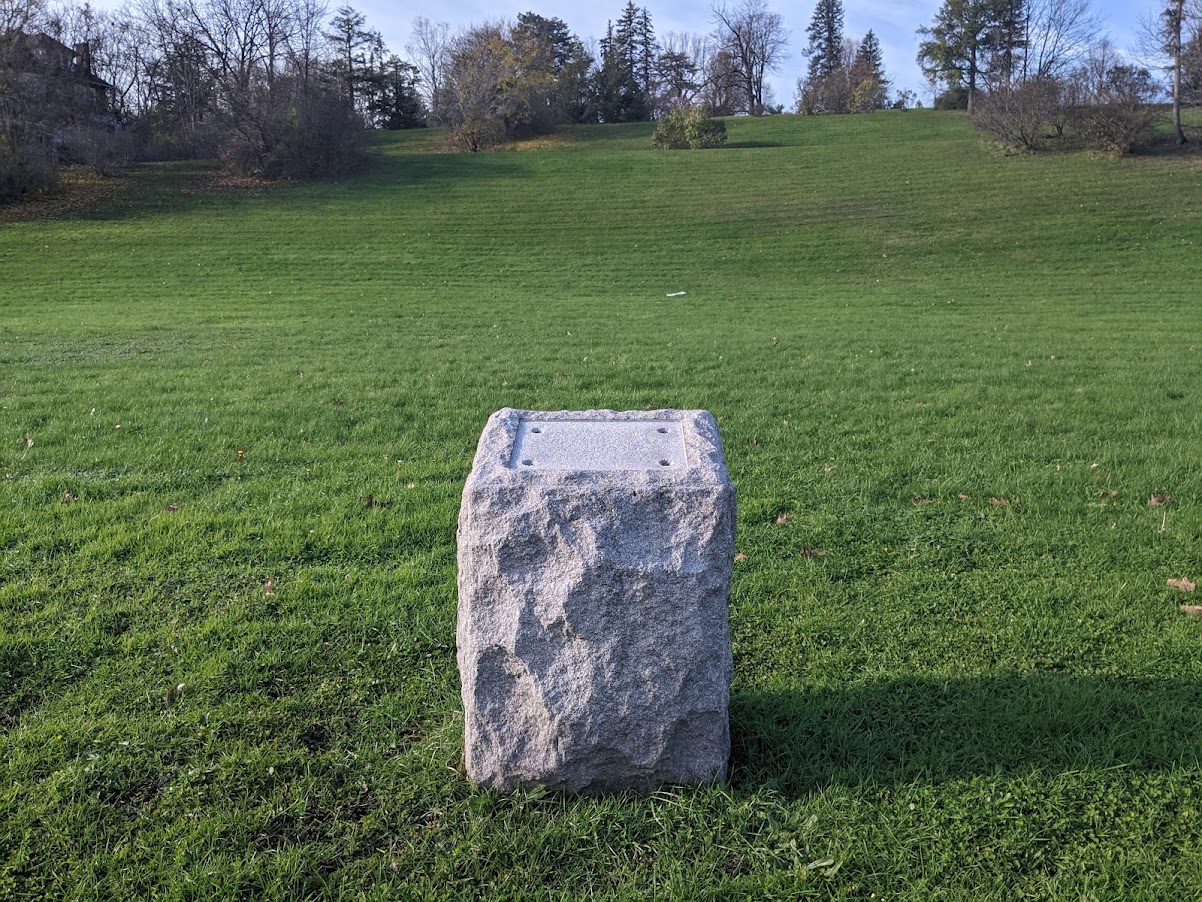
The second monument is nearby in Onondaga Park along the east side of Onondaga Avenue across from the City’s greenhouses. The plaque on this monument used to read:
Site of Indian Attack on Col. Van Schaick’s Expedition against the Onondagas April 21, 1779
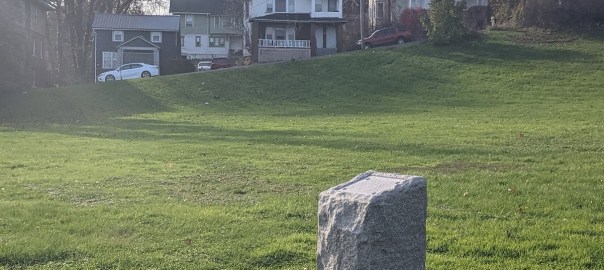
Thankfully, someone stole the plaque many years ago. All that’s left now is a bare stone.
These two monuments tell an incredibly misleading story. The one on Colvin makes no mention at all of Van Schaick’s violent purpose, and the one that used to be on Onondaga makes it seem as if the ‘expedition’ only fought back after they were initially attacked. So in addition to being a grave insult to the Onondaga Nation, these monuments are also bring us out of right relation with our community’s true history.
It is inexplicable that these monuments still stand in City-owned parkland, and they should be removed. This isn’t applying modern sensibilities to past events—the Onondaga Historical Association thought this was a bad idea when the monuments were put up in 1929. It’s remained a bad idea for 92 years, and leaving them up one day longer is also a bad idea. Take these monuments down.
In the early 1800’s, there were several distinct villages within Syracuse’s present city limits. Each had its own small business district, meeting hall, and churches, and many were built around a public square or village green. As Syracuse grew to encompass these small villages, their central public spaces became less important, and while some—such as Washington Square, the old green of the Village of Salina—remained central to their neighborhoods others—like Onondaga Hollow’s village green, Geddes’ St. Mark’s Square, and Lodi’s Lock Square—faded away and are barely recognizable as public spaces anymore.
These historic public spaces still matter for two reasons. First, because many of these early villages still retain their identity as distinct city neighborhoods and the public spaces at their centers should be sources of local pride. Second, these squares are great places to foster commercial activity, build new housing, and promote transit-oriented development in Syracuse’s neighborhoods so that the conditions of Downtown’s recent successes can bring prosperity to more of the City.
Onondaga Hollow
The oldest part of Syracuse is deep in the Valley where Seneca Turnpike crosses Valley Drive. There, the houses of Syracuse’s first settlers sit between newer bungalows and ranches. Onondaga Hollow was settled in 1784—before Onondaga County even existed—and when Seneca Turnpike provided the best route across the state, this little village was one of the most important spots in Central New York.
But when the Erie Canal replaced the turnpikes as New York’s primary intercity highway, Syracuse replaced Onondaga Hollow as the center of Onondaga County.
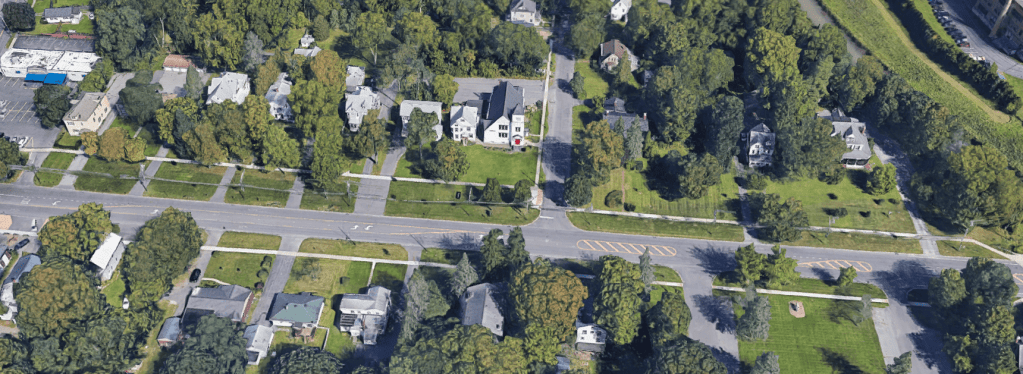
Onondaga Hollow’s village green is a 51’ wide strip of land along the northern side of Seneca Turnpike between Valley Drive and Onondaga Creek. Today, it’s carved up by the driveways of all the houses that line it, but you can trace its outline by following the sidewalk’s irregular path here.
Luckily, the Parks Department still owns and maintains the land. City Hall should restore the Onondaga Hollow village green by opening a new lane along its northern edge between Valley Drive and Onondaga Creek. This would create access to the properties that border the green and eliminate the need for center turning lanes on that part of Seneca Turnpike. City Hall could then remove the driveways from the green itself and extend the green south by narrowing the road to two lanes. That would allow the Parks Department to add amenities like benches, chess tables, and flower beds, and the historic Onondaga Hollow village green would once again be a place for the community.
Geddes
The Village of Geddes—built along the Erie Canal where it crossed under West Genesee Street—was another early site of salt production. This municipality encompassed much of what is now Syracuse’s Westside including Tipperary Hill and the West End.
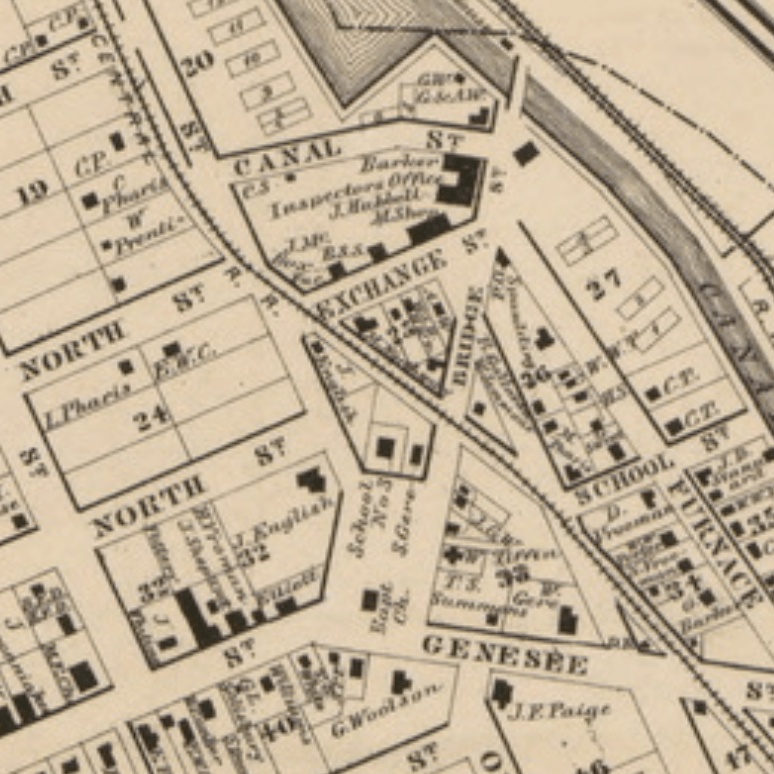
Geddes’ ‘downtown’ was near the Canal where Bridge, Exchange, and Furnace Streets (now St. Mark’s, Williams, and Fayette Streets) intersected. There are still several canal-era buildings in this spot.
Bridge Street connected that commercial center to the Village’s public square. St. Mark’s Square was located where the Genesee Road curves to hug the base of Tipperary Hill. For most of its history there has been a school on its north side, and Porter Elementary fills that spot now.
The square itself, though, is gone. Small urban squares had fallen out of favor during the urban renewal era, and City Hall constructed a new building for Hazard Branch Library on St Mark’s Square in 1968. Bridge Street has been cut up into sections, and the little portion that ran past Geddes’ village green is now called St. Mark’s Avenue.
After decades of disuse, this little village center is getting new life. Three large canal-era buildings have recently been converted to housing, a jazz club, and a planned food co-op. At St. Mark’s Square, the pandemic pushed some of Hazard Branch’s summer programming outside to the old public space.
Hazard Branch only really fills about half of the square. The library shields the other half—between the building and the school—from traffic noise on West Genesee Street, and that could be a great spot for community events. City Hall should move those parking spaces somewhere else and turn the lot back into a public green space.
Lodi
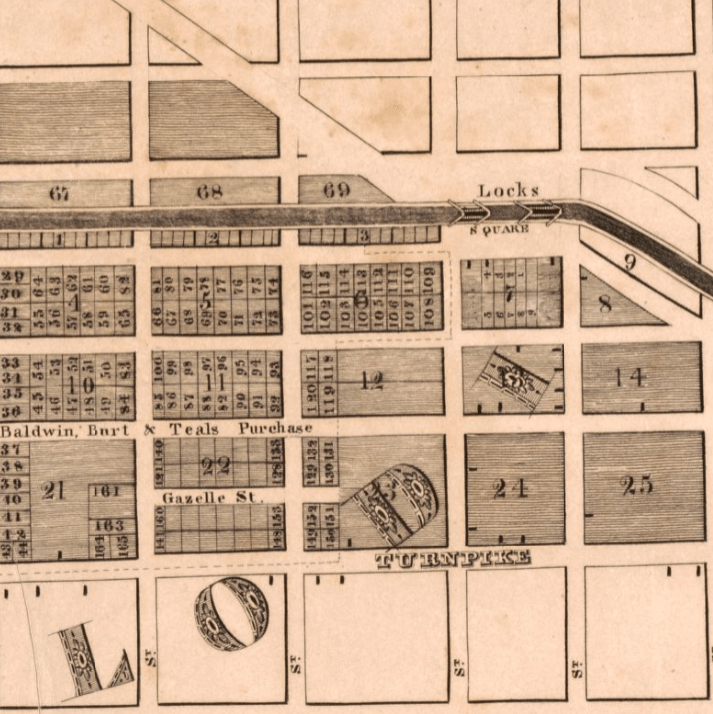
The short-lived Village of Lodi was a gamble. In the 1830’s, three men from Syracuse—Oliver Teall, Harvey Baldwin, and Aaron Burt—bet that the area around where Beech Street crosses Erie Boulevard (then the Erie Canal) would be a better place to build a city. The ground there was more elevated than swampy Syracuse, and that mattered a lot before roads were paved and when people still thought disease came from ‘miasmas.’
The speculators bought up a huge area of land—basically everything north of Genesee and south of the Canal between Beech and Almond Streets—and tried to build a city. They established a school, built a mill, and set up a small village center on Beech Street near where there were two locks on the canal. Beech Street was lined with small shops and a hotel, and the open space on the Canal’s northern bank between Beech and Pine Streets was called Lock Square.
Lodi never came close to overtaking Syracuse in importance. Syracuse paved its streets, drained its swamp, and absorbed Lodi in 1835. Lock Square remained a convenient trading place for a while after that, but by the early 1900’s it had lost its usefulness, and New York State built a canal maintenance facility on the spot. Today the City’s Water Department occupies the space, and almost all that’s left of this early village is Lodi Street—the road from Lock Square to the old Village of Salina.
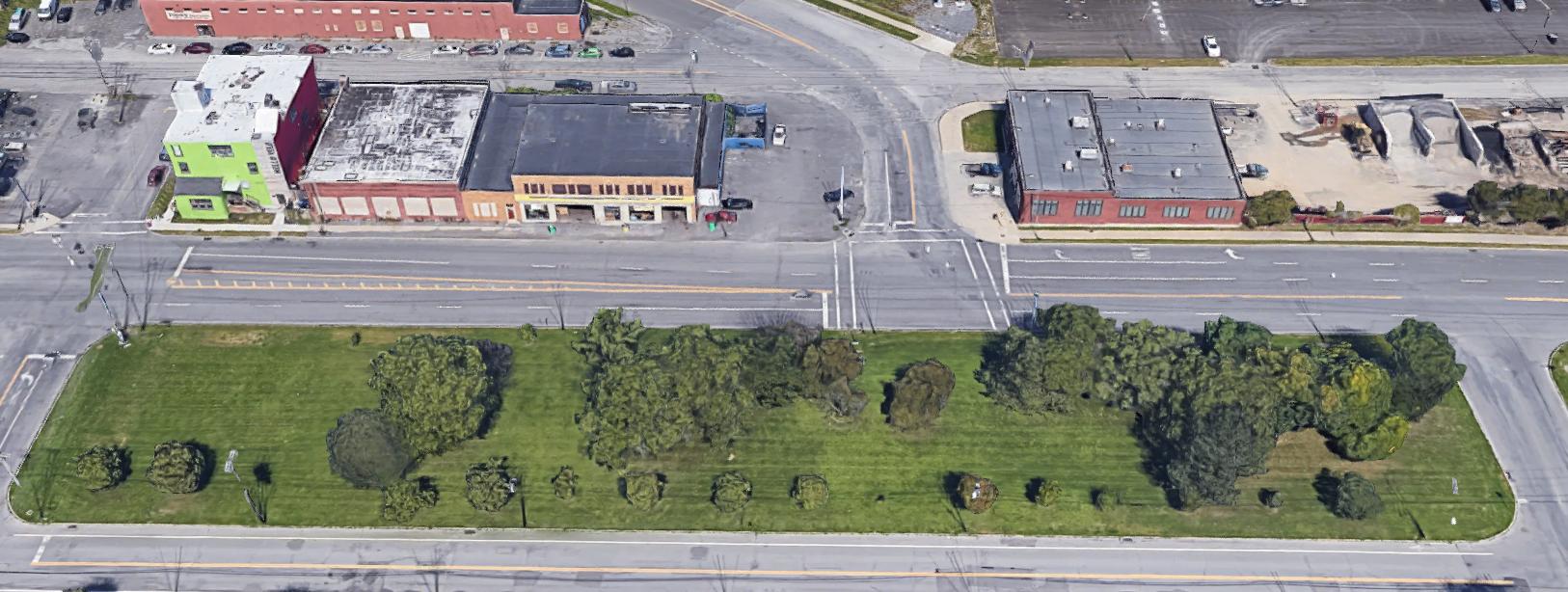
It’s unlikely City Hall will move the Water Department anytime soon, but there is a great opportunity to leverage the new Empire State Trail and existing public space on the other side of Erie Boulevard to recall Lodi’s old Lock Square. The I81 DEIS includes plans to build bike lanes from Lodi Street to the Empire State Trail on Water Street. But Lodi and Water don’t intersect, so NYSDOT’s plans to connect those streets with bike lanes along Canal and Walnut Streets. This unfortunate route would force bike riders heading north to make a dangerous left-turn onto Lodi with terrible visibility in both directions.
Better to build a bike/pedestrian path across the narrow strip of grass between Water Street and Erie Boulevard so that people on bike and on foot can cross from Water Street to Lodi there. City Hall could help ‘enclose’ the space by allowing mixed-use development on the western portion of this median. Add a sculptural fountain east of the path to recall the masonry locks buried beneath Erie Boulevard, and this new public space would be a mirror of Lodi’s old Lock Square.
Syracuse needs more good public spaces. They’re where we meet each other, pass time among our neighbors, and participate in community life. These three village centers were good public spaces, but they are almost invisible today. With a little effort, City Hall could bring them back again and make Syracuse a better place.
Centro has had a rough go of it the last few months, but the transit agency is poised to transform its service and serve the City better. Covid has shaken up service patterns and freed Centro to explore new service strategies, and the federal government’s infrastructure bill will provide the resources to implement those strategies effectively. Public transportation’s future is bright, and that’s a very good thing for Syracuse.
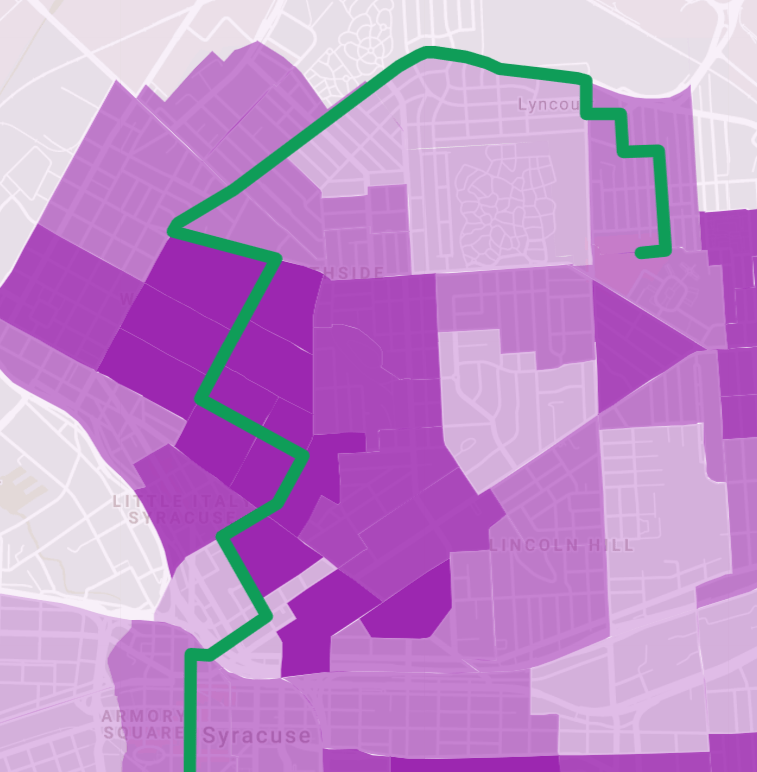
population density
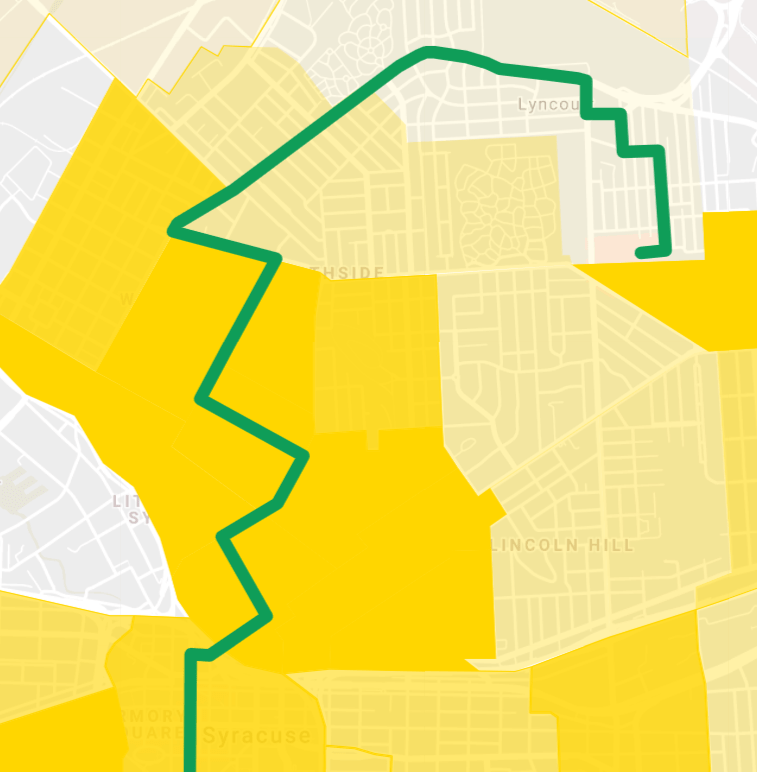
car free households
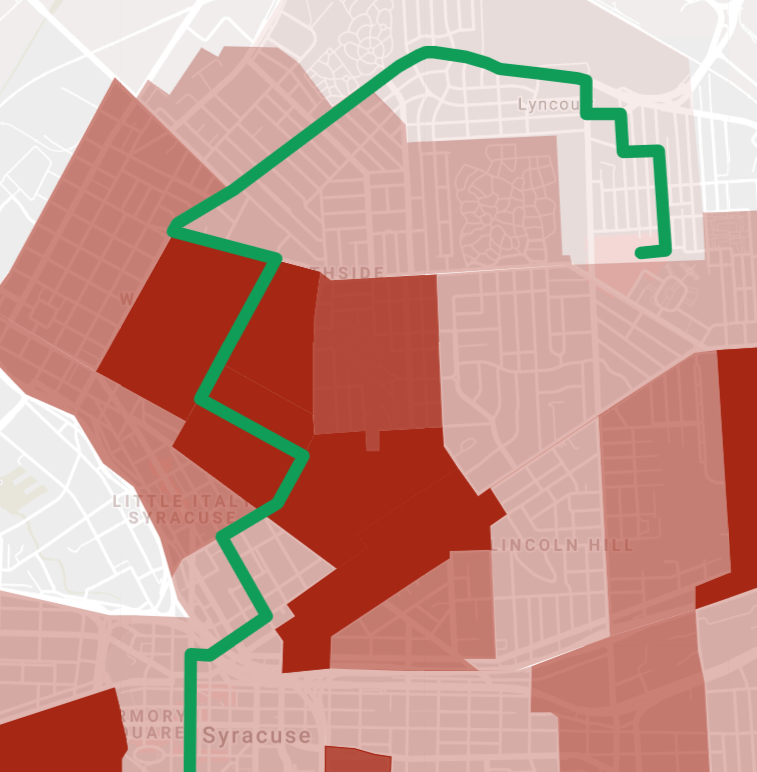
transit commuters
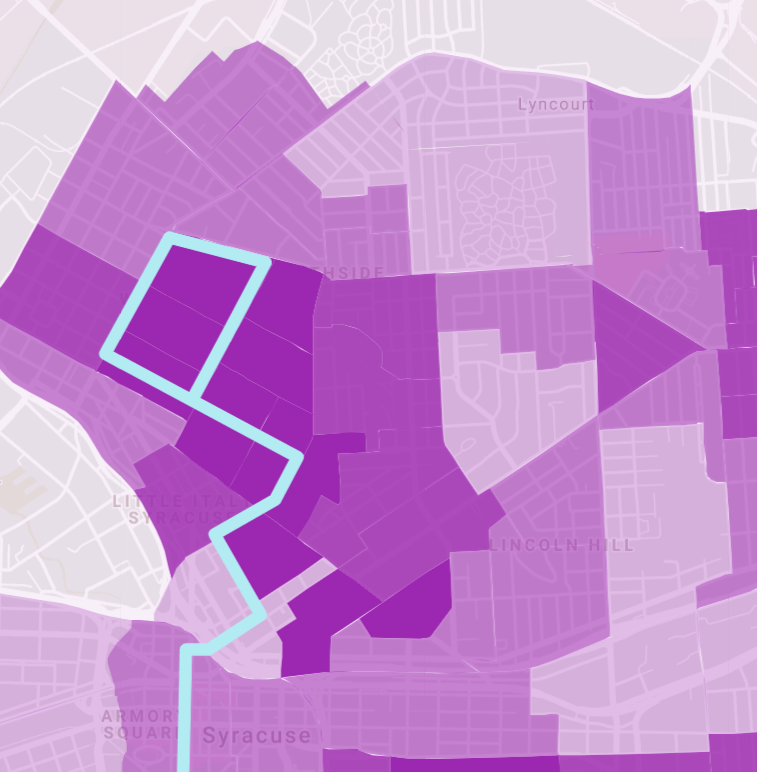
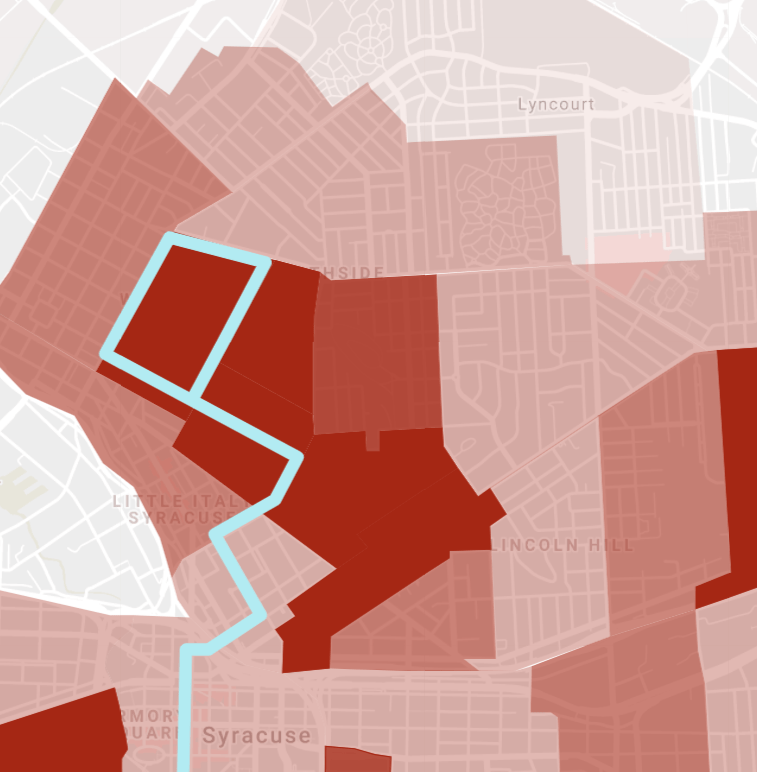
To see how Centro is changing its service to improve transit for the people who use it most, look at the 52 bus that runs through the Northside and Lyncourt. This has consistently been one of Centro’s busiest lines, but ridership is not spread evenly over the entire route. The bus picks up and drops off a lot of people between Butternut Street and Grant Boulevard, but it gets less use as it runs along Court Street.
That makes sense since the Northside is significantly more densely populated than Lyncount, it has a better mix of homes, institutions, and businesses than Lyncourt, and because households on the Northside are much less likely to own cars than are those in Lyncourt.
population density
car free households
transit commuters
So as Centro is hiring new operators and adding service back to the 52 line , it’s targeting that service to the Northside. Eight times a day, a new variation—the 252 bus, blue on the maps above—will run between the Northside and Downtown without continuing out Court Street to Lyncourt. This truncated route will still serve all of the 52 bus’s busiest stops, and—because it’s so much shorter than the full 52 line—it will allow for much more frequency where people need it most.
Centro is calling this an “urban centric” strategy, and it’s a very good idea—in order to truly connect people to opportunity, the bus needs to run frequently. Centro should use its limited resources to achieve meaningful frequency in neighborhoods like the Northside where many people ride the bus. Similar changes can and should be made to many of Centro’s other routes.
The recently passed federal Bipartisan Infrastructure Framework will supercharge this process. It contains $74 million for Centro to finally build and run BRT in Syracuse. As a start, this means two high-frequency bus lines—one from Eastwood to OCC along James Street and South Avenue, one from University Hill to the Regional Transportation Center along Adams and Salina Streets—with buses running no more than 15 minutes apart all day.
At root, BRT is nothing more than applying Centro’s ‘urban centric’ strategy to its highest ridership lines. The two corridors identified in the 2017 SMART1 plan are really just the best performing sections of four of Centro’s best performing lines. Investing in increased frequency on those high-ridership corridors will multiply the gains from Centro’s new service strategy.
So, if this experiment with the new 252 line goes well—if more people ride it because it targets better service where it’s most useful—then that line might be a candidate for conversion to BRT service in the future. These are the kind of iterative, data-driven service changes that will make BRT such an effective tool for continuously improving public transportation in Syracuse.
Eventually—as routes like the 252 and new service designs like BRT prove themselves—we should see similar improvements to lines like the 68 (Fayette and Erie Boulevard), 10 (South Salina), and 64 (Onondaga Avenue). Uplift Syracuse estimates that BRT service on those corridors would put 125,000 people and 80,000 jobs within walking distance of useful, reliable bus service. That’s the kind of transformational public transit this City needs and deserves.
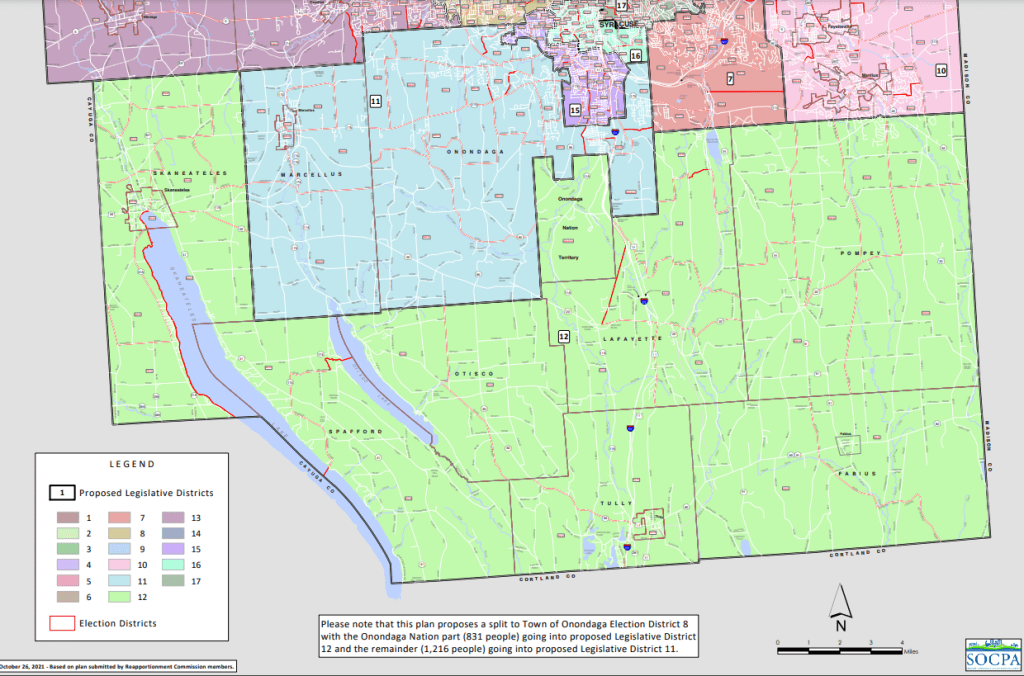
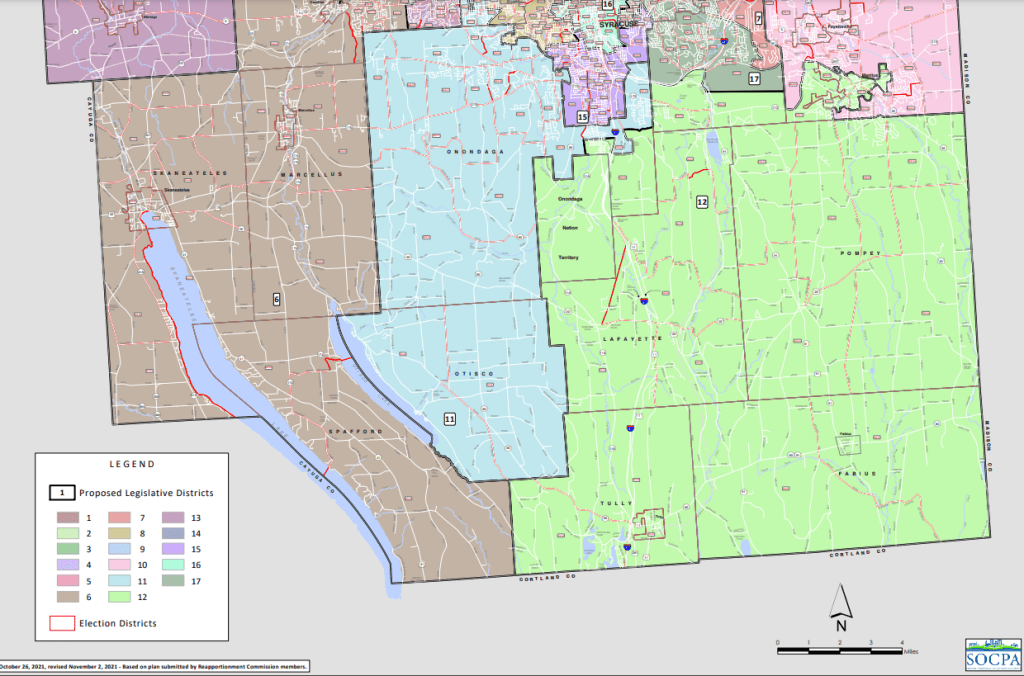
Last week, Onondaga County Democrats and Republicans each released their own proposals for new County Legislative districts. Both parties recommended big changes to the current map, but they disagreed on several major details. These disagreements show that we need to slow this process down and apply New York State’s newly enacted non-partisan standards to achieve a fair outcome.
the Democrats’ proposal
the Republicans’ proposal
Take the dispute over the district encompassing the rural southeastern portion of the County. The Democrats’ map groups the southeastern towns of Lafayette, Fabius, Pompey, and Tully with the southwestern towns of Skaneateles, Otisco, and Spafford. But David Knapp, Chairman of the County Legislature, insists that this would “disenfranchise rural voters” because “the needs of someone in the lakeside community of Skaneateles are not the same as those of a resident in agrarian Lafayette.” Instead, the Republicans grouped those southeastern towns (Lafayette, Fabius, Pompey, and Tully) with small portions of DeWitt, Onondaga, and Manlius.
But it’s not exactly clear what that fixes. The needs of the suburban residents of the Village of Manlius aren’t obviously closely aligned with Apple Valley either. The point seems to be that the southeastern towns should have their own district, and if that means padding their small population with densely settled slivers of the Towns of Manlius, DeWitt, and Onondaga, then so be it. Nevermind that this also ‘disenfranchises’ the people living in those communities, to use Mr. Knapp’s definition of the word.
the Democrats’ proposal
the Republicans’ proposal
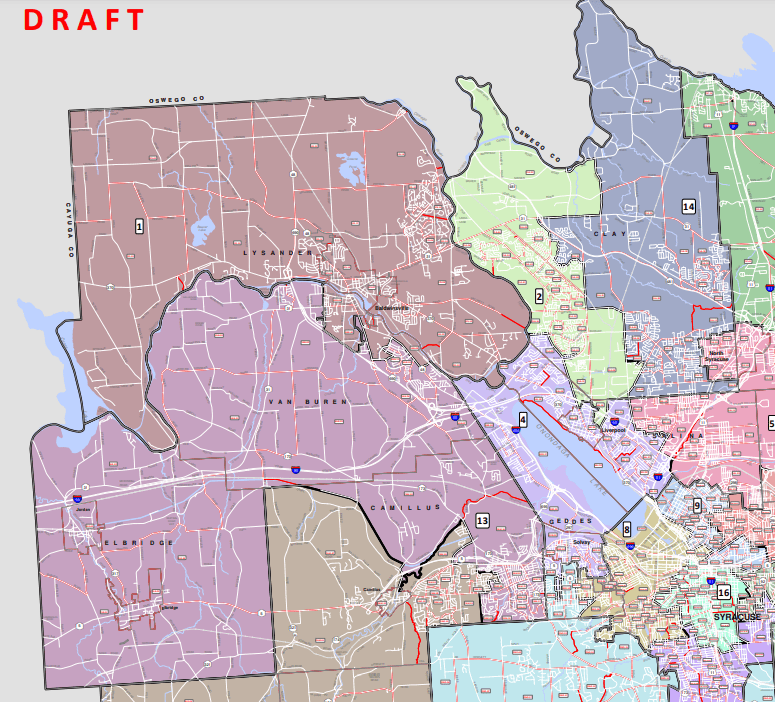
Or look at the disagreement about how to draw districts in the growing northwestern towns of Lysander, Clay, Camillus, and Van Buren. The Democrats’ map covers those towns with five legislative districts, but Kevin Hulslander, the Republican Chair of the Reapportionment Commission, claims that underestimates the rate at which those towns will grow over the next decade: “We’re establishing seven districts in the towns where the growth is to accommodate for the growth. Map number one [the Democrats’ proposal] includes only five districts. So, at the very core of what our job is here, map number one fails.”
But again, this is not an obvious solution. Demographic trends in Onondaga County are in such flux that it’s very difficult to predict exactly which towns will grow (or shrink!) over the next ten years. The census bureau predicted that the City would lose population between 2010 and 2020, and they were wrong. Cicero had—for decades—been the county’s fastest growing town, but it’s not anymore. If the Census Bureau cannot accurately predict which parts of Onondaga County will grow and how, then it’s very doubtful Mr. Hulslander can either.
Of course, decisions about who deserves representation—Lafayette or Manlius—and which parts of the County are most likely to grow—Van Buren or Syracuse—have partisan implications. The City and several inner ring suburbs are home to more registered Democrats than Republicans, and the opposite is true in the exurbs and rural parts of the county.
What Onondaga County needs are non-partisan guidelines that can ensure a fair process for drawing these legislative districts. Luckily, New York State has provided just that. New legislation directs all counties to draw districts according to existing population figures—not anticipated ones. The new legislation also says that legislative district lines should follow pre existing, broadly understood, meaningful boundaries such as town lines or school district catchments rather than trying to group people based on any individual politician’s idea of which communities are more deserving of representation.
Onondaga County’s Reapportionment Commission and Legislature should take the time to properly review this new law before deciding on any redistricting proposal. We need a fair and transparent process. There’s no rush. Let’s get this right.





















 inthesalt.city