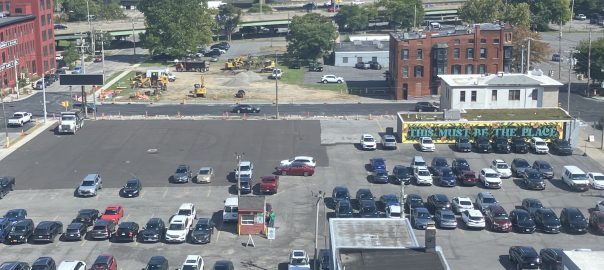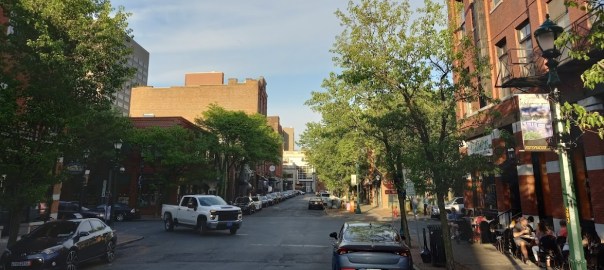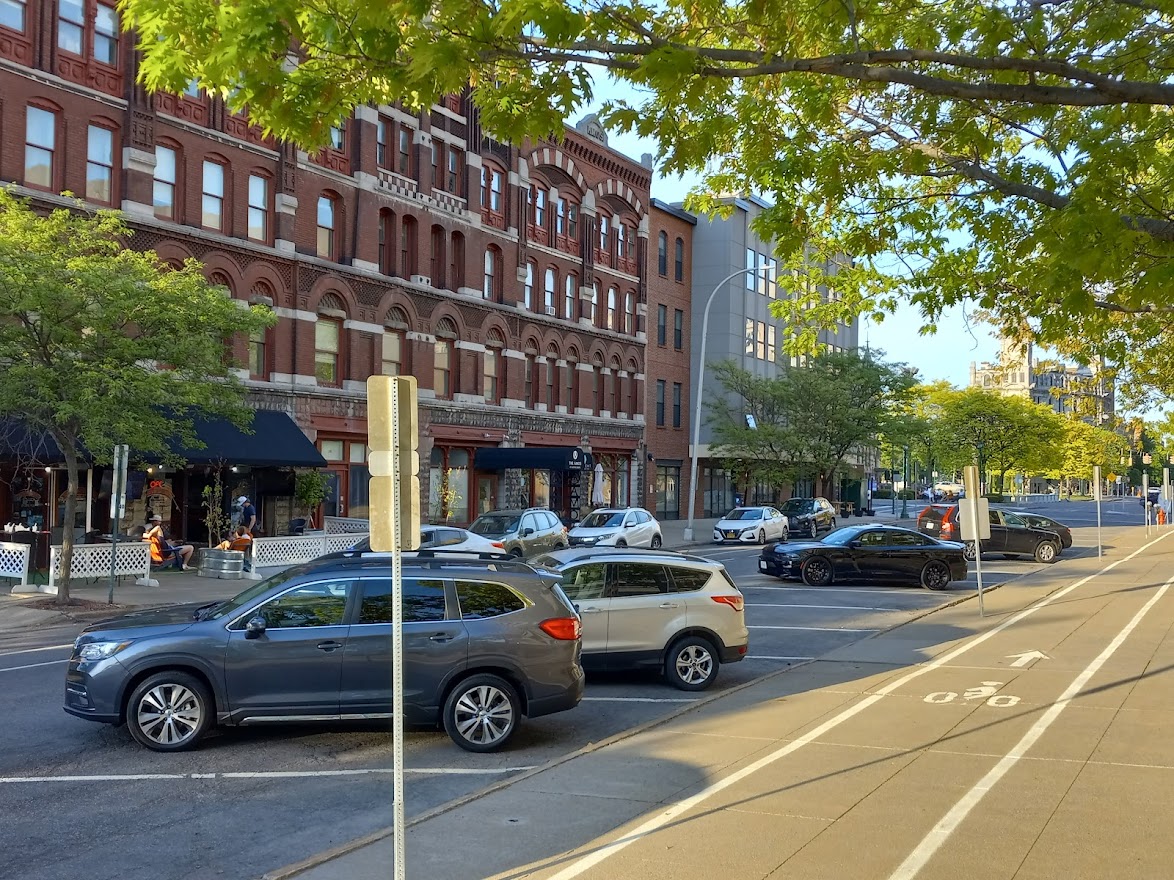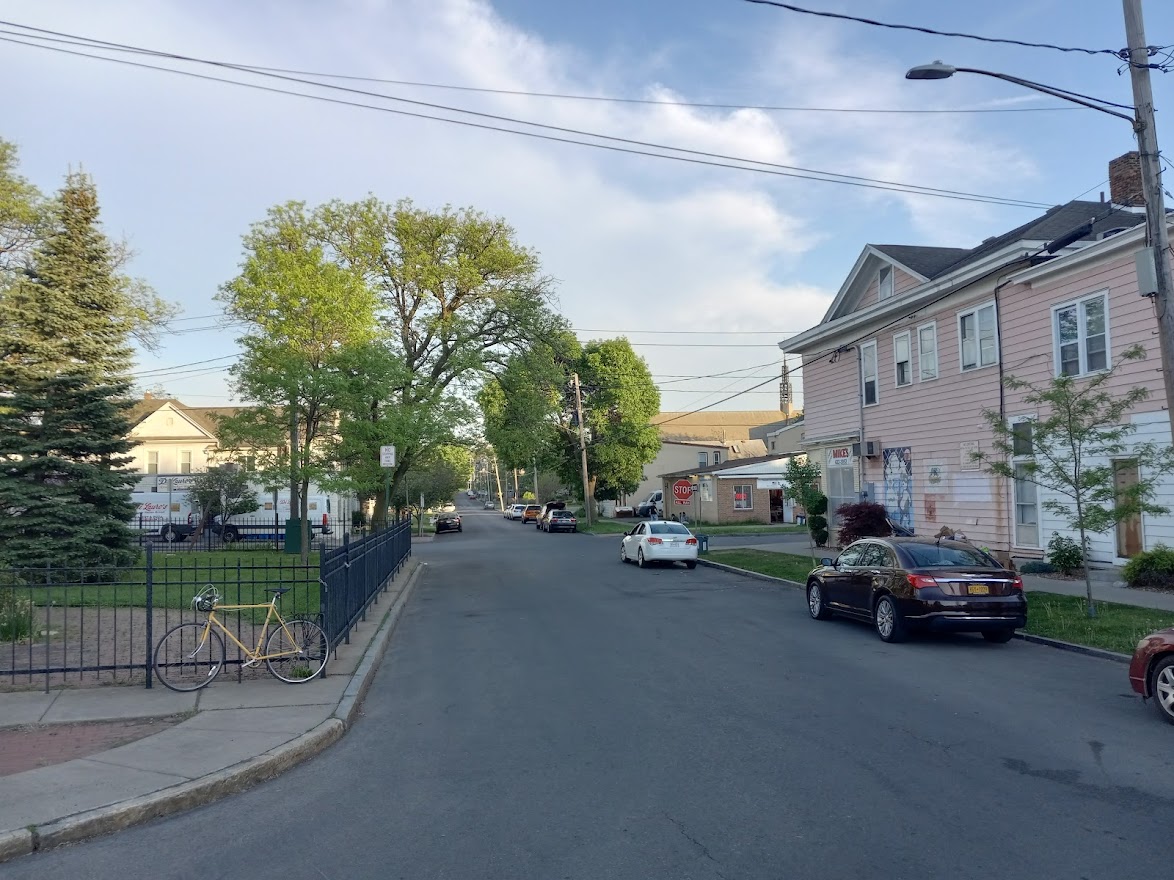
Must this be the place? It’s a good mural and a great song, but seeing such good public art surrounded by a sea of surface parking is….. depressing. Is this the highest and best use of a large lot Downtown, directly across the street from one of the highest rent apartment buildings in the region? Is the amount of property tax, or lack thereof, generated helping the fiscal health of the City? How can we encourage a better future for the block surrounding the mural?
Luckily, there may be a solution to this problem that generates more housing, economic development, and tax fairness. It’s also the policy with maybe the highest amount of internet fanatics: the land value tax.
An idea most associated with 19th century thinker and NYC mayoral candidate Henry George, a land value tax—also sometimes called a split-rate tax—assesses property taxes according to the value of a piece of land rather than the value of any building constructed on top of it. This means that underused land in high value places—like surface lots downtown—typically have a higher proportionate share in taxes while residential properties in lower land-value neighborhoods typically see their assessments go down. This incentivizes highest and best use in high value Downtown lots—if empty or underutilized parcels pay the same tax as fully developed land, then owners are more likely to build or sell to someone who can.
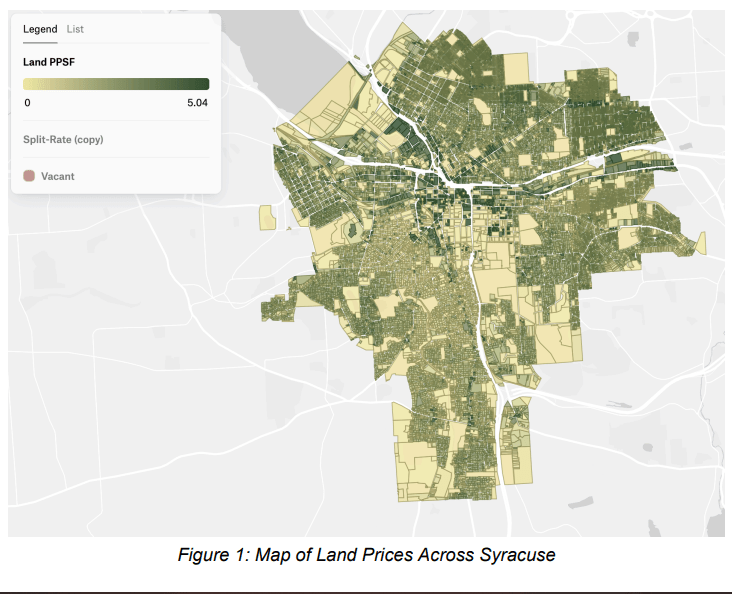
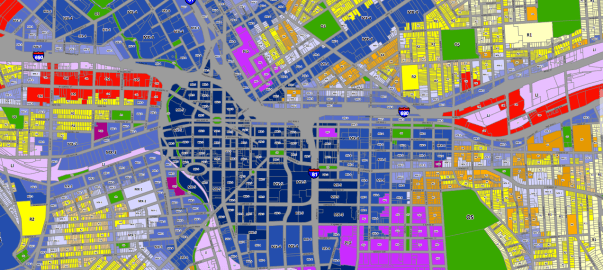
The Center for Land Economics recently published a study of how a hypothetical land value tax would affect tax rates in Syracuse. It found that most tax increases be downtown while the highest share of tax decreases would occur in the south and west sides. They also published this really interesting map charting land values in the city.
Greg Miller, author of the report, is coming to present his research as part of our In The Salt City Policy Happy Hours. October 8th at Harvey’s, we will gather starting at 5 with the presentation starting at 5:30. Please join us, the first two events have been a mixture of fun and informative with a good conversation, this should be the same!
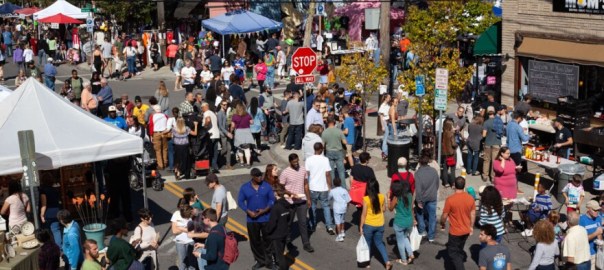
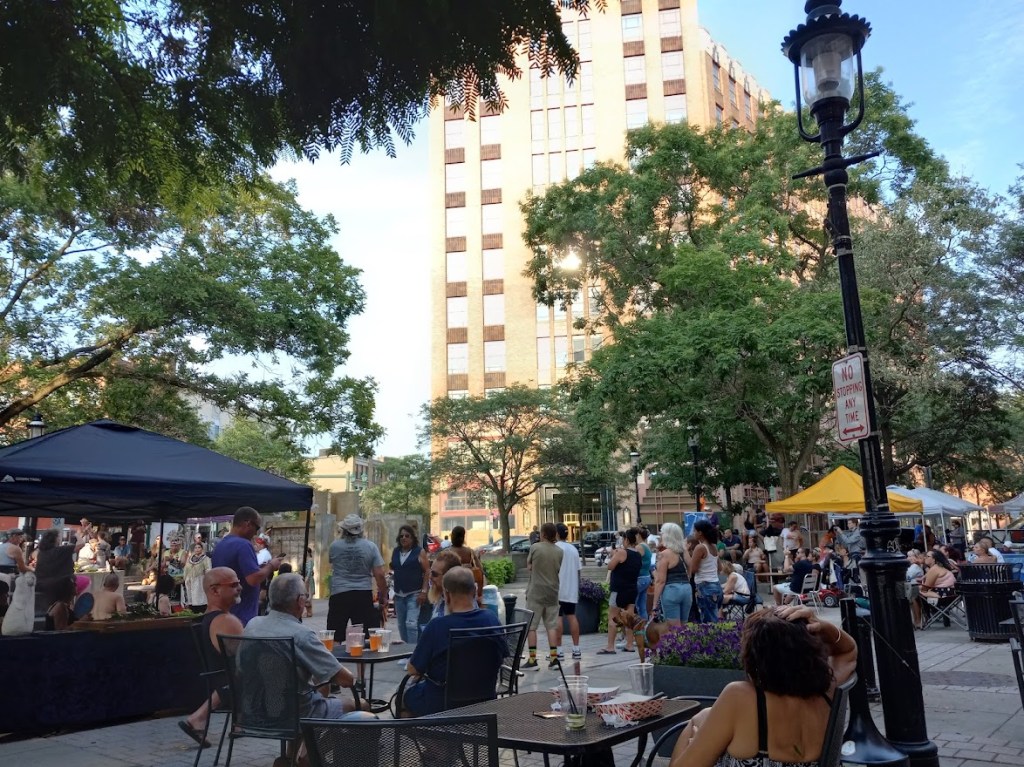
Every year the Westcott Street Cultural Fair opens Syracuse’s eyes to what a city street can really be. For a few hours, Westcott Street—normally a no-man’s land reserved for the operation of heavy machinery—is given over to the community and filled with people, and it’s great.
Streets are Syracuse’s primary public space. They take up 3,270 acres. That’s 23% of all the land in Syracuse, and it’s three times more space than all city-owned parkland. There’s plenty of room to pedestrianize a few blocks and improve the public space that’s right outside people’s front door.
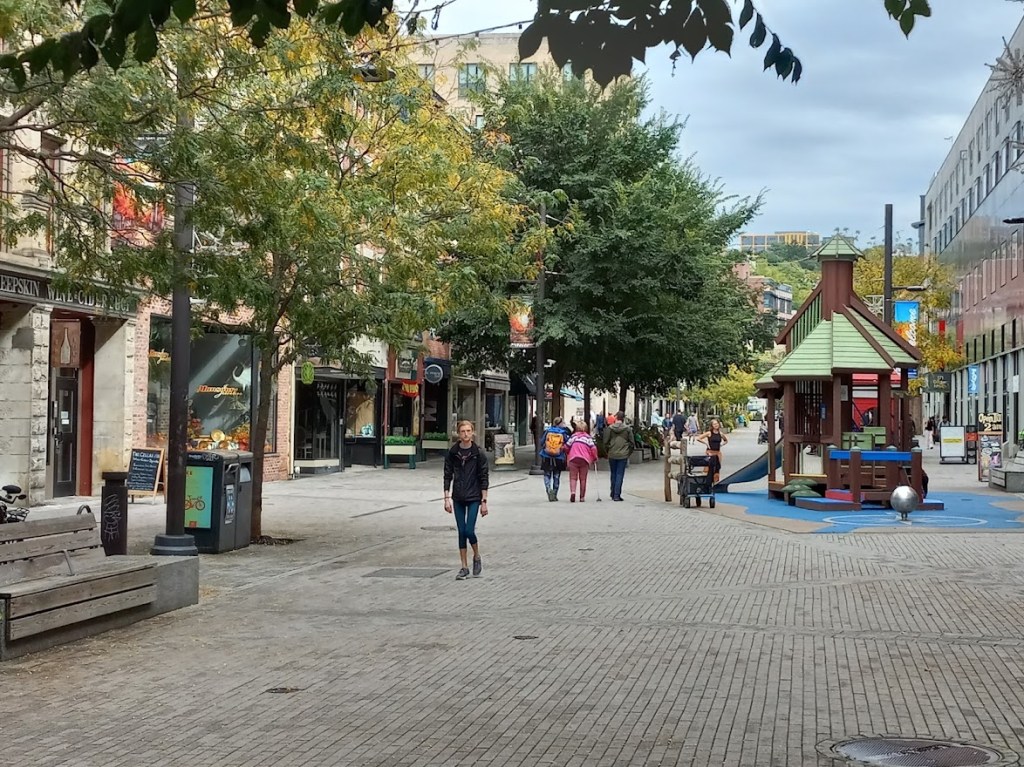
Streets in neighborhood commercial districts like Westcott are particularly well-suited to pedestrianization because surrounding businesses give lots of different people a reason to be in the space. This maximizes its use and fills it with the eyes and ears that are the best way to make public spaces feel safe. That’s what makes Hanover Square so successful, and it’s why City Hall should replicate this kind of public space across Syracuse in places like Walton Street, Amos Park, and Hawley-Green.
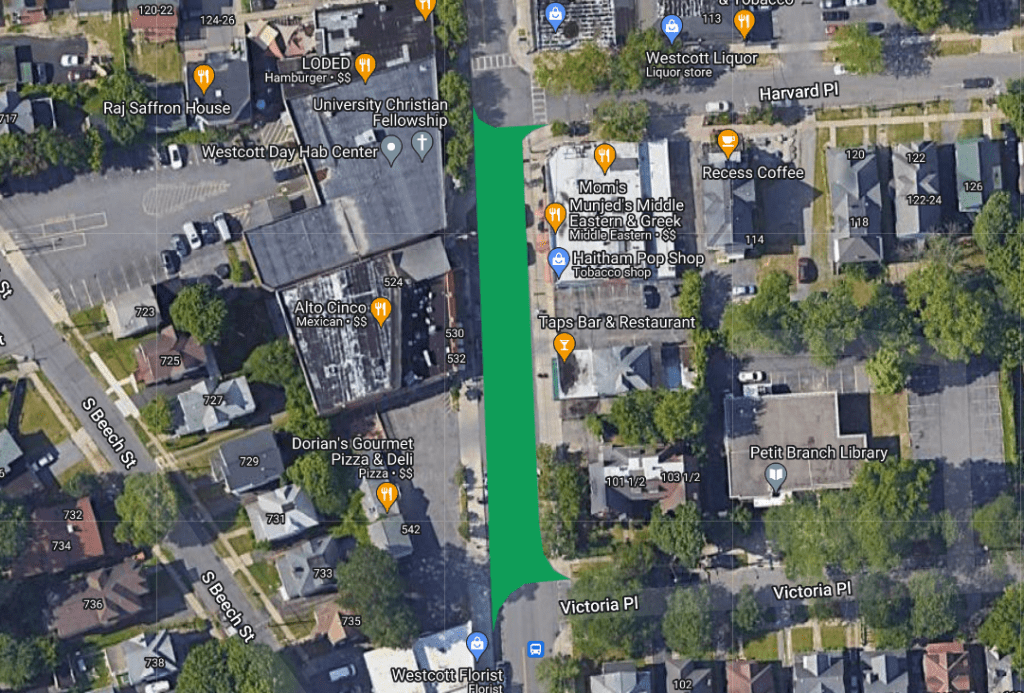
But pedestrianizing Westcott Street—between Harvard Place and Victoria Place, say—would differ from Hanover Square because it would make a much larger impact on traffic patterns in the surrounding blocks. The 100 block of East Genesee Street is—in terms of traffic circulation—redundant. Nobody needs that blocks to get from point A to point B, so closing it to cars didn’t really matter to most drivers. Hanover Square is a destination rather than a through-route.
Westcott Street is both a destination and a through-route. A lot of the traffic on Westcott is definitely bound for the business district and wouldn’t be particularly affected by pedestrianizing a single block. But Westcott is also part of a north-south route that links Teall Avenue, 690, and Colvin Street, so a lot of car drivers on Westcott Street are on their way somewhere else, and turning a portion of that route into better public space would change their behavior.
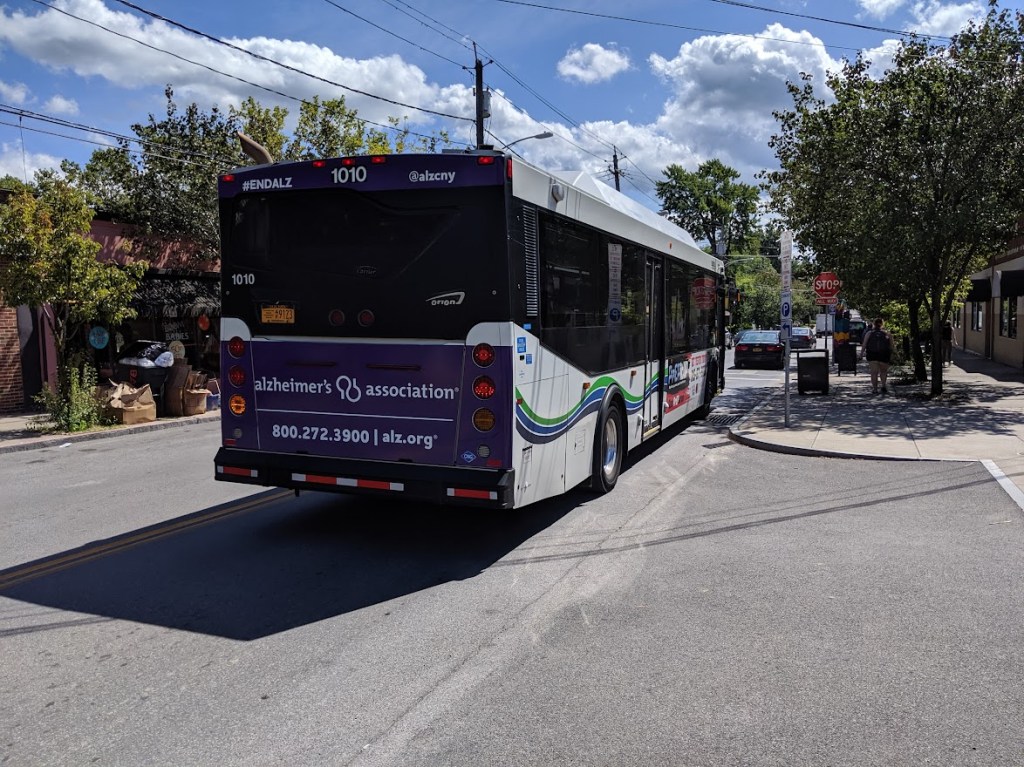
This makes pedestrianization on Westcott more complicated, but it also would make it more impactful. It would be more complicated because City Hall would need to account for changes in traffic patterns. It will be important to beef up traffic calming on surrounding streets like Columbus and Fellows Avenues so that they don’t see increases in the kind of speeding already so common on Westcott. Two Centro routes currently use this part of Westcott, and they would need to be accommodated as well. Those are solvable problems, but they present technical—not to mention political—challenges that would make pedestrianizing Westcott a harder lift than Hanover Square was.
But solving those challenges would have enormous benefits that go beyond what Syracuse has already seen in Hanover Square. Turning 1 single block of Westcott Street into public space would significantly reduce car traffic—and particularly high-speed through-traffic—on many surrounding blocks. This would make the neighborhood significantly safer, healthier, and livelier. Existing surface parking lots fronting the new pedestrian square would become much more valuable for new retail space and much needed housing, and the resulting increase in foot traffic would support more of the kinds of local businesses that make Westcott such a popular neighborhood.
This virtuous circle—walkability reduces car dependence, which allows increased residential density, which creates demand for neighborhood scale retail, which improves walkability, which reduces car dependence, which…—is the core of what makes urban neighborhoods successful and resilient, and City Hall should be doing all it can to jumpstart that cycle in neighborhoods across Syracuse.
Syracuse absolutely needs more quality public space, and the easiest way to build it is repurposing portions of our most common public property—city streets—into city squares. Existing projects like Hanover Square have tried to accomplish this without changing car traffic patterns too much, but Westcott Street shows how a bolder strategy could have a bigger impact and make our neighborhoods safer, healthier, and livelier.
When the Syracuse Police Department moves its main offices out of the Public Safety Building on State Street, City Hall should build a path through the property to reconnect Downtown with the neighborhoods immediately to its east.
City Hall built the present Public Safety Building as part of an urban renewal project explicitly designed to cut Downtown off from Syracuse’s close-in residential neighborhoods. It did this most effectively by totally demolishing one such neighborhood—the 15th Ward—and by closing short local streets better suited to pedestrian traffic than long-distance car commuting. South of Genesee Street, five local streets used to enter Downtown from the east. Today, only two—Harrison and Adams—are left, and both are too wide and carry too many cars driving too fast to be a safe and pleasant route for anybody travelling by bike, foot, or mobility device.
If I-81’s removal is going to really change the way people get around town—and it must—then City Hall needs to find ways to reestablish those lost connections. Piercing the superblocks around the Public Safety Building is a good place to start. All three of the lost east-west connections—Jefferson, Cedar, and Madison Streets—were removed to build Presidential Plaza and the Courthouse/Public Safety Building/Justice Center/Everson Museum complex.
Madison and Townsend Streets, 1951Madison and Townsend Streets, 1966Madison and Townsend Streets, 2021
street grid removal for urban renewal superblocks
Traces of each remain. The tree-covered walk along the north side of the Everson fountain follows Madison Street’s path. Privately-owned Presidential Court sits where Cedar Street used to run. Eastbound traffic on Genesee Street runs south of Forman Park on what used to be the easternmost block of Jefferson Street.
But although there are pieces of all these old streets, they are disconnected and do not form a path between University Hill and Downtown. Urban renewal superblocks, highway offramps, and a distinct lack of crosswalks all conspire to create a sort of pedestrian black hole between State, Genesee, Harrison, and Almond Streets.
traces of Cedar Street between Montgomery and Almond Streets
I-81’s demolition and the police department’s move out of the Public Safety Building present the opportunity to restore connections to Downtown. First, City Hall should pierce the State Street superblock by building a path across it in the area of the present Public Safety Building (the remainder of the large site can be redeveloped with homes and commercial space, some of which should front the path). Second, City Hall should work with NYSDOT and Sutton Real Estate Company—the owner of Presidential Court—to reopen connections across the Presidential Plaza superblock by linking Presidential Court with Almond Street. Third, City Hall and NYSDOT should install crosswalks and traffic lights on Almond, Townsend, and State Streets where those streets intersect reestablished east-west connections.
These are the kinds of interventions Syracuse needs to reconnect neighborhoods divided by urban renewal. The City has been carved up by highways and superblocks, and people getting around on foot, by bike, or with a mobility device have too few direct, safe options for travelling between neighborhoods. A new route through the Public Safety Building property would help reconnect small safe streets like Madison, Jefferson, and Cedar and play an important part in a larger network of safe routes across the whole City.
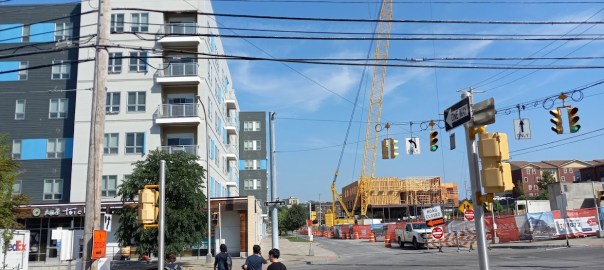
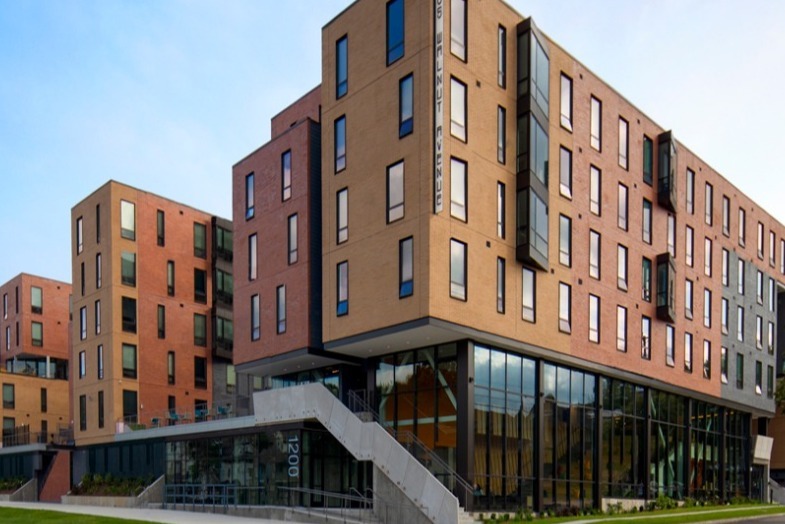
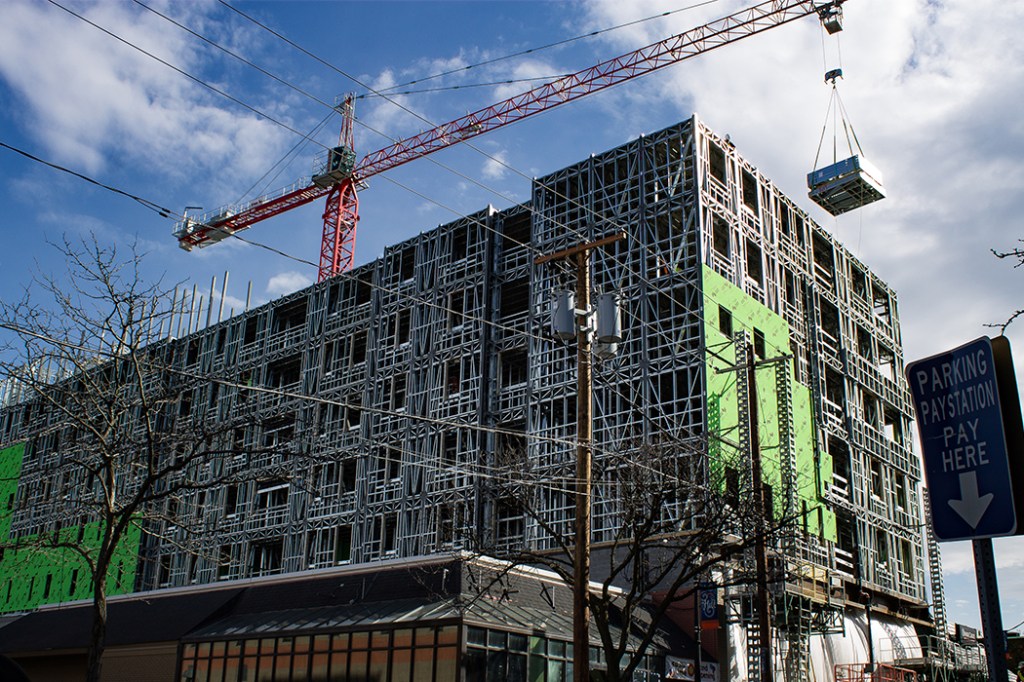
The large apartment buildings going up around University Hill expand housing opportunity in surrounding neighborhoods, and that’s a good thing.
These buildings—505 Walnut, Theory Syracuse, The Marshall, UPoint, etc—attract a lot of scorn because they’re big, new, expensive, and primarily marketed to university students. ‘Why’ a lot of people ask ‘do we need more luxurystudent apartments when so many people in this town struggle to pay the rent?’
The short answer is that we don’t need them—students do. Students are people, and they need housing just like anybody else.
A more complicated answer is that we (anybody trying to secure housing in Syracuse) need these new apartments because students need them. To see why, it’s helpful to think about how university students differ from other tenants in the City.
First, they are often willing and able to pay more in rent than many other Syracuse tenants. Syracuse University and LeMoyne College charge students between about $900 and $1,550 per bedroom per month for on-campus housing. Student loans and/or family savings cover that cost, but those sources of income can also be used to rent off-campus housing too. Compared to the on-campus options, splitting the $4,500 rent on a 6-bedroom apartment with five other roommates is a pretty good deal—even though that’s well out of reach of any large family that might also want an apartment that size—and a lot of student tenants jump at the opportunity.
Second, they are geographically constrained. A good number of students move to Syracuse for school, don’t have much information about the City, and don’t have the time or ability to chase down Craigslist leads all over town. Students tenants also often need to be able to get to their campus without a car, and that means finding housing within walking or biking distance or on a bus line that goes to campus. All of this means that student tenants are a sort of captive market for University-area landlords, and that gives those landlords the power to set their rents at prices student tenants will pay.
Third, they evict themselves. Landlords value the ability to get rid of tenants who can’t pay high rent or are loud or demand basic maintenance or need reasonable accommodations for a disability or whatever. Landlords cherish easy evictions, but tenants who want long-term housing stability have some—not enough, but some—rights that allow them to fight off eviction and stay in their homes. Student tenants, however, often voluntarily move every year and are almost guaranteed to vacate the apartment after two years, so landlords who exclusively rent to student tenants never get ‘stuck’ with someone they consider to be a ‘problem tenant.’
If you’re a tenant looking for a relatively inexpensive, long-term home, you do not want to be competing with student tenants for an apartment. Lot of landlords would prefer to rent to student tenants, and they can usually screen you out by just charging more than you can afford.
This is also a problem for prospective homebuyers. When building new housing isn’t an option, landlords looking to rent to tenants will simply buy existing housing—including 1 and 2-family homes commonly purchased by owner-occupants—and operate it as rental units. If you’re trying to buy a house for yourself, you do not want to be competing with landlords who rent to student tenants. They often have better access to financing and are often willing to pay more because the rent can cover a pretty big mortgage payment.
So it is a very good thing for most Syracuse tenants and prospective homebuyers that a few big landlords are building big new apartment buildings specifically for student tenants, and lots of student tenants are choosing to live in those buildings. Because of those big new buildings, fewer student tenants are competing with non-student tenants for apartments in the older neighborhoods around Syracuse University, and fewer landlords are competing with prospective homebuyers to purchase older housing to rent to students in those neighborhoods too.
Clearly, Syracuse’s housing problems are a lot bigger than “student tenants shape the rental market in ways that increase housing purchase and rental prices on and around University Hill,” and while big new student-targeted buildings can help solve that problem, they can’t solve every housing problem in the City.
Governor Kathy Hochul’s goal of building 800,000 new homes in New York in the next decade is good. We need new housing—a lot of it—in communities all across New York State for all kinds of different reasons, and her New York Housing Compact will help build a lot of new housing. As proposed, however, her plan might only make an impact Downstate. We need this statewide housing policy to build new homes in communities like Syracuse too,
In a place like Syracuse, we need new housing for at least three big reasons: the housing stock we have now doesn’t meet people’s modern needs, a lot of it’s in terrible shape, and certain neighborhoods don’t have enough housing for all the people who’d like to live there. The housing we’ve got now doesn’t fit the housing we need, and this mismatch is bad for affordability, it’s bad for public health , and it’s bad for racial and economic segregation.
Downstate has a lot of the same problems, but they are all conditioned by the overwhelming demand for housing down there. They need new housing for all of the reasons we do, but they also need a lot more housing in order to alleviate their sever housing shortage and make room enough to accommodate all the people who want to live there.
The Governor’s proposal is designed to address the New York City metro area’s housing shortage more than the statewide need for new housing. Its central policy is a builder’s remedy—basically a streamlined permitting process for new construction in instances where exclusionary zoning blocks new housing. It’s a policy that will definitely help Downstate, but which could also address the need for new housing in Upstate’s metropolitan communities, like Syracuse, where exclusionary zoning contributes to our housing problems.
But that builder’s remedy only goes into effect if there’s little or no new housing construction in a particular municipality. Downstate, projects can take advantage of the remedy when proposing new construction in a municipality that’s seen less than 3% growth in its total housing stock over a 3-year period. Upstate (in this instance, anywhere not served by the MTA), the builder’s remedy doesn’t go into effect unless new housing construction falls below 1% in any municipality over a 3-year period.
In Syracuse, that 1% threshold will probably work out to about 200 new housing units per year. In Salina, it’s more like 50. In DeWitt, about 40. These are tiny numbers, and they are well below what we need to build in order to actually address the problems that new construction can solve.
There’s a lot to like about the Governor’s housing proposal. The design of the policy is sound. The full plan also includes other good things like a new lead testing and remediation program and more funding for mixed-income housing Upstate.
But the plan’s core goal—to build hundreds of thousands of new units—won’t do much Upstate if the builder’s remedy only works in municipalities with New York City-sized housing shortages. We need either lower targets for new construction, or some other metric—like a shortage of affordable housing—to trigger the policy if it’s going to make a difference in a place like Syracuse.
There’s not much doubt that Centro will run a bus line to the new computer chip factory on Route 31 when it opens. What’s not so clear is how good the service will be, or if it will meaningfully improve anybody’s life.
Centro designs its service—particularly suburban service—as a kind of social safety net. It’s designed for people to have to ride because they are too poor to afford a car, and because they have no other option they’ll put up with the bare minimum of service—a handful of buses a day in each direction.
This model is fatally flawed. Nobody has to ride the bus. Everybody—even people who don’t own cars—has other mobility options like catching a ride with a friend or family member, taxi services like Blue Star or Uber, and ad hoc jitney services. Centro can’t rely on ridership from everybody who can’t afford a car, because there are many other low-cost options for getting around. It has to outcompete all of them too.
And bare-bones, safety-net service simply can’t outcompete a taxi or a jitney or a ride from a friend when it comes to commuting. This kind of service offers riders one bus—one single chance—to get to work on time. If you miss it because your kid needs extra help one morning, because the bus never came, or because sometimes everybody just runs a few minutes late, you’re at least out of a day’s pay and at most out of a job. That’s simply too big a risk for anybody to take every single day, and so even people who can’t afford a car will spend a lot of money on cab fare to avoid it. The stakes are just too high.
For Centro to run a successful service that people will actually use, they have to eliminate, or at least mitigate, that risk by running more buses. Frequent service—a bus every 10 to 15 minutes—gives people multiple options to make it to work so every single morning isn’t weighed down by the possibility of economic ruin. You try to catch the bus that gets you to the job with 15 minutes to spare, but if you miss that one then the next bus still gets you to work 5 minutes before you clock in. You can keep your job even if your morning doesn’t go exactly to plan.
Frequent, practical, competitive transit service costs money. Centro has to pay their operators, they have to pay for gas, they have to maintain a bigger fleet of buses. Uplift Syracuse estimated that upgrading Centro’s 8 best-performing lines to truly frequent service would cost about $8 million per year, and that was before Covid made it so much harder to hire new bus operators.
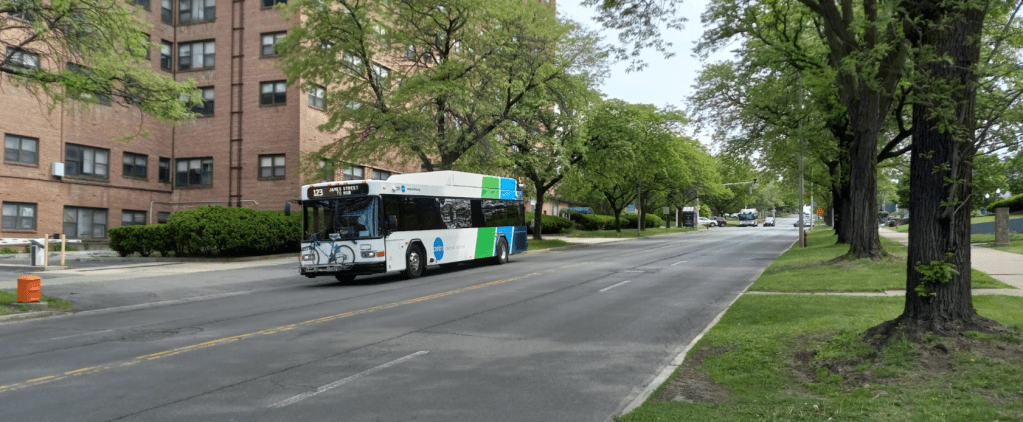
And since Centro doesn’t have nearly enough money, they rightly direct their funding to frequent service where it will do the most good: corridors where lots of people live, work, shop, worship, etc. That means James Street, Salina Street, Genesee Street, Butternut Street, Erie Boulevard, South Avenue. Centro’s best-performing lines are in the City where traditional development patterns are well suited to frequent transit service. There are currently no corridors outside the City that come anywhere near Syracuse’s levels of population and job density, and that’s why there is no decent bus service to the suburbs that anybody can rely on to get to work.
It might be possible to change that. Onondaga County just posted its first decade of meaningful population growth since 1970, and all indications are that our community will continue to grow. Those new people need somewhere to live, and there’s plenty of room for them in the urbanized area at the center of the County. More housing and mixed-use development along major suburban corridors like Old Liverpool Road, Milton Avenue, and Route 5 would create the conditions to necessary to support frequent transit service—lots of people and lots of places for them to go—and that same frequent transit service could be a reliable option for people trying to get to suburban jobs.
So here’s what it will take for Centro to run truly useful transit service to suburban employers like Amazon or Micron: lots more money, lots more housing, and much better planning. The entire County needs better bus service. Everybody needs access to all of the opportunities in this community, and this is how we can make it happen.
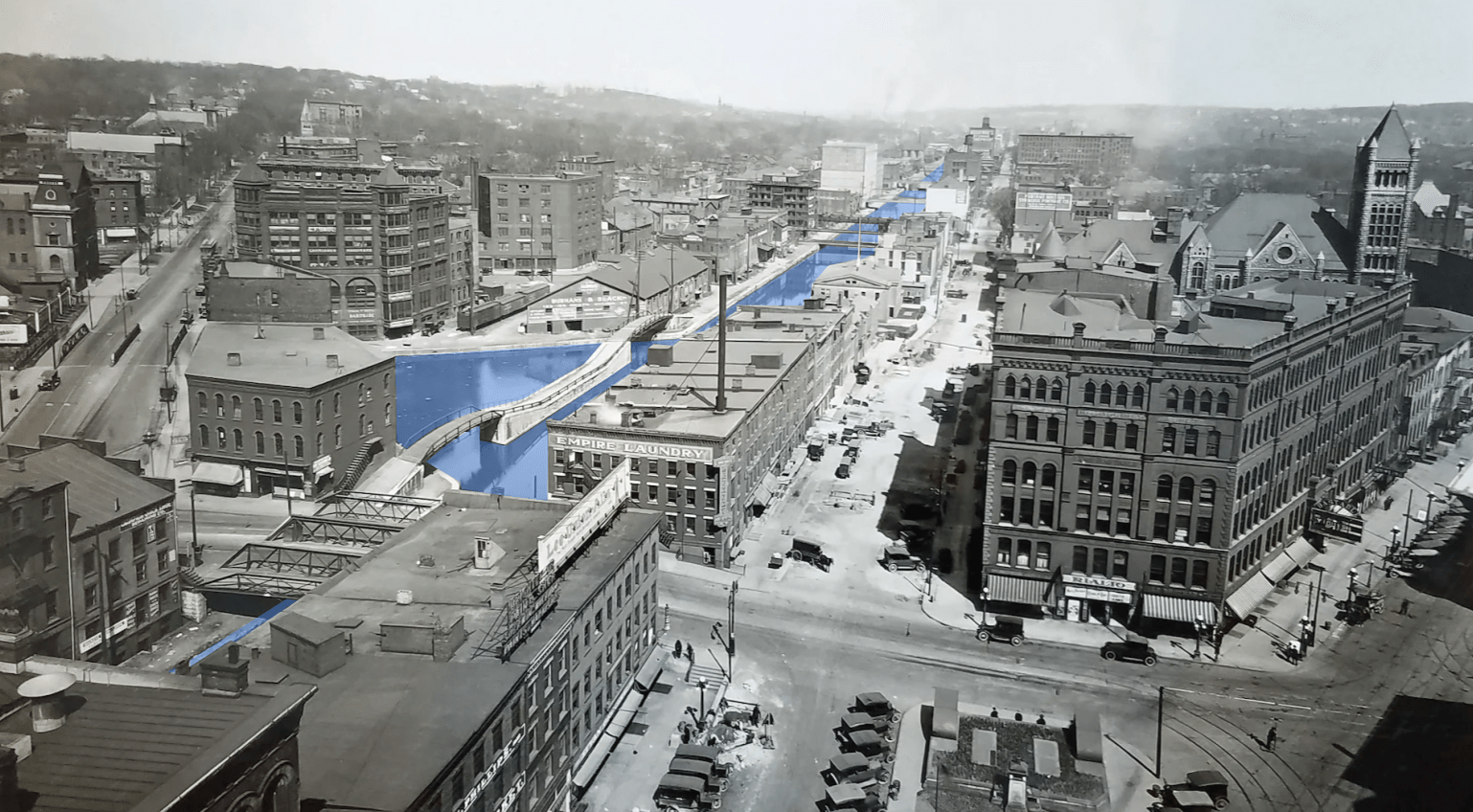
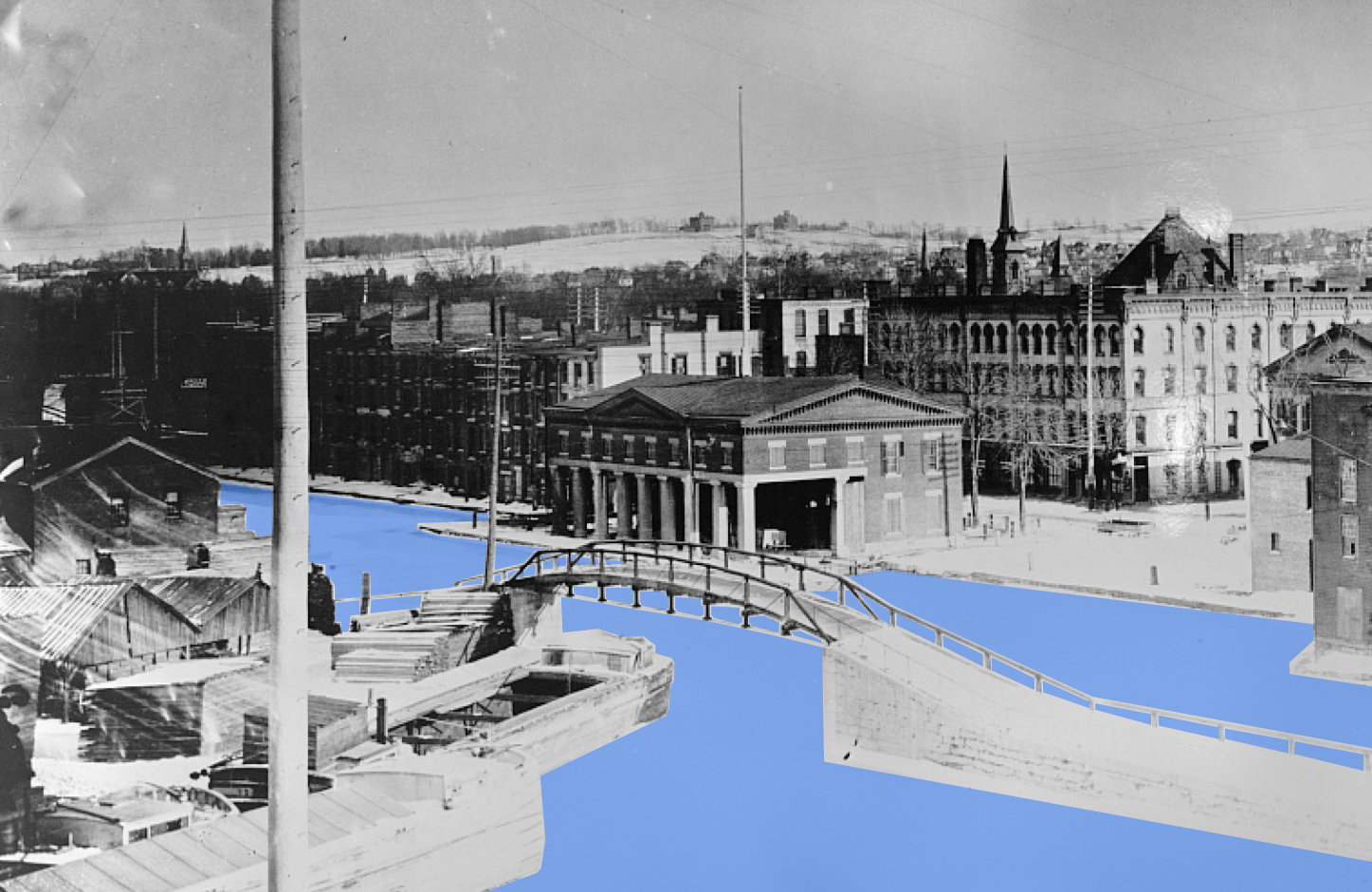
More and more people are starting to talk about the benefits of rewatering the Erie Canal in Downtown Syracuse. Old photos of Syracuse are tantalizing. Clinton Square is full of people watching the canal, and the City looks like Venice or Amsterdam or Suzhou. Compared to the Erie Boulevard of today, it can seem like Syracuse was crazy to erase this urban waterway 100 years ago.
If Syracuse is going to rewater the canal—and we should—then we have to understand why people wanted it gone, and we have to make sure that a restored canal doesn’t recreate the original canal’s problems.
Syracuse filled in the canal for three very good reasons. First, it was gross. 19th century industrial cities used waterways as open sewers and garbage pits, and the Erie Canal was no exception.
Second, the City wanted more roads. Car ownership was exploding in the 1920s and real estate developers were building new neighborhoods—like Scottholm—out of walking distance of the City’s center. That meant a lot more cars driving across Syracuse, and they wanted more room on the roads.
These are real practical problems, and it would be crazy to bring them back into Syracuse today.
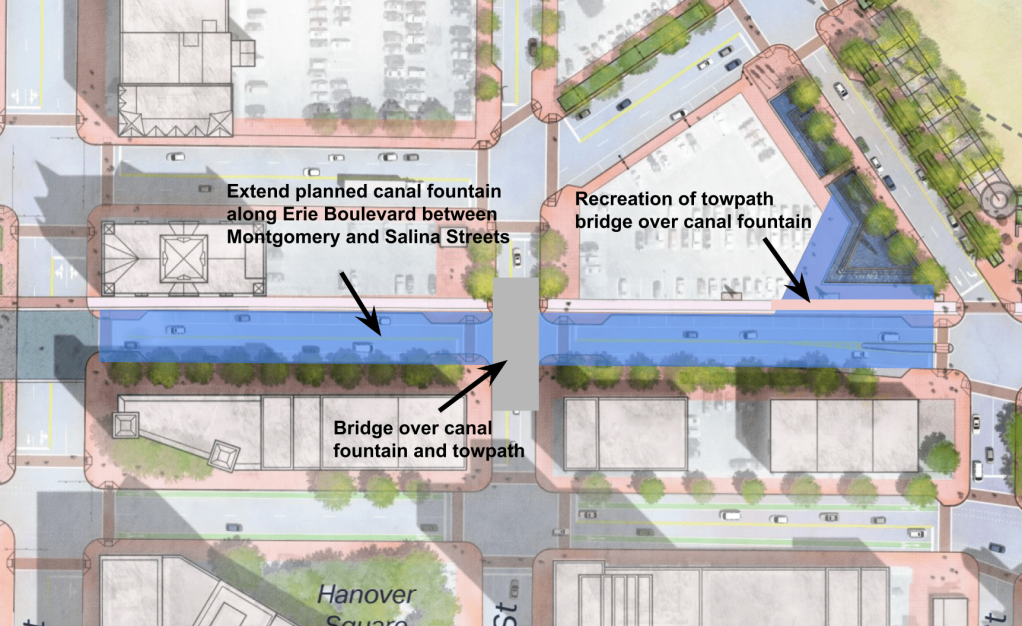
Luckily, it’s possible to get the best of both worlds—to bring water back to Erie Boulevard without bringing back the nuisances of the original canal. NYSDOT already intends to build a fountain at the corner of Oswego and Erie Boulevards as part of their plan for a ‘Canal District.’ They should simply extend that fountain into Erie Boulevard and stretch it west to Clinton Square.
Combined with Clinton Square, this would recreate a 3-block stretch of the Erie Canal’s original path through Syracuse, and it would sidestep the three main problems that led Syracuse to fill in the canal 100 years ago.
First, cleanliness. Syracuse’s rewatered canal will be a large fountain instead of a working waterway. That means boat crews won’t use it as a sewer, factories won’t use it as a trash bin, and dead mules won’t fall into it. It also means the water won’t stagnate, and it can be treated to prevent algal blooms. A canal fountain will be a lot cleaner and smell a lot better than the actual canal did.
Second, road capacity. When Syracuse built Erie Boulevard, it was the City’s primary east/west highway and carried a lot of cars. But now we have 690 for that, and nobody in their right mind would drive from DeWitt to Camillus on Erie Boulevard anymore. The two blocks between Salina and Montgomery Streets, in particular, are not useful for getting from point A to point B, and Syracuse could easily repurposed them without any noticeable effect on road capacity.
And third, bridges. A rewatered canal stretching from Montgomery Street to Clinton Square wouldn’t require dozens of bridges like the original canals did. A rewatered canal would also not carry any barges, so the one necessary bridge (at Warren Street) wouldn’t need to move to allow boat traffic to pass underneath.
A two-block fountain stretching from Clinton Square to the site of the Erie/Oswego confluence at Montgomery Street will restore the canal’s presence in the City’s center without recreating the problems that made the canal a nuisance.
The Creekwalk has a problem: its most interesting spots—the places where people stop and stare, where they can get close to the water, the places that make it unique—flood and have to get blocked off after heavy rains. Seen from the other side, the Creekwalk’s most reliably dry portions—the sidewalks Downtown—are its most boring.
interesting but flood-prone vs boring but flood-proof
The I81 project shows how City Hall can fix this problem. As part of the removal of the West Street interchange, NYSDOT is going to build a new section of Creekwalk along the west bank of the Creek from Erie Boulevard to Evans Street. The new section of trail will have views of the canal aqueduct that still carries Erie Boulevard over the Creek. The new trail will also function like a bypass of the flood prone but beautiful part of the Creekwalk that currently dips below 690 and runs right near the water into Franklin Square.
the flood-prone portion of the Creekwalk is shown in blue. The image on the left shows NYSDOT’s planned Creekwalk extension which can function as a detour around flooding when the Creek is high.
So once NYSDOT builds the new section of trail, it will never really be a problem when the Creek rises after heavy rains. City Hall can block off the flooded section, and people using the trail can take the—much higher and unlikely to flood—west bank path to avoid the problem area entirely. (for this reason, the Empire State Trail—which follows the Creekwalk from Downtown to the Inner Harbor—should shift to the new west bank path once it’s complete).
City Hall should apply this same logic to more of the trail. In effect, the Downtown section of the Creekwalk we have now is more like a flood-time detour than a real multi-use path. It crosses city streets, uses existing sidewalks, and is totally out of sight of the Creek all to avoid dealing with flooding closer to the water’s edge. The result is flood-proof but boring.
And it’s a huge missed opportunity because the Downtown section of Onondaga Creek is one of the most interesting spots in Syracuse. Beneath the modern city at street level, the Creek winds through old stone bridges, some built before the Civil War. The running water drowns out traffic noise, and the shade and stonework makes the path along the Creek cool and comfortable on hot days. It’s an amazing space, and more people should be able to experience it.
All City Hall has to do to make this happen is clear out some weeds, install a couple bridges, and build a few short connections between the existing path at the Creek’s edge and the current official Creekwalk up at street level. The end result would be two continuous parallel paths from Onondaga Place on the Westside to Plum Street in Franklin Square.
One—the current Creekwalk plus NYSDOT’s planned west bank detour, shown in green on the map below—would be totally flood proof, a viable option for using the Creekwalk no matter the weather, and a good route for the Empire State Trail.
The other—a water-level route along the Creek bank all the way through Downtown and Franklin Square, shown in blue on the map below—would keep people away from street traffic and follow the water’s hidden path through the very center of the City.
The Creekwalk is a huge success story. It’s the most impressive park City Hall has built in decades. It connects neighborhoods across Syracuse and puts people in touch with parts of the City they would never experience otherwise. But the oldest part of the path—the street-level portions Downtown—are simply not up to the high standards this success has set. City Hall can fix that by adding a water-level route that parallels existing street-level path through Downtown.
As the weather warms up and people start spending more time outside, it’s time to expand one of City Hall’s best pandemic-era pilot programs: Weekends on Walton.
For the last two summers, Syracuse has created new outdoor public space in Armory Square by opening two blocks of Walton Street for people to walk, sit, eat, and drink. It was an idea City Hall had already been investigating, and the pandemic made it necessary—when nobody could spend time inside, restaurants needed new outdoor seating to stay afloat.
The pilot worked. Restaurants did well, people were able to gather safely outdoors, and Armory Square got a much needed breath of life. When Summer 2021 rolled around, City Hall ironed out some kinks and ran the program again.
As with any successful pilot, City Hall should now scale the program up. There are three good ways to do this.
First, Weekends on Walton should become more permanent. The 2019 SMTC study that inspired the pilot program recommended physical changes to the street that would make Weekends on Walton more attractive and easier to implement. These include removable bollards at Walton’s intersections with Franklin and Clinton Streets, and making Walton a ‘curbless street’ like Genesee in Hanover Square.
These simple changes would constitute another iteration of the Weekends on Walton concept. They’d make the street—which is in a terrible state of repair and difficult to walk on—more attractive, accessible, and safer. They’d make Weekends on Walton more popular, and they’d make it easier to scale the project up again by keeping Walton open to pedestrians full-time like Genesee Street in Hanover Square.
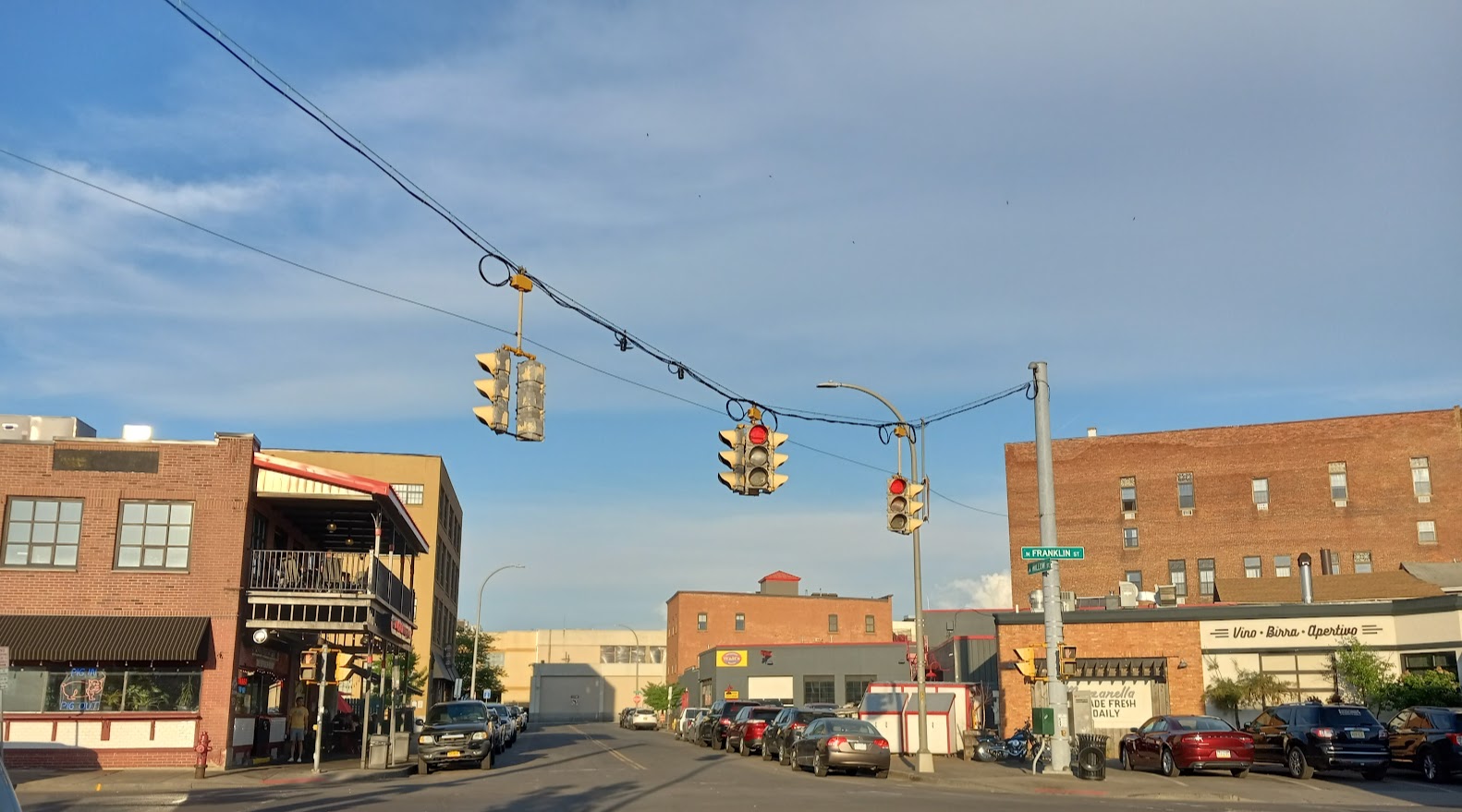
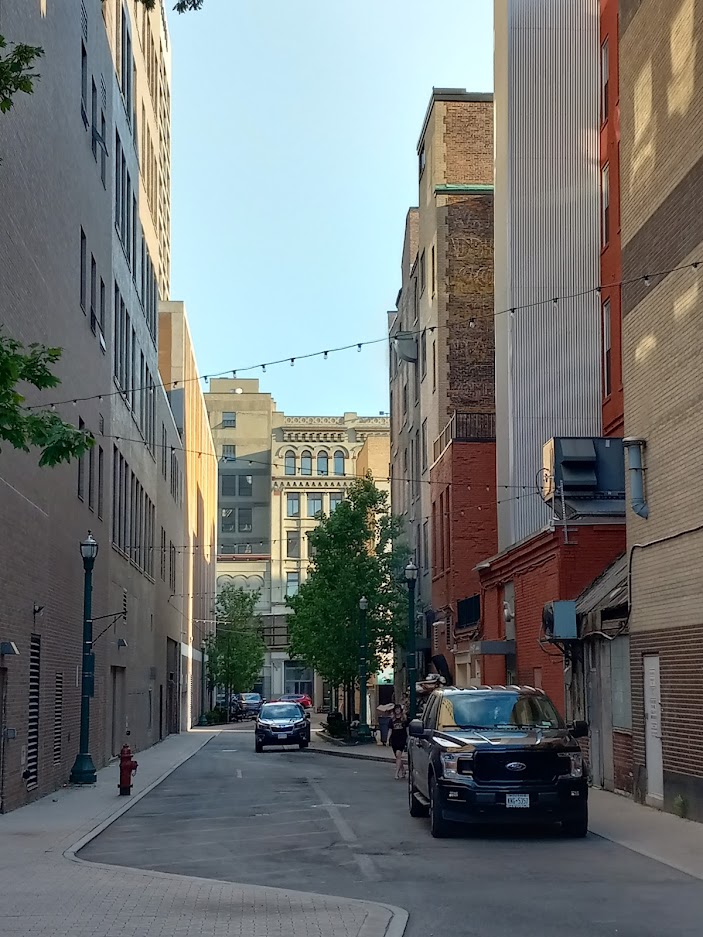
Second, City Hall should replicate the Weekends on Walton pilot in other parts of the City. There are several spots Downtown where the program could succeed. Willow Street between Dinosaur BBQ and Apizza Regionale, and Montgomery Street next to City Hall, Bank Alley are all flanked by multiple restaurants and unnecessary for cars driving around Downtown.
There are also several spots outside of Downtown that meet these criteria: McBride Street at Amos Park on the Northside, Dell Street in Westcott, Collingwood Avenue in Eastwood, Green Street and Hawley Avenue. Replicating the Weekends on Walton concept in spots like these would spread the project’s benefits to more neighborhoods.
Third, City Hall should expand the purpose of the project. The first iteration of Weekends on Walton was clearly designed to help some specific businesses get through the worst days of the pandemic. Those days are past now, and it’s time to ask how the broader public could benefit from giving streets back to the people.
In neighborhoods across the City, people beat the heat by getting outside. Walk through most any neighborhood on a hot day, and you’ll see people on their porches, on their stoops, in their front yards, enjoying the breeze and their neighbors’ company.
This is undoubtedly a good thing, and City Hall can help it out by turning individual blocks into public space in neighborhoods across Syracuse. That’d put small public parks right outside more people’s front doors.
Weekends on Walton is a great success story for City Hall. In a time of crisis, our government worked to try something new, and it made people’s lives better. Now we should build on that success by scaling the project up—making it more permanent, bringing it more places, and expanding its purpose.
City Hall wants to legalize Accessory Dwelling Units (ADUs, or small 1-bedroom apartments built in extra space on a residential property). That’s good, but in order to secure all the benefits that this type of housing can offer, City Hall will have to do more than just list it as an ‘allowed use’ in the zoning code—ReZone will also have to adjust other regulations that would functionally ban ADUs in most of the City if enacted as drafted.
ADUs (also sometimes called in-law apartments or granny flats) are a traditional housing type that used to be common in Syracuse and cities across America. Families that needed a little extra money to afford a mortgage—adults who wanted their aging parents close by to help with childcare—parents whose adult children who’d moved away and left the house mostly empty. People in all of these situations responded by turning some small part of their property—maybe the attic, or by building a garage with living space above—into an additional apartment where another person could live in privacy.
different types of ADUs
ADUs were banned from many cities during the era when planners and politicians tried to apply suburban ideals to urban neighborhoods. They thought it was strange and slightly deviant for unrelated people to live near each other, so zoning codes—like Syracuse’s—reserved a lot of residential land for single-family homes only and banned other traditional housing types including ADUs.
But ADUs are becoming popular again for the same reasons that they were popular in the past. People want the flexibility to adapt their property to meet their family’s needs. We’re not all picture-perfect midcentury sitcom families with identical needs that can all be served by suburban-style houses. ADUs are a good way to make Syracuse’s housing stock work for more people.
So it’s a very good thing that City Hall is amending ReZone to allow ADUs in all residential districts. Previous drafts of the new zoning law had excluded ADUs from any lot zoned R1, but in a February presentation to the Common Council, City Planner’s implied that the new draft would allow ADUs in R1 as well as all other residential districts.
However, the current draft outright bad on ADUs is not the only regulation that would make them a practical impossibility for most homeowners—lot coverage regulations are another barrier. ReZone says that built structures can only cover 30% of the area of residential lots with single-family homes. But most homes in most Syracuse’s neighborhoods (except its post-war semi-suburban areas like Meadowbrook and Winkworth) already cover more than ⅓ of their lots. In these situations, it would be impossible to build an ADU in the rear yard (either as a standalone structure or as an addition to the house) even though the rest of the ordinance is written to encourage that kind of construction.
This coverage requirement isn’t about environmental considerations like stormwater runoff. Homeowners are allowed to cover much more of their lots—up to 65%—with impermeable surface so long as that extra 35% is surface parking. There’s no good reason to value space for parked cars over housing for people who need it.
So when City Hall finally releases the new ReZone draft (they promised it by March, but that deadline’s long past), look to see whether they’ve taken the necessary steps to make ADUs not just legal, but also practical for the people who need them in neighborhoods across the City.