All posts by inthesaltcity

Judging the Mayor’s Next Two Years

Ben Walsh just announced that he’s going to run for reelection in 2021. That gives the Mayor two years to convince you to vote for him. Here are four things to watch over that time to help inform your decision.

Sidewalks

It wasn’t a big deal when Ben-Walsh-the-candidate said he’d do something about Syracuse’s snow-covered sidewalks. Everyone knows it’s a problem, everyone wants it fixed, but no one has ever been able to make it happen.

So it was a big deal when Ben-Walsh-the-mayor actually rolled out a sidewalk plowing program in his first winter in office. That pilot program was small, but it was more than any other mayor had done, and year later City Hall doubled the size of the program.

But that pilot program pales in comparison to the Mayor’s most recent sidewalk proposal. In his 2020 State of the City, Mayor Walsh promised to plow all the City’s sidewalks and he promised to actually keep them in good repair. This would be a very very big deal, and we’ll see if the Mayor can make it happen before he runs for reelection.

Centro

Similarly, Ben-Walsh-the-candidate’s vague support for public transportation was hard to take very seriously—everybody says they like the bus, but very few politicians actually do anything to make the service better—but a City where people use the sidewalks also has to be a City where people ride the bus because Syracuse is too big for people to be able to walk everywhere worth going.

Mayor-elect Walsh’s transition team made his support for Centro a little more specific. They endorsed SMTC’s SMART1 plan, and they prioritized better service on the Eastside.

But we haven’t heard anything about the Mayor’s plans for Centro since then. For too long, Syracuse’s City Hall has pled poverty when the City’s people have demanded better bus service. That’s left public transportation to the County and the State, and both are failing City residents. It’s time for the Mayor to make Centro a priority and bring better bus service to Syracuse.

I81

Ben Walsh’s stance on I81 is the best example of his political approach. He turned this City-Suburb wedge issue on its head by arguing forcefully and credibly that the Grid plan was the best for the entire County. Contrast that idealistic appeal for consensus with the cynical ‘compromise’ floated by the Grid’s opponents: a tunnel that would recreate all the viaduct’s worst problems at twice the cost.

Walsh’s commitment to doing the smart thing on I81 paid off. Since he claimed that space in the debate, County Executive Ryan McMahon has remained neutral and Governor Andrew Cuomo has released a DEIS that supports the Grid.

But now we’ve gone back into limbo waiting for the final EIS and Record of Decision. In the meantime, the Grid plan has morphed into a highway widening project, and other interests have started making claims on the money that should go towards mitigating the  project’s impacts on City residents.

Before Mayor Walsh’s term is out, this process needs to end. We need final word that the viaduct is coming down, and we need to know that the project will actually benefit people in the City by bringing construction jobs in, getting smog out, and making it easier for people to actually get around.

Blueprint 15

I81 is about way more than what to do with the viaduct—it’s also going to mean big changes for the neighborhoods that surround the highway. It won’t be worth the effort to tear down the viaduct if we don’t end up with a healthier, better housed, more integrated City.

Blueprint 15 is Mayor Walsh’s plan to make that dream a reality. The plan would demolish Pioneer Homes and Central Village, it would replace them with all new mixed-income housing, it would bring businesses and community services into the neighborhood, it would improve MLK Elementary, and it would put more people within walking distance of the region’s two main job centers.

That initial proposal had all the right words, but all the wrong numbers. Tearing down 1000 old affordable apartments in order to build 700 new ones and 700 new market-rate apartments is the definition of displacement. There’s no need to do that, especially when there’s plenty of room in the project area to build more homes. Before we actually get around to tearing down the viaduct, Mayor Walsh’s Blueprint 15 plan needs to change.

.   .   .

Ben Walsh has made a lot of his first two years as Syracuse’s mayor. He’ll need to do just as much and more over the next two if he’s going to earn a second term. These are four of the biggest things to watch to judge for yourself whether he should get your vote.

The Captive Rider Myth

Centro likes to divide its riders into two groups—‘captive’ riders that have to use the bus because it’s their only option, and ‘choice’ that choose to use the bus because it’s the best option available to them.

But the idea that anybody has to ride the bus—that people are ‘captive’ to transit—is a myth. It’s a myth because people always have options, and it’s a myth because bus riders choose to build their life in such a way that the bus is their best option.

.   .   .

A couple weeks ago I was waiting at a bus stop with seven other people. I had my bike, but it was cold, the bus was due, and I wanted to ride home in heated comfort.

We waited, fidgeting with impatience and to stay warm, making halting small talk—mostly grumbling about the bus—as the scheduled arrival time came and went. My phone was dead so I asked a kid to check when the next bus was due. He did, and we found out that our bus wasn’t coming at all, and we’d have to wait for the next run. One man called a cab, the kid called his Mom for a ride, and I got on my bike and left. Just like that, three people without ready access to a car found another way to get around when the bus became a worse option.

We made that decision in the moment, but thousands of other people make similar decisions every single day—they decide to walk, or bike, or hail a cab, or bum a ride to get around town. When SMTC asked how people on the Northside get to work, they learned that plenty bike as far as Liverpool and Baldwinsville because that’s the best option available to them. If Syracuse had better bus service, any of these people might choose to use public transportation instead, but Centro would call them ‘captive’ riders because they’re poor and don’t own cars. 

.   .   .

But what about those other five people who stayed to wait for the bus even though it wouldn’t show for another 40 minutes? People who simply couldn’t walk to where they were going, didn’t have anyone to give them a ride, and couldn’t afford cab fare. Weren’t they truly captive?

Maybe. Maybe the only reason they were at that bus stop was because none of them owned a car, maybe none of them could afford to fill up a gas tank, and maybe terrible experiences like that have convinced them that the second they get enough money they’ll spend it on a car.

But there are plenty of people who put up with situations like that on a regular basis, who wouldn’t mind having a car, and who can technically afford a to buy one, but still choose to ride the bus.

Think of it this way: you may want a car, but it’s not at the top of your list of best ways to use your money. Maybe it matters less to you than buying healthy food, than living in the right neighborhood, than paying medical bills, than sending money to your mother, than saving up for your son’s college tuition. Maybe you would buy a car if you made more money, but you don’t, and right now a car just isn’t the best use of what money you’ve got.

In a City where the median household income is about $35,000, this is the situation that a lot of people find themselves in. There are many pressing needs competing for that finite amount of money, and the $9,282 a year it costs to own a car just isn’t worth it when Centro provides a viable alternative for getting around town. People in that situation have made an informed decision not to waste their money on a car, and so they appear dependent on the bus—‘captive’ riders—but in fact the bus has enabled them to set their minds on more important things by freeing them from dependence on a car.

.   .   .

The caricature of the captive rider is someone who rides the bus, but only under duress—a person who doesn’t own a car, but desperately wants one and would buy one the minute that was possible—a person who can’t afford to take a cab everywhere, but would if they had the money.

There may be some riders like that, but they are not the majority. Most people ride the bus because it’s the best option for them to get around. They complain about the service, wish it went more places, wish the buses came more often, wish they didn’t get stuck in traffic, but they choose to ride because the bus makes their lives better.

Free to Choose the Bus

People ride Centro when it’s the most practical option for getting where they want to go. Problem is, Centro’s not a very practical option for getting to work in a lot of the County, so a lot of people who don’t own cars miss out on a lot of opportunities for employment.

Instead of just making Centro better so that it’s a more practical option for more people to go more places, Onondaga County, Centerstate CEO and New York State are teaming up to offer yet another commuter/vanpool program. Like the Rides-to-Work, Wheels-for-Work, Providence, Lyft programs that came before it, this program is designed to allow employers who are nowhere near a bus stop to hire people who don’t own cars so that those workers can make enough money to purchase a car and keep that job. It’s not a program to help people get to work without a car—it’s a program to get people to buy more cars.

.   .   .

The thinking behind these programs goes something like this: people are poor because they don’t have jobs, unemployed people can’t get jobs because they don’t have cars, and people don’t have cars because they’re poor. In this vicious circle, poverty, unemployment, and bus ridership all hang together, and the solution is to break that circle by giving people a ride to work just long enough so that they can save up to buy a car. At that point, the car enables employment which creates wealth—the virtuous circle of middle class car-ownership.

But you can’t turn a man from a poor-unemployed-bus-rider into a middle class-working-car-owner just by giving him a ride to work for a few weeks. There just are no necessary connections between class, employment, and transportation. Plenty of employed workers are still poor and still ride the bus (for that matter, a good number of rich workers do too). Buying a car is an economic decision that rational people make after weighing the upfront cost and $3000 annual expense against the opportunities the car can provide. A lot of people in Syracuse have decided that there are better uses for their paychecks than paying down the interest on a car loan.

These programs that give people a ride “until they’re up on their feet” all ultimately fail because they deny working people that choice. They try to make car ownership the only option for full participation in Syracuse’s economic and cultural life—to put a $3000 tax on getting a job in this town. They mistake people’s rational decision to ride the bus for a mark of deviance that has to be removed.

.   .   .

When too many people can’t find work without a car, when there are too many gaps in bus service, and when too many jobs hide in those gaps, the best way to fix the problem fast is to invest in Centro. Running buses to more of the County and running more buses running on the lines that already exist—making the bus a more practical option for more people to get more places—would expand economic opportunity immediately. In the long term, a County Executive who’s interested in this kind of thing would steer economic development to those places where lots of buses already run—not to an empty business park on Route 31.

Better bus service is the real key to making more jobs more accessible to more people while preserving the freedom of choice that enables people to live car-free. And, by expanding economic opportunity and increasing access to employment, better bus service also gives more people the option to buy their own cars if they want. People in Syracuse need more options so that they can choose for themselves how to get around town, and the bus is best way to provide that freedom.

Walking to the Market

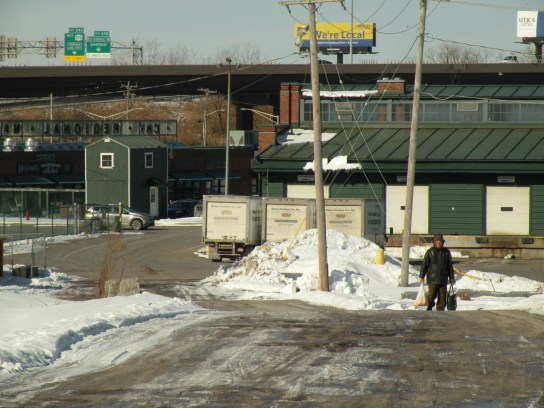
It was 5 degrees Saturday morning, but people still walked to the Farmers Market. They put up with the cold, the unsafe streets, and the snow-covered sidewalks because the Market provides access to good cheap food, and because Saturday’s weather was too common to change anybody’s weekly routine.

And if people were willing to walk there on Saturday, then you know they’re willing to walk there in just about any weather. People walk to the Market because that’s how they get around town.

So it’s a mess that walking to the Market is so dangerous. There aren’t sidewalks between Hiawatha Boulevard and the Market. That’s a problem all year, but especially when it snows. No sidewalks mean no one has to shovel a path for people to walk, and so no one does. That forces some people to walk through the snow, and it pushes others onto the streets.

Even where there are sidewalks, they don’t go where people need them. The streets around the Market and RTC are all designed for cars not people. They’re too long and too circuitous, taking people way out of their way to get where they’re going. That’s not much of a problem when you’re driving a car, but it’s a huge hassle on foot—why walk an extra hundred feet along a curving driveway when it’s a straight line from the bus stop to the bus station? There’s no good reason, so people don’t, and so they end up having to walk through more snow because no one ever gave serious thought to making life easier for people who get around on foot.

So it’s a very good thing that SMTC and City Hall are working on plans to make it safer and easier for people to walk, bike, and bus in this area. The RTC/Market Area Mobility Study catalogs many of the ways that this part of the City fails people who live car-free, and it proposes some simple fixes: paving the gravel path at Carbon Street, adding crosswalks, a separated bike path, SIDEWALKS.

Tens of thousands of people in Syracuse get around on foot, but too much of the City ignores their needs. The Market and the RTC need to be more accessible to more people, and SMTC’s ideas are a good starting point to make that happen.

The Case for Regional Rail

Central New York’s villages and cities are all places where people can live cheaply and easily without the need for a car. They are places where daily necessities are within walking distance, places with a variety of kinds of housing, places where full participation in the community’s economic and social life is possible for people who get around by rolling, walking, biking, or riding the bus.

But all these places—Cortland, Liverpool, Fulton, Auburn, Baldwinsville, Oswego, Oneida, Phoenix, Syracuse—are disconnected. Long distances and infrequent (or nonexistent) transit prevent people from travelling between them without a car, making it impossible for a car-free resident of Cortland to take a job in Auburn, or for a plant in Syracuse to hire someone living car-free in Oneida. The result is that the places with the most jobs are also home to most of the region’s jobless workers.

Better intercity public transportation would right this wrong, linking Central New York’s urban centers, connecting people to jobs, and uniting a 5-county 800,000 person region.

Density of car-free households by census tract

Car-free households cluster in Central New York’s cities and villages. Syracuse, Cortland, Auburn, Fulton, Oswego, and Oneida are home to many people who live car-free. So are smaller villages like Phoenix, Baldwinsville, and Liverpool. These are all places where people can meet their daily needs—buying groceries, attending school, getting to work—on foot, bike, or bus.

Density of jobs by census tract

These are all also places where there are lots of jobs. The shaded areas on this map contain 86% of all jobs in Central New York. They’re heavily concentrated in Downtown Syracuse and on University Hill, but many jobs are available across the rest of the city and its suburbs. Outside of Syracuse, jobs cluster around smaller cities like Oswego, Auburn, Fulton, Cortland, and Oneida, and around villages like Canastota, Oneida, Skaneateles, and Chittenango.

But even though all of these job opportunities are accessible to many people who get around without a car, any given person living car-free can only access a small fraction of the total. People living in Downtown Syracuse can walk to the jobs available there, but not to any of those available in Downtown Cortland or Oneida. Some people heroically bike from the Northside to work in Salina, but they can’t very well ride all the way to Fulton. Centro runs limited service between Oswego, Syracuse, and Auburn, but it’s barely adequate for making jobs in any of those urban centers accessible to people living in any other.

Compare that limited situation to the options available to a car-owner in Clay. The region’s multi-billion dollar highway network puts every single job within an hour’s drive of that remote location—bringing economic opportunity to the relatively affluent residents of a sparsely populated area while that same level of choice is denied to those who for whatever reason do not own a car.

Density of unemployed workers by census tract

The result is that urban centers like Oswego, Phoenix, Syracuse, Auburn, Liverpool, and Cortland—places that account for just third of the region’s workforce but 88% of its car-free households—are home to more than half of all unemployed workers in Central New York.

But what if each urban center was not just the place where nearby car-free households could find work, but also a portal to every other urban center in the region? A person could walk from Syracuse’s Westside to a transit station and ride to work in Canastota. Someone else could bike to the Fulton station and access opportunities to work in any one of Central New York’s major employment centers.

Here are those same maps—car-free households, jobs, and people looking for work—overlaid with blue lines showing some of the rail lines that already run across Central New York. Trains running on these tracks could open new opportunities to the Central New Yorkers who need them most. Or forget rail—buses running on the interstates could do the same thing. The kind of vehicle doesn’t really matter so long as the service connects these places and runs fast enough and often enough to make it a real option for daily commuting.

Central New Yorkers who live car-free cluster in urban centers. These places are also where most of the region’s jobs are. But because there are no reliable connections between those centers, people who do not own cars can only apply to work at a very small percentage of the jobs available to car-owners. Better intercity transit service could be that reliable connection between employment and population centers—it could make the economic opportunity that already exists in Central New York more equally accessible to everybody who lives here, whether or not they own a car.

Apartments Go Up and Rents Come Down

Two new residential projects planned for Downtown’s eastern edge indicate that developers may have finally run out of tenants willing and able to pay $2,000 a month to live in the city center, and now they’re building more affordable apartments.

For a full decade, this didn’t feel possible. Every single new apartment project got a front page story in the Post-Standard, they all filled up immediately, and they all charged ridiculous rents.

But for all of the noise it made, Downtown’s population boom wasn’t actually all that big. Downtown’s boosters estimate that about 1,500 more people live there now than did in 2010. That was a big increase for a small part of town, but it only accounts for 0.22% of the metro area’s total population. There just weren’t that many new apartments getting built, and so there weren’t that many people moving Downtown.

Developers understood that they were only building enough new housing to accommodate .22% of potential tenants, so they priced their apartments to attract the richest .22% of the metro area that they could get. $2,000 a month is an affordable rent for people making at least $75,000 a year. In 2010, only 71 Downtown households made that much. In 2018, 290 did. Households making at least $75,000 a year accounted for 83% of Downtown’s population growth over that period.


But there are only so many people willing and able to pay that much to live in the city center, and at least two developers think that part of the market is pretty much tapped-out. Grazi Zazzara (who previously turned the Blue Cross Blue Shield building into $2,000 a month apartments) and Matthew Paulus (who previously turned the Dietz Lantern factory into $2,000 a month apartments) have both recently announced separate projects to renovate Downtown buildings, and both developers will only charge people $1,000 a month to live in them. These guys are capitalists—they’re not lowering their rents out of the goodness of their hearts. They’re doing it because they don’t think they can get enough people to agree to pay $2,000 to live in these new apartments, and that’s because most people willing and able to pay that much already have a $2,000 apartment to live in.


Syracuse has a housing shortage. Too many people can’t make their rent, too many houses are poisoning the people who live in them, there are too few section 8 vouchers for everybody who needs them. These are the most pressing housing problems that City Hall, HUD, and all of the housing non-profits need to address.

But while all of those actors are attacking those problems, it’s good to see private developers building so much new housing that they’re forced to lower the rent in order to attract tenants who make a little less than the people living in Downtown’s penthouses. Those new tenants will still be richer than the City as a whole, those developers will still call the apartments ‘luxury,’ there’s still a lot more work to do to make Syracuse’s housing market equitable, but this is a sure step in the right direction.

Getting to the Train Station

You arrive in Syracuse on a brand new high speed train. The trip back from Buffalo was less than 90 minutes—way faster than the 2 and a quarter hours it used to take before New York State built high speed rail. You caught up on some tv on the ride and are ready to get home for dinner.

Getting home’s the problem though. Obviously, you don’t live within walking distance of the train station—no one does. The woman next to you is waving down a cab, the student visiting home from UB is waiting for his Mom to come pick him up from Auburn, and you’re staring down a 45 minute bus ride with transfer. The three mile trip to your house will take half as long at the 150 trip from Buffalo.

High speed rail could transform intercity transportation in New York, giving people a faster, more comfortable, and more frequent option to get across the State. But for people to actually ride those trains, it’s going to have to be a whole lot easier to get to the station in the first place. Right now, too many Upstate Amtrak stations are in no-man’s land, surrounded by acres of asphalt and empty lots. At the same time, too few Amtrak stations are connected to the cities they serve by robust public transportation. New York State and its cities have to fix both problems if high speed rail is really going to live up to its promise.

More Housing around Stations

Syracuse’s Amtrak station is in the middle of a sea of asphalt, under the shadow of a highway, next to a cold storage warehouse, and half a mile from the nearest house. The situation’s not much better at any of Upstate’s other train stations: rivers separate Albany and Rome from their stations, Buffalo’s is underneath 190, and Amsterdam’s is almost in the country. Only Rochester, Utica, and Schenectady have stations within walking distance of a lot of people’s homes.

These maps (from UVA's Weldon Cooper Center for Public Service) show people's homes as black dots and Amtrak stations as red dots. Too many stations are in places where no one lives.

Since every single train trip starts and ends on foot, it would be better if more people could live within walking distance of all of these train stations. Syracuse’s City Hall thinks so too, which is why the 2012 Land Use & Development Plan cited the potential for high speed rail as a reason to encourage development on all the “vacant or underutilized property” around the train station, and it’s why the ReZone project is going to allow new housing to be built in that area.

In other cities, Amtrak could accomplish the same thing by just moving its stations to places where people already live. In Amsterdam, shifting the station about a mile East would put it in the middle of town instead of the City’s outskirts. In Albany, a similarly short move would get the station across the Hudson River and within walking distance of downtown.

Proposal to move Amsterdam’s train station downtown


Better Public Transportation at Stations

But not every place worth going can be within walking distance of a train station, so people arriving in any city by train will also need options to get around the city itself. Mainly, they need high quality public transportation.

Every Upstate train station (except Amsterdam) is served by passable public transportation. It’s not frequent enough, not connected enough, and not fast enough, and it needs to be better. At the very least, that means actually linking the new Amtrak station to Metro Rail in Buffalo, adopting something like the Reimagine RTS plan in Rochester, building the three proposed bus rapid transit lines in Syracuse, and building the Blue and Purple BusPlus lines in Albany.

But why settle for the very least? Every single city in New York—from NYC to Buffalo—needs better public transportation. They all need more buses and more drivers serving more riders in more neighborhoods, some cities even need more trains, and that simply means that the State needs to put more money into the STOA and MTOA. It’s one of the most effective things that the Governor could do to make high speed rail successful, and it’s one of the best things that he could do to make New York State a better place to live. 

.   .   .

When people travel between Upstate’s cities, they’re going home, or visiting a friend, or getting to work—no one is just trying to get between train stations. So while faster, more frequent, more reliable rail service would make it a lot easier for people to travel between Upstate’s cities, we also need to make sure that it’s easy to get from any train station to all the different places that those people actually want to go. That means more housing and more destinations within walking distance of those stations, and it means better local transit service connecting entire cities to their train stations.

Trouble with the Curb

In the 2020 State of the City address, Mayor Ben Walsh announced that City Hall is going to try and find a way to take full responsibility for sidewalk maintenance and snow removal, and he announced that City Hall is going to repair a lot more pavement. These two promises have the potential to remake Syracuse’s streets so that they work for everybody in the City.

Streets are the publicly-owned space (all of it) between private property lines. That space contains the paved lanes where cars drive and park, and it also contains the raised concrete area where people walk and wait for the bus, where neighbors stop and chat, where kids set up lemonade stands.

For decades (forever?) City Hall has spent millions of dollars to maintain the portion of that public space below the curb, and it has sheepishly suggested that everybody else could, maybe, if it wasn’t too much trouble, use their own time, money, and energy to maintain the little plot of public space above the curb in front of their property. This local experiment in the Tragedy of the Commons has left Syracuse with broken sidewalks covered in snow, and it’s left people dangerously exposed to car-traffic because the only place they can walk is on the pavement below the curb.

So it’s a big deal that Mayor Walsh is trying to get City Hall to take full responsibility for the full width of the public street instead of confining DPW’s maintenance work to the car-dominated area between the curbs. So many people get around Syracuse some way other than in a car, and they need wide, clear, level, ADA-compliant sidewalks across the City. The Mayor’s commitment sidewalk maintenance can meet that need.

But it would be much better to get past this backwards notion that got Syracuse in this mess in the first place. The notion that the street is made up of two parts—space for cars below the curb, and sidewalks above the curb. One the real street that has to be maintained, and the other a nice amenity if we can afford it.

The Mayor’s commitment to major road reconstruction has the potential to eliminate that division by redesigning city streets to actually accommodate all of the different people who need to use them in different ways.

Bollards that carve out space below the curb for bikes, raised crosswalks that extend the sidewalk past the curb through the intersection, additional curbs that separate bus lanes from all other paved lanes, getting rid of curbs entirely, banning motor vehicles even below the curb—all of these potential changes blow apart the idea that the curb is some special boundary line that marks the edges of the real street. All help people make good use of the whole street—from property line to property line—in a variety of ways, and all make it clear that City Hall has an obvious responsibility to maintain the whole street for all of those uses.

None of this is guaranteed. The Mayor only announced his intention to maintain every sidewalk—City Hall still has to work out the actual details of how to actually do it. And more street paving could actually make Syracuse worse if it’s just a way to reassure car-drivers that City Hall still thinks they’re the most important people on the street.

But the promise is there, the potential is there. In a City where 30% of households don’t have a car, 20% of people are too young to drive, and 13% of workers walk to their jobs, it’s ridiculous that local government has left its sidewalks to deteriorate so badly for so long. This new commitment to sidewalk maintenance can change that, and a new understanding of how people really use our streets can make sure that it never happens again.

Congressman Katko’s Letters

When the Trump administration tries to harm Upstate New York, John Katko writes a letter about it. That’s what he did last week after Sonny Perdue announced a plan to take away people’s food stamps. The Congressman wrote a letter to the Secretary of Agriculture asking that “we don’t make people food insecure as a result of this.”

We’ve seen this one before. For three years the Trump administration has been making it harder for refugees to come to America. That’s bad for Upstate New York where new immigrants have been a blessing for so many struggling cities and towns over the last two decades. So Congressman Katko has written and co-signed letters about it, asking a man who campaigned for the presidency on xenophobia to abandon his signature policy and instead “uphold our nation’s commitment to assist individuals who have been displaced by violence and strife.”

None of those letters worked, and this one probably won’t either. Republicans have been trying all kinds of different ways to cut food stamps for years—from administrative tricks like getting rid of the software that allows people to use food stamps at farmers markets, to direct legislative action in the Farm Bill. This is a core value for them, and just writing letters about it isn’t going to change that.

For now we’re stuck hoping that John Katko writes persuasively enough to change Sonny Perdue’s mind. Stuck hoping that it’s not just another purely symbolic gesture designed to save the Congressman face while his party—led by a man whose stated position on Upstate New York is that people should leave it—weaponizes domestic policy to depopulate our communities.

But 2020 is an election year, so we won’t be stuck with that thin hope for long. Come November we can vote them all out and get a federal government and a local representative willing and able to exercise real power—to do more than write letters—to benefit Upstate New York.

ReZone and Syracuse’s Housing Shortage

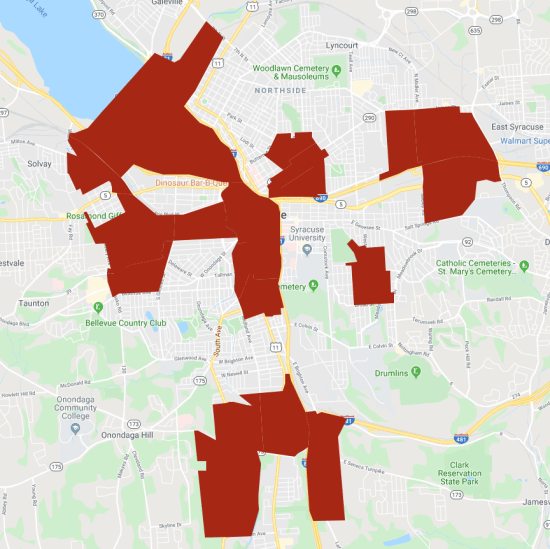
There aren’t enough places to live in many Syracuse neighborhoods, and the City’s new zoning ordinance needs to help do something about it. Between 2000 and 2016, in 18 census tracts containing ⅓ of the City’s population, the number of people looking for a place to live increased faster than did the total number of apartments and houses. In those neighborhoods, the housing shortage caused depopulation, high rents, and gentrification. ReZone can alleviate some of that stress by allowing more housing construction in those neighborhoods.

Neighborhoods where growth in the number of households outpaced growth in housing supply from 2000 to 2016

These are the neighborhoods where the housing shortage has gotten worse since 2000. They are all places where, relative to the rest of Syracuse, more families are moving in, but there are fewer apartments and houses for those new families to move in to.

Even though new people moved into all of these neighborhoods, population actually decreased in some of them (red in the map on the left). That’s because the average size of the families living in many of these neighborhoods decreased (yellow in the map on the right).

The housing shortage is pushing up rents (orange in the map on the left) in Downtown, Franklin Square, Westcott, Eastwood, Salt Springs, the Northside and the Valley. Housing costs are becoming unaffordable (brown in the map on the right) for more people living in most of these neighborhoods, and even in some other neighborhoods where rents are going down like parts of the Northside, Tipp Hill, Eastwood, the Valley, and the West End.

The two neighborhoods with housing shortages where rents are going up but people are more able to afford them are Franklin Square and Downtown. This is gentrification, and more housing is the only way to give more people access to all of the benefits that come from living in these two increasingly wealthy neighborhoods.

In Westcott, the Northside, and parts of the Valley, rents are going up, people are less able to afford them, and households are growing. These are neighborhoods where people want to be, but high housing costs are forcing them to find more roommates to share resources and split the rent. Something similar is happening in Hawley-Green as well. More, smaller, cheaper apartments could relieve pressure on the people living in those neighborhoods and better match the types of housing available to what people need.

In Tipp Hill, the West End, and Eastwood south of James, rents are falling but people are still increasingly unable to afford them, and the population overall is falling because households are shrinking. These are also places where more, smaller, cheaper apartments would give people living options better suited to their changing financial and living situations.

In parts of the Southside, Near Westside, Nob Hill, and Skunk City, rents are falling and becoming more affordable for the people who live in those neighborhoods, but overall population is falling because households are getting smaller. In these places, it should be legal to subdivide existing houses into smaller apartments in order to make more room for people who want to take advantage of the increasingly affordable housing.


New housing of different kinds would be so helpful in all of these neighborhoods, ReZone’s new zoning map will determine whether or not it’s legal to build new housing in any of them.

City Hall has released four drafts of that map in the last three years. The current December 2019 draft, on the right, addresses the housing shortage in some neighborhoods, but not others. It will allow new apartments across Downtown, Franklin Square, lower James Street, Nob Hill, and the Southside.

The map also allows 1-family houses to be converted to 2-(or more)-family houses in all of Tipp Hill, Skunk City, the Near Westside, Hawley-Green, and the Northside. But the most recent draft is worse than City Hall’s first map from February 2017 (above on the left). That earlier map allowed more housing with looser parking and setback restrictions in the MX (blue) zoning districts in these neighborhoods, but each successive draft has reduced MX zoning in all of them.

The new map also preserves the ban on multi-family housing, a ban that can only make the housing shortage worse, in most of Westcott, the West End, the Valley, and Eastwood. In those neighborhoods, big 1-family houses are either filling up with young people squeezing in to save on rent, or they’re emptying out as smaller families struggle to afford apartments too big for their needs.

The housing shortage in Syracuse is pushing up rents, emptying out some neighborhoods, and making it too difficult to move into others. It’s causing depopulation and gentrification. It’s bad, and one part of fixing it is removing City Hall’s purely administrative ban on new housing. ReZone is a chance to do that.